How to Turn Study Notes into Songs
On this page
Think of a jingle you heard once and still can’t shake, or the alphabet song you learned as a child. Music sticks in memory in a way that plain text rarely does, which is exactly why “turn your study notes into a song” has become a popular study hack. The idea is simple: feed your notes to an AI, get back a catchy track built around the facts you need to remember, and let the melody do some of the heavy lifting.
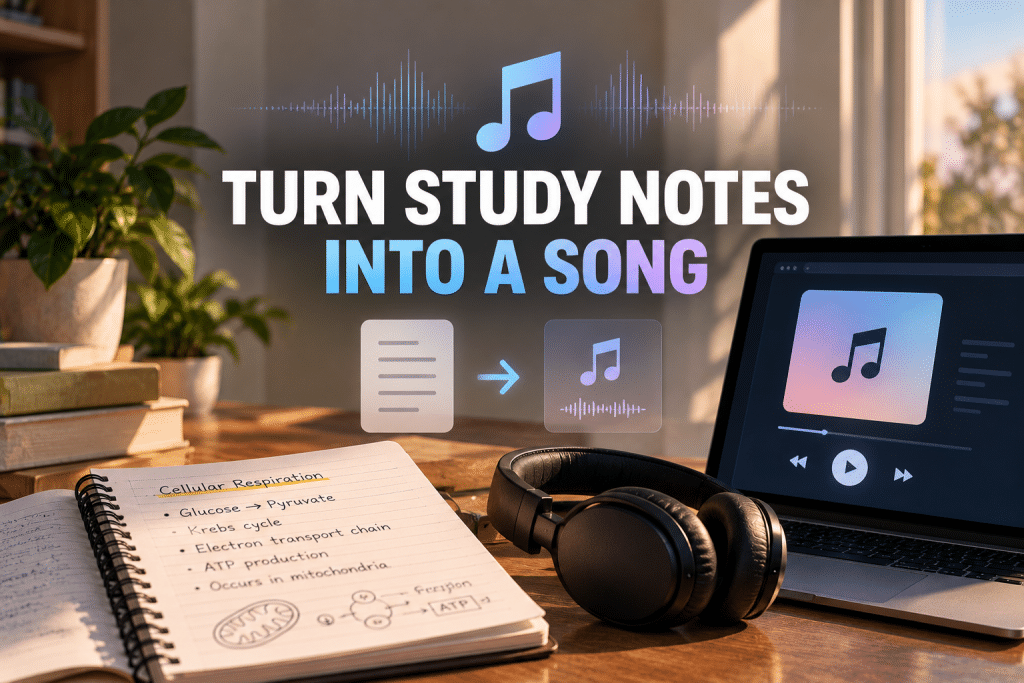
A handful of AI tools now do this automatically. You paste notes or upload a document, pick a style, and the tool writes lyrics from your material and sets them to music. This guide covers whether the method actually works, how these tools operate, and the best AI study song generators available in 2026, with honest notes on what each does well and where it falls short.
Does Turning Notes into a Song Actually Work?
The short answer is yes, for the right kind of material, but the marketing oversells it. Several of these tools advertise retention gains of anywhere from 30% to 65%, and those figures are vendor claims rather than results from independent, peer-reviewed studies. Treat them as advertising, not science.
What research on music and memory does support is narrower and still useful. Melody and rhythm give your brain extra retrieval cues, which is why songs work well for discrete, ordered facts: the periodic table, dates, the cranial nerves, vocabulary lists, the steps of a process. The chunking and repetition that a song forces onto your notes is itself a solid revision technique.
Where the method is weak is deep understanding. A song can help you recall that the mitochondria is the powerhouse of the cell, but it will not teach you how cellular respiration works or help you write an essay analyzing it. Use musical mnemonics for the memorization layer of studying, not as a replacement for actually learning the concepts.
How These Tools Work
Most AI study song generators follow the same basic steps:
-
Add your material. Paste notes, type a topic, or upload a PDF or document.
-
Pick a style. Choose a genre or mood, pop, rap, lo-fi, so the result is something you will actually replay.
-
The AI writes and composes. It pulls the key facts from your notes into rhyming lyrics and sets them to a generated melody.
-
Review and study. Play it back, read the lyrics alongside, and use it as a revision loop rather than a one-time listen.
The best results come from clean, focused notes. Feed a tool one tightly scoped topic rather than an entire chapter, and the lyrics stay accurate and memorable instead of vague.
The Best AI Study Song Generators in 2026
1. StudySong
Official website: studysongapp.com
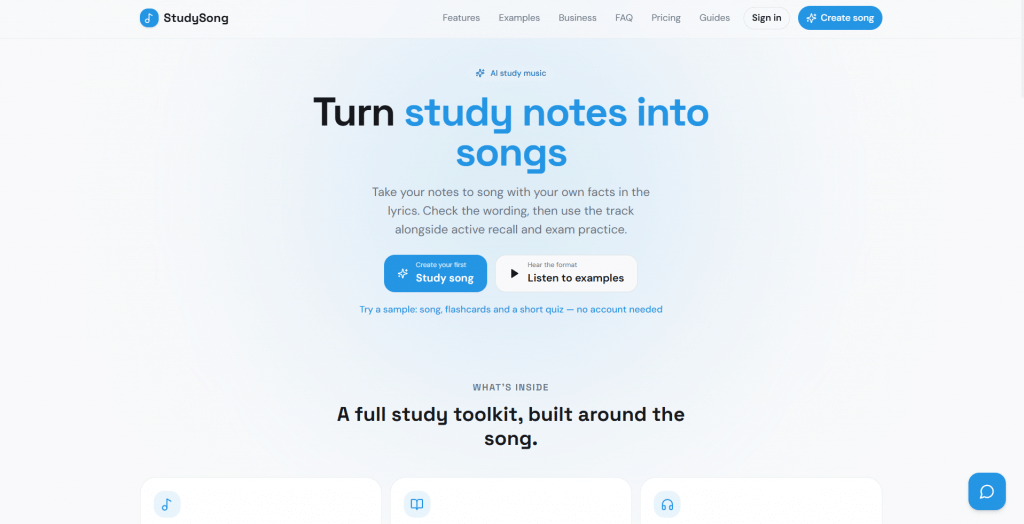
Platform: Web, free to use.
Features: StudySong is one of the most complete free options. You enter notes or a topic and it generates a song, then automatically builds flashcards and a short quiz from the same material, so you get three study formats from one input. It supports 18+ languages and is aimed squarely at exam revision.
|
Plan |
Price |
Key features |
|
Free |
$0 |
Song generation, auto flashcards and quizzes, 18+ languages |
Public feedback: Users like getting flashcards and quizzes alongside the song at no cost; some note the melodies can feel generic.
-
Completely free with no obvious paywall
-
Generates flashcards and quizzes from the same notes, not just a song
-
Broad language support for non-English study
-
Melodies are functional rather than genuinely catchy
-
Less control over genre and style than paid rivals
2. LalaLearn
Official website: lalalearn.ai
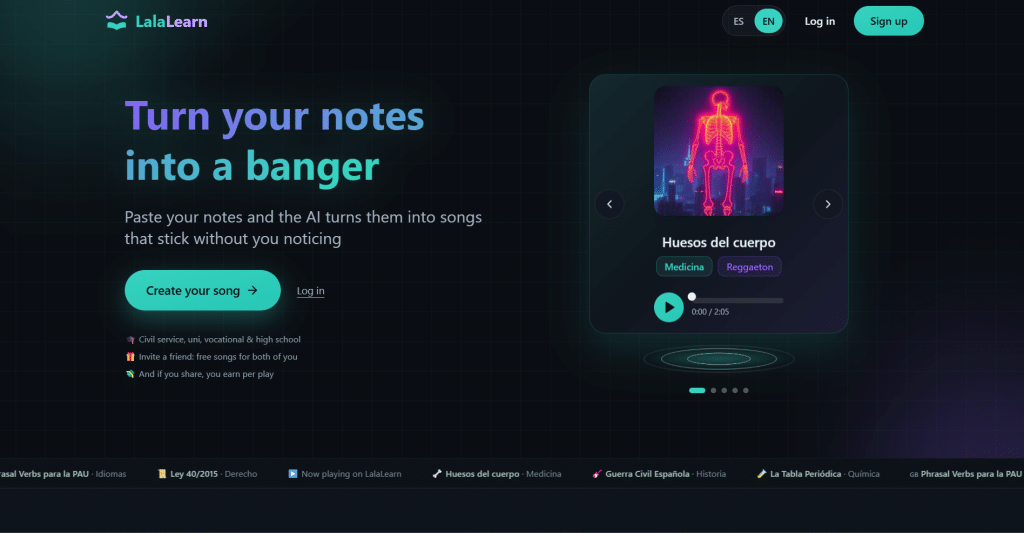
Platform: Web.
Features: LalaLearn turns whole syllabi or documents into songs and keeps a community library of tracks other students have made, so you can search for a song on your topic before generating your own. It runs on a credit system, with credits spent per generation.
|
Plan |
Price |
Key features |
|
Free |
$0 |
Starter credits, library access |
|
Paid |
Credit packs / subscription |
More generations |
Public feedback: The community library is a draw for finding ready-made songs; the credit model means heavy users hit limits and pay more.
-
Community library of existing songs to search before you generate
-
Handles larger inputs like full syllabi
-
Free starter credits to test it
-
Credit system adds up for frequent use
-
Library quality depends on other users
3. Studinotes
Official website: studinotes.com
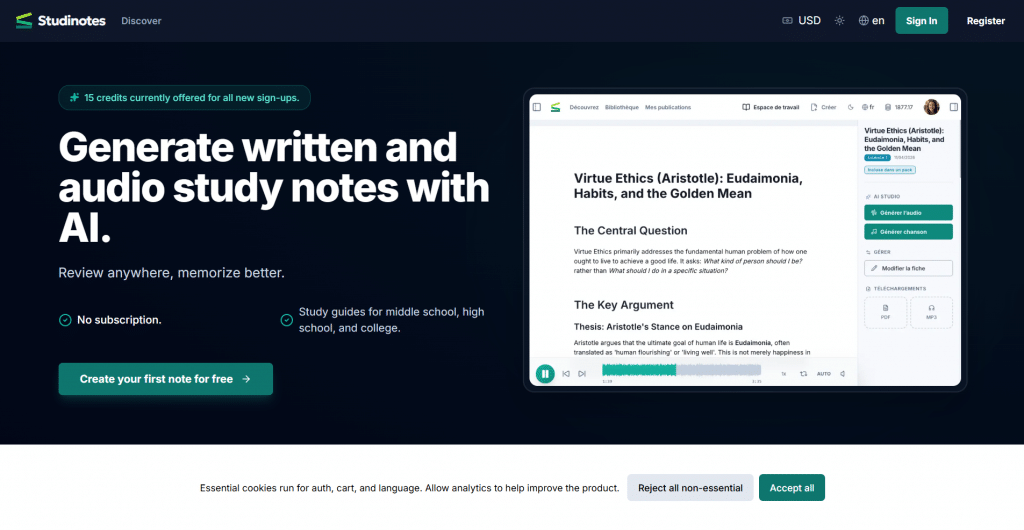
Platform: Web.
Features: Studinotes is broader than a pure song maker. Alongside turning notes into songs it produces audio study guides, and it runs a marketplace where students can share or sell study material. That makes it useful if you want both a musical mnemonic and a spoken revision track from the same notes.
|
Plan |
Price |
Key features |
|
Free |
$0 |
Basic song and audio generation |
|
Paid |
Subscription |
More generations, marketplace features |
Public feedback: Valued for combining songs with audio guides; the marketplace quality varies since it is user-generated.
-
Produces both songs and spoken audio study guides
-
Marketplace gives access to ready-made study material
-
Flexible for different revision styles
-
Marketplace content is uneven in quality
-
Song generation is one feature among many, not the sole focus
4. Qstudy AI
Official website: qstudy.ai
Platform: Web, integrates with Notion.
Features: Qstudy AI is a full study suite where the song is one of around 18 output formats generated from your notes, alongside summaries, flashcards, mind maps, and practice questions. Its Notion integration suits students who already organize revision there. The song is a nice extra rather than the main event.
|
Plan |
Price |
Key features |
|
Free |
$0 |
Limited generations across formats |
|
Paid |
Subscription |
Higher limits, full format access |
Public feedback: Liked as an all-in-one study tool; the song feature is seen as secondary to its stronger summary and flashcard tools.
-
Song is one of 18 study formats from a single set of notes
-
Notion integration fits existing workflows
-
Strong all-round revision toolkit
-
Song quality is secondary to its text-based features
-
Best value only if you use the wider suite
Comparison Table
|
Tool |
Platform |
Free tier |
Standout feature |
|
StudySong |
Web |
Yes, full |
Auto flashcards and quizzes too |
|
Rhymember |
iOS |
Yes, limited |
Genre choice, rap focus |
|
Memody |
Web |
Yes |
Synced short songs |
|
Studinotes |
Web |
Yes |
Songs plus audio guides |
|
Qstudy AI |
Web + Notion |
Yes, limited |
18 study formats in one |
|
LalaLearn |
Web |
Starter credits |
Community song library |
How to Choose and Use Them Well
If you want the most for free, StudySong is the easiest starting point because it adds flashcards and quizzes at no cost. For a more polished, replayable track with genre control, Rhymember is the pick if you are on iOS. If you already run your revision through Notion or want many study formats at once, Qstudy AI makes more sense, while LalaLearn suits larger documents and anyone who likes browsing a shared library.
Whichever you choose, the method works best when you keep a few things in mind. Feed each song one focused topic so the facts stay accurate. Check the lyrics against your notes, since AI can paraphrase a fact into something subtly wrong. Replay the track across several short sessions rather than once, because the repetition is where the memory gain comes from. And keep songs for the memorization layer only, using normal study for the understanding that exams also test.
Conclusion
Turning study notes into a song is a genuinely useful memory aid for the right material, and these AI tools make it effortless to try. StudySong offers the best free all-round package, Rhymember the most polished mobile experience, and Qstudy AI the widest set of study formats. Just keep the retention claims in perspective: a song is a strong cue for facts and lists, not a shortcut to understanding. Use one to lock in the details, pair it with real study for the concepts, and you get the best of both.
❓ Frequently Asked Questions
Answers to relevant questions about this AI tool