NotebookLM Update: Now with Gemini 3.5 and Antigravity
On this page
In its latest global update, Google has radically transformed the NotebookLM platform, evolving it from an experimental text summarization tool into a fully integrated development environment (IDE) and a proactive research station. The major architectural shift is the transition to the cutting-edge Gemini 3.5 language model, working in tight integration with the advanced Antigravity agentic platform. This grants the system unprecedented capabilities for advanced logical reasoning and the autonomous execution of complex, multi-step research tasks in the background.
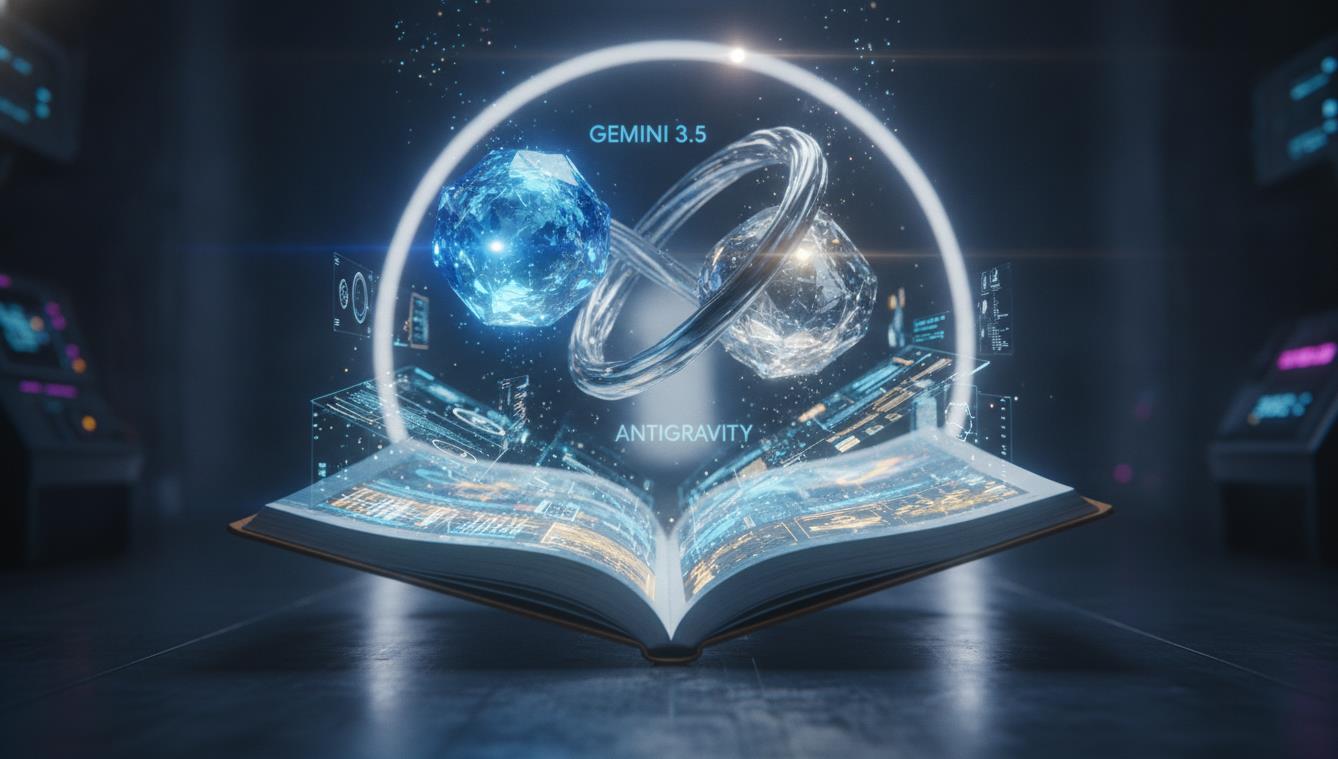
The key technological breakthrough is the provision of an isolated, secure cloud computer for every individual notebook (user project). This allows the AI not only to analyze uploaded text but also to autonomously write, test, and execute deterministic code for deep data analysis, mathematical calculations, and parsing unstructured datasets. The system is further equipped with a built-in arsenal of over 100 curated software skills.
The spectrum of output and export formats has significantly expanded. While the platform previously generated mostly text and basic notes, it can now autonomously create production-ready corporate presentations (PPTX), complex spreadsheets (XLSX, CSV), vector graphics (SVG), structured databases (JSON), and high-quality images using the integrated Nano Banana visual models (including support for Gemini 3.1 Flash Image and Gemini 3 Pro Image). The Studio panel has gained new multimedia formats, including the innovative Video Overviews—automatically generated educational videos featuring detailed animated slides and voiceovers based on uploaded materials.
Finally, the fundamental onboarding process has changed: users no longer need to upload prepared local documents beforehand. A full research project can start from a loose idea or question, and the AI will autonomously build a verified repository of sources via Google’s advanced multilingual web search algorithms. The update is already available for users with a Google AI Ultra subscription and Workspace corporate clients with AI Ultra and AI Expanded access.
Comparison Table: NotebookLM (Before / After)
The table below details a summary of the platform’s key changes, illustrating the massive transition from a passive document processing system to a proactive analytical agent capable of autonomous data synthesis.
| Feature / Function |
Previous Version (Before Update) |
New Version (With Gemini 3.5 and Antigravity) |
|
Core AI Model |
Early iterations of Gemini 1.5 Pro / Flash; basic summarization algorithms. |
Gemini 3.5 tightly integrated with the Antigravity agentic orchestration platform. |
|
Computing Paradigm |
Passive NLP within a given context window; reliance on RAG. |
Dedicated secure cloud computer for executing real code in the background. |
|
Research Initiation |
Required manual upload of prepared documents, notes, or links. |
Can start with a “loose idea”; AI autonomously searches the web and helps build a repository. |
|
Web Search Mechanics |
Highly limited, fully dependent on the user’s local files. |
Advanced Google Search, deep multilingual search, and primary source author identification. |
|
Software Skills & Code |
None; the model attempted to calculate by predicting tokens. |
Integration of over 100 curated software skills for complex statistical and structural analysis. |
|
Text & Table Formats |
Local text notes in the interface, basic Markdown. |
Direct export to corporate standards: PDF, DOCX, Markdown, TXT, CSV, JSON, Microsoft Excel (XLSX). |
|
Data Visualization |
Basic text description of numerical trends and data. |
Autonomous generation of scalable vector graphics (SVG) and raster charts (PNG) based on calculations. |
|
Image Generation |
None; the platform focused on text analysis. |
Native integration of powerful Nano Banana models (2 and Pro) for creating photorealistic images (JPG, PNG, GIF). |
|
Multimedia (Studio Panel) |
Popular Audio Overviews (podcasts), basic text notes. |
Audio Overviews, Video Overviews (slide presentations), interactive mind maps, flashcards, quizzes, infographics. |
|
Analysis Quality & Accuracy |
Baseline accuracy, prone to hallucinations on large datasets. |
Overall win rate increased to 65%; 69.9% in large document analysis; 78.2% in advanced web research. |
|
Algorithm Transparency |
“Black box” raw output. |
Creation of verifiable intermediate Artifacts; full visibility into the step-by-step reasoning process. |
Historical Context and Platform Evolution
To fully grasp the scale of this update, we must look at the project’s trajectory. Three years ago, NotebookLM launched as a modest experimental product within Google Labs. It was initially positioned as a “virtual research assistant” designed to help users navigate their own notes and documents. The product was built by a visionary team including renowned science author Steven Johnson and product manager Raiza Martin. Their initial goal was to create a tool that helped uncover hidden connections in disparate texts.
Over the years, the platform has earned the trust of millions of researchers, students, educators, and corporate analysts, becoming an indispensable partner in collaborative knowledge management. However, previous versions, despite their popularity (especially thanks to the Audio Overviews feature), remained confined to the RAG (Retrieval-Augmented Generation) paradigm. The system simply found a text snippet in an uploaded document and rephrased it. The new update marks a definitive breakout from this restrictive paradigm, shifting the project into the realm of autonomous agents and complex artifact generation.
Architectural Shift: The Gemini 3.5 Engine and Antigravity Ecosystem
The fundamental architecture underpinning the new NotebookLM is the integration of the latest Gemini 3.5 large language model with the revolutionary Antigravity development environment. This merger creates a unique architecture where the language model is no longer a passive oracle waiting for single queries but functions as the command core for orchestrating complex tasks.
What is Antigravity?
Antigravity is not just an interface update; it is a completely new AI operating paradigm from Google. Historically, development and research tools focused on speeding up manual coding or writing. Antigravity, conversely, is designed as the world’s first agentic development platform, aimed at macro-level process orchestration.
The Antigravity platform encompasses an entire ecosystem of tools now powering NotebookLM’s hidden processes:
- Antigravity 2.0 Desktop Application: While standard users interact with NotebookLM via the web, the Antigravity ecosystem also exists as a standalone desktop app compatible with macOS Monterey 12, Windows 10 (64-bit), and modern Linux distributions (with glibc 2.28).
- Antigravity CLI (Command Line Interface): A lightweight terminal interface allowing developers to instantly spawn new agents without a graphical shell.
- Antigravity SDK: A developer toolkit providing programmatic access to the same agent harness powering Google’s products.
Integrating this powerful infrastructure into NotebookLM fundamentally alters how the AI interacts with research data. The AI employs an “agentic orchestration” approach. Upon receiving a complex prompt (e.g., “Analyze the financial reports of three competing companies over the last five years and draft a consolidated forecast”), the system triggers multiple parallel, asynchronous processes. Various sub-agents autonomously plan steps, gather information across different parts of the repository, cross-reference data, and verify it for contradictions.
From Log Files to Verifiable Artifacts
A crucial aspect of the new architecture is solving the “black box” problem inherent to early generative networks. Previously, users had to blindly trust the final output without understanding the derivation. In business and science, such blind trust is unacceptable.
Antigravity resolves this via the concept of generating Artifacts. Instead of forcing users to read long technical logs or hidden chains of thought, agents generate tangible intermediate deliverables. These can be task lists, implementation plans, logic trees, or data mapping structures. If a researcher spots that an agent took a wrong turn mid-way, they can leave a comment directly on the Artifact—just like leaving edits in Google Docs. The agent instantly incorporates this feedback into its workflow without halting the execution cycle. This unprecedented transparency (better visibility into the thinking process) makes NotebookLM the most reliable partner for serious analytical research.
Empirical Performance and Success Metrics
Profound architectural changes required rigorous internal validation. In a series of strict side-by-side evaluations by Google engineers, the updated system with Gemini 3.5 and Antigravity demonstrated a massive leap over the previous baseline.
| Testing Dimension |
Win Rate |
Analytical Commentary |
|
Overall Average Across Key Dimensions |
> 65% |
This represents a 15-point margin above parity across five core evaluation vectors (source-grounded Q&A, multilingual analysis, long-form documents, content generation, multi-source research). |
|
Massive Document Analysis |
69.9% |
The AI’s ability to retain context and extract precise facts from multi-page reports or entire books without suffering from the “lost in the middle” phenomenon. |
|
Advanced Web Research & Source Discovery |
78.2% |
Unprecedented capability of agents to find obscure or highly specialized data on the open web, surpassing human search patterns. |
Secure Cloud Computer and Coding Skills
Perhaps the most radical, paradigm-shifting addition for a consumer and enterprise tool is the introduction of a “secure cloud computer” for each individual user notebook.
Historically, large language models excelled at linguistic tasks but struggled fundamentally with precise mathematical calculations, statistics, and algorithmic logic. They tried to “guess” math answers based on word probability distributions in training data, inevitably causing catastrophic hallucinations when handling real accounting or sociological datasets.
Google elegantly solved this by embedding a deterministic environment within a probabilistic system. Now, when NotebookLM needs to perform deep data analysis, it doesn’t try to predict the text result. Instead, the Gemini 3.5 model acts as a Software Engineer: it autonomously writes code (e.g., Python scripts using Pandas or NumPy libraries), compiles it, and runs it on an isolated, secure cloud server. The cloud computer performs these exact mathematical operations, aggregates data, and returns an absolutely precise, deterministic result to the language model, which then packages it into human-readable text or a chart.
To ensure maximum flexibility and efficiency, the system comes with over 100 curated software skills. These are ready-made algorithmic blocks, libraries, and patterns the AI can invoke to solve specialized tasks—from complex statistical regressions to parsing specific data structures and resolving formatting conflicts. This completely shatters the barrier between natural language and complex programming, allowing any user to orchestrate an analytics department simply by describing the desired outcome.
Production-Grade Output: Structured Artifacts and New Export Formats
A major flaw of early AI assistants was the format of the final result. Usually, the output was an unformatted wall of text in a browser window that users had to manually copy, paste into corporate templates, and format (e.g., moving tabular data into Excel). With Antigravity and secure cloud computing, NotebookLM now compiles context from sources to generate high-quality, downloadable files that meet professional needs.
Users can write detailed system instructions to tightly control how the AI compiles, structures, and formats the results. The new supported output formats cover nearly all corporate and academic standards.
| Data Type / Scenario |
Supported Formats |
Practical Application |
|
Complex Text Documents |
PDF, DOCX, Markdown, TXT |
Instant generation of multi-page reports with embedded tables, study guides, student worksheets, or polished business plans. |
|
Structured Databases |
CSV, JSON |
Critical for engineers and developers. The AI can extract disparate facts from hundreds of text files and pack them into a machine-readable JSON array for import into other systems. |
|
Microsoft Office Tools |
XLSX (Excel), PPTX (PowerPoint) |
Autonomous creation of detailed budget spreadsheets with complex formulas (XLSX) or slide decks for the board based on technical specs (PPTX). |
|
Analytical Data Visualization |
SVG (vector graphics), PNG |
Thanks to cloud math calculations, the system generates perfectly accurate statistical charts, distribution graphs, and trend lines. |
|
Creative & Illustrative Images |
PNG, JPG, GIF |
Creating accompanying illustrations, mockups, and infographics via built-in Nano Banana models. |
As a result, NotebookLM has transformed from a simple text search engine into a full-cycle digital production factory, saving dozens of hours of routine manual labor.
The Multimedia Revolution: Upgraded Studio Panel
The epicenter of creative, educational, and multimedia interaction in the NotebookLM ecosystem is the “Studio” panel. Previously, this panel gained cult status thanks to a single, incredibly powerful feature—Audio Overviews. This allowed users to upload a dry technical document and turn it into an engaging podcast-style dialogue between two AI hosts. However, with the global update, the Studio panel has undergone an unprecedented upgrade, becoming a full-fledged educational and production laboratory.
One of the most important interface and functional improvements is that users are no longer limited to a single output. You can now simultaneously generate and save multiple versions of the same artifact type. For example, from one history textbook, you can generate an audio overview adapted for first-graders, another for university students with deep causal analysis, and a third in French. This offers incredible flexibility for personalized learning.
The spectrum of artifacts generated in the Studio panel covers all cognitive learning patterns:
- Audio Overviews: Vastly improved podcast generation algorithms with greater control over style and accents.
- Interactive Mind Maps: Automated visual networks illustrating complex relationships between concepts, terms, and entities in documents.
- Flashcards: Two-sided cards for rapid memorization of facts, dates, and definitions—invaluable for students and professionals prepping for certifications.
- Quizzes: Autonomous creation of testing systems of varying difficulty based on uploaded material.
- Video Overviews: A brand-new multimedia format requiring a deeper dive.
This tool ecosystem makes the platform highly inclusive, catering to different learning styles (visual, auditory) and providing massive support for users with visual impairments or reading difficulties. Furthermore, the panel supports multitasking: a researcher can listen to a fresh audio overview while simultaneously browsing a visual mind map of the same document.
Conclusion
This update is the biggest change NotebookLM has seen, moving it from a tool that summarized documents you uploaded to one that can research a topic from scratch, run real code to analyze data, and produce finished files. The combination of the Gemini 3.5 model and the Antigravity agent platform is what makes that possible: instead of only rephrasing text it finds, NotebookLM can now plan multi-step work, search the web to build its own source library, run calculations on a secure cloud machine, and export the result as a document, spreadsheet, slide deck, chart, or image.
Two shifts stand out. The secure cloud computer addresses a real weakness of language models, that they guess at math rather than compute it, by having the AI write and run actual code for precise results. And the move to verifiable “artifacts,” where you can see and comment on the AI’s intermediate steps, tackles the black-box problem that makes people wary of trusting AI analysis. Google reports large accuracy gains from the new system, though, as with any vendor benchmark, those figures are best treated as a starting point rather than the final word.
The practical catch is access: the update is limited to Google AI Ultra subscribers and eligible Workspace plans, so it is not yet available to everyone. For researchers, analysts, students, and teams who do have it, this turns NotebookLM from a helpful reading assistant into something closer to an autonomous research and production tool. It is a significant step in how a mainstream AI tool handles serious analytical work, and a clear signal of where these platforms are heading.