NotebookLM Update: Now with Gemini 3.5 and Antigravity
On this page
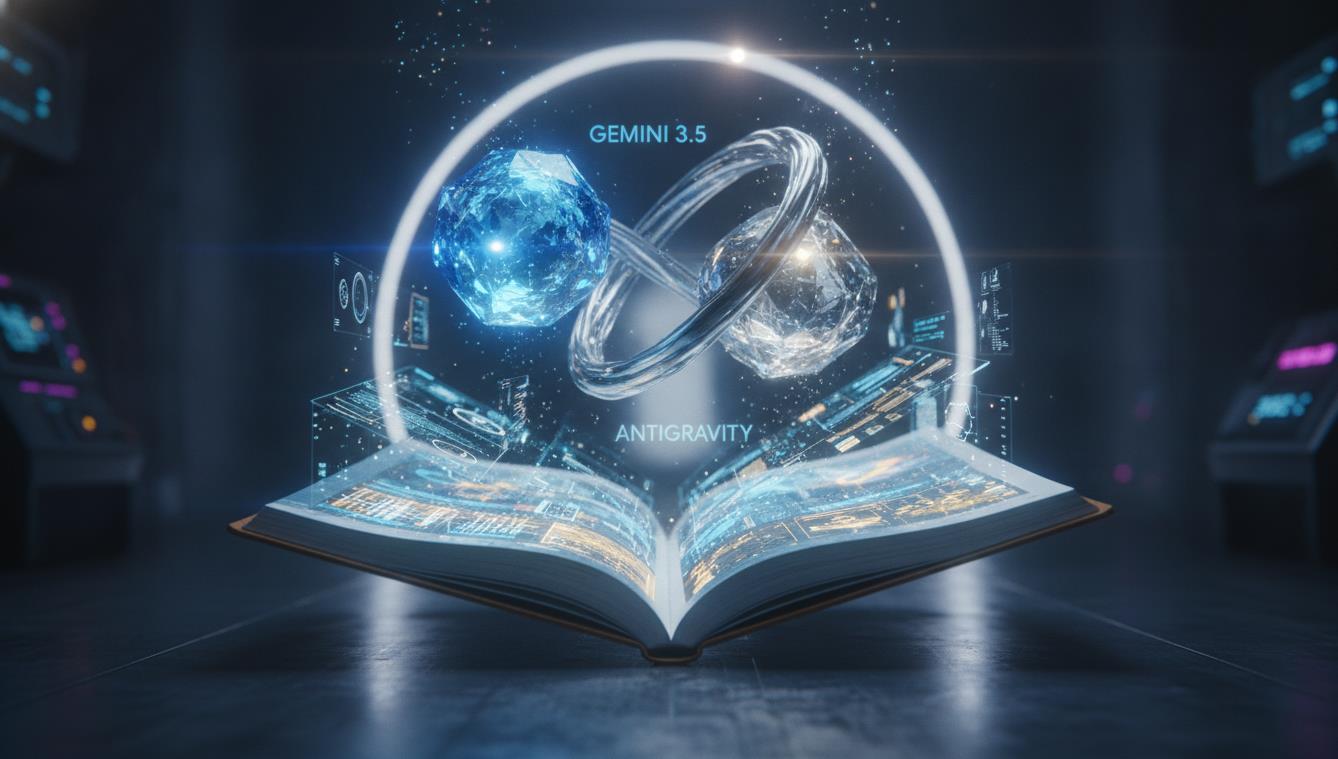
In its latest global update, Google has radically transformed the NotebookLM platform, evolving it from an experimental text summarization tool into a fully integrated development environment (IDE) and a proactive research station. The major architectural shift is the transition to the cutting-edge Gemini 3.5 language model, working in tight integration with the advanced Antigravity agentic platform. This grants the system unprecedented capabilities for advanced logical reasoning and the autonomous execution of complex, multi-step research tasks in the background.
The key technological breakthrough is the provision of an isolated, secure cloud computer for every individual notebook (user project). This allows the AI not only to analyze uploaded text but also to autonomously write, test, and execute deterministic code for deep data analysis, mathematical calculations, and parsing unstructured datasets. The system is further equipped with a built-in arsenal of over 100 curated software skills.
The spectrum of output and export formats has significantly expanded. While the platform previously generated mostly text and basic notes, it can now autonomously create production-ready corporate presentations (PPTX), complex spreadsheets (XLSX, CSV), vector graphics (SVG), structured databases (JSON), and high-quality images using the integrated Nano Banana visual models (including support for Gemini 3.1 Flash Image and Gemini 3 Pro Image). The Studio panel has gained new multimedia formats, including the innovative Video Overviews—automatically generated educational videos featuring detailed animated slides and voiceovers based on uploaded materials.
Finally, the fundamental onboarding process has changed: users no longer need to upload prepared local documents beforehand. A full research project can start from a loose idea or question, and the AI will autonomously build a verified repository of sources via Google’s advanced multilingual web search algorithms. The update is already available for users with a Google AI Ultra subscription and Workspace corporate clients with AI Ultra and AI Expanded access.
Comparison Table: NotebookLM (Before / After)
The table below details a summary of the platform’s key changes, illustrating the massive transition from a passive document processing system to a proactive analytical agent capable of autonomous data synthesis.
| Feature / Function |
Previous Version (Before Update) |
New Version (With Gemini 3.5 and Antigravity) |
|
Core AI Model |
Early iterations of Gemini 1.5 Pro / Flash; basic summarization algorithms. |
Gemini 3.5 tightly integrated with the Antigravity agentic orchestration platform. |
|
Computing Paradigm |
Passive NLP within a given context window; reliance on RAG. |
Dedicated secure cloud computer for executing real code in the background. |
|
Research Initiation |
Required manual upload of prepared documents, notes, or links. |
Can start with a “loose idea”; AI autonomously searches the web and helps build a repository. |
|
Web Search Mechanics |
Highly limited, fully dependent on the user’s local files. |
Advanced Google Search, deep multilingual search, and primary source author identification. |
|
Software Skills & Code |
None; the model attempted to calculate by predicting tokens. |
Integration of over 100 curated software skills for complex statistical and structural analysis. |
|
Text & Table Formats |
Local text notes in the interface, basic Markdown. |
Direct export to corporate standards: PDF, DOCX, Markdown, TXT, CSV, JSON, Microsoft Excel (XLSX). |
|
Data Visualization |
Basic text description of numerical trends and data. |
Autonomous generation of scalable vector graphics (SVG) and raster charts (PNG) based on calculations. |
|
Image Generation |
None; the platform focused on text analysis. |
Native integration of powerful Nano Banana models (2 and Pro) for creating photorealistic images (JPG, PNG, GIF). |
|
Multimedia (Studio Panel) |
Popular Audio Overviews (podcasts), basic text notes. |
Audio Overviews, Video Overviews (slide presentations), interactive mind maps, flashcards, quizzes, infographics. |
|
Analysis Quality & Accuracy |
Baseline accuracy, prone to hallucinations on large datasets. |
Overall win rate increased to 65%; 69.9% in large document analysis; 78.2% in advanced web research. |
|
Algorithm Transparency |
“Black box” raw output. |
Creation of verifiable intermediate Artifacts; full visibility into the step-by-step reasoning process. |
Historical Context and Platform Evolution
To fully grasp the scale of this update, we must look at the project’s trajectory. Three years ago, NotebookLM launched as a modest experimental product within Google Labs. It was initially positioned as a “virtual research assistant” designed to help users navigate their own notes and documents. The product was built by a visionary team including renowned science author Steven Johnson and product manager Raiza Martin. Their initial goal was to create a tool that helped uncover hidden connections in disparate texts.
Over the years, the platform has earned the trust of millions of researchers, students, educators, and corporate analysts, becoming an indispensable partner in collaborative knowledge management. However, previous versions, despite their popularity (especially thanks to the Audio Overviews feature), remained confined to the RAG (Retrieval-Augmented Generation) paradigm. The system simply found a text snippet in an uploaded document and rephrased it. The new update marks a definitive breakout from this restrictive paradigm, shifting the project into the realm of autonomous agents and complex artifact generation.
Architectural Shift: The Gemini 3.5 Engine and Antigravity Ecosystem
The fundamental architecture underpinning the new NotebookLM is the integration of the latest Gemini 3.5 large language model with the revolutionary Antigravity development environment. This merger creates a unique architecture where the language model is no longer a passive oracle waiting for single queries but functions as the command core for orchestrating complex tasks.
What is Antigravity?
Antigravity is not just an interface update; it is a completely new AI operating paradigm from Google. Historically, development and research tools focused on speeding up manual coding or writing. Antigravity, conversely, is designed as the world’s first agentic development platform, aimed at macro-level process orchestration.
The Antigravity platform encompasses an entire ecosystem of tools now powering NotebookLM’s hidden processes:
- Antigravity 2.0 Desktop Application: While standard users interact with NotebookLM via the web, the Antigravity ecosystem also exists as a standalone desktop app compatible with macOS Monterey 12, Windows 10 (64-bit), and modern Linux distributions (with glibc 2.28).
- Antigravity CLI (Command Line Interface): A lightweight terminal interface allowing developers to instantly spawn new agents without a graphical shell.
- Antigravity SDK: A developer toolkit providing programmatic access to the same agent harness powering Google’s products.
Integrating this powerful infrastructure into NotebookLM fundamentally alters how the AI interacts with research data. The AI employs an “agentic orchestration” approach. Upon receiving a complex prompt (e.g., “Analyze the financial reports of three competing companies over the last five years and draft a consolidated forecast”), the system triggers multiple parallel, asynchronous processes. Various sub-agents autonomously plan steps, gather information across different parts of the repository, cross-reference data, and verify it for contradictions.
From Log Files to Verifiable Artifacts
A crucial aspect of the new architecture is solving the “black box” problem inherent to early generative networks. Previously, users had to blindly trust the final output without understanding the derivation. In business and science, such blind trust is unacceptable.
Antigravity resolves this via the concept of generating Artifacts. Instead of forcing users to read long technical logs or hidden chains of thought, agents generate tangible intermediate deliverables. These can be task lists, implementation plans, logic trees, or data mapping structures. If a researcher spots that an agent took a wrong turn mid-way, they can leave a comment directly on the Artifact—just like leaving edits in Google Docs. The agent instantly incorporates this feedback into its workflow without halting the execution cycle. This unprecedented transparency (better visibility into the thinking process) makes NotebookLM the most reliable partner for serious analytical research.
Empirical Performance and Success Metrics
Profound architectural changes required rigorous internal validation. In a series of strict side-by-side evaluations by Google engineers, the updated system with Gemini 3.5 and Antigravity demonstrated a massive leap over the previous baseline.
| Testing Dimension |
Win Rate |
Analytical Commentary |
|
Overall Average Across Key Dimensions |
> 65% |
This represents a 15-point margin above parity across five core evaluation vectors (source-grounded Q&A, multilingual analysis, long-form documents, content generation, multi-source research). |
|
Massive Document Analysis |
69.9% |
The AI’s ability to retain context and extract precise facts from multi-page reports or entire books without suffering from the “lost in the middle” phenomenon. |
|
Advanced Web Research & Source Discovery |
78.2% |
Unprecedented capability of agents to find obscure or highly specialized data on the open web, surpassing human search patterns. |
Computational Autonomy: Secure Cloud Computer and Coding Skills
Perhaps the most radical, paradigm-shifting addition for a consumer and enterprise tool is the introduction of a “secure cloud computer” for each individual user notebook.
Historically, large language models excelled at linguistic tasks but struggled fundamentally with precise mathematical calculations, statistics, and algorithmic logic. They tried to “guess” math answers based on word probability distributions in training data, inevitably causing catastrophic hallucinations when handling real accounting or sociological datasets.
Google elegantly solved this by embedding a deterministic environment within a probabilistic system. Now, when NotebookLM needs to perform deep data analysis, it doesn’t try to predict the text result. Instead, the Gemini 3.5 model acts as a Software Engineer: it autonomously writes code (e.g., Python scripts using Pandas or NumPy libraries), compiles it, and runs it on an isolated, secure cloud server. The cloud computer performs these exact mathematical operations, aggregates data, and returns an absolutely precise, deterministic result to the language model, which then packages it into human-readable text or a chart.
To ensure maximum flexibility and efficiency, the system comes with over 100 curated software skills. These are ready-made algorithmic blocks, libraries, and patterns the AI can invoke to solve specialized tasks—from complex statistical regressions to parsing specific data structures and resolving formatting conflicts. This completely shatters the barrier between natural language and complex programming, allowing any user to orchestrate an analytics department simply by describing the desired outcome.
Revolutionizing Research Initiation: From Static Files to Dynamic Web Search
Another critical update is the changing philosophy behind initial data gathering. For a long time, NotebookLM operated strictly on a RAG principle: “bring your own documents.” Its effectiveness relied 100% on the quality, relevance, and completeness of the PDFs or notes the user uploaded. Without a ready bibliography, the tool was largely useless.
The new version completely flips this logic. Research can now start with a blank slate, fueled only by loose ideas, scattered thoughts, or abstract hypotheses. The AI acts as an intellectual partner at the earliest, most difficult stage of any scientific or business project: literature search and validation.
Deep integration with Google Search allows NotebookLM to guide the user through building a source repository directly in the interactive chat interface. For instance, if an analyst is studying the impact of new alloys in aerospace, they can ask the system to find relevant, high-quality scientific papers and patents online. The system supports advanced features like multilingual search (finding primary sources in foreign academic databases and instantly translating them) and author-specific searches to discover related works.
Crucially, the user retains absolute control. NotebookLM doesn’t blindly feed web data into its context window. It acts as a thoughtful curator: proposing sources, summarizing them, explaining their relevance, and leaving the final decision to add the material to the notebook up to the user. This strict source-grounded methodology ensures the knowledge base remains reliable and free of internet noise, with every claim in the final report clearly attributed to a verified primary document. In the era of information overload and fake news, this capability to act as a trusted filter is invaluable.
Production-Grade Output: Structured Artifacts and New Export Formats
A major flaw of early AI assistants was the format of the final result. Usually, the output was an unformatted wall of text in a browser window that users had to manually copy, paste into corporate templates, and format (e.g., moving tabular data into Excel). With Antigravity and secure cloud computing, NotebookLM now compiles context from sources to generate high-quality, downloadable files that meet professional needs.
Users can write detailed system instructions to tightly control how the AI compiles, structures, and formats the results. The new supported output formats cover nearly all corporate and academic standards.
| Data Type / Scenario |
Supported Formats |
Practical Application |
|
Complex Text Documents |
PDF, DOCX, Markdown, TXT |
Instant generation of multi-page reports with embedded tables, study guides, student worksheets, or polished business plans. |
|
Structured Databases |
CSV, JSON |
Critical for engineers and developers. The AI can extract disparate facts from hundreds of text files and pack them into a machine-readable JSON array for import into other systems. |
|
Microsoft Office Tools |
XLSX (Excel), PPTX (PowerPoint) |
Autonomous creation of detailed budget spreadsheets with complex formulas (XLSX) or slide decks for the board based on technical specs (PPTX). |
|
Analytical Data Visualization |
SVG (vector graphics), PNG |
Thanks to cloud math calculations, the system generates perfectly accurate statistical charts, distribution graphs, and trend lines. |
|
Creative & Illustrative Images |
PNG, JPG, GIF |
Creating accompanying illustrations, mockups, and infographics via built-in Nano Banana models. |
As a result, NotebookLM has transformed from a simple text search engine into a full-cycle digital production factory, saving dozens of hours of routine manual labor.
The Multimedia Revolution: Upgraded Studio Panel
The epicenter of creative, educational, and multimedia interaction in the NotebookLM ecosystem is the “Studio” panel. Previously, this panel gained cult status thanks to a single, incredibly powerful feature—Audio Overviews. This allowed users to upload a dry technical document and turn it into an engaging podcast-style dialogue between two AI hosts. However, with the global update, the Studio panel has undergone an unprecedented upgrade, becoming a full-fledged educational and production laboratory.
One of the most important interface and functional improvements is that users are no longer limited to a single output. You can now simultaneously generate and save multiple versions of the same artifact type. For example, from one history textbook, you can generate an audio overview adapted for first-graders, another for university students with deep causal analysis, and a third in French. This offers incredible flexibility for personalized learning.
The spectrum of artifacts generated in the Studio panel covers all cognitive learning patterns:
- Audio Overviews: Vastly improved podcast generation algorithms with greater control over style and accents.
- Interactive Mind Maps: Automated visual networks illustrating complex relationships between concepts, terms, and entities in documents.
- Flashcards: Two-sided cards for rapid memorization of facts, dates, and definitions—invaluable for students and professionals prepping for certifications.
- Quizzes: Autonomous creation of testing systems of varying difficulty based on uploaded material.
- Video Overviews: A brand-new multimedia format requiring a deeper dive.
This tool ecosystem makes the platform highly inclusive, catering to different learning styles (visual, auditory) and providing massive support for users with visual impairments or reading difficulties. Furthermore, the panel supports multitasking: a researcher can listen to a fresh audio overview while simultaneously browsing a visual mind map of the same document.
A New Era of Visual Synthesis: Deep Dive into Video Overviews
The introduction of Video Overviews is arguably the most futuristic and discussed addition to the Studio panel. This technology takes complex, multi-page volumes of abstract text and distills them into clear, easily digestible video content, ensuring maximum visual immersion in the material.
Currently, these videos are structured as detailed animated sequences of static images (infographic slides) accompanied by a perfectly synchronized AI voiceover. Even without full-motion cinematic video, the educational value is immense.
Users have studio-level control over generation. Before rendering, you can set strict parameters: choose the format, target language, visual style (e.g., minimalist, corporate, academic), and write detailed system prompts. For example: “I am a beginner in quantum physics; focus the video on explaining the graphs using simple metaphors and avoid complex formulas.” Or conversely: “I am an expert in machine learning; skip basic definitions and focus the video on the architectural differences.” This degree of personalization is unprecedented in traditional media.
The creation process is simple: click “Video Overview” in the Studio panel, and Antigravity algorithms run asynchronously. Videos can be played in NotebookLM’s built-in player and shared with colleagues or students via a secure link (provided viewers have notebook access). This opens massive opportunities for teamwork, corporate onboarding, and remote education.
Many tech analysts view these slide-based Video Overviews as merely a transitional step toward generating full cinematic educational films. As NotebookLM deepens its integration with advanced generative video models (like Google Veo or Sora-based systems), these generated slideshows will act as storyboards and scene prompts for automatically creating high-quality, hyper-realistic documentaries on any text. Thus, mastering Video Overviews today is a strategic skill for effectively interacting with future video agents.
Spatial Intelligence and Creativity: Nano Banana Integration
Beyond structured charts and video presentations, NotebookLM has received a massive raster graphics upgrade by natively integrating the Nano Banana image generation and editing models—specifically Nano Banana 2 (Gemini 3.1 Flash Image architecture) and the flagship Nano Banana Pro (Gemini 3 Pro Image architecture).
Backed by the Gemini Enterprise Agent Platform infrastructure, these enterprise-grade models allow NotebookLM to create complex, context-aware illustrations and infographics directly from research text.
Nano Banana Pro Capabilities
The Nano Banana models bring unprecedented photorealism, typographical accuracy, and studio control. A major flaw of early image generators was their inability to render text correctly. A key feature of Nano Banana Pro is generating highly legible, meaningful text within images across multiple languages. This makes it ideal for autonomously creating marketing mockups, posters, and explanatory infographics inserted into final NotebookLM PDF reports.
The model possesses outstanding spatial intelligence. It provides tools for localized editing: users can alter a specific part of an image without ruining the composition. A full virtual photographer’s arsenal is available: adjusting camera angles, depth of field, advanced color grading, and radically transforming scene lighting. Images are generated in various aspect ratios, with standard 1K and 2K outputs, while 4K generation is currently in preview.
Multimodal Prompting and Video Analysis
A crucial innovation in Nano Banana 2 is multimodal input support. The model can now accept full video files as prompts. Using deep video understanding algorithms, it analyzes visual context frame-by-frame, identifying subjects and dynamic actions.
Based on this analysis, the system generates context-aware images. For instance, analyzing a science experiment video, it can automatically generate a perfect YouTube thumbnail or an infographic explaining the recorded physics. This opens massive opportunities for content analysts and educators.
Security, Transparency, and Ecosystem
To ensure ethical AI use and prevent deepfakes, all Nano Banana images include an invisible SynthID digital watermark. This watermark resists cropping and compression, allowing automated identification.
Enterprise clients have already proven these models’ effectiveness, leveraging drop-in compatibility with the OpenAI API. Wolffun Game uses Gemini to compute complex PvP architectures; HubX embedded native multimodality in its ReShoot app for conversational photo editing; and Toongether democratizes visual storytelling for comic creation.
There is also an independent Banana Nano Universe platform offering Pro access, allowing 100 daily generations and standard API access. All this colossal visual power now implicitly resides under the hood of the updated NotebookLM.
Transforming Professional Workflows: Practical Scenarios
The convergence of Gemini 3.5, deterministic cloud computing, web access, and advanced multimedia outputs creates entirely new workflow paradigms. Google highlights three key scenarios demonstrating this synergy.
Intellectual Amplification for Data Analysts
Scientists and Data Analysts constantly face the grueling task of merging disparate databases. The new NotebookLM handles this routine. An analyst can upload dirty raw data with conflicting formats or currencies.
Instead of writing cleaning scripts manually, the analyst formulates a natural language task. The Antigravity agent finds missing web context, writes Python code on the secure cloud computer to normalize the data, and generates mathematically precise SVG charts. The agent then compiles all charts and structured tables into a polished PDF report. Days of work shrink to minutes of dialogue.
Communication Automation for Tech Professionals
Program Managers bridging technical reality and business goals can upload heavy API documentation and database logic. NotebookLM instantly deciphers it and autonomously generates DOCX user guides, PPTX slide decks for the board, or step-by-step developer roadmaps. This radically accelerates the product development cycle.
Democratizing Analytics for Small Business
Small business owners lacking data science teams can upload chaotic receipts, social media ad spend data, and sales records. The cloud computer calculates ROI, identifies seasonal patterns, evaluates financial impacts, and provides mathematically sound business expansion advice. Complex financial auditing becomes accessible with a click.
Global Rollout, Availability, and Ecosystem
Such profound architectural changes require massive server power, rolling out progressively. Starting today, these updates are available globally on the web. Initial access to resource-heavy features (cloud computing, complex artifacts) is granted to:
- Individual users with a Google AI Ultra subscription.
- Workspace business customers with AI Ultra Access and AI Expanded Access.
NotebookLM is no longer a closed ecosystem. Thanks to the Antigravity CLI, SDK, and export capabilities, developers can seamlessly move projects from the web to powerful local environments, integrating with Google Cloud Platform (GCP). In the future, access to new formats and multimedia features will expand as computing networks optimize.
Strategic Implications and the Shift in Knowledge Work
The evolution from a summarizer to an agentic IDE marks a fundamental shift in user expectations.
First, the Antigravity architecture ends the era of stateless chatbots. Verifiable Artifacts finally solve the corporate trust problem, letting specialists guide AI on a micro-level without writing code.
Second, the secure cloud computer acknowledges that LLMs shouldn’t simulate math probabilistically. Combining code generation with deterministic execution eliminates hallucinations in exact sciences.
Finally, multimodal generation (Video Overviews, Nano Banana, Audio Overviews) turns research into digital media asset production. An article instantly becomes a podcast, flashcards, vector infographics, and a video lecture. NotebookLM sets an unreachable gold standard, moving from the era of information search to autonomous intellectual synthesis.