Is Apex Vision AI Detectable? The Truth About AI Aimbots
On this page
Apex Legends is not just another battle royale. It is a high-speed arena where time is compressed, movement is unpredictable, and gunplay demands exceptional target-tracking skill. This mechanical depth has given rise not only to millions of dedicated players but also to a shadowy arms race rooted in the very foundations of cheat technology.
Today, that race has entered a new phase. Crude memory-reading hacks are being replaced by neural-network-based computer vision systems—Apex Vision AI. The question haunting the community is no longer “does it work?” but “can it be caught?” We are diving into the world of AI aimbots to separate marketing fairy tales from the harsh reality of code and anti-cheat.
For the Uninitiated: A Quick Primer on Apex Legends
For those who do not frequent game servers, some context is needed. Apex Legends, from Respawn Entertainment, is a free-to-play hero shooter battle royale released in 2019. Unlike many competitors, the game emphasizes extended firefights, complex movement mechanics—slides, jumps, ziplines, and the legendary gravity lift—and the unique abilities of its legend characters.
It is not enough to simply click on a target’s head. You must predict the trajectory of an enemy who might zip away on a cable, vanish into smoke, or deploy a shield. The high time-to-kill (TTK) turns every fight into a duel of endurance, and it is here that the value of perfect tracking soars.
The game features a fierce competitive scene, including the ALGS, and a storied ranked system where the stakes of winning and losing are particularly high. This is precisely what provokes the emergence of cheat programs—aimbots—through which certain individuals try to “bypass” the game’s algorithms and climb to the top of the ladder.
The reason for the popularity of cheat bots is simple: ego and rank. High ranks in Apex serve as a social elevator and a way to monetize content. When legitimate skill hits a ceiling or demands thousands of hours of play, the player seeks a shortcut.
However, the era of uncontested memory-based cheating is ending. Hardware solutions and neural networks are entering the arena.
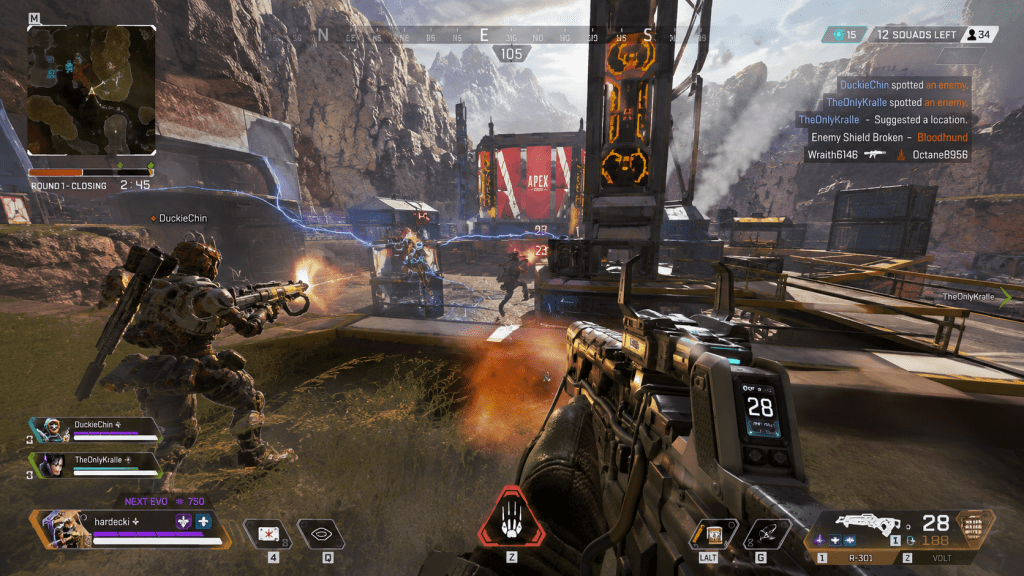
The Evolution of the Aimbot: From Memory Code to On-Screen Pixels
The classic aimbot has always been a rather blunt instrument. The traditional approach involves injecting a dynamic library into the game process, reading memory buffers, and directly modifying camera coordinates. This is effective, instantaneous… and unnatural. Such methods produced the infamous “snaps”—instantaneous crosshair snapping to heads, easily recognizable even to the naked eye on recordings.
It is precisely against such cheats that systems like Easy Anti-Cheat first learned to fight. Signature analysis, file integrity checks, injection detection—the genre classics that force cheat creators to seek other paths.
What Is a Vision AI Aimbot and How Does It Differ from Old-School Hacks?
An AI aimbot, especially of the vision-based class, is a fundamentally different beast. It does not touch the game’s memory and does not inject code. Instead, it mimics the behavior of a legitimate player but with “enhanced vision.” Its operation rests on three pillars:
- Image Capture. The program captures a frame from the player’s monitor via screen capture or a capture card, obtaining a flat image without access to the game’s internal coordinates.
- Analysis. A trained computer vision model (most often YOLOv8 or its analogs), tuned to recognize legend silhouettes, comes into play. The neural network analyzes every pixel, ignoring the interface and effects, and finds enemies in smoke, against complex geometry, and at distances up to 250+ meters.
- Input Generation. Having determined where the enemy is, the system sends commands to the mouse or controller, emulating human behavior. It is at this point that all the myths are born.
A Survey of Leading Apex Vision AI Solutions
Below are descriptions of several popular AI aimbots (vision-based / computer vision) that, as of 2026, are considered among the best in terms of undetectability. The risk of being caught always exists (behavioral analysis, reports, hardware detection), but these options stand out due to smoothing, lack of direct interaction with EAC, and regular updates.
Attention: the information we provide is for educational purposes only. If you are a player, do not use these tools. On the other hand, knowledge of them will help you recognize cheaters in the game. The AIMarketCap editorial team categorically condemns the use of cheating methods and advocates for compliance with Fair Play rules.
1. AI Aim Assist
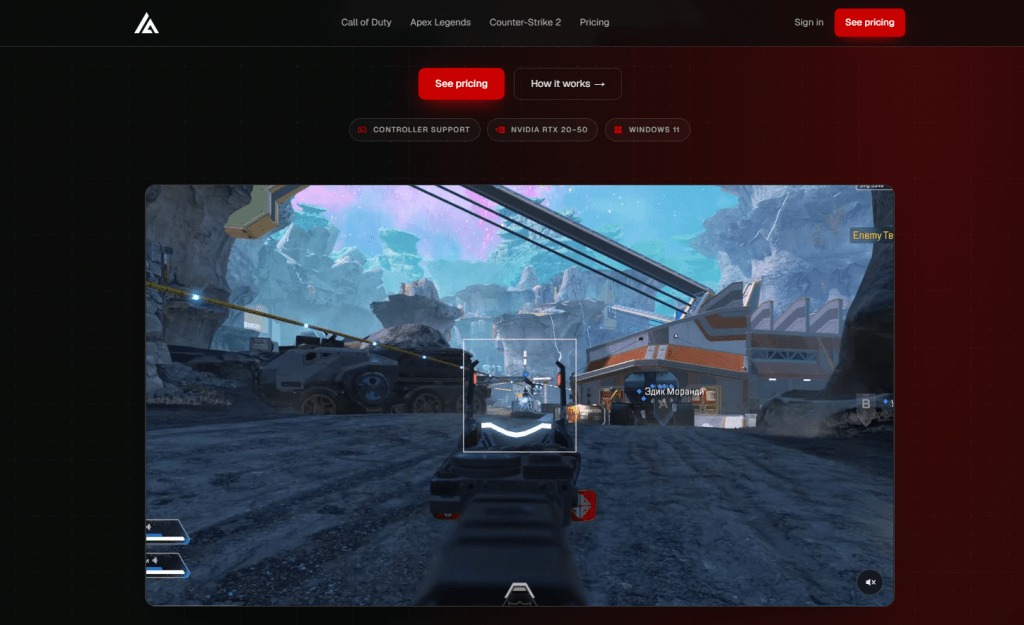
Official website: aimassist.ai/apex-aim-assist
A modern pixel-vision overlay based on an advanced neural network (Vision Engine v3 as of 2026.5). Analyzes every frame from the screen, recognizes silhouettes of all legends (even with skins, through smoke, Gibby dome, Caustic gas), tracks movement (slides, jumps, grapples, finishers). Provides smooth aim assist, mimicking enhanced controller aim.
Undetectability: High. Does not hook the game, does not generate controller inputs directly, does not interact with the anti-cheat. Respawn’s input detection looks for anomalous patterns—this tool avoids them through smoothing and human-like tracking. Positioned as an accessibility tool.
- Excellent tracking at all distances
- Controller/PC support
- Minimal FPS drop
- Regular model updates
- Works in Ranked/BR
- Subscription (price is not the lowest)
- Requires good hardware (RTX for fast processing).
2. NobleAIM
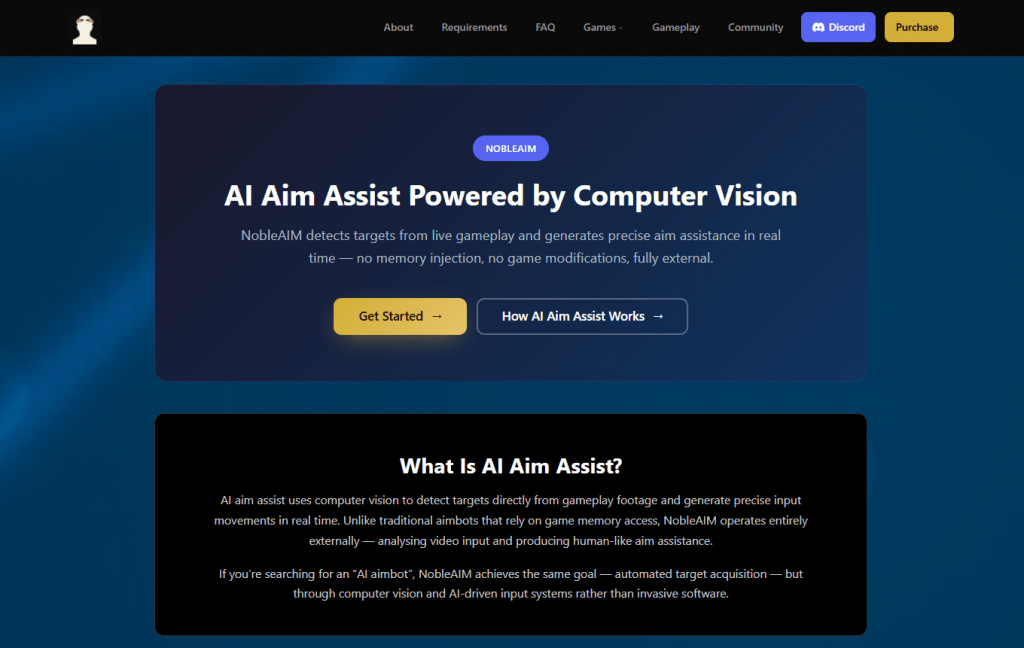
Official website: nobleaim.co.uk
Computer vision aim assist, running completely externally. Uses a capture card or screen capture for real-time video analysis. The model is trained on Apex Legends—detects enemies through effects and movement. Generates smooth crosshair adjustments (4ms tracking).
Undetectability: Among the highest for external solutions. Does not touch game files, memory, or OS-level input (especially in the separate-device variant). Completely outside EAC.
- Excellent performance in chaotic fights (squads, movement-heavy)
- Console support via capture card, human-like smoothing.
- Real-time detection of all legends
- May require additional hardware (capture card for maximum stealth)
- High price
3. Elysium AI
Official website: elysiumai.com — currently non-operational, domain listed for sale.
Project Status: Defunct as of 2026
Elysium AI was a commercial AI aimbot that, until quite recently, positioned itself as one of the most affordable and advanced vision-based cheating solutions on the market. It utilized computer vision for target acquisition and tracking, offering customization of smoothness, FOV, bone priority, and other parameters, with support for both controller and mouse inputs. Sellers marketed it heavily as a “cheap and legit” option, emphasizing private, undetected mouse movement and stream-proof operation, with regular updates promised to bypass anti-cheat patches.
However, as of 2026, the project is completely dead. Its website no longer resolves, the domain has been put up for sale, and its GitHub page returns a 404 error. We include it here nonetheless as a cautionary tale.
A simple and banal story. After several enforcement waves—resulting in thousands of hardware bans and behavior-detection strikes—the developers simply abandoned the project rather than continue risking exposure and legal pushback.
This pattern is typical in the underground cheat industry. Many private AI aimbots enjoy a lifespan of only 3 to 8 months before their creators pull the plug, cash out, and vanish. The customers, meanwhile, are left holding worthless subscriptions, banned accounts, and the bitter realization that they have been parted from their money with nothing to show for it.
- Affordable price point
- User-friendly interface
- Decent optimization
- Advertised as suitable for long-term, non-rage use
- Little public information about the underlying model compared to competitors
- Complete dependency on developer support, which proved unreliable
- Project shuttered; no refunds, no updates, no recourse
- Users who invested in it were left exposed to ban waves without any future protection
4. Titan Two + AI Vision
Hardware solutions, e.g., LighttVision and similar
A combination of Titan Two (or similar) with computer vision AI. A camera/capture looks at the screen, the neural network (YOLO-like) detects enemies, and the device emulates input to the controller. Popular on consoles (PS5/Xbox).
Undetectability: High at the hardware level—does not touch the game’s software. AI makes tracking almost indistinguishable from human. However, EA is strengthening third-party device detection (ban waves on Titan/XIM/Cronus in 2026), so it is not 100% safe.
- Strong effect on consoles, where software cheats are harder
- Can be made relatively cheaply
- Requires good hardware
- Possible account/HWID bans
- Tracking sometimes “mid” per reviews
- Growing risk from Respawn.
Comparative Table of AI Solutions
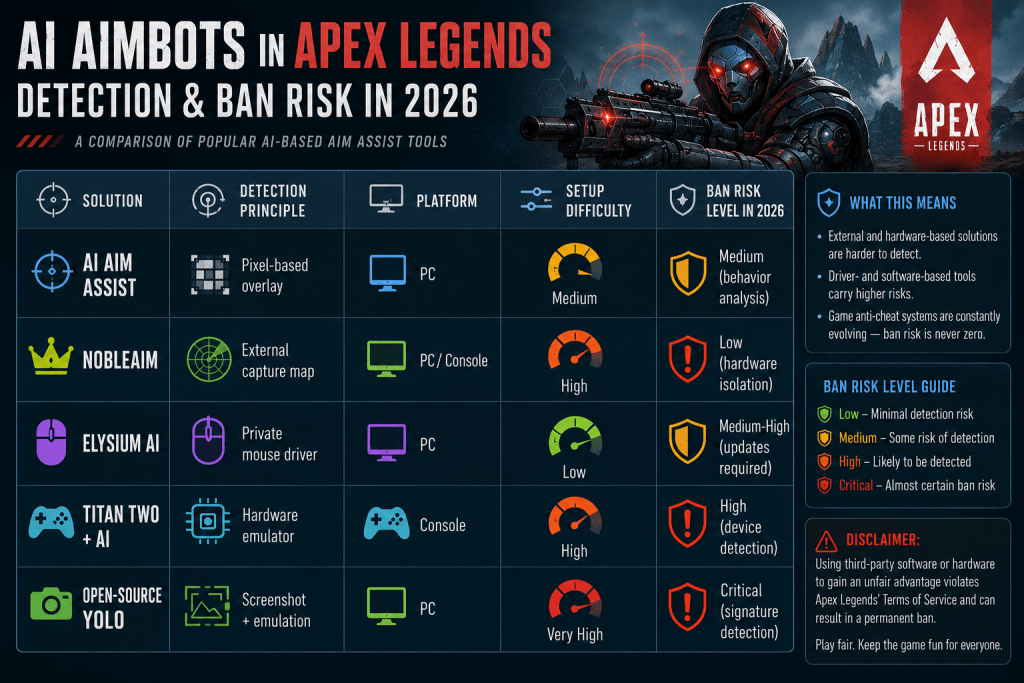
Our Comment: Do not delude yourselves. Even top-tier options can lead to bans through reports + manual review or EA’s behavioral AI. On consoles, hardware detection is intensifying.
Myths About AI Aimbots and Their Debunking
Let’s talk in more detail. The marketers of this shadow business have spawned a whole series of myths, trying to convince potential clients that their products will make anti-cheat weep helplessly in the corner. We have already said this is dishonest advertising. Now we explain why.
Myth #1
The AI aimbot does not touch the game’s memory, so it is completely invisible to the anti-cheat.
Truth: Yes, it does not poke into the game process. But the good news ends there. Anti-cheat is no longer just a dumb signature scanner. It is a complex ecosystem that monitors processes running alongside the game, suspicious overlays, and framebuffer interceptions.
Your “invisible” bot leaves digital traces at the operating system level. Moreover, screen capture is an action that can be tracked. Think you are hidden? Not so fast.
Myth #2
The neural network mimics human aim, so server-side algorithms will take me for a pro player.
Truth: The sweetest and most harmful myth that cheat sellers peddle to newcomers. Human aim is chaos. Micro-delays, hand tremor, attention shifts, blinking, fatigue, emotional spikes, random errors. A neural network, even with the smoothest smoothing, produces a statistically sterile picture.
Behavioral analysis on the server does not see a cool clip; it sees raw data: ideal reaction time distribution, mathematically precise mouse movement curves, absence of “human noise.” Respawn’s algorithms do not need to watch killcams. They see your telemetry, and it screams that you are not human.
Myth #3
I play on console, and with hardware like Titan Two, I cannot be banned.
Truth: The favorite mantra of console cheaters who for years felt like gods in console lobbies. But the party is ending, and the lights are already on.
In 2026, EA officially announced the strengthening of third-party device detection. How does it work? Analysis of input patterns at the console OS level, detection of anomalies in controller polling frequency, verification of device authenticity via Bluetooth stack handshake.
Your Titan Two pretends to be a gamepad, but its digital fingerprint differs from the original. Machine learning systems that hunt cheaters have learned to read that fingerprint.
Myth #4
If I set the aim not to the head but to the body, and occasionally miss, I will fool the system.
Truth: A naive attempt to appease the anti-cheat gods with a small sacrifice. The problem is that algorithms analyze not just the fact of hitting, but the entire crosshair movement trajectory.
A machine does not miss “like a human.” It injects artificial noise that has its own, machine signature. Imagine trying to forge a signature, but instead of a live hand, you use a plotter. Even if you program it for small smudges, an expert will still see the mechanical nature.
Same here: your “imperfect” cheat is just a slower, but still unnatural, bot. One report, one recording, one moderator glance—and you are done.
Myth #5
Open-source projects from GitHub are a free and safe way to gain an advantage.
Truth: This is like taking a weapon blueprint from the internet and going to war against a real army. The source code of public projects like Apex-CV-YOLO is available to everyone, including anti-cheat developers. The signatures of these tools, their behavioral patterns, standard screen capture methods—all have long been studied and entered into databases.
By running a raw open-source cheat without deep custom modification, you are not hacking the system. You are voluntarily hanging a “Ban me” sign on your account.
Myth #6
The AI aimbot is just an accessibility program; I won’t be banned.
Truth: Those who think that are fooling themselves first and foremost. Yes, legitimate accessibility tools exist for people with disabilities. The difference is that real accessibility solutions do not use computer vision for automatic searching, identifying, and tracking enemies without player involvement.
When your “helper” finds a target in smoke and tracks it faster than physiologically possible, that is not assistance. That is cheating. The terms of service, the moderators, and other players all understand this perfectly. Hiding behind disability while using a neural network to stomp in ranked is not only a rule violation but also outright disrespect to people who genuinely need accessibility tools.
Will EA Win the Arms Race?
The confrontation between developers and cheaters is an eternal escalation cycle. Currently, Respawn and EA have at least three attack vectors that make life for AI cheat owners increasingly nerve-wracking.
- Server-Side Behavioral Analysis. Machine learning is used not only to create cheats but also to find them. Server algorithms analyze billions of game sessions to find statistical anomalies: unnaturally steady target holding in smoke, superhuman reaction to enemy model appearance from behind a corner, and aiming patterns not characteristic of a human at any skill level.
- “Hardware Hunting.” In 2026, EA officially announced the strengthening of measures against third-party devices, directly targeting the console + Cronus/Titan combo.
- Legal Pressure and Infrastructure Bans. This is not just losing an account with all its cosmetics, but also hardware bans on components.
However, it is naive to speak of a complete developer victory. As long as an external camera pointed at the monitor is used for input to the computer vision system, intercepting that channel at the software level is physically impossible. The race is shifting to behavioral analysis, where the advantage is currently not with the attackers. Creating an algorithm that is simultaneously effective in competitive play and perfectly replicates the chaotic neurophysiological handwriting of a human is an order of magnitude harder than simply detecting objects in an image.
The bottom line? Unfortunately, not too comforting for honest players. Cheating technology will not disappear because it feeds on unsatisfied ambitions and the craving for quick success, which will always be part of human nature.
But there is also good news: the era of impunity for cheating is ending. The risk of a full and permanent account loss outweighs the dubious pleasure of a rank earned not by skill but by a graphics card. This is evidenced by ban statistics.
Ban Statistics
There is no clean statistic of “X accounts banned specifically for YOLO-vision AI” in the public domain. Respawn/EA publish overall ban-wave numbers and sometimes break them down by category (hardware, DMA, input manipulation). Nevertheless, some conclusions can be drawn.
AI aimbots most often fall under hardware bans (Titan Two, XIM, Cronus + AI vision) or behavior detection. Here are the current data for 2026 from official updates and Anti-Cheat Team reports:
- February 2026: Over 2,000 accounts permanently banned for XIM cheating devices. This follows the January wave of 1,000+ accounts for Titan devices.
- March 2026 (weekly wave): Total ban of 10,909 accounts. Of these, specifically:
- XIM / Titan: 245
- DMA: 402
- Other cheating hardware: 300
- HWID Spoofer: 1,071
By March 2026, the total number of hardware bans (including Titan/XIM/Cronus) exceeded 3,000+ since the start of the year. And that does not count larger waves. Over a season, banned accounts number in the tens or even hundreds of thousands. For example, since Season 23 (2024–2025) — over 400,000+ accounts just for cheating.
What does this mean specifically for AI aimbots?
- On consoles (where AI Vision + Titan/Cronus is especially popular), bans are primarily based on hardware detection. Respawn directly stated that third-party devices (Titan Two, XIM, Cronus, Strikepack) = cheating, and bans permanently without appeals.
- On PC, external AI also gets banned, but less frequently—more often through indirect signs (anomalous input patterns, mass reports) or if used alongside other cheats.
Our summary: The recent hardware waves of 2026 clearly target the most popular AI + Titan/XIM combinations. Respawn is improving detection (including AI-based behavior models), and the risks for AI-aimbot users are growing.
Conclusion
The truth about AI aimbots in Apex Legends is sobering. They are not an overpowered advantage but an expensive, technically complex, and ethically dubious crutch that creates an illusion of invincibility right up until the first ban wave.
The esports and game development industry does not stand still. The battle has moved from the battlefield to mathematical data analysis models, and in this battle, the machine imitating a human will sooner or later lose to the machine looking for anomalies. Betting on scripts and neural networks is always a one-way ticket with baggage of lost time, money, and digital identity.
❓ Frequently Asked Questions
Answers to relevant questions about this AI tool