AI News Generator: Automating News Content
On this page
The global acceleration of information distribution demands near-instantaneous content production cycles across digital journalism and corporate syndication networks. Maintaining editorial relevance requires automated systems capable of ingesting high-volume data streams, cross-referencing primary sources, and outputting objective copy within seconds of an event. Traditional editorial workflows, reliant on manual wire-service monitoring and human drafting, increasingly face operational bottlenecks. Automated AI news generators solve this scalability issue by processing disparate structured and unstructured data into coherent, publication-ready text while maintaining the rigorous stylistic boundaries of traditional newsrooms.
Mechanics of AI-Driven Journalism and the Inverted Pyramid
Automated news generation operates on a specialized semantic architecture designed to replicate the classic inverted pyramid structure of journalism. Unlike creative prose or marketing copy, a news algorithm prioritizes immediate information density, placing the most critical factual vectors—who, what, when, where, and why—in the opening lead paragraph. To achieve this without introducing factual errors, modern platforms integrate Retrieval-Augmented Generation (RAG) loops. Instead of relying solely on the static weight parameters of a large language model, the system queries live verified APIs, RSS feeds, and governmental databases to establish a baseline of real-time truth before initiating text synthesis.
Factual accuracy and algorithmic hallucination remain the primary technical challenges in automated reporting. When language models encounter conflicting reports from different wire services, they can inadvertently synthesize contradictory details or produce logical anomalies. To mitigate this, advanced editorial pipelines implement semantic consensus scoring and source-authority filtering. If an automated system evaluates an incoming data point and finds it falls below a specific confidence threshold, the pipeline automatically routes the draft to a human editor for secondary verification. This hybrid configuration ensures the speed of automated asset generation does not compromise institutional credibility.
Advanced Platforms for Automated News Generation
OpenAI GPT-5 Enterprise API represents the foundational standard for high-volume text synthesis and real-time data contextualization. Its core strength lies in its expansive context window and advanced reasoning capabilities, allowing editorial systems to ingest hundreds of pages of raw financial reports or legal filings and distill them into objective, neutral-tone breaking news bulletins within seconds.

Visit the official OpenAI website
Jasper Corporate AI Suite provides specialized content workflows tailored specifically for brand journalism and corporate communication departments. Utilizing fine-tuned programmatic templates, it ensures that automated industry updates, product launches, and regulatory announcements align precisely with predetermined organizational guidelines and cross-platform formatting requirements.

Visit the official Jasper AI website
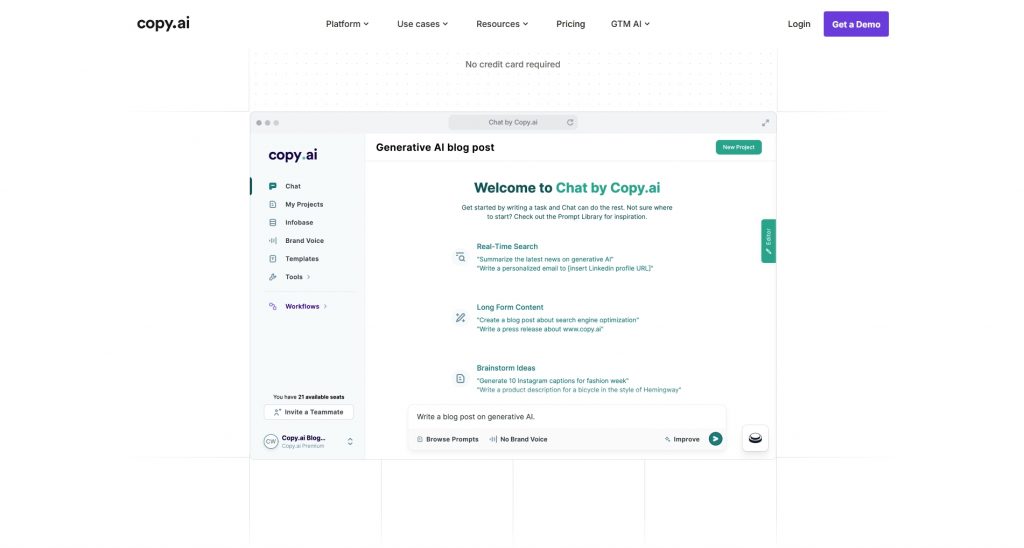
Copy.ai Workflow Automation excels in the rapid generation of short-form micro-content, automated newsletter updates, and multi-channel social media briefs. Its intuitive operational framework allows developers to build interconnected content pipelines that instantly translate primary wire service data into optimized summaries for specific distribution channels.
Visit the official Copy.ai website
Technical Specifications and Platform Comparison
| Platform Name | Primary Functionality | Integration & Latency Specs | Subscription Tiers |
|---|---|---|---|
| OpenAI GPT-5 Enterprise API | Raw text synthesis & advanced reasoning RAG | Real-time streaming API, low token latency | Custom enterprise pricing per token |
| Jasper Corporate AI Suite | Template-driven brand journalism | REST API, custom brand-voice memory layers | Plans from $39 / month per seat |
| Copy.ai Workflow Automation | Multi-channel syndication pipelines | Webhook triggers, programmatic native integrations | Advanced tiers from $49 / month |
Protocol for High-Fidelity Automated News Production
Deploying automated language models within an active journalistic or corporate distribution network requires strict compliance with verification protocols to prevent the dissemination of unverified or compromised data elements.
- Source Authentication and API Whitelisting: Restrict your automated ingestion engines strictly to verified, primary data sources. By white-listing specific wire service APIs, institutional press rooms, and official legal databases, you prevent the algorithm from scraping unverified social media commentary or satirical publications, reducing the risk of programmatic misinformation cascades.
- Algorithmic Neutrality Engineering: Systematically strip out subjective modifiers and emotionally charged terminology from your prompt generation vectors. Instructing the model to adhere exclusively to the Associated Press (AP) Stylebook ensures the output maintains a clinical, detached, and highly objective tone across all generated assets.
- Factual Auditing and Sandbox Validation: Run all programmatically generated news items through an isolated staging database before pushing content to live CMS endpoints. Implementing automated string matching against primary data tables allows the system to cross-verify names, dates, and currency values, guaranteeing structural precision.
Automated news generation provides unprecedented distribution velocity, but speed is secondary to structural accuracy; a single unverified programmatic publication can permanently dissolve decades of institutional editorial authority.
Conclusion
Integrating generative artificial intelligence into news production pipelines represents a fundamental shift in digital media scalability. Choosing the correct operational platform depends on your specific integration requirements. For complex data synthesis across massive context windows, the OpenAI GPT-5 Enterprise API provides the necessary architectural foundation. For corporate settings requiring strict compliance with internal branding and predetermined stylistic guardrails, enterprise workflow platforms like Jasper or Copy.ai deliver the targeted control required to maintain publishing standards at scale.