Top AI Tools to Write Your Spiritual Journey Story
On this page
We rarely get the opportunity to pause and reflect on our path and life’s purpose. Each of us lives a unique story: moments of insight, crises of faith, spiritual awakenings, and the quiet joy of growth. But how do you transform the chaos of memories into a coherent narrative while preserving the depth and authenticity of your experiences?

Artificial intelligence comes to the rescue not as a soulless text generator, but as a patient conversationalist and co-author. Specialized AI tools help structure memories, ask the right questions, and turn scattered thoughts into a cohesive story—whether it’s a memoir, a spiritual autobiography, or a message for future generations.
We have gathered the best services of 2026 to help you begin this journey.
Who Needs This and What For?
Describing one’s inner journey is a popular spiritual practice, a form of self-discovery, and a literary genre that helps transform personal experience into a story that matters to others. People have been doing this for centuries. One of the first to write something similar was Saint Augustine in his “Confessions” (397–400 AD). British Quakers kept thousands of such “journals” from the 17th century onward.
In the 20th and 21st centuries, the genre of spiritual autobiography was revived and became highly popular: from Paramahansa Yogananda’s “Autobiography of a Yogi” and Thomas Merton’s “The Seven Storey Mountain” to modern bestsellers. Today, spiritual memoirs are a stable segment of non-fiction.
Many people today engage in creating spiritual or life narratives:
- People aged 40 and over, experiencing a reassessment of life or a spiritual crisis, want to capture their insights.
- Practitioners (meditation, yoga, religion) seek to make sense of their spiritual experience and pass it on to students or loved ones.
- Families want to preserve the wisdom of older generations for descendants.
- Beginning writers with a spiritual background seek help with structuring and overcoming writer’s block.
- Those who find it easier to speak than to write, voice-first interfaces make the process accessible to everyone.
Today’s users especially value the convenience, privacy, and emotional support that AI tools offer in this endeavor. They make it possible to preserve a legacy, create a personal book for loved ones, or simply understand oneself better, all at a fraction of the cost of hiring a professional ghostwriter.
How AI Tools for Writing Your Spiritual Journey Work
Tools based on generative models (such as GPT, Claude, or specialized LLMs) turn scattered memories and voice notes into coherent prose. Here is how a typical workflow is structured:
- The user shares memories through text, audio, or even photos.
- The AI acts as an attentive interviewer: it asks clarifying questions, helps retrieve forgotten details, and follows the logic of your narrative.
- The algorithm then structures the material—organizes chapters, builds a narrative arc (for example, “from crisis to enlightenment”), and turns notes into literary text.
Importantly, most services retain memory of previous sessions, ensuring a consistent style and coherence throughout the book.
Top Services for Writing Your Spiritual Story
We have selected the most interesting and effective services—from highly specialized “biographers” to powerful universal models.
1. StoriedLife AI
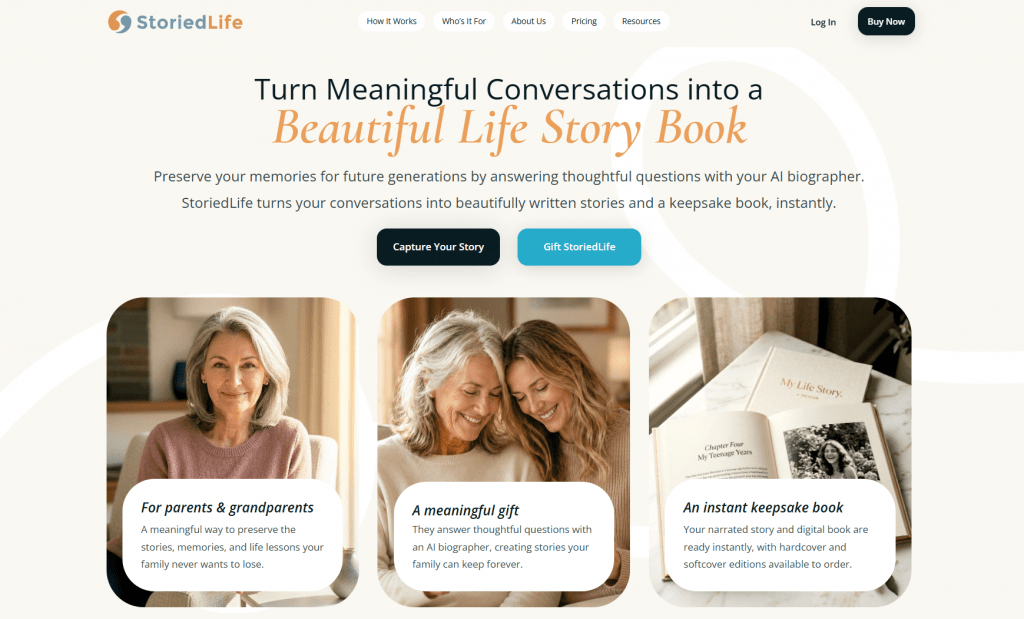
Official website: storiedlife.ai
StoriedLife is a next-generation AI biographer that turns live conversations into polished memoirs with illustrations. The platform supports 58 languages and features continuous memory, making it ideal for long-term spiritual projects.
The user interacts with AI assistant Eva, who asks deep, insightful questions, helps structure memories into chapters, and generates a coherent narrative. You can add photos and mark private moments. The final output is a PDF file or a printed hardcover book.
The service is ideal for those who prefer conversation to writing, especially seniors and families wishing to preserve spiritual wisdom. User reviews are positive—praising convenience, emotional connection, and book quality. It makes an excellent gift for parents.
- Pricing: Approximately $129/year (includes digital PDF and print options for books at an additional $49—$69). A 30-day money-back guarantee applies.
- Platform: Mobile app (conversational AI).
- Natural conversational interface and long-term session memory.
- Support for multiple languages.
- Focus on preserving family legacy.
- Relatively affordable compared to professional writing services.
- Requires a subscription with annual renewal.
- Less focused on deep creative literary processing.
2. Autobiographer App
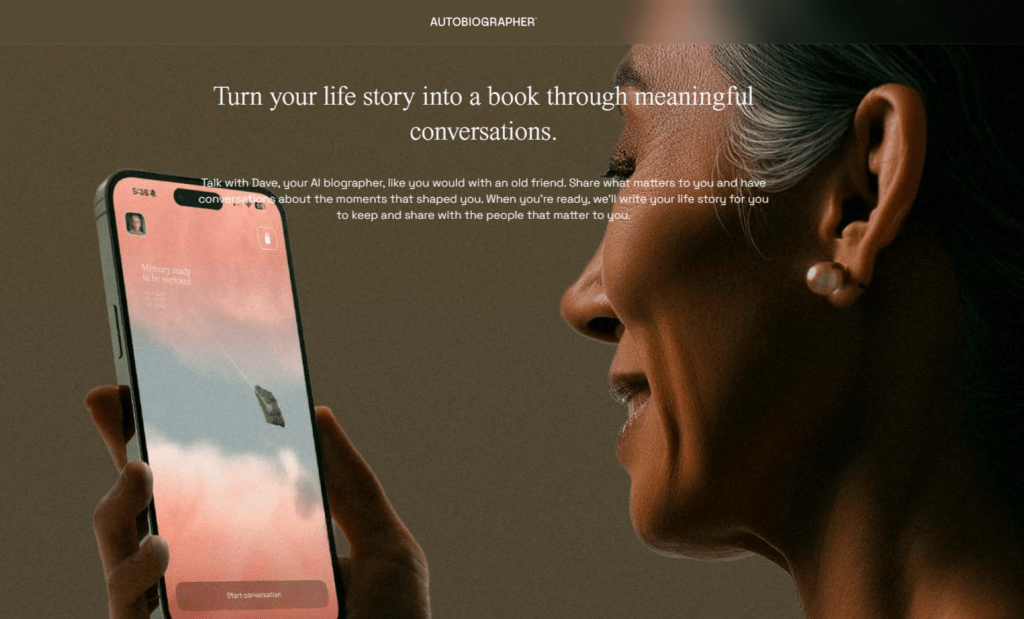
Official website: autobiographer.com
This iOS app features an AI biographer named Dave who helps transform memories into an autobiography through thoughtful conversations. The app uses the Claude 3 model from Anthropic, known for its emotional coherence and ability to ask the right questions.
The user converses with the AI guide (using either audio or text). Dave suggests story topics, asks you to describe emotions, and then organizes the material into the “Memory Vault“—an encrypted private space. The AI generates prose: short stories, gratitude letters, or full memoirs. Export to PDF is available for up to 250 pages per year.
For making sense of a spiritual path through guided reflection, as a gift to loved ones, or for those who prefer voice input, this is an ideal solution.
- Pricing: Approximately $99/year or $16/month.
- Platform: iOS app.
- Intuitive process focused on personal emotions and spirituality.
- Full control over content with lifetime encrypted storage.
- Ease of use and meaningful results.
- Available only for iOS, no Android version.
- Automatic subscription renewal.
- Some users have privacy concerns.
3. Squibler AI Memoir Writer

Official website: squibler.io
Squibler is a powerful AI book writer with a dedicated memoir mode, templates, and guided interviews. Recently, the platform upgraded to an “agentic” editor that maintains full context across the entire book—characters, plot, tone. This allows rewriting individual chapters with automatic adjustment of related parts.
The user inputs memories or key events, uses the Guided Interview for detail, and the AI structures chapters and generates descriptive prose with customizable style. This is an ideal choice for structured spiritual memoirs with a clear narrative arc (from seeking to enlightenment).
- Pricing: Free tier with limited credits, Plus $16/month (annual subscription), Pro $49/month (unlimited).
- Platform: Web application.
- Flexible tool for creative and spiritual writing with guided mode.
- Tiered pricing from free to professional.
- Powerful editor that maintains context across the entire book.
- Credit system and limits on the free tier.
- High cost of top tiers.
4. Memoirji
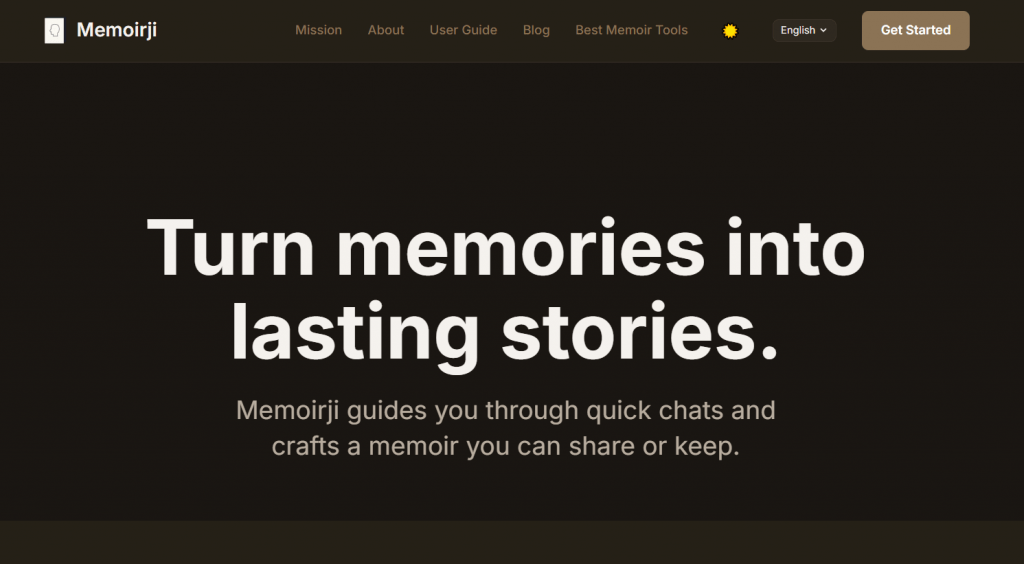
Official website: memoirji.com
Memoirji is a free AI bot for creating a life story book through WhatsApp chat. The user interacts with the bot, which asks themed questions, collects memories, and creates a PDF memoir (open book or themed). It is a simple entry point for spiritual journaling and reflection. It is especially suitable for seniors and families unfamiliar with complex applications.
- Pricing: Free (with multimedia restrictions), Personal $9.99/month, Family/Unlimited — higher.
- Platform: WhatsApp.
- Free access and exceptionally high convenience.
- No app download required.
- Quick start.
- Limited editing capabilities.
- Dependence on WhatsApp and multimedia restrictions in the free version.
5. Remento

Official website: remento.co
Remento is a voice-first AI service that transcribes audio and video into a polished book. The user records voice or video, adds photos, and the AI transcribes, cleans up filler words, and organizes them into stories. Prompts guide the narrative.
It is ideal for oral spiritual storytelling (meditations, insights spoken aloud), for busy people, and for seniors who prefer telling rather than writing. The output is a printed book with QR codes linking to audio recordings.
Reviews on Trustpilot are high (~4.9). Users praise the ease of voice capture, family value, and book quality.
- Pricing: Approximately $99/year (1 book up to 200–380 pages + extras), additional copies $69+.
- Platform: Web and app, with a voice focus.
- Excellent voice capture for spiritual insights.
- Extremely high user ratings.
- Quality printed products with QR codes.
- Subscription with auto-renewal.
- Page limits and additional costs for PDF.
6. Claude AI
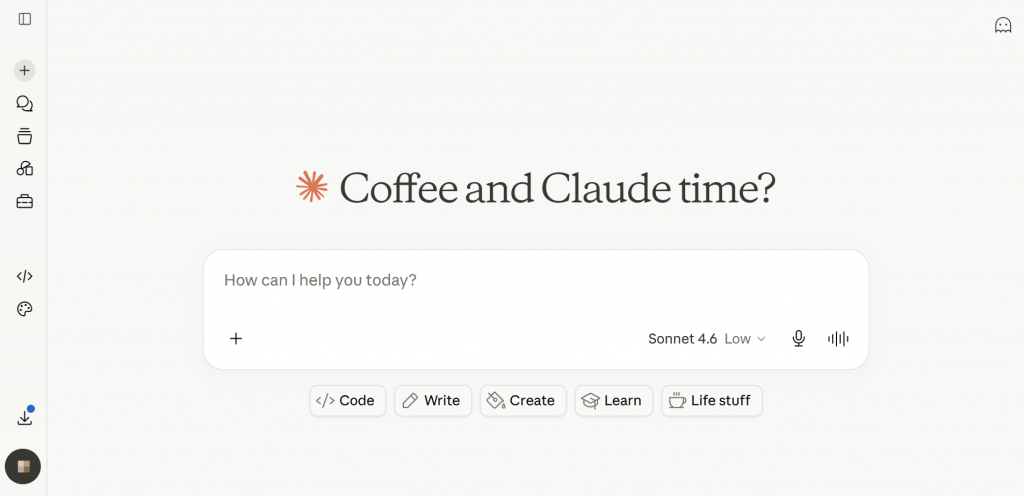
Official website: claude.ai
Claude is not a specialized memoir tool, but one of the best universal LLMs for long texts. Its large context window and strong reasoning capabilities make it ideal for deep spiritual analysis, thematic coherence, and memoir editing.
The user uploads documents, notes, and memories and provides prompts for outlining, drafting, and rewriting while preserving voice. The Projects feature allows maintaining memory throughout the entire project.
- Pricing: Pro from $20/month.
- Platform: Web and app.
- High-quality prose, reflectiveness, and long context.
- Excellent ethical and safe handling of sensitive spiritual content.
- Powerful analytics for creating complex narrative arcs.
- No specialized memoir interface.
- Requires strong prompt engineering skills.
- Full power available only with subscription.
Universal LLMs vs. Specialized Tools: What to Choose?
At this point, it is important to distinguish between the two approaches.
- Universal LLMs such as Claude or ChatGPT offer more creative freedom and depth of analysis. You control the structure, fine-tune the style, and can work on any project—from poetry to philosophical treatises. However, this requires time to learn and skill in crafting prompts.
- Specialized services like StoriedLife, Autobiographer, or Remento offer a ready-made user experience: they know what questions to ask and make the process accessible even to those who are not tech-savvy. They guide you by the hand from the first entry to the finished book.
We recommend starting with free or freemium specialized services (Memoirji, basic versions of Squibler) to get comfortable with the process. Then either move to more advanced specialized tools (StoriedLife, Remento, Autobiographer) or use the power of Claude for independent, deep literary work.
The choice depends on your style—whether you prefer speaking or writing, and whether you are willing to build the narrative structure yourself.
Comparative Table
|
Service |
Pricing (approx.) |
Platform |
Best For |
Rating |
Key Pro |
Key Con |
|---|---|---|---|---|---|---|
|
StoriedLife AI |
$129/year |
App |
Conversational legacy preservation |
4+ |
Memory & multilingual |
Subscription |
|
Autobiographer |
$99/year |
iOS App |
Guided voice reflection |
4.2 |
Emotional depth |
iOS only |
|
Squibler |
Free—$49/mo |
Web |
Structured creative memoirs |
2.5–4 |
Templates & editor |
Credits/support |
|
Memoirji |
Free—$40/mo |
|
Simple quick start |
Positive |
Accessibility |
Limited functionality |
|
Remento |
$99/year |
Web/Voice |
Oral and spoken stories |
4.9 |
Voice to book |
Extras cost |
|
Claude AI |
$20/mo |
Web |
Deep editing and story arcs |
High |
Reasoning quality |
Prompt-dependent |
Conclusion
For writing a spiritual story, the best helpers are conversational tools like StoriedLife, Autobiographer, or Remento (if voice and reflection matter) and powerful LLMs like Claude (if depth and control matter). These tools democratize writing, allowing you to preserve the authenticity of voice and emotion, unlike pure text generation.
Start with a free or low-barrier entry point (Memoirji, Squibler, or Claude), then move to specialized solutions for creating a polished book. You will appreciate the privacy, simplicity, and therapeutic value of this process. Choose according to your style (speaking vs. writing) and budget—the investment in preserving legacy for future generations pays off not in money, but in priceless life experience.
❓ Frequently Asked Questions
Answers to relevant questions about this AI tool