Acuration IQ promises to move big decisions out of slide decks: structured reviews, visible risks, and action briefs leaders can approve. We cover how it works, who it fits, what deployment looks like, and what its pilot stage means for buyers.
Acuration Review: The AI Engine for Stalled Decisions
On this page
Somewhere between the business review and the leadership sign-off, most recommendations quietly stall, and Acuration built its product to live in exactly that spot. The product is Acuration IQ, from Acuration Pvt Ltd of Hyderabad, India. The company calls it an AI decision workflow engine, and the category it plays in goes by the name decision intelligence platform: software that structures how a decision gets prepared rather than what a dashboard displays. Under the hood sits a context-aware LLM that reads your reports, notes, and metrics; around it sits a review process with rules about evidence, ownership, and approval.
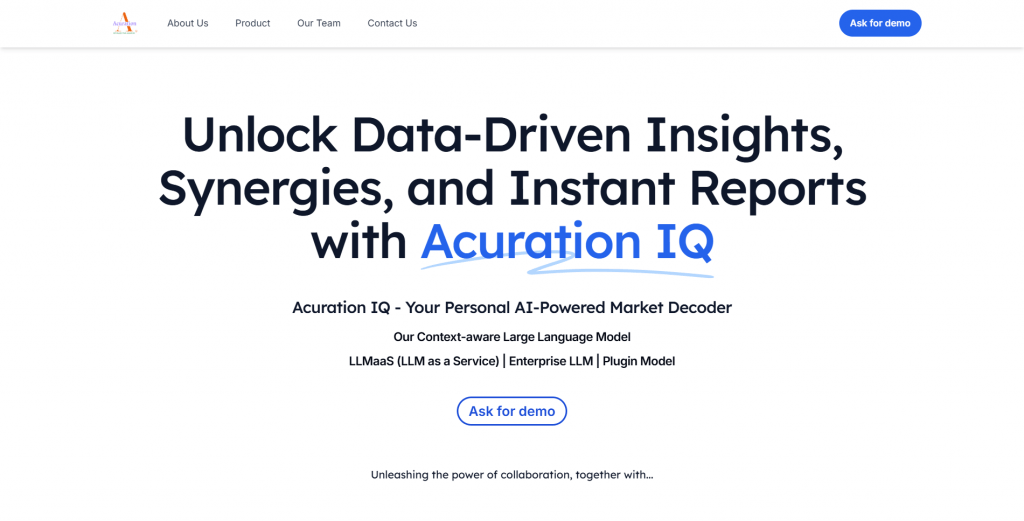
One status flag belongs up front, because it shapes everything else in this review. Acuration IQ is a pilot-stage MVP. There is no self-serve signup and no public price list; the site offers controlled demos and pilot programs run on simulated or sanitized data. What follows is a look at what the product does today and what it promises next, with the two kept clearly apart.
How a Review Becomes an Action Brief
The workflow runs in six steps, and you can walk through them as one continuous motion: define the review and the action it should end in, load the inputs (reports, metrics, meeting notes, known risks), compare the possible actions, check which evidence is strong and which is missing, generate the brief, and preserve the trail of who reviewed and changed what.
The output is the part worth pausing on. Acuration is explicit that the deliverable is a leadership action brief rather than another report, and its own demo shows the shape:
A Q3 supplier performance review arrives as one card. Recommended action: escalate to leadership. Why it matters now: delivery variance is widening ahead of Q4 commitments. Evidence: mostly strong. Open risks: two unresolved. Next step: leadership review and approval. One screen, and a leader knows what is being asked, what supports it, and what still wobbles.
Every brief carries the same anatomy: the recommendation, the reasoning, the supporting evidence, the evidence gaps, key risks, alternatives considered, and what needs sign-off. The product pages frame the same idea for boards: board-ready decision packs with audit trails and versioning, plus KPI benchmarking and partner scoring for evaluation-heavy reviews. Teams still assembling those packs by hand often pair this kind of workflow with an AI presentation maker like Gamma to build the deck itself.
Where It Fits Best
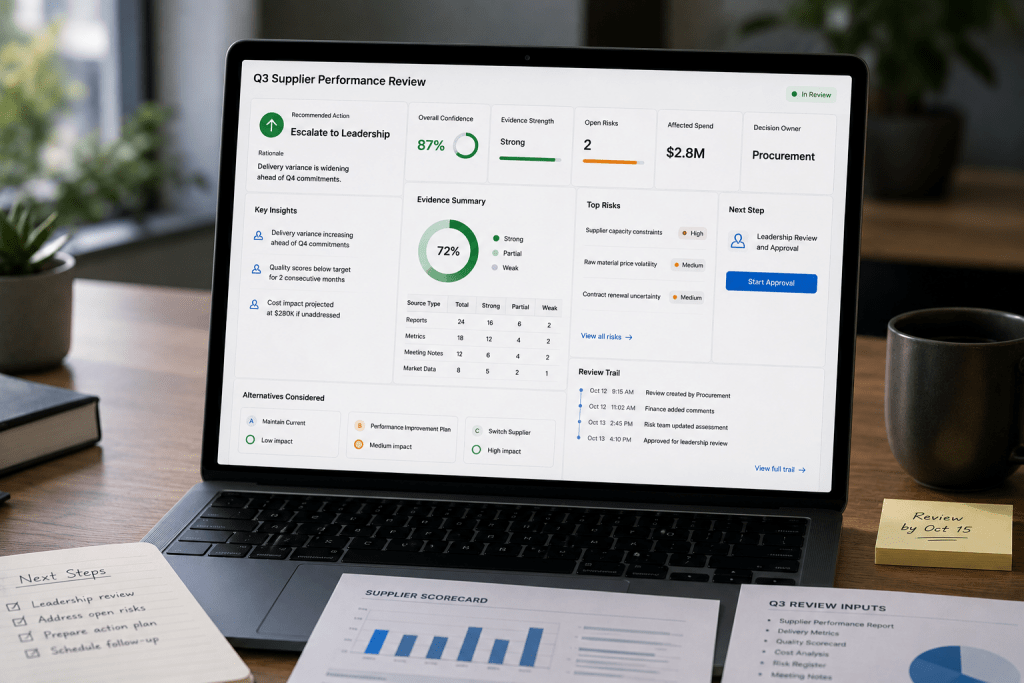
The suggested starting point is one recurring review workflow, and the use cases cluster around decisions with many contributors and one approval gate:
-
Vendor and supplier reviews. This is the partner evaluation tool at work: delivery, quality, cost, and dependency risk pulled into one structured review, with escalation options laid out instead of argued from memory. The company’s earlier platform leaned on partner discovery and predictive analytics for collaboration outcomes, and that DNA shows here.
-
Operations and spending calls. Supply chain trade-offs, cost escalations, and technology or capex approvals follow the same pattern: several functions feed in, one leadership gate waits at the end.
-
M&A screening. For corporate development teams the platform frames AI due diligence as strategic fit, evidence gaps, and next-step recommendations rather than a folder of PDFs.
One design principle runs through all of it: the AI prepares, people decide. Acuration repeats this almost like a mantra, and it is a sensible one, because a recommendation nobody can interrogate is exactly the kind of data-driven insights theater the product claims to replace.
Pros & Cons
- The action brief format forces clarity: every recommendation ships with its evidence, gaps, risks, and alternatives attached.
- Human judgment stays in charge by design, with role-based access and a review trail recording who changed what.
- Pilots start on simulated or sanitized data, a cautious pattern more enterprise AI vendors should copy.
- The deployment path bends toward privacy: VPC / private deployment first, with a locally installed enterprise LLM in the wider Acuration line.
- The demo costs nothing, and the wider platform exports to PDF, Excel, Word, CSV, and JSON.
- Pilot-stage software means no self-serve access, no public pricing, and no track record of production deployments to check.
- Security certifications and compliance standards are not yet published; they are scoped per engagement instead.
- The team is small and founder-led, which cuts both ways: fast conversations and concentrated risk.
Pricing: What Getting In Looks Like
There is no price list to quote, so here is the honest version of the buying path:
|
Stage |
What it involves |
Cost |
|
Controlled demo |
A guided walkthrough on request |
Free |
|
Pilot program |
One recurring review workflow, simulated or sanitized data |
Scoped individually |
|
Production |
Data scope, privacy, access, and deployment model agreed first |
Negotiated |
Treat the pilot conversation as part of the evaluation. A vendor that insists on agreeing data scope and deployment before touching live enterprise data is telling you how it thinks about risk, and in this category that answer matters as much as the feature list.
Languages and Access
Everything ships in English: the site, the materials, the briefs. No other languages are announced, Russian included. Access is a browser and a demo request away, the public site carries no login wall, and the enterprise deployment options mean the eventual product can live inside your own infrastructure rather than on someone else’s cloud.
Final Thoughts on Acuration
Acuration IQ is easy to describe and hard to fake: a structured path from messy review inputs to a brief a leadership team can actually approve. The thinking is sound, the human-in-charge principle is the right one, and the pilot-first, sanitized-data posture reads like a company that respects enterprise caution. What it cannot yet offer is proof at scale, public pricing, or published certifications, which keeps this review’s verdict conditional. For a team drowning in reviews that never become decisions, the demo is free and the idea deserves the look. The slide decks were never going to fix themselves.
❓ Frequently Asked Questions
Answers to relevant questions about this AI tool
Sources
-
Acuration IQ — acuration.com
-
Acuration IQ - AI-Assisted Decision Workflow Engine — acurationiq.com
-
Acuration Private Limited — linkedin.com
-
Sri Aditya Challa - LinkedIn — linkedin.com
-
Acuration - Dynamic Business — dynamicbusiness.com