Oracle AI is not a single app but a layer of artificial intelligence woven through Oracle’s cloud, database, and business applications. We break down what Oracle AI actually includes, from OCI Generative AI to Database 23ai and AI agents, who it is for, and how its pricing works.
Oracle AI: Enterprise AI & Cloud Solutions
On this page
Oracle has spread artificial intelligence across its portfolio: the Oracle Cloud Infrastructure (OCI) that runs the models, the database that stores and searches the data, and the Fusion and NetSuite applications people use daily. The result is less a single tool and more an AI layer built into software that large organizations already run.
That makes Oracle AI different from a standalone chatbot. Its pitch is that your AI sits next to your enterprise data, under enterprise security and governance, rather than in a separate app you copy data into. This guide explains what Oracle AI includes, how the pieces fit, who benefits, and how to think about cost.
What Is Oracle AI?
Oracle AI is the umbrella name for the AI capabilities across Oracle’s cloud and software stack: generative AI on OCI, AI built into the Oracle Database, prebuilt AI inside business applications, and the GPU infrastructure that powers it all. The common thread is the enterprise. It is aimed at companies that want to apply AI to their own operational data, finance, HR, supply chain, customer records, without moving that data out of the governed systems where it already lives.
The Main Pieces of Oracle AI
Oracle AI is easiest to understand as a few distinct layers:
-
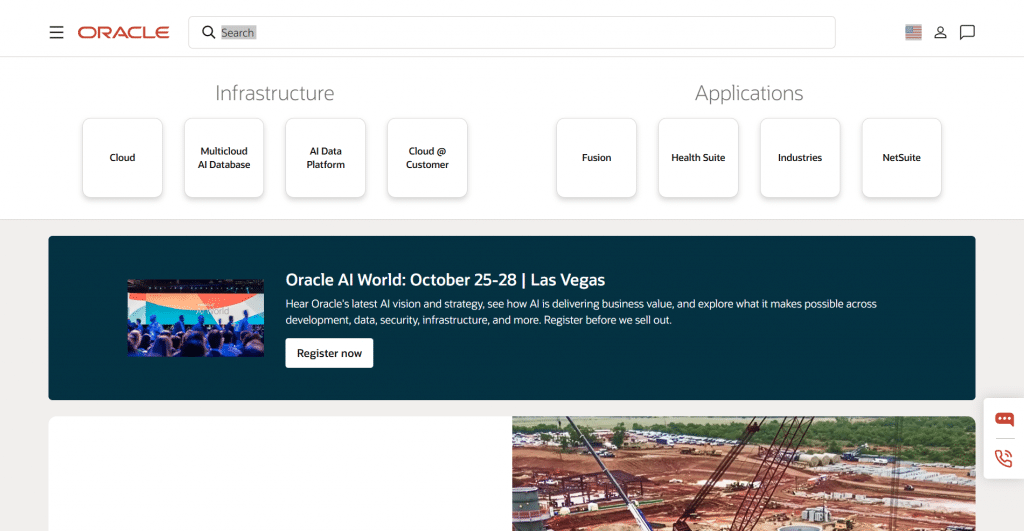
OCI Generative AI. A managed service that gives access to large language models for text generation, summarization, and chat, which you can call through an API or build into your own apps. It includes options to customize models on your own data.
-
OCI Generative AI Agents. Prebuilt AI agents, including retrieval-augmented generation (RAG) agents, that answer questions against your enterprise data and can take actions, rather than just generating text in isolation.
-
AI in Oracle Database 23ai. The database adds AI Vector Search, which stores and searches data by meaning rather than exact keywords. This lets you run semantic search and RAG directly where your data lives, without exporting it to a separate vector database.
-
AI in Fusion and NetSuite apps. Ready-made AI features embedded in Oracle’s business applications, such as drafting text, summarizing records, and suggesting next steps inside finance, HR, and supply-chain workflows.
-
AI infrastructure. The GPU compute, superclusters, and networking on OCI that train and run large models, which Oracle also rents to other AI companies at scale.
How Oracle AI Works
The pieces are designed to connect, so a typical flow looks like this:
-
Your data stays in place. Operational data lives in the Oracle Database or Fusion apps you already run.
-
AI reaches the data directly. Vector Search in Database 23ai and the GenAI Agents query that data where it sits, under existing permissions.
-
Models do the work. OCI Generative AI handles the language tasks, grounded in your data through RAG so answers reflect your business, not just generic training.
-
Results appear in context. Output shows up inside the app or workflow you are using, or through an API in software you build.
The design goal is to keep AI, data, and security in one governed environment rather than stitching together separate tools.
Who Oracle AI Is For
-
Existing Oracle customers running Fusion, NetSuite, or the Oracle Database, who get AI features inside tools they already use.
-
Large enterprises that need AI applied to sensitive operational data under strict governance and compliance.
-
Developers in OCI who want managed access to generative models and agents without running their own model infrastructure.
-
AI companies needing large-scale GPU capacity, who use Oracle’s infrastructure to train and serve models.
Who should weigh it carefully: small businesses and individuals, since Oracle AI is built around enterprise systems and is overkill, and over-budget, for simple needs. Teams with no existing Oracle footprint may also find more direct options elsewhere, since much of the value comes from AI sitting next to data already in Oracle.
Oracle AI Pros & Cons
-
AI sits directly next to enterprise data, reducing risky data movement
-
Strong governance, security, and compliance for regulated industries
-
Vector Search built into the database, so no separate vector store needed
-
Prebuilt AI inside Fusion and NetSuite means fast value for existing users
-
Access to large-scale GPU infrastructure on demand
-
Agents and RAG ground answers in your own business data
-
Aimed at enterprises, so it is complex and costly for small users
-
Most value depends on already using Oracle’s cloud, database, or apps
-
Consumption-based pricing can be hard to predict without planning
-
A learning curve to configure and govern well across the stack
Oracle AI Pricing
There is no single price for Oracle AI, because it spans many services. The broad picture:
-
OCI Generative AI and Agents are consumption-based, billed by usage (for example, by tokens processed or units of compute), so you pay for what you run.
-
AI in Oracle Database 23ai, including Vector Search, comes with the database rather than as a separate AI charge.
-
AI features in Fusion and NetSuite are generally included in or added to those application subscriptions.
-
AI infrastructure (GPU compute) is priced by the capacity and duration you reserve.
Oracle has publicly positioned itself against premium surcharges for generative AI, but real cost depends heavily on scale, so enterprise deployments are typically scoped with a quote. Always check Oracle’s current pricing pages and model it against your expected usage, since consumption pricing rewards planning.
Languages and Access
Oracle AI is delivered through OCI and Oracle’s applications, so access is by cloud subscription rather than a consumer sign-up. The generative models support major languages for text tasks, with English the most mature. Availability varies by OCI region and by which services have rolled out where, so the practical first step is checking that the specific Oracle AI service you need is offered in your region and tier.
Final Verdict
Oracle AI is best understood not as a product you try but as an AI layer for organizations already built on Oracle. Its real strength is placing generative models, agents, and semantic search right next to governed enterprise data, exactly what large, regulated companies struggle to do safely with standalone tools. For an existing Oracle shop, that integration is compelling and often the fastest safe route to useful AI. For everyone else, the calculus changes: without Oracle data and systems underneath, much of the advantage disappears, and the complexity and enterprise pricing are hard to justify. As enterprise AI that lives with your data, Oracle AI is a serious platform; as a quick tool for a small team, it is simply not built for that.
❓ Frequently Asked Questions
Answers to relevant questions about this AI tool