Chatbot

Main page » Chatbot » Page 2

Are you familiar with WriteSonic? It is one of the most advanced neural networks for text generation.

T&Cs Apply
Pricing model: Free plan with limitations, paid subscriptions from $16/month. Developer: Writesonic (founded by Samanyou Garg, San Francisco).

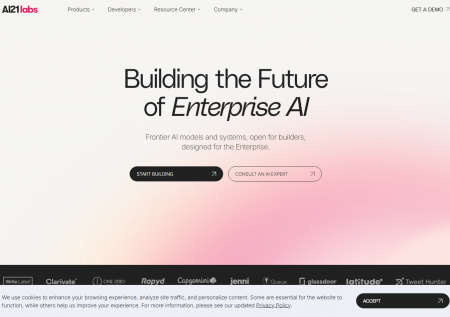
Working with text? Wordtune AI is your indispensable smart online assistant. This neural network for generating text (or rather, its enhanced versions) is a powerful AI for writing texts that becomes your co-author.

T&Cs Apply
Pricing: Free plan (limited functionality), paid subscriptions starting at $6.99/month. Developer: AI21 Labs.

OpenAI's Big Language Model That Can Conversation and More

T&Cs Apply
Pricing model: Freemium (free access to GPT-3.5, paid subscription ChatGPT Plus for $20/month for GPT-4). Developer company: OpenAI (founders: Sam Altman, Ilya Sutskever).

The Evolution of Conversational AI: A Guide to Modern Chatbots

The AI Chatbot category represents one of the most dynamic and rapidly evolving sectors within the artificial intelligence landscape. While early iterations of chatbots relied on rigid, rule-based scripts, modern solutions are powered by Large Language Models (LLMs) and sophisticated Natural Language Processing (NLP). These tools are designed to simulate human-like conversation, process complex instructions, and provide actionable information across text, voice, and even visual interfaces.
At its core, an AI chatbot is a software application that facilitates automated communication between a machine and a human user. Unlike traditional search engines that return a list of links, these tools synthesize information to provide direct answers, generate creative content, and execute tasks within a conversational framework. This shift from "search" to "conversation" has fundamentally altered how professionals and casual users interact with digital data.

[spoiler title="Read More"]

Core Functions and Capabilities

Modern AI chatbots serve as multi-functional assistants capable of handling a diverse array of workflows. Their utility extends far beyond simple Q&A interactions, encompassing high-level cognitive tasks:

  1. Information Synthesis and Retrieval: Tools like Perplexity AI and Google Gemini utilize real-time web access to scan the internet, cite sources, and provide summarized answers to complex queries. This reduces the time spent on manual research.
  2. Creative and Technical Writing: Chatbots are widely used for drafting emails, reports, and marketing copy. ChatGPT and Claude are frequently utilized for their ability to maintain specific tones of voice and adhere to complex structural requirements.
  3. Coding and Debugging: Many chatbots act as programming companions. They can write code in multiple languages, identify bugs in existing snippets, and explain architectural concepts to developers.
  4. Data Analysis and Visualization: Advanced models can now process uploaded files (such as CSVs or PDFs). For example, users can upload a spreadsheet to ChatGPT to generate charts or identify trends without writing a single line of SQL or Python.
  5. Language Translation and Localization: Leveraging deep learning, these tools provide context-aware translations that surpass the accuracy of traditional word-for-word translation software.

Target Audience and Practical Use Cases

The versatility of AI chatbots makes them indispensable across various professional and creative domains.

  • For Business Professionals and Marketers
    Marketers use chatbots like Jasper Chat or Chatsonic to brainstorm campaign ideas and generate social media content. In the enterprise sector, tools are used to automate customer support (e.g., Tidio or Intercom), allowing businesses to handle thousands of inquiries simultaneously without increasing headcount.
  • For Developers and Students
    Students leverage chatbots as personalized tutors to explain difficult concepts in physics, history, or mathematics. Developers use them to accelerate documentation writing or to quickly prototype functional code blocks.
  • For Artists and Creators
    Creative professionals use "persona-based" chatbots or specialized models like Character AI for role-playing, world-building, or testing dialogue for scripts and novels.

Classification of AI Chatbot Technologies

The chatbot market is not monolithic; it can be segmented based on deployment, model architecture, and primary intent.

  1. General-Purpose Assistants
    These are the "Swiss Army Knives" of the AI world. ChatGPT, Google Gemini, and Microsoft Copilot fall into this category. They are designed to be broadly capable, handling everything from scheduling a meeting to explaining quantum mechanics.
  2. Specialized Research and Search Engines
    Unlike general assistants, these prioritize factual accuracy and sourcing. Perplexity AI is a prime example, functioning more like a conversational search engine that prioritizes citations and up-to-date data over creative writing.
  3. Developer and Open-Source Platforms
    For those requiring privacy or customization, open-source models like Llama (by Meta) or platforms like HuggingChat provide the infrastructure to run bots locally or fine-tune them on proprietary datasets. Poe by Quora takes a different approach by allowing users to access multiple different models (like GPT-4 and Claude 3) through a single interface.
  4. Niche and Persona-Driven Bots
    Some tools focus on the "human" element. Pi (by Inflection AI) is designed to be a supportive, emotionally intelligent companion, while Character AI focuses on entertainment and the simulation of specific historical or fictional personalities.

Key Technical Features to Consider

When evaluating an AI chatbot for professional or personal use, several technical nuances should influence the decision:

  1. Context Window: This refers to how much information the chatbot can "remember" during a single session. A larger context window allows for the analysis of long documents or extended conversations without the bot losing track of earlier details.
  2. Multimodality: Modern bots are increasingly multimodal, meaning they can "see" images, "hear" voice commands, and "speak" responses. GPT-4o and Gemini 1.5 Pro are leaders in this space.
  3. Integrations: For productivity, the ability of a bot to connect with other software is vital. Microsoft Copilot integrates directly with Excel and Word, while Google Gemini is built into the Workspace ecosystem (Docs, Gmail, Drive).
  4. Hallucination Rate: While all LLMs can occasionally present false information as fact (hallucination), certain models are tuned for higher precision. Users should look for bots that provide citations to verify claims.

Navigating the AI Chatbot Landscape

The tools listed on this page represent the current frontier of human-computer interaction. From the enterprise-grade reasoning of Claude to the ubiquitous accessibility of ChatGPT, each tool offers a different balance of creativity, logic, and speed.
When choosing a tool from this list, consider your primary objective. If you require deep integration with a Windows-based workflow, Microsoft Copilot is the logical choice. If your priority is open-source flexibility and data privacy, exploring Llama-based implementations or Mistral might be more appropriate. For those who need a creative partner that can also handle heavy-duty research, Google Gemini or Claude offer some of the most sophisticated reasoning capabilities currently available on the market.
As this technology continues to mature, the distinction between "chatting" and "working" will continue to blur, making these tools central to the modern digital experience.

[/spoiler]