Best AI Prompts to Generate Pet Images: Create Cute Portraits
On this page
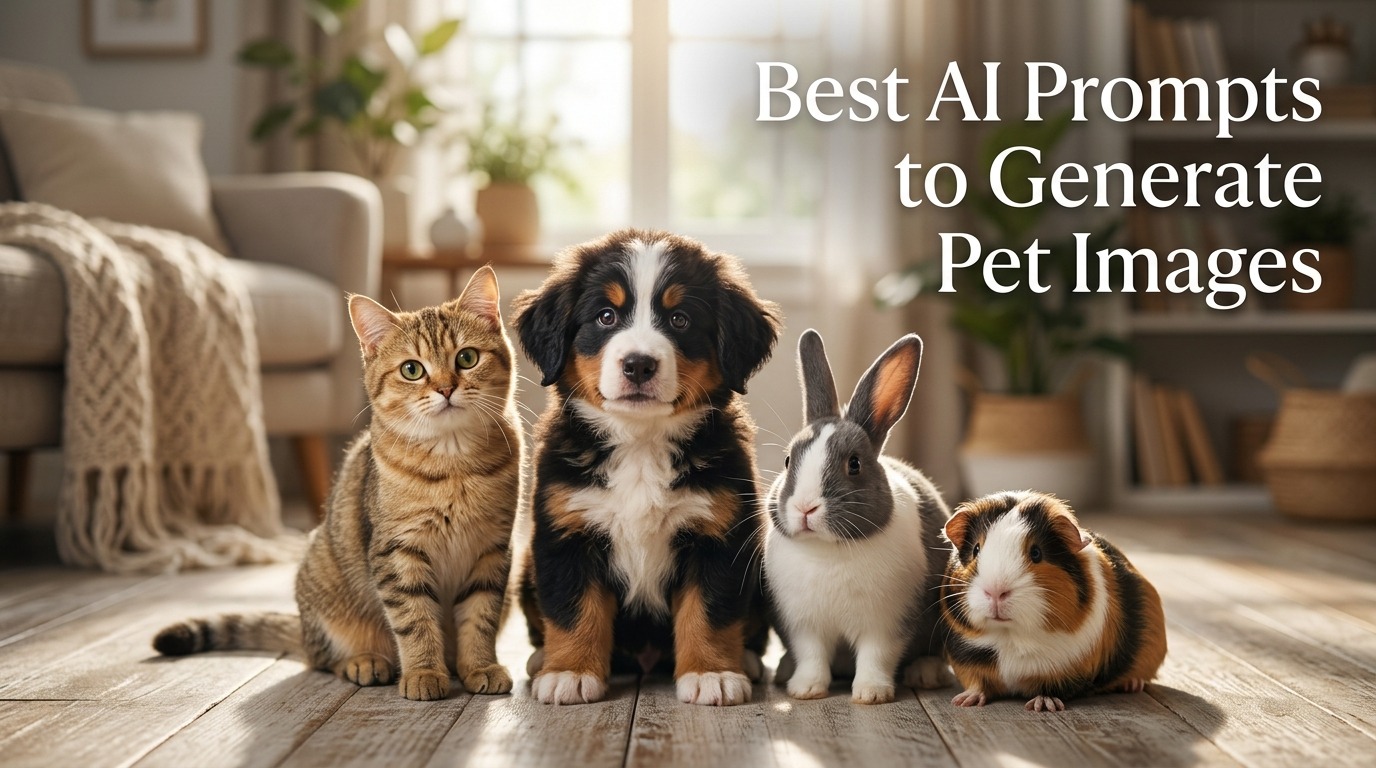
High-fidelity generative models have evolved from producing abstract, often flawed interpretations of mammalian anatomy to rendering hyper-realistic, emotionally resonant, and stylistically diverse imagery. This capability serves a wide array of use cases, from commercial e-commerce branding and marketing collateral to personalized memorial keepsakes, character design, and stylized digital art.
Generating a masterpiece, however, requires more than simply requesting an image of a dog or a cat. The underlying diffusion models and their accompanying text encoders rely on precise, structured linguistic inputs—known as prompts—to navigate their multidimensional latent space and construct an image pixel by pixel. The quality of the output is directly proportional to the semantic density and structural logic of the prompt provided by the human operator. This guide provides an exhaustive analysis of how to engineer optimal prompts for AI pet image generation, evaluates the foremost tools available for this task, and presents a categorized, highly structured repository of the most effective prompts utilized by digital art professionals today.
The Linguistic Framework of Prompt Composition
To successfully command an AI image generator, one must transition from conversational, vague requests to structured, descriptive syntax. Generative AI models do not function like internet search engines retrieving existing photographs; they are algorithmic synthesizers that require architectural blueprints for the image they are about to construct. The most successful pet photography prompts adhere to a specific formula that dictates the subject, the action, the environment, the lighting, the camera specifications, and the overarching artistic style.
Subject Specification and Micro-Expressions
The foundation of the prompt must unequivocally identify the animal with clinical precision. Vague terminology such as “a dog” or “a cat” forces the artificial intelligence to aggregate a generic average from its training data, often resulting in genetically inconsistent or unremarkable outputs. Precise breed names, age markers, and coat colors are mandatory structural anchors. Furthermore, in animal photography, emotion and narrative are conveyed entirely through posture and micro-expressions, as animals lack the complex facial musculature of humans.
Instead of requesting a “happy dog,” expert prompt engineers utilize anatomical descriptors such as a joyful head tilt, alert perked ears, wide expressive brown eyes, and a slightly exposed tongue. The texture of the animal’s coat must also be explicitly defined to guide the rendering engine. Phrases such as “glossy short coat,” “fluffy undercoat,” “wiry terrier hair,” or “individual hair strands visible catching the light” dramatically improve the photorealism of the output, preventing the fur from appearing plastic or matted.
Action, Posture, and Environmental Context
Dynamic movement or deliberate posing dictates the physical composition of the frame. The prompt must explicitly state the subject’s physical state. Descriptors indicating whether the animal is curled in a symmetrical ball on a velvet cushion, leaping through the air with extended paws, or staring directly into the camera lens establish the geometric hierarchy of the image.
The environment surrounding the subject serves to contextualize the narrative and communicate brand positioning or artistic mood. A pet photographed in a sleek, minimalist apartment conveys a vastly different narrative than one photographed on a rugged hiking trail or in a sunlit botanical garden. The environment must complement the animal’s breed and the desired emotional response, utilizing descriptors that establish the setting’s atmosphere, such as a cozy domestic living room with a glowing fireplace in the softly blurred background.
Lighting Paradigms and Optical Physics
Lighting transforms the emotional resonance of an animal portrait more than any other singular element, dictating volume, depth, and texture. Generative models are highly responsive to professional photography lighting terminology, as their training datasets contain millions of expertly tagged images. By utilizing specific lighting directives, the prompt dictates the simulation of photons within the generated scene.
Common and highly effective lighting triggers include “golden hour backlighting” to create a glowing, ethereal halo around the fur, “Rembrandt lighting” for dramatic, moody facial shadows that add three-dimensional depth, “soft diffused overcast light” to eliminate harsh shadows and render accurate coat colors, and “studio softbox key light” for a clean, sterile commercial aesthetic.
To achieve true photorealism, the prompt must also instruct the AI to emulate specific optical physics and camera equipment. Text-to-image models understand focal lengths, film stocks, aperture settings, and camera bodies. Specifying equipment such as a Canon EOS R5 with an 85mm f/1.2 portrait lens forces the AI to simulate a shallow depth of field, resulting in a creamy bokeh background and a razor-sharp focus on the subject’s eyes.
Structural Element | Function in the Generative Process | Example Terminology |
Primary Subject | Anchors the core entity in the latent space. | “Siberian Husky puppy,” “Persian cat” |
Physical Traits | Prevents generic averaging; defines texture. | “Heterochromia,” “dense double coat” |
Action & Expression | Dictates emotion and physical geometry. | “Mid-stride,” “slow blink,” “head tilt” |
Lighting Setup | Defines volume, depth, and atmosphere. | “Rembrandt lighting,” “golden hour backlight” |
Optical Physics | Triggers photorealistic lens simulations. | “85mm f/1.4,” “shallow depth of field” |
Environment | Contextualizes the narrative. | “Lush green forest,” “minimalist white studio” |
The sequence of this information is paramount, particularly in advanced models like FLUX and Stable Diffusion. The underlying text encoders, such as CLIP and T5, allocate disproportionate attention to the initial tokens mentioned in a prompt. Therefore, the most effective structural formula is to lead with the primary subject and expression, followed by the action, setting, lighting, camera details, and finally, constraints or aspect ratio parameters.
Comparative Analysis of AI Generative Instruments
The landscape of artificial intelligence image generators is diverse, with distinct architectural models excelling at different aspects of pet portraiture. Selecting the optimal tool depends heavily on the specific requirements of the project—whether the primary objective is absolute photorealism, heavy artistic stylization, or strict adherence to a complex, multi-subject narrative.
FLUX (Versions 1.1 Pro and Dev)
Developed by Black Forest Labs, FLUX represents the current industry standard for hyper-photorealism, exact spatial consistency, and typographic rendering. The model utilizes a dual-encoder approach, leveraging both CLIP (for high-level conceptual understanding) and T5 (for processing nuanced, highly specific instructions). FLUX excels at adhering strictly to complex prompts without “forgetting” elements. If commanded to generate multiple distinct animals in a specific setting, FLUX will reliably render all subjects. It is particularly adept at commercial lifestyle photography, macro photography, and rendering precise breed anatomies without the anatomical mutations (e.g., extra limbs or paws) that plagued earlier generations of AI. FLUX requires layered, descriptive, natural-language prompts rather than disjointed keywords.
Stable Diffusion (SDXL)
Stable Diffusion provides the highest degree of granular control available to prompt engineers. As an open-source model, its primary advantage in pet photography is the ability to utilize LoRAs (Low-Rank Adaptations)—small, specialized files that fine-tune the model to recognize a specific subject or style. This allows users to train a LoRA on their own specific pet, ensuring the AI consistently generates that exact animal’s unique markings across varying prompts. Prompting in Stable Diffusion relies heavily on keyword weighting (e.g., (fluffy fur: 1.2)) to emphasize specific traits, and explicit negative prompts (e.g., –no extra fingers, –no distorted anatomy) to prune unwanted artifacts from the generation. It requires a more technical approach to prompting but rewards the user with unparalleled customization.
Midjourney (Version 6)
Midjourney is renowned for its unmatched artistic flair, default cinematic lighting, and inherent aesthetic beauty. While it can produce photorealistic images, it naturally leans toward a stylized, highly polished output that often resembles high-end conceptual art or fantasy illustration. It is the optimal tool for stylized commercial campaigns, fantasy animal hybrids, and anthropomorphic portraits. Midjourney v6 responds well to natural language but still benefits from comma-separated keywords and parameters. It is highly responsive to style references (–sref) and requires the explicit declaration of aspect ratios (e.g., –ar 16:9) at the end of the prompt to control the frame composition.
DALL-E 3
Integrated into OpenAI’s ecosystem, DALL-E 3 operates uniquely by having a large language model (ChatGPT) sit between the user’s input and the image generator. The user can provide a conversational request, and the language model will rewrite it into a highly detailed prompt optimized for DALL-E’s latent space. DALL-E 3 is exceptional at following complex, multi-subject instructions and understanding semantic relationships. It is highly suited for humorous, anthropomorphic, or highly specific narrative scenes, such as animals engaging in human activities in complex environments. However, it often injects a slightly illustrative or hyper-real quality, making absolute photorealism more challenging to achieve compared to FLUX.
Gemini
Integrated into Google’s ecosystem, Gemini is highly capable of generating both photorealistic pet photography and stylized portraits. Its strength lies in its deep semantic understanding of natural language, allowing prompt engineers to specify complex lighting, camera settings, and textures. For instance, it excels at interpreting technical prompts requesting a “photorealistic studio headshot” with “bright catchlights,” “clean grooming,” and “ultra-realistic fur texture”. Gemini is an optimal tool for users seeking a conversational interface that can translate nuanced artistic and photographic directives into high-fidelity visual outputs
Categorized Selection of Premium AI Prompts
The following prompt architectures have been engineered, tested, and categorized to demonstrate the full spectrum of AI pet portraiture capabilities. They are structured as modular templates, designed to be customized by substituting the descriptive elements with the specific requirements of the user.
1. Hyper-Photorealistic Studio Portraiture
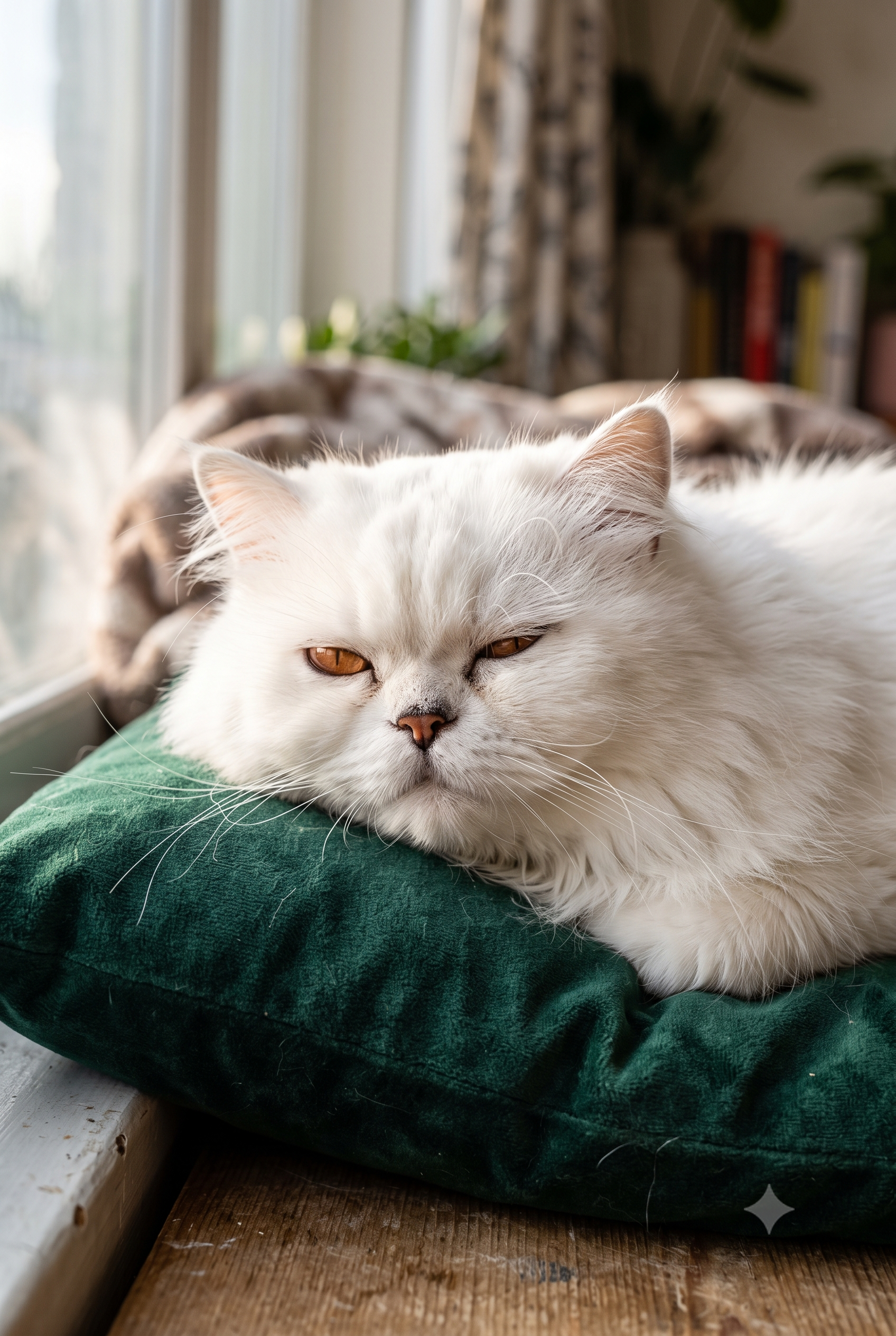
These prompts are meticulously designed to yield outputs indistinguishable from high-end professional photography. The language focuses heavily on lighting design, optical physics, and the rendering of microscopic details such as fur texture and corneal reflections.
The Minimalist Commercial Headshot
A photorealistic studio headshot of a Siberian Husky sitting calmly against a soft black velvet backdrop. Subtle rim light outlining the dense double coat, bright catchlights reflecting in the striking blue eyes. Clean grooming, shallow depth of field. Shot on Canon EOS R5 with an 85mm f/1.4 lens, eye-level close-up framing, ultra-realistic fur texture, high-end editorial pet photography, sharp and clean composition.
Architectural Analysis: The specification of a “black velvet backdrop” combined with “rim light” forces the generative model to create a high-contrast boundary, physically separating the subject from the background and enhancing the perception of depth. The inclusion of “catchlights” is a critical metric for photorealistic animal imagery, ensuring the eyes appear aqueous and alive rather than flat and synthetic.
The Atmospheric Natural Light Portrait
A photorealistic close-up of a Persian cat lounging on a velvet cushion in a sunbeam on a windowsill. Long flowing white fur, copper eyes half-closed in a slow, content blink. Soft diffused morning window light creating gentle shadows, visible whiskers and nose texture. Luxurious cozy apartment interior softly blurred in the background, shallow depth of field. Shot on Nikon Z8 with 50mm f/1.8, intimate framing, natural skin and fur detail.
Architectural Analysis: This prompt utilizes physiological cues (“half-closed,” “slow blink”) to convey feline contentment without using subjective, easily misinterpreted words like “happy.” Instructing the model to use “diffused morning window light” ensures the white fur is appropriately exposed, maintaining intricate detail in the highlights that would otherwise be lost in a high-contrast rendering.
The Dramatic Chiaroscuro Portrait
Majestic German Shepherd portrait, alert ears forward, intelligent amber eyes, strong jawline. Dramatic Rembrandt side lighting creating deep chiaroscuro depth in the dark and tan coat. Dark neutral background, powerful and noble expression, visible individual hair strands, 8K resolution, sharp focus on the snout and eyes, professional animal portrait.
Architectural Analysis: “Rembrandt lighting” serves as a powerful semantic trigger for models like Midjourney and FLUX. It guarantees a moody, painterly, yet photorealistic transition from illumination to shadow across the subject’s facial geometry, establishing a noble and powerful aesthetic.
2. Dynamic Action and Outdoor Lifestyle Photography
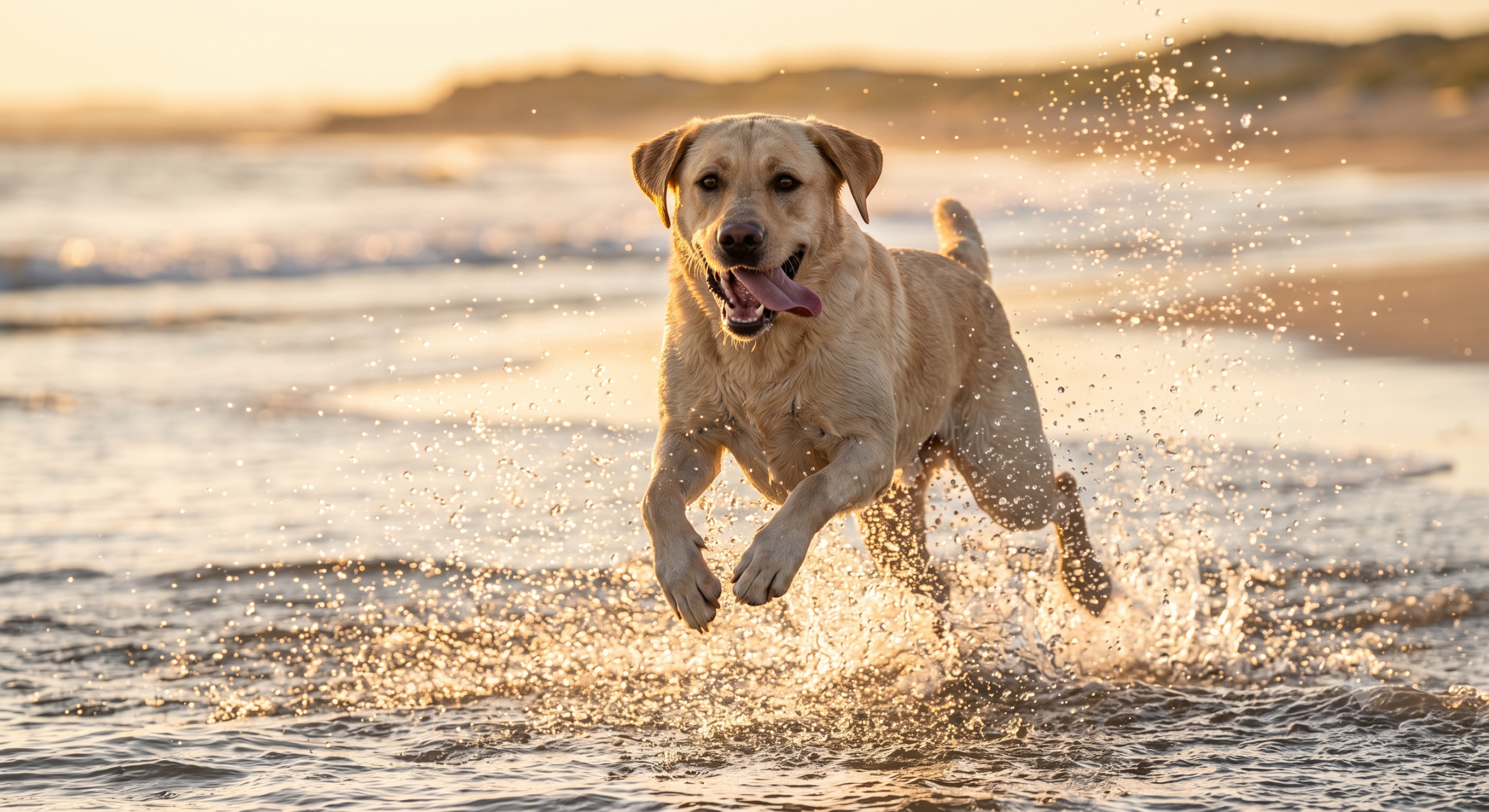
Capturing animals in motion requires specialized prompt language to dictate shutter speed, manage motion blur, and establish environmental interaction, simulating the physical constraints of real-world photography.
The High-Speed Aqueous Action Shot
A photorealistic high-speed action photo of a Labrador Retriever jumping through shallow ocean water, splash droplets frozen midair. Intense playful expression, tongue out. Sunny outdoor lighting, golden hour backlight creating a glowing halo on the water droplets. Background blurred. Shot on Sony A1 with 135mm f/2, fast shutter freeze frame, sports photography composition, crisp fur detail, vivid natural colors.
Architectural Analysis: The explicit directives “fast shutter freeze frame” and “droplets frozen midair” prevent the diffusion model from rendering the moving water and limbs as a blurry smear. This forces the engine to generate crisp, individual water particles and sharp muscular definition, a hallmark of professional sports and wildlife photography.
The Commercial Brand Lifestyle Narrative
Wide editorial lifestyle photograph of a healthy Border Collie walking on a tree-lined dirt path in a lush park at early morning golden hour. The dog is slightly ahead of its owner, who is partially visible from the waist down wearing casual earth-toned clothing and holding a premium woven leash in a warm tan finish. Warm backlight and sun flares cutting through the canopy. Grass and trees blurred into creamy bokeh, shot on Sony A7IV with 70-200mm f/2.8, cinematic color grading.
Architectural Analysis: Optimized for commercial pet brand marketing, this prompt specifies a “wide editorial lifestyle” shot, ensuring the environment is sufficiently visible to communicate a brand narrative. The “70-200mm f/2.8” lens specification compresses the background, keeping the viewer’s focal point entirely on the animal and the product (the leash).
3. Anthropomorphic and Humorous Conceptual Art
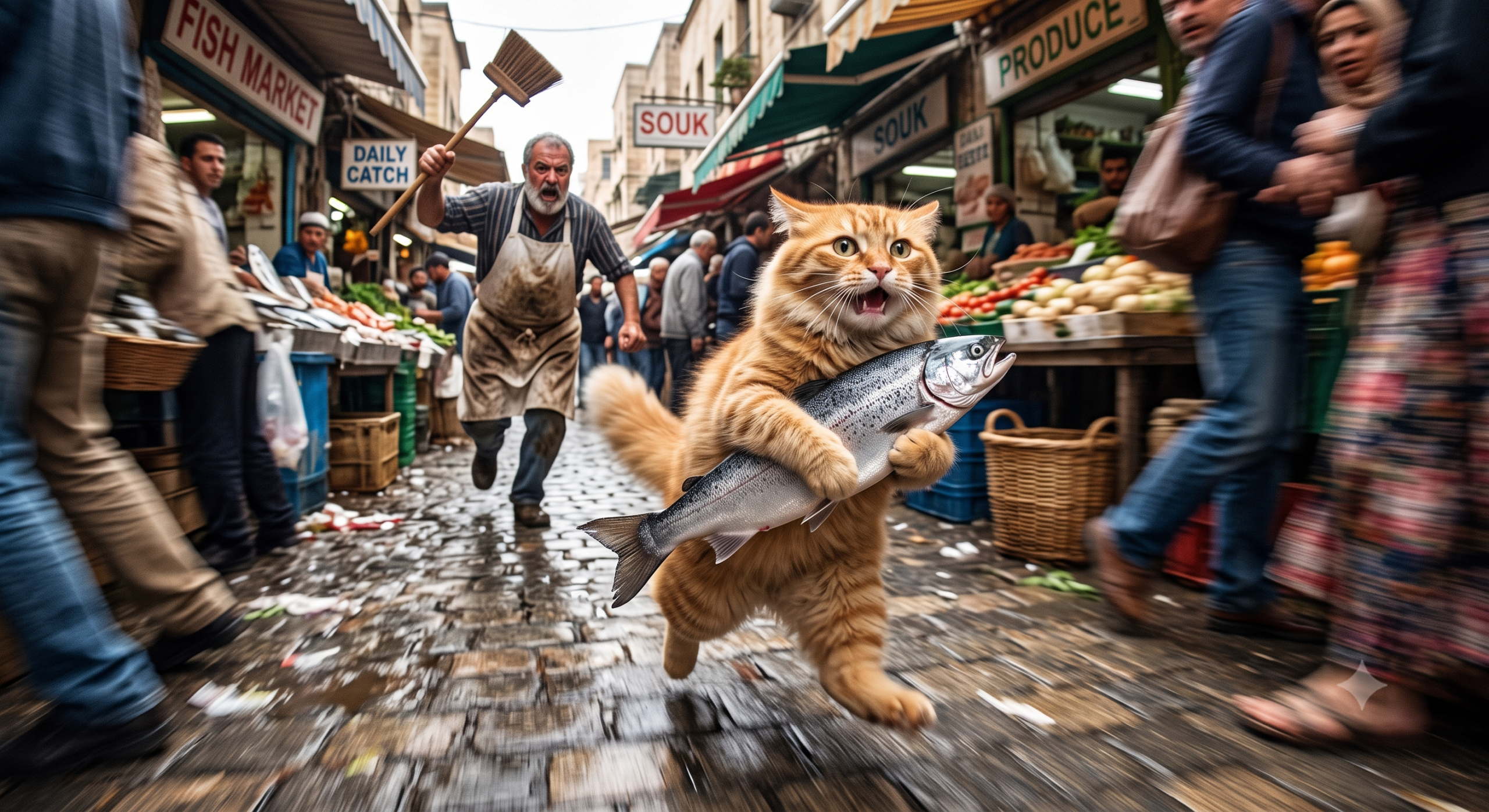
Anthropomorphism—endowing animals with human traits, clothing, or professions—is immensely popular for social media content, marketing campaigns, and greeting card designs. The technical challenge lies in instructing the AI to fit human clothing onto animal anatomy without creating grotesque physical mutations.
The Corporate Canine Executive
A well-groomed, anthropomorphic Golden Retriever acting as a business executive. The dog is wearing a tailored navy-blue suit, crisp white shirt, and silk tie, sitting in a luxurious office. Reviewing documents with reading glasses resting on its snout. Large mahogany desk, floor-to-ceiling windows showing a city skyline, cinematic corporate lighting, highly detailed, modern professional headshot aesthetic.
Architectural Analysis: By emphasizing terms like “tailored” and placing the glasses explicitly “on its snout,” the prompt helps the AI logically map human clothing and accessories onto canine skeletal structure. The corporate lighting and environmental details legitimize the scene, preventing it from appearing as a low-quality superimposition.
The Chaotic Urban Escape
A photorealistic, humorous image of a fluffy tabby cat running on two hind legs away from the camera, clutching a large fresh fish tightly in its front paws. The cat is running through a bustling outdoor street market. Heavy motion blur emphasizes the cat's rapid, frantic movement. The cat is looking back over its shoulder with a panicked, wide-eyed, comical expression. A fish seller in the background is running with a raised broom. Shot with a fisheye lens.
Architectural Analysis: This highly narrative prompt is perfectly suited for the semantic understanding of DALL-E 3 or FLUX. The combination of a “fisheye lens” with “heavy motion blur” creates a dynamic, comedic visual distortion that visually amplifies the frantic energy and humor of the scene.
The Period-Accurate Tavern Patron
A portrait photo of a serious Irish Bulldog sitting on a worn wooden barstool in a dimly lit 1800s Irish pub. The dog is wearing a tweed flat cap and a small vest. A pint of dark stout beer is on the bar in front of him. Cinematic warm tavern lighting, practical lighting from overhead lamps, highly detailed, shot on 35mm film, film grain.
Architectural Analysis: Grounding the anthropomorphic subject in a highly detailed, historically accurate environment (“1800s Irish pub,” “tweed flat cap,” “35mm film”) sells the illusion of the narrative. The practical lighting specifications ensure the subject integrates seamlessly into the background shadows.
4. Stylized, Fine Art, and Animation Styles
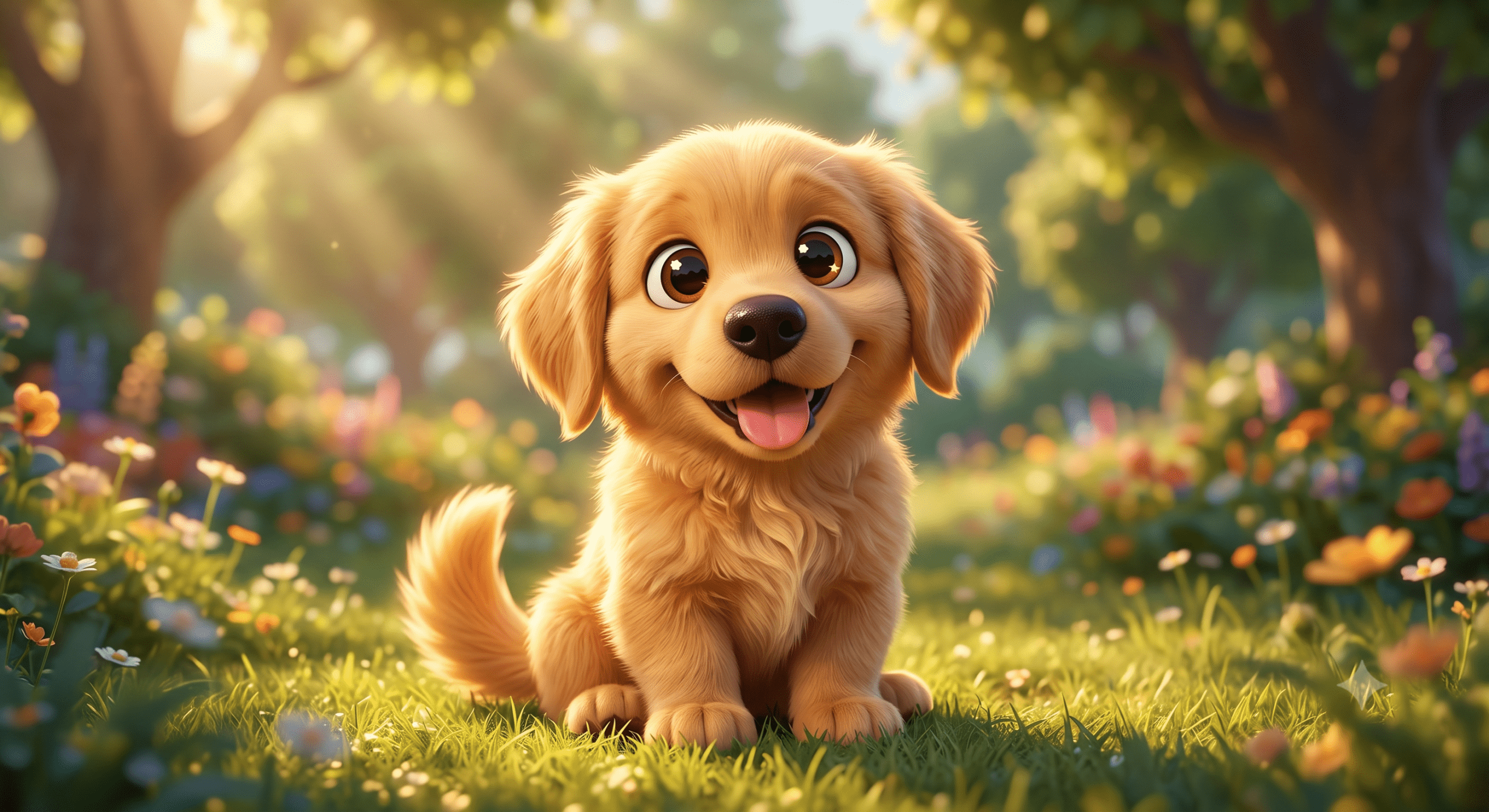
Generative AI excels at translating photographic concepts into diverse artistic mediums, mapping the likeness of an animal onto specific historical art styles or modern animation techniques.
The 3D Animation Studio Aesthetic
Reimagine a Golden Retriever puppy as an adorable 3D animated character in the style of a modern Pixar movie. Big expressive shiny eyes, soft fluffy stylized fur, a cheerful smile, and exaggerated cute proportions. Warm sunlit scene with a soft bokeh background, gentle rim lighting, polished cinematic render, vibrant colors, 8k resolution, volumetric lighting.
Architectural Analysis: Keywords such as “stylized fur,” “exaggerated cute proportions,” and “volumetric lighting” forcefully instruct the AI to abandon photorealism. Instead, it adopts the smooth, mathematically perfect lighting calculations and exaggerated features characteristic of high-end 3D rendering engines utilized in modern feature animation.
The Traditional Asian Ink Wash
A minimalist Japanese sumi-e ink painting of a sleeping cat. Rendered with a few confident, flowing black brush strokes, soft ink bleeding gradients, and abundant white negative space. A faint red hanko stamp in the bottom corner, a hint of a bamboo branch. Textured rice paper background, elegant, zen, wabi-sabi aesthetic.
Architectural Analysis: This prompt relies on intentional limitation, counteracting the AI’s natural tendency to overcomplicate an image with noise and detail. By demanding “abundant white negative space” and specifying “textured rice paper,” the output becomes a restrained, culturally accurate piece of fine art.
The Expressive Gallery Watercolor
Loose, expressive watercolor illustration of a Corgi puppy. Soft bleeding pigments, delicate color drips, and crisp detail kept only around the eyes and nose. Fresh palette of teal, ochre, and rose against a white textured watercolor paper background. Visible brush water marks, whimsical children's book illustration style, airy negative space.
Architectural Analysis: Directing the AI to maintain “crisp detail only around the eyes and nose” while permitting “bleeding pigments” elsewhere mimics the exact physical technique of master watercolorists. This targeted precision prevents the image from appearing as a generic digital filter applied over a photograph.
5. Fantasy, Hybrid Creatures, and Science Fiction
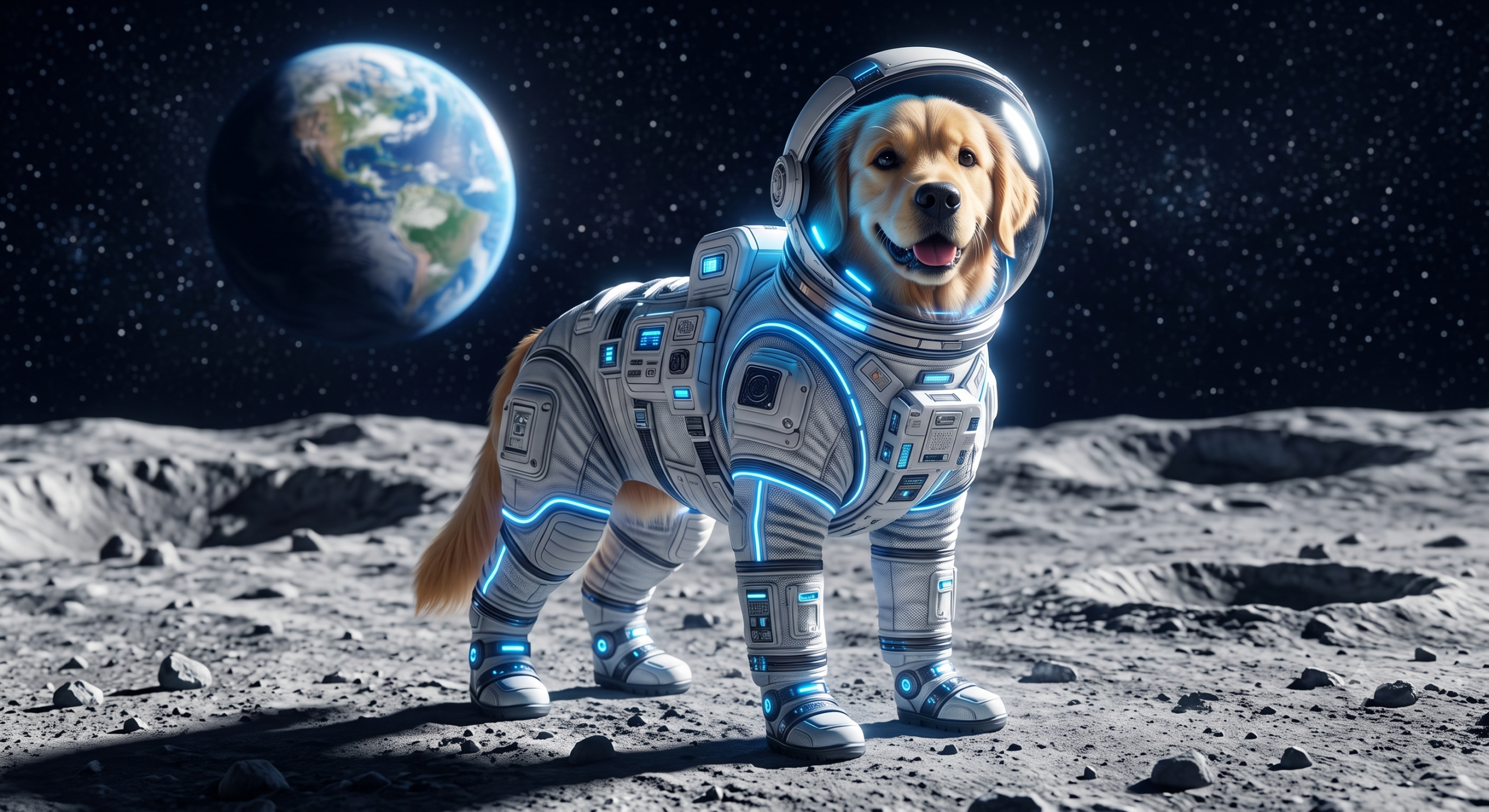
For world-building, tabletop gaming, or surrealist digital art, generative models can effortlessly blend disparate animal anatomies or place domestic pets into fantastical, otherworldly environments.
The Mythical Anatomical Hybrid
A hyper-realistic, highly detailed digital painting of an 'Owlcat'—a seamless hybrid between a snowy owl and a silver Maine Coon cat. The creature features remarkable soft fur transitioning seamlessly into feathered wings. Sitting on a mossy branch in an enchanted, mist-filled glowing forest. Dynamic composition, dramatic ethereal lighting, volumetric rays piercing the canopy, 8k resolution, high-end fantasy concept art.
Architectural Analysis: When commanding the generation of hybrid creatures, explicitly instructing the AI on how the textures interact and merge (e.g., “fur transitioning seamlessly into feathered wings”) prevents an ugly, disjointed, stitched-together appearance, resulting in a cohesive and believable fantasy organism.
The Extraterrestrial Canine Explorer
A photorealistic portrait of a Golden Retriever wearing a highly detailed, futuristic white astronaut spacesuit with glowing blue neon accents. The dog is standing on the rocky, cratered surface of the moon. Earth is visible in the starry background sky. Crisp, harsh lunar lighting, stark shadows, cinematic sci-fi movie poster aesthetic, Unreal Engine 5 render style.
Architectural Analysis: Specifying “harsh lunar lighting” and “stark shadows” forces the AI to abandon the soft, diffused lighting it defaults to for animal portraits. This results in a dramatic, high-contrast image that accurately mimics the physics of light propagation in the vacuum of space.
6. Memorial and Heirloom Tributes
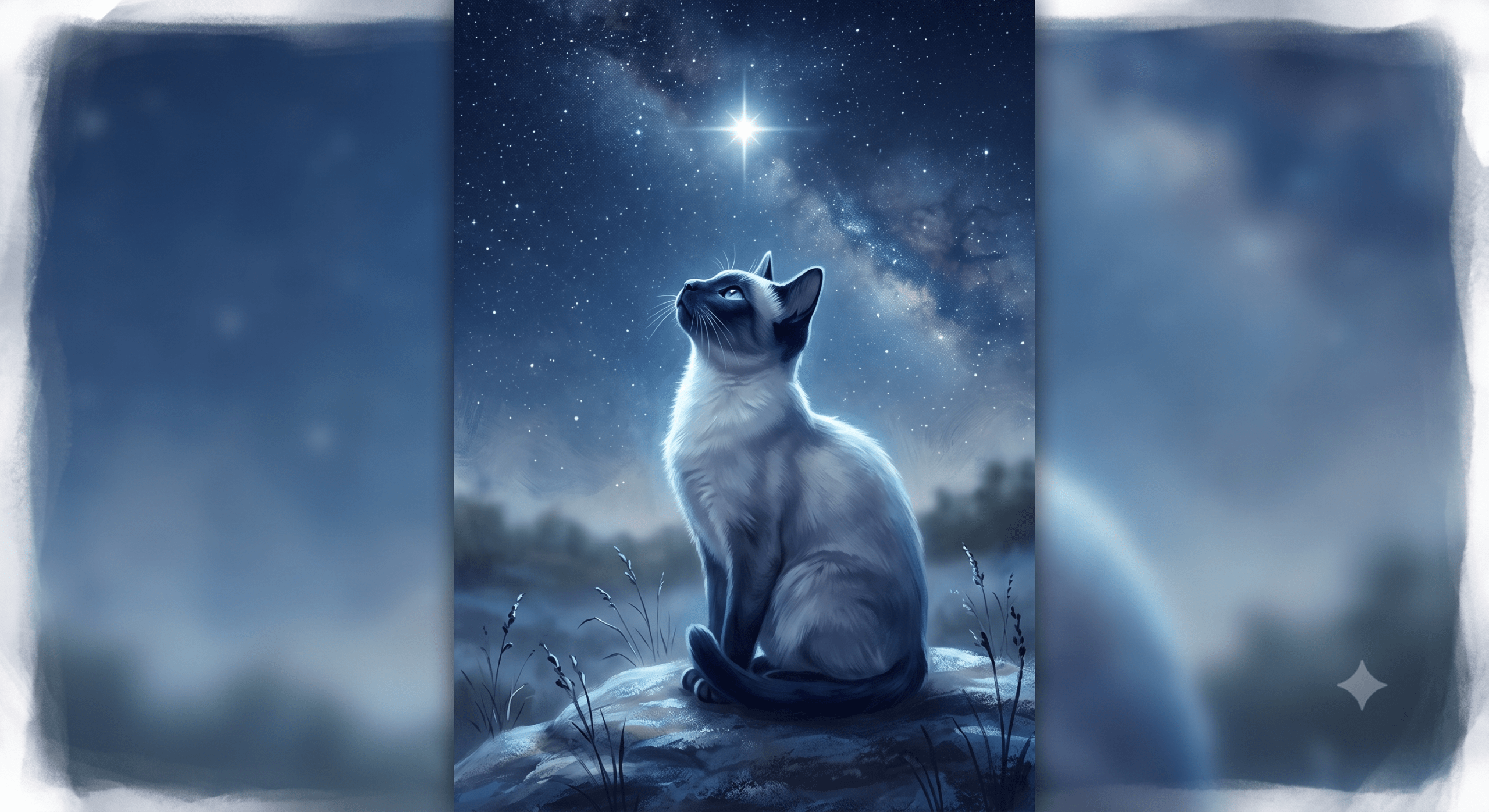
For personalized keepsakes, prompts can be engineered to generate gentle, ethereal imagery that honors a pet’s memory using symbolic lighting and soft aesthetics.
The Ethereal Starlit Keepsake
Render a peaceful tribute portrait of a Siamese cat gazing upward beneath a starry night sky. A single bright shining star positioned directly above, casting a soft moonlit glow on its fur. Calm reflective mood, deep blue and silver color palette, soft painterly dreamlike style, comforting memorial keepsake, serene atmosphere.
Architectural Analysis: The use of symbolic elements (“single bright shining star”) combined with specific color constraints (“deep blue and silver palette”) and stylistic modifiers (“painterly dreamlike style”) ensures the model outputs a dignified, emotionally resonant image devoid of harsh realism or unnecessary environmental clutter.
Advanced Prompt Engineering Strategies and Failure Mitigation
Even utilizing premium prompt structures, the generative process is inherently iterative. Models often produce anatomical anomalies or misinterpret stylistic cues. Mastering advanced prompt engineering techniques allows for rigorous control and refinement of the final output.
The Implementation of Negative Prompting
Models such as Stable Diffusion and certain interfaces for FLUX allow, and often require, explicit instructions on what elements to exclude from the generation. Negative prompting dictates the boundaries of the latent space exploration.
- Optimal Application: In a designated negative prompt field, engineers utilize terms such as blurry, low quality, distorted, plastic fur, bad anatomy, missing limbs, floating limbs, extra ears, cartoon, text, watermark, bad proportions.
- The Linguistic Pitfall: A common error is utilizing negative syntax within the standard positive prompt (e.g., stating “a dog that is not barking”). The AI text encoder, particularly CLIP, often focuses heavily on the token “barking” and generates it regardless of the negation. The optimal strategy is to dictate the positive alternative: “a dog with its mouth firmly closed”.
Preventing Semantic Dilution (“Prompt Salad”)
A prevalent novice error is the stacking of conflicting, disparate style references in a singular prompt. Inputting a string such as “Wes Anderson, Tarantino, neo-noir, cyberpunk, watercolor, photorealistic dog” forces the diffusion model to mathematically average contradictory aesthetics, resulting in visual noise and structural degradation.
- Strategic Resolution: Engineers must select one or a maximum of two dominant style anchors to govern the scene. If a specific hybrid aesthetic is required, the hybrid must be named explicitly (e.g., “retro-futuristic 1970s sci-fi”) rather than stringing together unrelated conceptual keywords.
Geometric Control: Aspect Ratios and Composition
Pet photography is heavily dependent on specific framing. Generating a square (1:1 aspect ratio) image and subsequently attempting to crop it into a vertical portrait often destroys the intended composition and resolution.
- Strategic Resolution: The desired aspect ratio must be dictated within the prompt or software settings prior to generation. Parameters such as –ar 4:5 or 2:3 are utilized for vertical portraits, 16:9 for cinematic landscapes and video thumbnails, and 1:1 for social media grid formats. Informing the AI of the intended frame shape allows its spatial algorithms to position the subject appropriately, such as providing a running animal with lateral space to move into within a horizontal frame.
Aspect Weighting and Seed Replication
In advanced generative interfaces, prompt engineers can assign numerical weights to specific semantic tokens to force the AI to prioritize certain elements. For instance, if the prompt “a fluffy golden retriever in a field of red flowers” yields a landscape dominated by flora with a diminutive subject, adjusting the syntax to (fluffy golden retriever: 1.5) in a field of (red flowers: 0.8) mathematically forces the algorithm to dedicate more rendering focus to the canine.
Furthermore, when refining a generated image, utilizing the same “seed value” (the initial mathematical noise pattern used to generate the image) enables reproducibility. By locking the seed and making minor adjustments to the text prompt or weights, the user can iterate upon a successful composition without the model completely redrawing the scene from scratch.
The synthesis of AI pet imagery has transcended simple technological novelty, maturing into a robust, highly technical discipline that merges algorithmic prompt engineering with classical principles of photographic composition, lighting, and anatomy. By abandoning vague conversational requests in favor of highly structured, clinically specific prompts, creators can predictably generate breathtaking, bespoke imagery across an infinite spectrum of styles.
❓ Frequently Asked Questions
Answers to relevant questions about this AI tool