Grok 4.7: xAI’s New Model, Benchmarks & Specs
On this page
On September 21, 2026, xAI announced the Grok 4.7 model, its latest frontier model for coding, agentic tasks, and professional knowledge work. The company calls it its most capable model yet, built on a new larger base model, trained with a longer reinforcement learning run, and better at checking its own work. The headline numbers are strong in places, but the fuller picture, once independent testing is added, is more nuanced. Here is what actually shipped, the verified benchmarks, and where Grok 4.7 stands against its rivals.
What Is New in Grok 4.7
Grok 4.7 is not just Grok 4.6 with extra polish. The underlying model has changed:
-
A new, larger base model, trained with a longer reinforcement learning run weighted toward hard, multi-hour tasks.
-
Better self-verification and long-context handling, the improvements that matter most in real agentic workflows rather than short prompts.
-
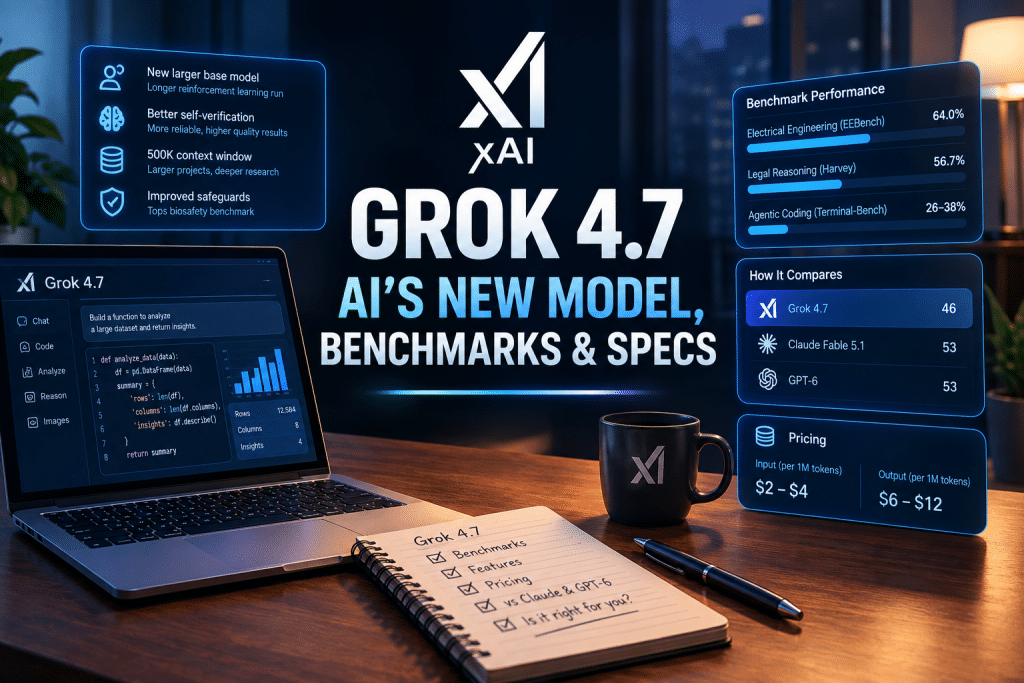
A 500K-token context window, useful for large codebases, multi-file projects, and long research or agent tasks.
-
Overhauled safeguards, which xAI calls its best-calibrated to date, topping a biosafety benchmark and blocking most dangerous dual-use prompts in internal tests.
It is available through the xAI API (as grok-4.7), Grok Build, and Cursor, with GitHub rolling it out to Copilot users.
The Benchmarks: Where It Leads and Lags
This is where honest coverage matters, because the vendor and independent pictures differ.
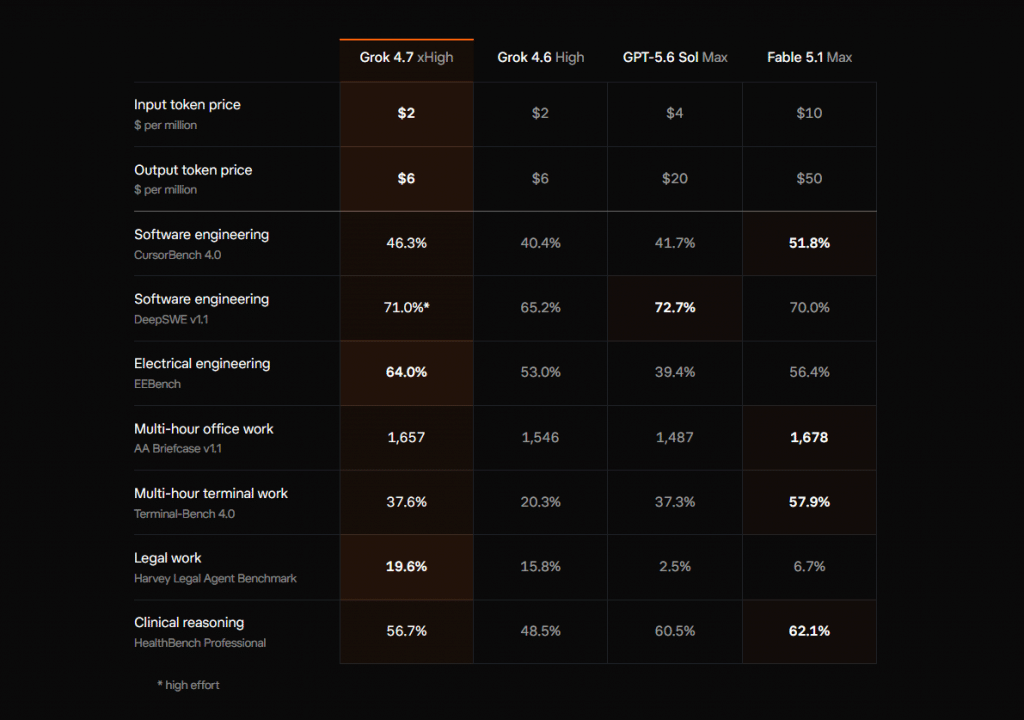
On xAI’s own benchmarks, Grok 4.7 beats Grok 4.6 across the board and edges GPT-5.6 Sol Max on several tests. It genuinely leads in specialized fields: 64% on EEBench (electrical engineering) and a large jump on the Harvey Legal Agent benchmark, both areas where it outperforms Claude Fable 5.1. On DeepSWE at high effort it hit 71%, up from 65.2% on Grok 4.6.
The independent read is more measured. On the Artificial Analysis Intelligence Index, which runs every model through one shared harness, Grok 4.7 scores 46 and lands mid-pack, behind both Claude Fable 5.1 and GPT-6 at 53. The gap is widest in agentic coding: on Terminal-Bench 4.0 it manages around 26 to 38% depending on the test setup, versus roughly 55% for Claude Fable 5.1 and 60% for GPT-6 Astra. Reviewers also note it is slow and verbose, so the real cost to finish a task can run higher than the per-token price implies.
The honest summary: Grok 4.7 is a genuinely capable model that leads on legal and engineering reasoning but trails the frontier leaders on raw coding and overall intelligence.
Grok 4.7 Pricing
Grok 4.7 launched at the same price as Grok 4.6, which is aggressive for a model of its class, closer to cheaper models than to Western frontier rivals.
|
Tier |
Input (per 1M tokens) |
Output (per 1M tokens) |
|
Standard (under 200K tokens) |
$2.00 ($0.50 cached) |
$6.00 |
|
Large context (above 200K) |
$4.00 ($1.00 cached) |
$12.00 |
A faster variant costs about twice as much for roughly double the output speed, and the US regional endpoint carries a 10% premium. The low headline price is the real selling point, though the model’s verbosity means the effective cost per finished task is higher than the sticker rate suggests.
How It Compares
-
Versus Claude Fable 5.1 and GPT-6: behind both on overall intelligence and agentic coding, but competitive or ahead on electrical engineering and legal reasoning, at a much lower price.
-
Versus GPT-5.6 Sol Max: ahead on several of xAI’s tests, including CursorBench, making it a credible cost-efficient alternative.
-
Versus cheaper models: priced in similar territory, so the competition is as much about value as raw capability.
Elon Musk has signaled that future updates, Grok 4.8, 4.9, and Grok 5, will target outright frontier leadership, positioning 4.7 as a strong step rather than the final destination.
The Takeaway
Grok 4.7 is a real and meaningful upgrade: a larger base model, better self-verification, a 500K context window, and standout results in engineering and legal reasoning, all at a price well below the frontier leaders. It is also a lesson in reading benchmarks carefully, since xAI’s “most capable yet” framing is true within its own tests but sits below Claude Fable 5.1 and GPT-6 on independent, harness-neutral evaluation. For cost-conscious teams doing legal, engineering, or knowledge work, Grok 4.7 is a compelling value pick. For those who need the absolute best agentic coding or raw intelligence, the frontier leaders still hold the edge.
❓ Frequently Asked Questions
Answers to relevant questions about this AI tool