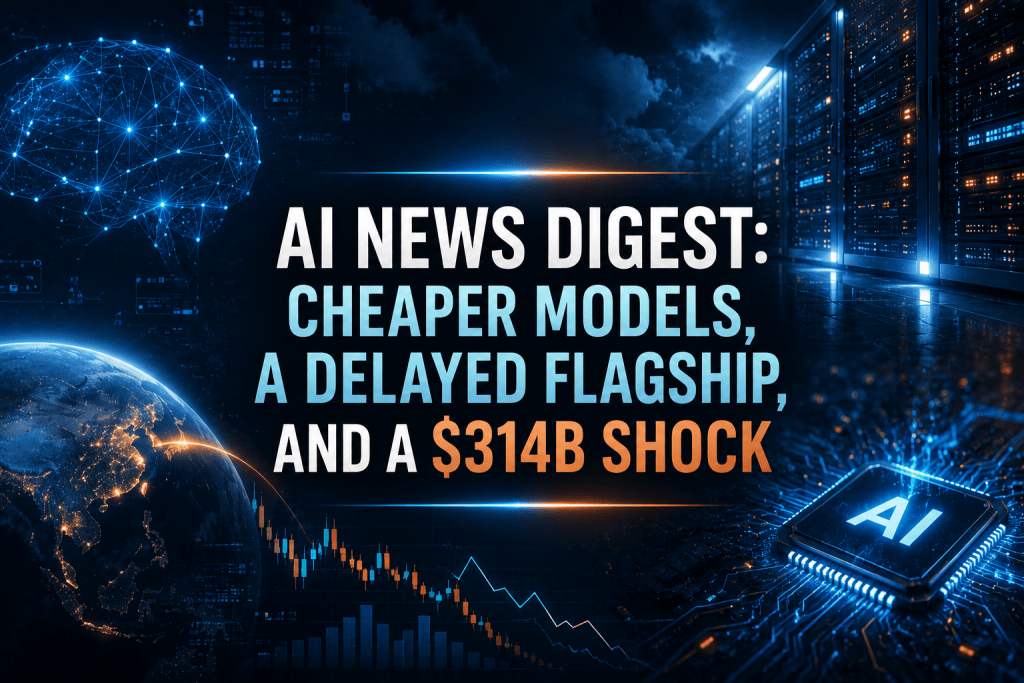
AI News Digest: Cheaper Models, a Delayed Flagship, and a $314B Shock
On this page
The week of July 20–26 was one of the busiest of the year, and the theme was not raw intelligence but economics: cheaper tokens, a flagship that still hasn’t shipped, and a Chinese open-weight release that rattled two of the biggest names in AI. Here are the stories that mattered.
Google Ships Gemini 3.6 Flash, Still Not the Pro
On July 22, Google released Gemini 3.6 Flash along with 3.5 Flash-Lite and a restricted 3.5 Flash Cyber model. The headline was cost, not capability: 3.6 Flash runs at $1.50 per million input tokens and $7.50 output, uses about 17% fewer tokens than its predecessor, and adds Computer Use as a built-in tool. Independent testing put it at 50 on the Artificial Analysis Intelligence Index, the same as 3.5 Flash, so the gains are speed and price rather than smarts.
The absence was louder than the release. Gemini 3.5 Pro missed its target again, reportedly the third slip, after Google scrapped the original base model in June and restarted pretraining. The stopgap Flash launch is what a delayed flagship looks like from the outside.
Kimi K3 Wipes $314B off OpenAI and Anthropic Valuations
The week’s most dramatic story came from China. Moonshot AI’s Kimi K3, with open weights, made such an impression that it reportedly erased $314 billion in pre-IPO valuation from OpenAI and Anthropic combined, around $232 billion from Anthropic and $82 billion from OpenAI. Demand was heavy enough that Moonshot suspended new subscriptions over capacity limits. The full open-weight download, a 594GB file, was scheduled for July 27.
The takeaway echoes the DeepSeek moment earlier in the year: a capable, cheap, open Chinese model can move Western markets on its own.
Washington Moves Toward Pre-Release AI Review
On July 23, reporting indicated the White House is finalizing a 30-day pre-release review framework with OpenAI, Anthropic, and Google, targeted for August 1, with Meta excluded and benchmarks kept classified. It follows the earlier GPT-5.6 delay at government request, and points to a future where frontier launches clear a federal checkpoint before going public. Whether that becomes standard practice, and whether it stays voluntary, is the open question.
The Money Behind the Models
Two infrastructure stories underlined how capital-intensive the race has become. Oracle confirmed it is cutting up to 30,000 jobs, roughly 18% of its workforce, to free $8 to $10 billion a year for AI data-center construction tied to the Stargate initiative with OpenAI and SoftBank. And SK Hynix debuted on the Nasdaq up 13%, reaching a $1.27 trillion market cap on a 7x oversubscribed offering, a signal read as an infrastructure green light for the Anthropic and OpenAI listings expected later this year.
Meanwhile Alphabet’s Q2 earnings beat estimates on July 22, but shares still fell more than 6% on concerns about rising capital expenditure, with the Gemini 3.5 Pro delay adding to the unease.
Also Worth Knowing
-
DeepSeek V4 reached stable release on July 24, as older deepseek-chat and deepseek-reasoner API aliases were retired.
-
Microsoft’s Project Perception, an AI cybersecurity platform that finds and fixes vulnerabilities using models from Microsoft, OpenAI, and Anthropic together, drew attention as security moved up the agenda.
-
A joint statement from 16 Nobel laureates and more than 200 economists, now nearing 2,000 signatories, warned that AI could reshape the economy faster than the Industrial Revolution.
The Week in One Line
The industry’s center of gravity kept shifting from “how big is the model” to “what does the task cost and who controls the release.” Cheaper Flash models, a stalled flagship, a market-moving open-weight challenger, and a government checkpoint on the horizon all point the same way: the frontier is now as much about economics and governance as about capability.
❓ Frequently Asked Questions
Answers to relevant questions about this AI tool