GPT-5.6 Is Here for Everyone: OpenAI’s New Model Family
On this page
The OpenAI GPT-5.6 release is rolling out now, with access opening to all users over the course of about 24 hours. GPT-5.6 is not a single model but a three-tier family, and it arrives alongside the biggest reshaping of OpenAI’s product lineup in some time. Here is what shipped and what it means.
Three Models, One Generation: Sol, Terra, and Luna
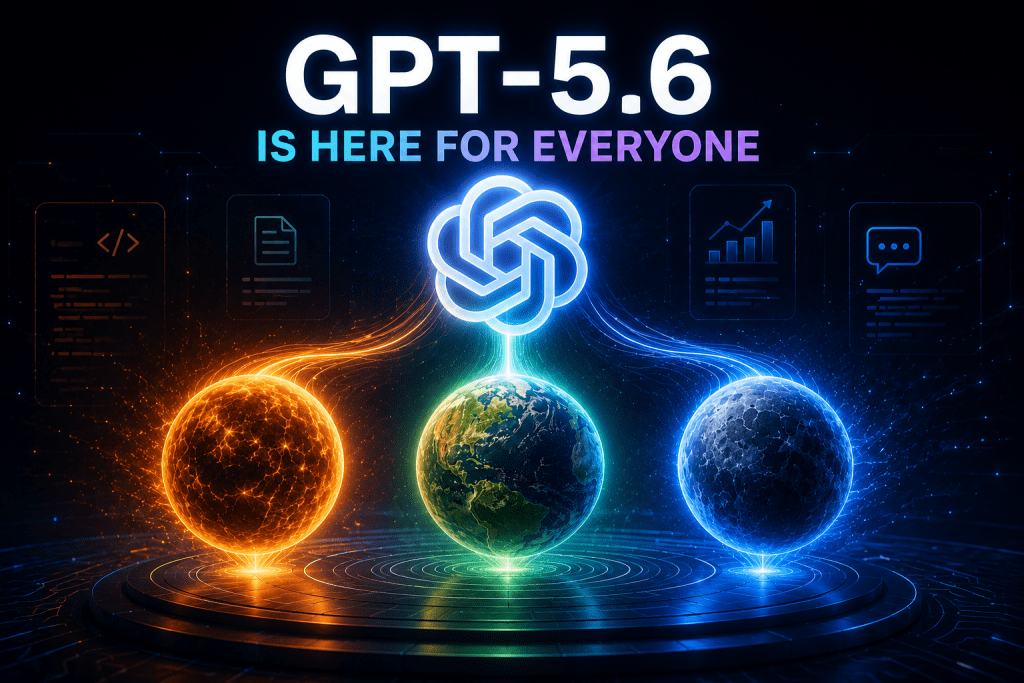
GPT-5.6 comes in three tiers that sit at different points on the price-performance ladder. Under OpenAI’s new naming system, the number marks the generation, while the names mark durable capability tiers that can advance on their own schedule.
- GPT-5.6 Sol is the flagship, built for the hardest reasoning, coding, science, and long-running agent tasks. It is available for paid ChatGPT plans (Plus, Pro, Business, and Enterprise) through medium- and higher-effort settings.
- GPT-5.6 Terra is the balanced everyday model. OpenAI says it matches GPT-5.5’s performance at roughly half the cost, and it is the tier Free and Go users get inside ChatGPT Work and Codex.
- GPT-5.6 Luna is the fastest and cheapest option, aimed at high-volume, lower-cost work.
The three GPT-5.6 tiers differ sharply in cost as well as capability, so the practical question for most people is simply which one their plan gives them and in which app.
Worth clarifying, since early write-ups blurred this: in standard ChatGPT chat, only Sol is exposed to paid users. Terra and Luna show up in ChatGPT Work, Codex, and the API rather than the normal chat picker, so the “free-for-all” framing applies to Terra in those areas, not to the whole family everywhere.
The Bigger Story: Codex Folds Into ChatGPT
The model release doubles as a product strategy reset, pushing OpenAI from “chatbot” toward what several observers are calling a work operating system. Two changes stand out.
Codex merges into ChatGPT. The desktop app is now a full agent. It works directly with your files, documents, spreadsheets, and browser, so you no longer need to be a developer or learn Codex separately to use the agent’s full capability. Codex keeps a coding-focused entry point beside Chat and Work for those who want it.
ChatGPT Work arrives. This is a new agent for professional work built on GPT-5.6, and it lands squarely opposite Anthropic’s Claude Cowork. It can take on tasks end to end: pulling context from documents and tools like Slack, Notion, Microsoft 365, and Google Drive, then producing decks, docs, spreadsheets, dashboards, and interactive explanations. It can also message colleagues and upload finished files on its own.
OpenAI’s own advice on getting started is telling: the best way to learn ChatGPT Work is to hand it a task you already know well so you can judge the output.
Why It Matters
For everyday users, the headline is simple: a stronger default model family, with a capable tier reaching free accounts in the work and coding apps. For teams and developers, the more useful shift is the tiered structure. A workflow no longer needs the most expensive model at every step. Luna can handle cheap routing or cleanup, Terra can carry most production work, and Sol can be reserved for difficult reasoning and final checks.
On benchmarks, OpenAI positions Sol at or near the frontier. On GPT-5.6 vs Claude Fable 5, OpenAI reports a new high on the Agents’ Last Exam evaluation of long-running professional work, with Sol ahead of Anthropic’s model, though rivals still lead on some coding benchmarks. As always, vendor-reported numbers are a starting point, not the last word.
The Takeaway
GPT-5.6 is less a single upgrade than a repositioning. The three-tier family gives clearer choices across intelligence, speed, and cost, while the Codex-into-ChatGPT merge and the launch of ChatGPT Work signal where OpenAI is heading: from a place you chat with toward a place that does the work for you.
Whether that appeals depends on how much you want an agent acting on your behalf rather than a chatbot answering your questions. Either way, the rollout is live and reaching accounts now. We will keep following how the new modes hold up in real use.
❓ Frequently Asked Questions
Answers to relevant questions about this AI tool