Google Updates Gemini 3.5 with Live Translate Features
On this page
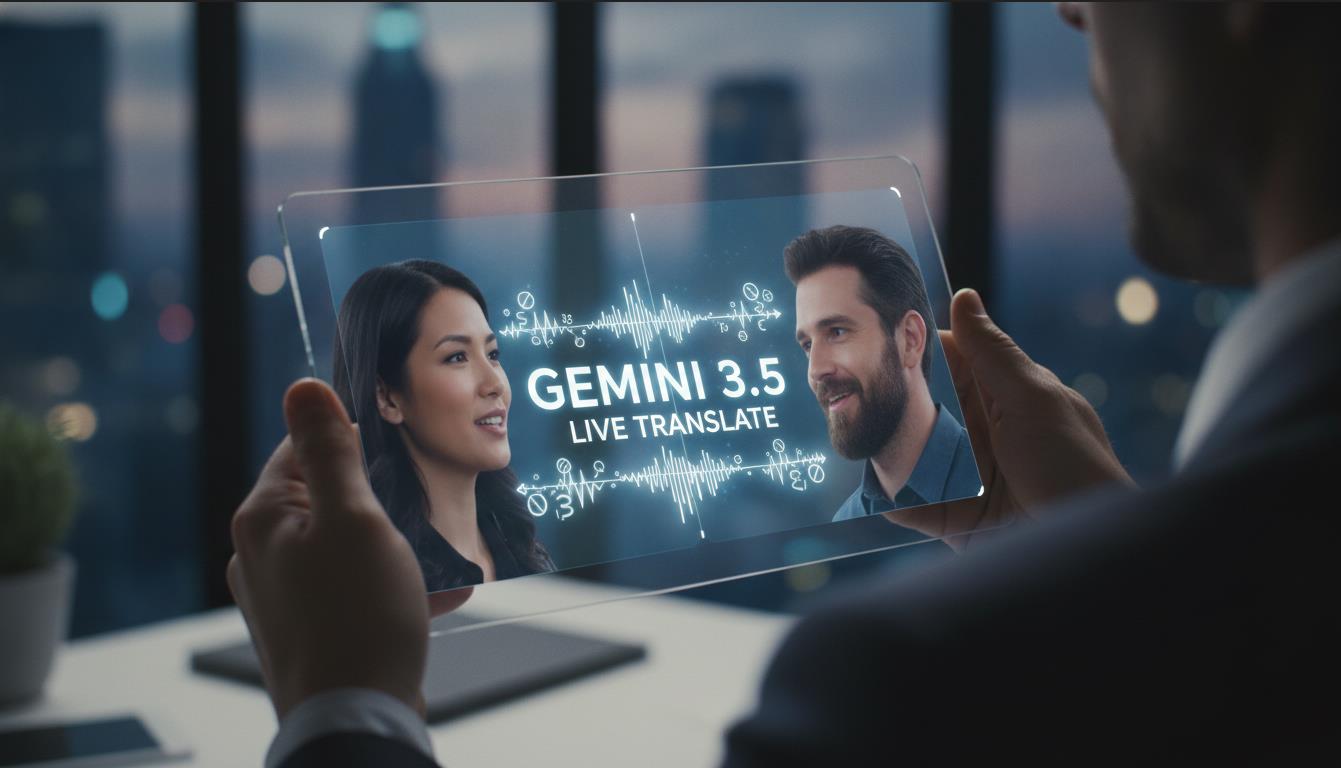
The release of Gemini 3.5 Live Translate is part of a broader rollout of the Gemini 3.5 model family, focused on increasing speed, multimodality, and agent autonomy. The transition from intermediate text transcription to direct speech-to-speech conversion preserves crucial non-verbal elements of communication, making cross-language interaction more human and organic. The analysis of the market context and technical specifications presented in this report demonstrates that the implementation of this technology does not merely optimize the user experience; it transforms simultaneous multilingual translation from a premium corporate add-on into a basic industry standard for software, end consumers, and communication service developers.
Architectural Foundation and Audio Generation Specifications
Gemini 3.5 Live Translate is available in public preview. Google describes it as a low-latency audio-to-audio model designed specifically for real-time translation rather than general-purpose reasoning or multimodal tasks.
The model accepts up to 131,072 input tokens and can generate up to 65,536 output tokens. Audio is counted at approximately 25 tokens per second, which gives the input window a theoretical capacity of around 87 minutes of audio. This should not be treated as a guaranteed session length, however, since practical limits may also depend on output usage, connection stability, and Live API session constraints.
The large context window may help the model follow terminology, names, and earlier parts of a long conversation. Translation accuracy can still vary, particularly during lengthy sessions or conversations involving several speakers.
Technical Input/Output Specifications and Latency Management
To achieve the low latency required to maintain the illusion of simultaneous translation, the architecture imposes strict requirements on the data format. Two-way streaming is executed based on raw Pulse-Code Modulation (PCM) data.
| Stream Characteristic |
Technical Requirements and Parameters |
|
Input Audio Format |
Raw 16-bit PCM, 16 kHz (mono, little-endian) |
|
Output Audio Format |
Raw 16-bit PCM, 24 kHz (mono, little-endian) |
|
Chunk Size |
100 milliseconds (100ms) |
|
Connection Type |
WebSocket with session streaming support |
|
Interaction Modality |
Strictly audio-to-audio (text input is not supported for translation) |
Key Capabilities and Innovative Features
Here are the key capabilities and features of Gemini 3.5:
Continuous Streaming Translation and Prosody Preservation
The primary user-facing differentiator of Gemini 3.5 Live Translate from existing alternatives is its continuous streaming capability. Classical translation systems must wait for a long pause or a semantic end-point. This is due to the structure of certain languages (for example, in German, the defining verb is often located at the very end of a complex sentence), making it impossible to translate the beginning of a phrase without understanding its conclusion. Google’s technology performs probabilistic prediction and dynamic adjustment of the audio output, smoothing over unnatural pauses and preventing choppy audio effects.
Beyond eliminating delays, the model translates prosodic elements. The speech-to-speech process captures pitch, pacing, emotional tone, and specific intonations of the speaker, after which these acoustic characteristics are mapped onto the synthesized voice. While developers acknowledge that perfect voice replication is not always guaranteed, preserving basic prosody radically alters the perception of the dialogue. The interaction ceases to feel robotic; the foreign counterpart hears living speech reflecting surprise, questioning, or assertion, rather than a monotonous synthesizer.
Scale of Language Support and Matrix Translation
At its release on June 9, 2026, Gemini 3.5 Live Translate boasts support for more than 70 languages. A significant advantage is the lack of manual configuration: the neural network automatically identifies the speaker’s language in real time, even if the speaker switches between different languages mid-monologue or uses foreign loanwords.
For corporate communications, this signifies a transition from a radial (hub-and-spoke) translation routing scheme to direct matrix translation. In traditional systems, translating from one rare language to another often routed through English as an intermediary node (e.g., Swedish -> English -> Mandarin), doubling the latency and increasing the likelihood of semantic distortion. The Gemini 3.5 model enables over 2,000 unique direct language combinations, streamlining the multi-party communication process.
Noise Filtering and SynthID Cryptographic Watermarking
The practical application of speech recognition systems frequently encounters the challenge of unpredictable acoustic environments. The architecture of Gemini 3.5 Live Translate demonstrates high noise robustness. The model is trained to isolate the human voice from the sounds of a busy street, loud offices, or broadcasts with complex background audio, making it viable for use in ride-hailing services, navigation, and field journalism.
Note: Given the ethical risks associated with generating realistic AI voices, Google has integrated SynthID digital watermarking technology into the translation architecture. Any audio stream generated by the model is embedded with a cryptographic marker that is imperceptible to the human ear but easily identifiable by algorithms. This measure allows auditors and technical systems to reliably identify audio as AI-generated, serving as a cornerstone for ensuring information security, complying with regulatory standards, and countering the spread of deepfakes in the media landscape.
Deep API Integration: The Architectural Dichotomy of Live Agent and Live Translation
For developers utilizing the Gemini Live API infrastructure, a choice is provided between two fundamentally different mental models and interaction pipelines: Live Agent and Live Translation. Understanding this dichotomy is critical for proper software design.
| Characteristic |
Live Agent |
Live Translation |
|
Functional Role |
Intelligent Assistant (listens, reasons, and takes actions on the user’s behalf) |
Simultaneous Interpreter (functions exclusively as a speech processing pipeline) |
|
Interaction Style |
Turn-based dialogue; relies on pauses, intent detection, and handles interruptions |
Continuous stream processing; translates speaker’s speech without waiting for turns |
|
Tool Support |
Native integration with function calling, Google Search, and custom system instructions |
Translation only. Function calls, system instructions, and third-party tools are strictly unsupported |
|
Input Modalities |
Fully multimodal: supports text, audio, video, and static images |
Strict limitation: audio only. Text input is not supported to guarantee strict latency thresholds |
|
API Configuration |
Tuning Generation, speech, tools, and instructions parameters |
Tuning the translationConfig object (targetLanguageCode, echoTargetLanguage) |
Restricting input exclusively to the audio format in Live Translation mode is a deliberate engineering compromise. Eliminating the need to analyze text prompts, video streams, or complex toolsets allows all available Tensor Processing Unit (TPU) computational power to be redirected toward high-speed acoustic parsing, reducing latency to an absolute minimum.
Translation mode configuration is achieved by passing the translationConfig object within generationConfig during WebSocket session initialization. Basic parameters include:
- targetLanguageCode: The BCP-47 target language code (e.g., “uk” for Ukrainian, “pl” for Polish, “es” for Spanish; defaults to “en”).
- echoTargetLanguage: A boolean parameter defining the system’s behavior if the input audio stream is already in the target language. If true, the model echoes (parrots) the audio; if false (default), the model remains silent to avoid acoustic feedback loops.
- inputAudioTranscription and outputAudioTranscription: Objects that allow parallel retrieval of text transcripts for both the original speech and the translation, intended for display in the application interface (e.g., as subtitles).
For secure API usage in client-side browser applications (to avoid compromising secret API keys), the architecture supports ephemeral tokens. By default, translation parameters are strictly locked on the server; however, a developer can pass the “lock_additional_fields”: [] flag to unlock the configuration, allowing the client to dynamically change the target language during the session.
Distribution Ecosystem: Applications, Enterprise Services, and Devices
The massive release on June 9, 2026, spanned several key distribution channels simultaneously, making the technology accessible to everyday consumers, multinational corporations, and independent developers.
Consumer Segment: Google Translate on iOS and Android
For mass-market users, the Gemini 3.5 Live Translate functionality has been integrated into a global update of the Google Translate mobile app on Android and iOS. The user experience is maximally simplified: by connecting any pair of headphones and navigating to the “Live translate” section (located in the bottom left corner of the interface), the app transforms into a personal simultaneous interpreter.
Several interaction scenarios are provided within the mobile app:
- Conversation: Two-way translation where the translated speech plays out loud through the smartphone speakers or headphones, enabling dialogue.
- Face to face: The smartphone screen is split into two zones facing opposite directions. Each speaker sees the text transcription and translation in their own language, providing reliable visual support in noisy environments.
- Listening Mode: A unique hardware integration initially available exclusively for Android users. If a user does not have headphones, they can activate this mode and hold the smartphone to their ear, simulating a regular phone call. The system routes the translated audio stream directly to the device’s earpiece. This ensures the highest level of privacy, allowing the user to listen to a museum guide, a lecture in a foreign language, or a foreign counterpart without those nearby hearing the translation.
The Google Translate app supports a wide range of languages, including Ukrainian, providing both text and voice translation for travelers, refugees, students, and business professionals.
Enterprise Segment: Transformation of Google Meet
In the realm of corporate communications, Gemini 3.5 Live Translate completely overhauls the positioning of the Google Meet video conferencing service. Previously, the platform provided voice translation services for only five core languages, and the architecture strictly relied on English as a mandatory bridging link.
| Google Meet Capabilities |
Previous Version |
With Gemini 3.5 Live Translate Integration |
|
Number of Supported Languages |
5 languages |
70+ languages |
|
Language Combinations per Meeting |
Only to/from English |
Over 2,000 unique direct translation combinations |
|
Feature Access |
Standard settings menu |
Updated interface for instant one-click access |
Integration began as a private preview for select Google Workspace business customers in June 2026, with plans for a broad rollout by the end of the year. The implementation of 70+ languages transforms the platform into an engine for seamless global collaboration. This move forces a reevaluation of industry standards: what was previously considered a premium feature now becomes the expected baseline for corporate video conferencing, posing a serious challenge to competitors like Microsoft Teams and Zoom.
Developer Ecosystem and Integration Platforms
For the B2B market and independent developers, the gemini-3.5-live-translate-preview model is available in public preview via the Google AI Studio portal and the Gemini Live API. Developers gained direct access to continuous streaming infrastructure, freeing them from the need to build their own cascaded pipelines (speech-to-text -> text translation -> text-to-speech).
A key driver of the technology’s adoption has been partnerships with aggregator platforms and Real-Time Communication (RTC) infrastructure providers. Companies such as Agora, LiveKit, Fishjam, Pipecat, and Vision Agents integrated Gemini Live API support from the earliest days of the release. Leveraging third-party streaming media infrastructures (such as Fishjam’s MoQ protocol) allows thousands of developers to easily embed simultaneous translation into telemedicine apps, customer service portals, streaming platforms, and multiplayer games.
The largest corporate use case to date is the technology’s integration by the Southeast Asian superapp Grab. The platform, which processes over 10 million calls monthly, is piloting Gemini 3.5 Live Translate to facilitate communication between drivers and international tourists. The successful deployment of the model in a ride-hailing application confirms its robustness against traffic noise, unstable internet connections, and complex acoustic patterns. Concurrently, the CJ ENM conglomerate is testing the technology for automated media content dubbing tasks.
Economic Model and API Billing
| Billing Category |
Free Tier |
Paid Tier (Price per 1 Million Tokens) |
Equivalent Cost per 1 Minute of Audio |
|
Input Audio Stream (Input price) |
Free of charge |
$3.50 |
$0.0053 |
|
Output Audio Stream (Output price) |
Free of charge |
$21.00 |
$0.0315 |
Since the architecture converts every second of audio into approximately 25 tokens, the effective total cost of processing one minute of continuous two-way conversation is about $0.0368 (or $2.20 per hour).
A critical privacy aspect is that in the Paid Tier, user audio data is not used by Google to further train its AI models (Used to improve our products: No), paving the way for the technology’s adoption in strictly regulated industries (finance, medicine, law). Conversely, in the Free Tier, data may be used for neural network training.
Technical Limitations and Identified Issues
Despite the heralded breakthroughs, the model remains in preview status and possesses a set of documented limitations that must be factored into system design.
- Voice Replication Inconsistency: The model does not guarantee flawless voice cloning. Practice shows that after extended pauses in speech, the system may drop the acoustic profile and alter the timbre. There have also been noted instances of incorrect gender assignment (based on the first spoken words) and the model getting “stuck” on a single speaker’s profile during rapid multi-speaker conversations with frequent interruptions.
- Language Detection Problems: Although the model supports auto-detection for 70+ languages, algorithms struggle when processing speech with a heavy non-native accent. Difficulties arise when distinguishing closely related dialects and languages (e.g., Spanish and Portuguese), as well as during unnaturally fast switching between languages by the speaker. Documentation clarifies that these errors primarily impact the quality of the generated text transcription, while the final audio translation typically remains accurate.
- Background Noise Processing and Acoustic Artifacts: Active noise cancellation algorithms are trained to filter out background music and crowd murmurs but do not always execute this flawlessly. A specific issue occurs when the echoTargetLanguage: true parameter is enabled: if background speech matches the target translation language, the system’s attempts to “echo-translate” this background noise can introduce digital artifacts and distortion into the final translated audio.
- Modality and Network Infrastructure Limitations: Live Translation mode completely excludes the possibility of text or visual input. Furthermore, the cloud-based nature of the service makes it entirely reliant on internet connection quality; under unstable network conditions (ping fluctuations), continuous dialogue will suffer from interruptions or lag.
Availability in Ukraine and Other Regions
Access to Gemini 3.5 Live Translate depends on the Google product being used. A language may be supported in Google Translate, for example, without every related feature being available through Google Meet or the Gemini API in the same region.
Google currently lists Ukraine among the supported regions for Google AI Studio and the Gemini API. Developers must be at least 18 years old and may be asked to verify their age through their Google account. Access can also depend on the account type, billing setup, and whether the model is available in public preview.
Different terms apply in the European Economic Area, Switzerland, and the United Kingdom. Google permits access to its developer services in these markets, but API-powered applications made available to users there must use paid services. This is a usage condition rather than a region-wide suspension of Google AI Studio.
Live Translate audio includes SynthID, Google’s watermark for identifying AI-generated content. The watermark adds a useful layer of transparency, but it should not be presented as complete protection against voice cloning or other forms of misuse.
Strategic Conclusions
An analysis of the architecture, market positioning, and functional capabilities of Gemini 3.5 Live Translate yields the following strategic conclusions:
- Technological Watershed: The transition from cascaded transcription systems to direct neural network “audio-to-audio” conversion proves that preserving emotional tone, timbre, and rhythm during simultaneous translation is technically feasible with minimal latency. The utilization of 100-millisecond fragments and probabilistic prediction algorithms achieves a fluidity comparable to the work of professional human interpreters.
- Reshuffling the Enterprise Software Market: The integration of over 70 languages and matrix translation capabilities (2,000+ language pairs) into Google Meet sets a new baseline of expectations within the industry. Competitors will be compelled to accelerate the deployment of similar continuous multilingual translation technologies to maintain their market shares in corporate communications.
- Economic Democratization of Development: The record-low cost of audio processing under paid API tiers (roughly 3.6 cents per minute), coupled with the protection of corporate data from neural network training, paves the way for the mass adoption of simultaneous translation. This stimulates the emergence of a new class of applications in logistics, telemedicine, tourism, and streaming broadcasting, exemplified by the successful integration into the Grab platform.
- Challenges of Localization and Regulatory Compliance: Further global rollout of the platform will face the necessity of balancing cloud-based processing with local data privacy laws. While the integration of SynthID cryptographic markers resolves the deepfake issue, the geo-blocking of developer tools (including in European countries and Ukraine) indicates that regulatory landscapes remain the primary hurdle to the technology’s ubiquitous dominance.
Overall, Gemini 3.5 Live Translate demonstrates the evolutionary leap of generative AI from the era of static text chatbots to the creation of autonomous, ultra-fast acoustic pipelines capable of dismantling language barriers on a global scale in real time.
❓ Frequently Asked Questions
Answers to relevant questions about this AI tool