Best AI Figurative Language Checkers for Writers
On this page

Even experienced writers can find it challenging to assess how effectively they’ve used certain techniques or whether they’ve accidentally fallen back on clichés. Figurative language checkers are AI-based tools that scan text to identify elements of figurative speech. Modern neural networks can recognize not only the literal meanings of words but also their figurative senses.
What solutions does the market offer today? Find out in our overview.
How AI Works in Text Expressiveness Analysis
The emergence of style analyzers became possible thanks to Large Language Models (LLMs) trained on vast corpora of fiction and colloquial language.
Unlike simple grammar checks, analyzing figurative language requires the machine to understand context. This demands fairly complex neural network architectures and advanced methodologies.
Fortunately, we now have them.
Standard AI spell-checking focuses on style and readability. It doesn’t concern itself with analyzing metaphors.
A specialized figurative language checker works differently: it labels text segments, categorizing them (e.g., hyperbole, idiom, symbolism). The writer sees not just language errors but a complete picture of their use of literary devices.
Creative individuals gain objective data to develop their artistic style. Researchers, in turn, obtain a statistical basis for studying linguistic patterns.
One might also speculate that data scientists will find their stake in this field. Ultimately, AI itself might one day learn to speak in metaphors as skillfully as Jane Austen.
Top 5 AI Tools for Checking Figurative Language in 2026
We have selected the best figurative language checkers that have proven themselves in 2026.
Figurative Checker: The Versatile Free Analyzer
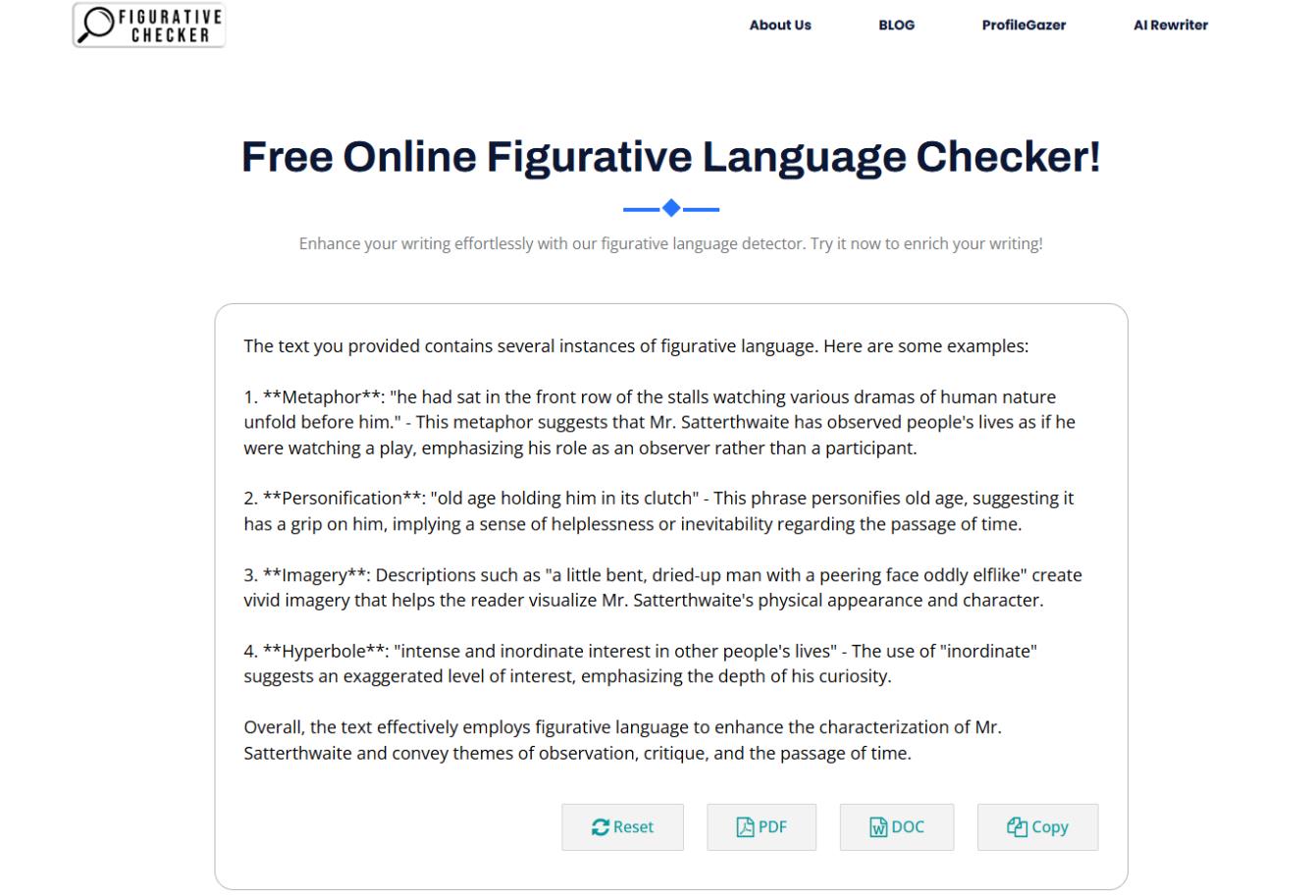
One of the most popular free tools. Figurative Checker is a web platform for automatically scanning text and identifying patterns of figurative language. It detects similes, metaphors, personification, hyperbole, and idioms. The interface is extremely simple: paste text and analyze with one click.
- Features: Users note the user-friendly interface and instant results. The tool is completely free and works with English texts.
- Target Audience: Writers, students, and anyone looking to quickly improve the expressiveness of their text.
Rephrasely Figurative Language Checker: A Multifunctional Platform
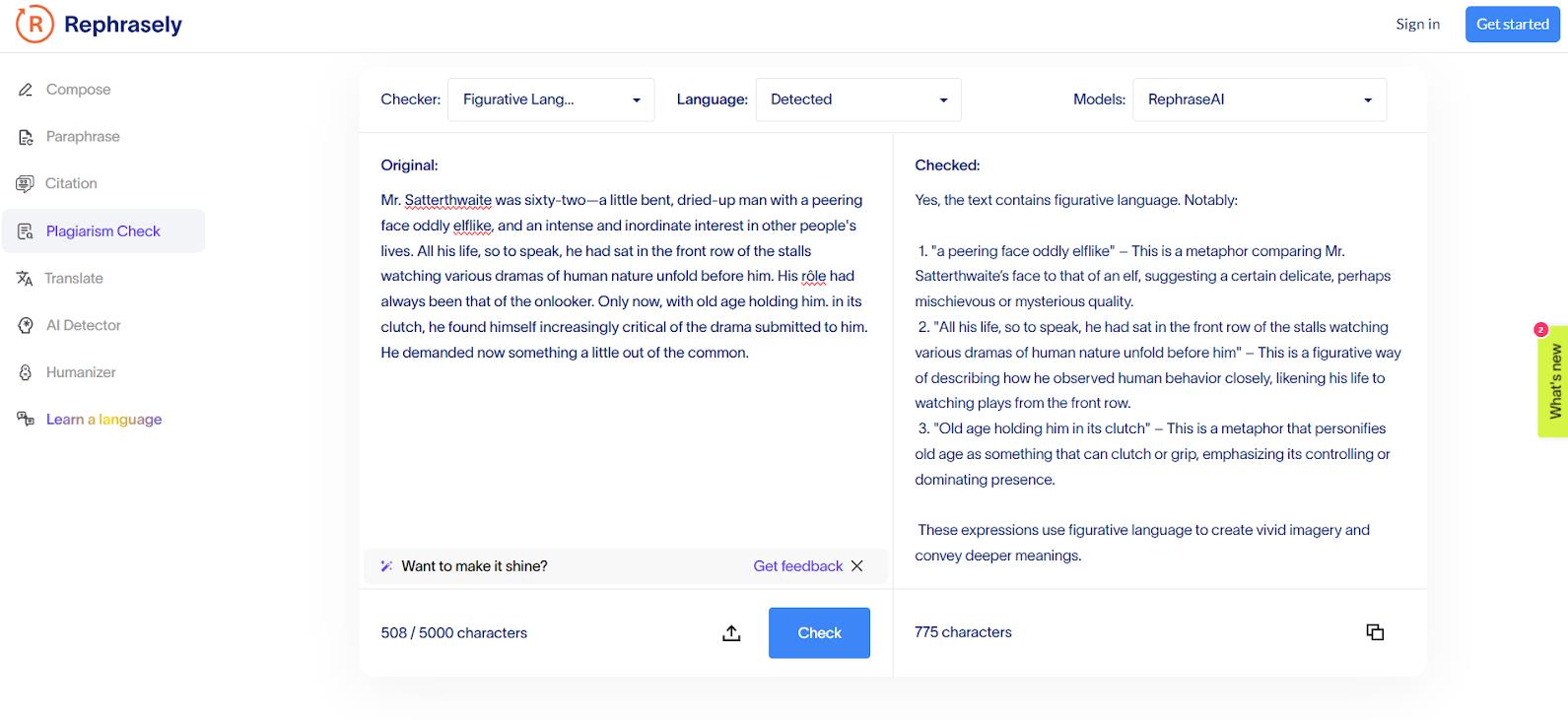
Rephrasely is known as a paraphrasing tool. However, its figurative language checking module deserves special attention.
The search for metaphors and similes is complemented by 18 text processing modes, including summarization, grammar checking, and citation generation. Over 100 languages are supported.
- Advantages: Identified figures of speech can be immediately refined through paraphrasing. This feature is particularly useful for academic work.
- Pricing: A free version with a limit of 500 characters per input. Paid plans: weekly ($7.99), monthly ($7.99), and yearly ($59.99). All premium plans grant access to inputs of up to 5000 characters, plagiarism checks, and all paraphrasing modes.
Metaphor & Figure of Speech Detector: Flexible Literary Analysis
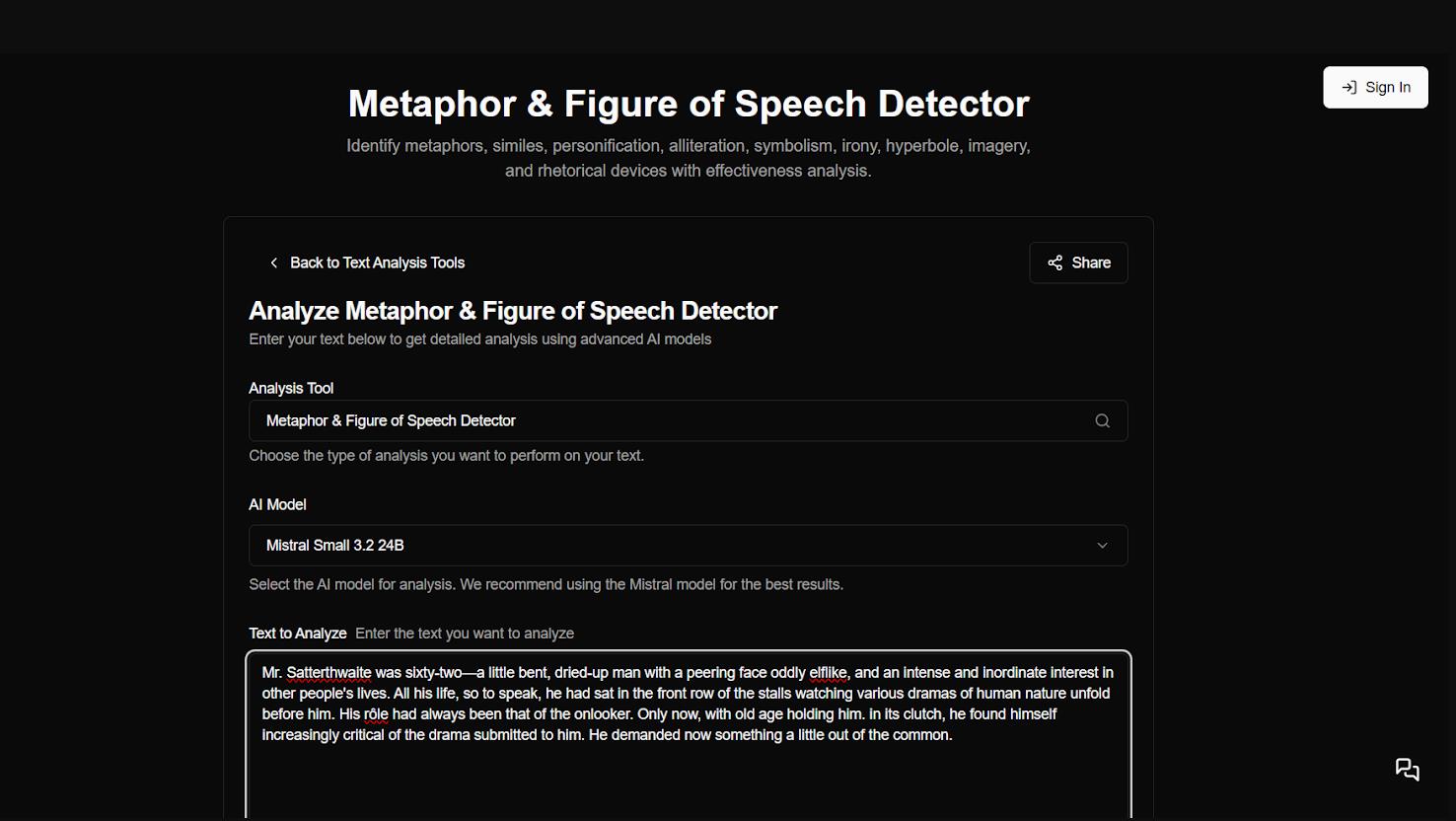
This tool stands out for its ability to fine-tune analysis to the user’s specific tasks. It allows you to choose the AI model (Mistral is recommended). It detects a wide range of devices, from alliteration to irony and rhetorical questions.
- Features: The system accepts additional instructions through an "Additional Notes" field. This allows the analysis to focus on specific aspects. Results can be copied or discussed with a built-in AI assistant.
- Price: Completely free.
LinguistAgent: A Professional Solution for Researchers
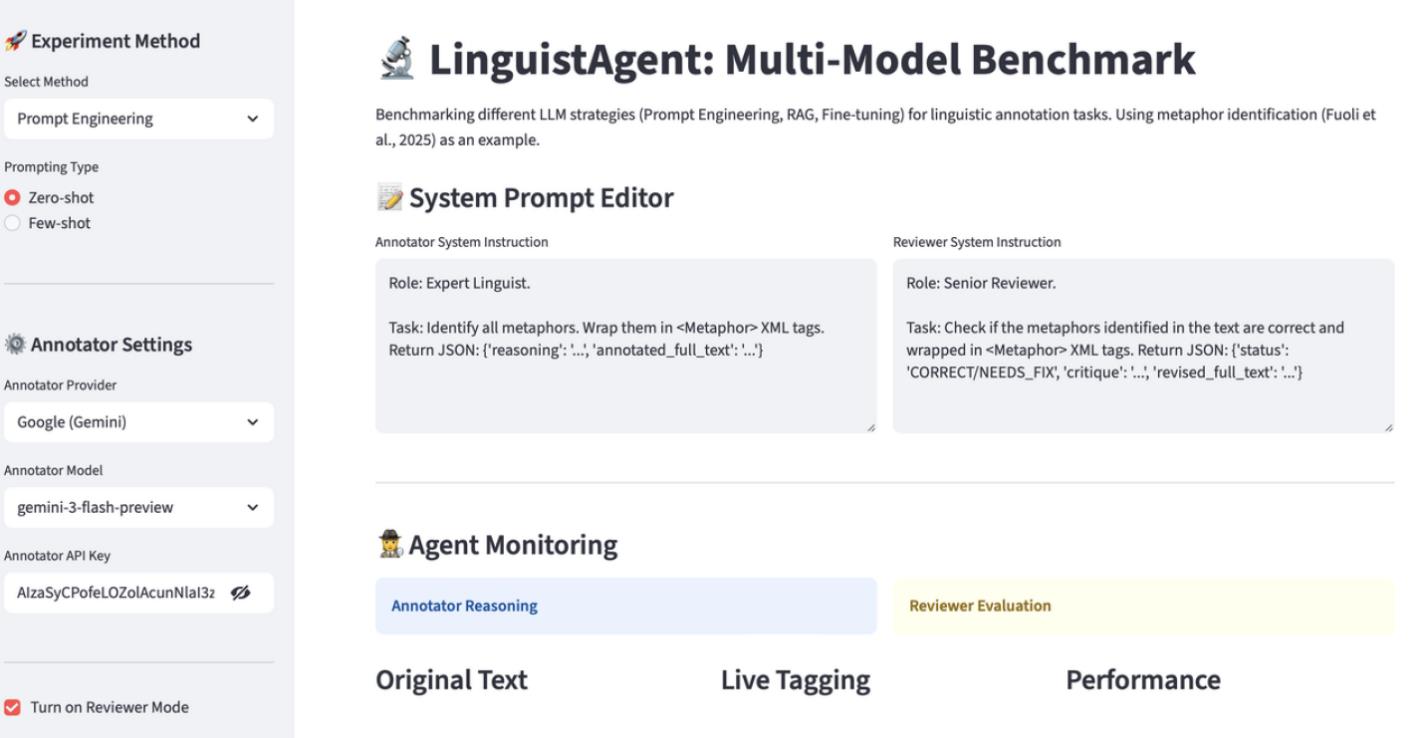
LinguistAgent is an academic platform for automating linguistic annotation. It is built on advanced multi-agent systems.
- Features: The system uses complex chains of reasoning to verify found metaphors (Annotator + Reviewer architecture). It applies Precision, Recall, and F-measure metrics to assess annotation quality. It supports experiments with RAG and fine-tuning.
- Target Audience: Linguists and discourse researchers who require verified and structured text annotation.
- Price: The tool and code are openly available (on GitHub). It is free for researchers.
Discourse Analyzer AI Toolkit: A Platform for Discourse Analysis
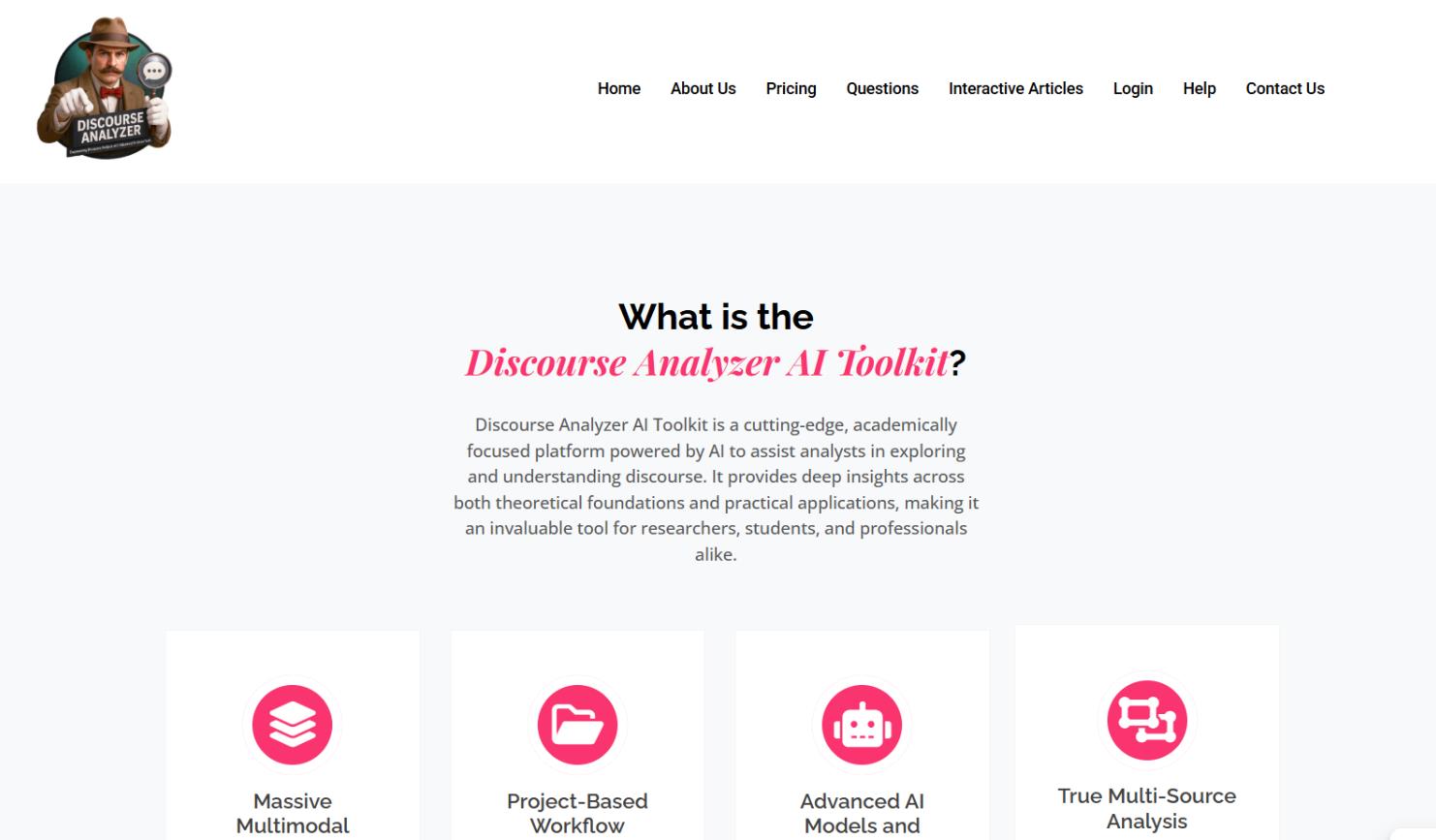
Discourse Analyzer is a comprehensive platform with a suite of tools for various types of text analysis. It includes a specialized module for working with figurative language.
There is a dedicated "Figurative-Language" section with "Metaphor Identification" and "Metaphorical Themes" tools. The platform supports sentiment analysis, rhetorical device analysis, and argumentation analysis.
- Features: Supports uploading up to 1 million tokens. This is sufficient for analyzing entire books or text corpora. A choice of different AI models is available.
- Pricing: Three pricing plans — White Dwarf (for small projects), Blue Giant (medium loads), Red Giant (intensive use). Monthly and yearly subscriptions are available (the yearly plan grants an extra +200 credits monthly).
- Target Audience: Academic researchers, students, and professionals in the field of discourse analysis.
Specialized Tools: Precision vs. Versatility
While the top 5 tools cover most everyday tasks, the following two instruments solve specific problems. They are useful when you need more than just a text check, but deep analytics or integration into workflows.
Lingobright: The Text Expressiveness Calculator
Lingobright occupies the niche of quantitative analysis. It’s not just a detector, but a tool for numerically evaluating text.
- Key Features: Automatically finds elements of figurative language and calculates a "figurative language score" — an assessment of the text’s saturation with expressive means.
- Features: Useful for comparing different versions of the same text or analyzing the evolution of an author’s style. It provides an objective metric where intuition is typically relied upon.
- Target Audience: Writers looking to track changes in their style over time, and researchers working with stylometry.
Nyckel Simile Classifier: The Simile Specialist
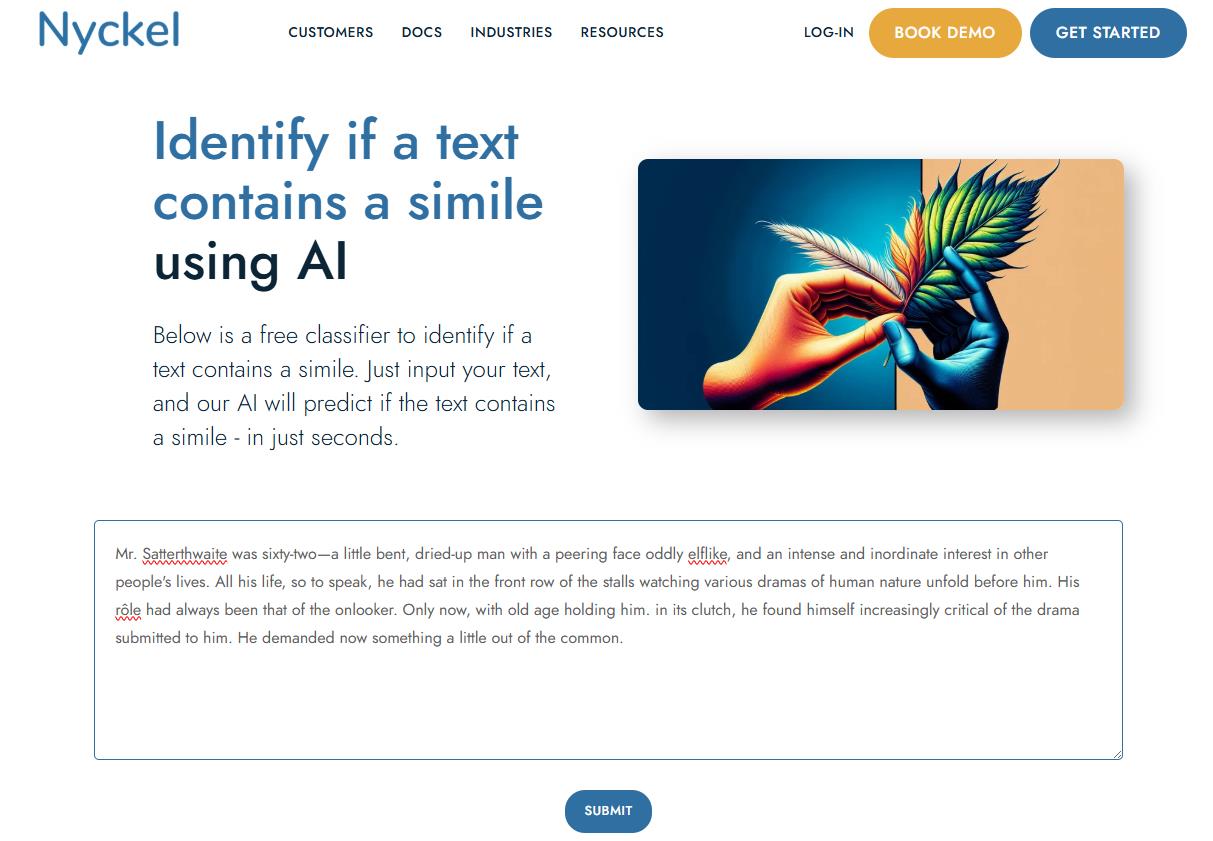
Nyckel demonstrates the power of narrow specialization. Its tool solves one task, but solves it perfectly.
- Key Features: Classifies sentences based on the principle "contains simile / does not contain simile." It operates on a pre-trained model and its own dataset.
- Features: Extremely high accuracy within its niche. The tool can be integrated into larger research or educational pipelines via API.
- Target Audience: Researchers and developers who need a reliable and simple component for detecting similes in large text corpora.
How to Choose the Right Checker?
The choice depends on your tasks. For students and bloggers needing a quick check of an essay or post, the free Figurative Checker or the multifunctional Rephrasely are ideal.
Professional writers and screenwriters should consider the Metaphor Detector with its fine-tuning capabilities.
For academics and linguists, the best choices are the LinguistAgent and Discourse Analyzer platforms. They offer methodological transparency and high annotation accuracy for in-depth discourse and metaphor analysis.
❓ Frequently Asked Questions
Answers to relevant questions about this AI tool