Mistral AI: Powerful Open-Source LLMs
On this page
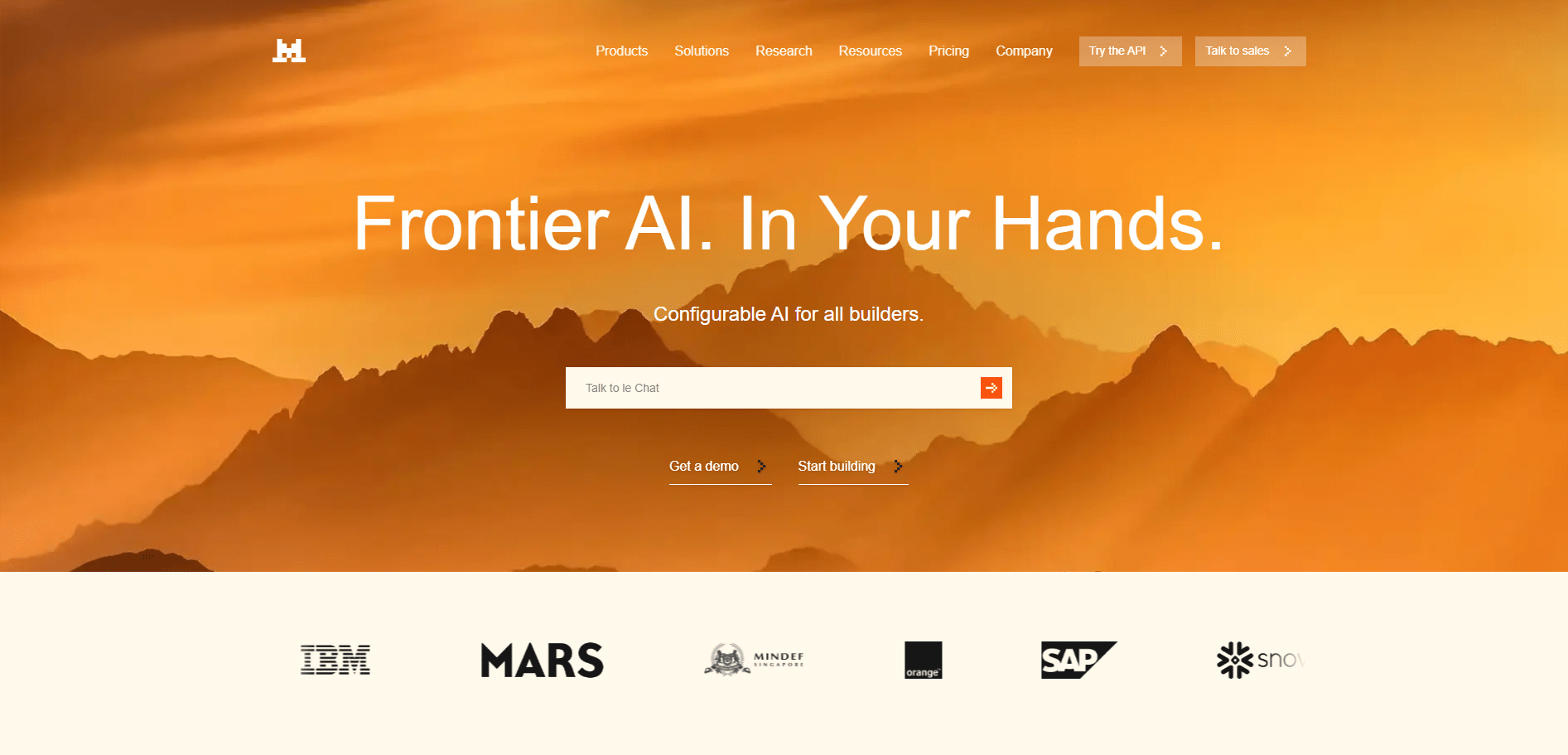
Mistral AI is an advanced AI system capable of generating human-like text. It originates from France, and its key advantage lies in being open and efficient.
We can connect to their platform via the mistral ai api—a bridge that allows us to integrate this AI’s intelligence directly into our own applications or services. This answers the question of what mistral ai is: a tool that helps automate text-related tasks.
For business use, this is especially valuable. Instead of relying on third-party closed systems, we can run their models internally, maintaining full control over our data. So if you need a powerful AI for business that handles text generation—from writing emails to document analysis—Mistral AI emerges as a serious option.
What Can Mistral AI Do?
What can the Mistral AI model actually do? Put simply, what is mistral ai? It’s like an intelligent assistant for handling text—and much more.
- It can generate various types of content—from business reports to creative notes—just provide a general topic. It can hold conversations, answering questions almost like a real person, or power website chatbots. For long documents, it can summarize key points and extract essential information.
- Particularly useful for us is its ability to work with code: writing, reviewing, or explaining it. It understands not only English but also other major European languages.
- There’s also mistral ocr—technology that converts text from images or scanned documents into standard, editable formats. Overall, Mistral AI is a highly versatile tool that takes over repetitive tasks and saves us time.
How Does It Work?
Let’s break down how this system works under the hood—without technical jargon. At its core, Mistral uses a sophisticated architecture trained on massive text datasets. This enables the model to grasp meaning and context, understanding precisely what we ask of it.
You don’t need machine learning expertise—basic API skills are enough. Simply obtain your access key (a digital pass), configure the correct endpoint in your system, and send a text request. The model responds in a clear, structured format—almost like communicating with a colleague.
The key is providing clear and precise instructions. The AI will then process the input, generate a response, or execute any assigned task. This makes automating routine text operations simple and efficient, saving both time and effort.
Who Can Benefit From It?
Where can Mistral AI be useful? Mainly in areas requiring automation of text processing—from analysis to creation.
- Marketing teams can delegate social media posts, email campaigns, or even ad copy generation to the AI.
- Content creators can use it to draft and refine SEO-optimized articles, selecting relevant keywords and descriptions.
- Customer support benefits from automated responses via chatbots handling common inquiries. Legal and analytical teams save time processing contracts or lengthy reports by extracting key clauses. Developers can leverage it for code generation and documentation.
In short, Mistral AI is a flexible tool adaptable to diverse team needs—marketing, content, and IT alike. It reduces time spent on repetitive work, allowing focus on higher-value tasks.
- High-quality text and code generation.
- Open-source model ensures transparency and data control.
- Access to powerful models at competitive pricing.
- Efficient multilingual support.
- No ready-to-use web interface—API access only.
- Technical knowledge required for direct integration.
- Fewer pre-built solutions and plugins available.
Pricing and Paid Services
Mistral AI offers its models through a SaaS (Software as a Service) model with pay-per-minute or pay-per-use billing based on computational resources. A free tier is available with limited requests, allowing users to test core functionality.
Paid plans provide higher request limits, access to more powerful and newer models, and increased context length allowances. Pricing is based on the volume of processed tokens (text units).
Conclusion
We’re evaluating Mistral AI—essentially modern large language models with an open architecture. It appears to be a solid choice if transparency, full data control, and high performance matter to you.
Key advantages include strong text generation and analysis capabilities, openness for inspection, excellent code handling, and multilingual support. Its API integration is flexible, documentation is thorough.
On the downside, there’s no ready web interface—only API access, which requires at least basic technical skills. Also, the brand isn’t yet as widely recognized as giants like OpenAI.
However, for developers, these drawbacks aren’t critical—they can seamlessly integrate the API into products or build custom interfaces as needed. Ultimately, the model is fully ready for real-world applications.
❓ Frequently Asked Questions
Answers to relevant questions about this AI tool
Sources
-
Pricing - Mistral — mistral.ai
-
Documentation - Mistral AI — docs.mistral.ai
-
Pricing - Mistral Docs — docs.mistral.ai
-
Introducing Mistral 3 - Mistral AI — mistral.ai
-
Mistral AI news and analysis - TechCrunch — techcrunch.com