
AI service combines computer vision with ancient feng shui principles to analyze bedrooms and homes. Free, simple, and practical for beginners. Not a replacement for a master, but a handy second opinion for real spaces.
AI Feng Shui Analysis & Interior Design Tool
On this page
What Is AI Feng Shui and What Is It Used For?
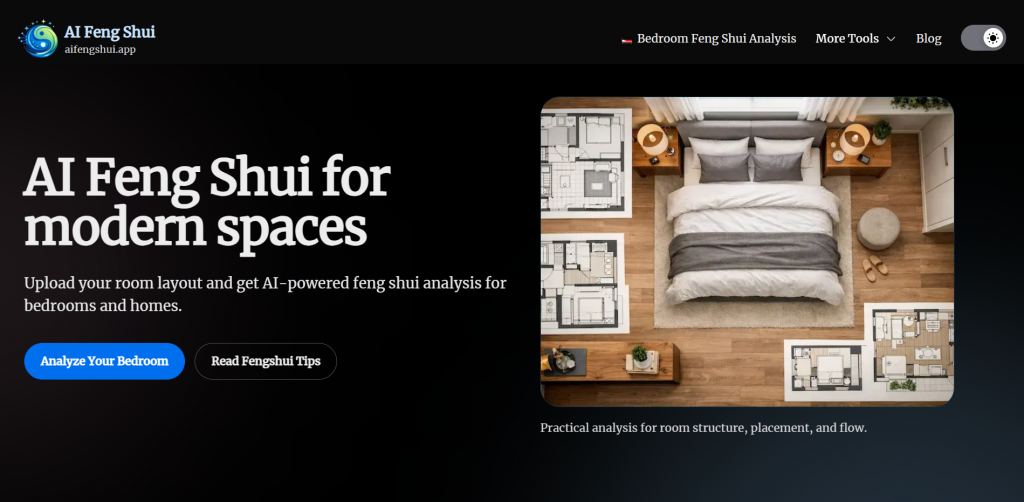
AI Feng Shui is an online tool that analyzes a room’s layout from a photograph or drawing and provides recommendations for improving the space’s energy. The service focuses primarily on bedrooms – as a key zone for sleep and recovery – but it can also work with entire apartments, living rooms, desks, and even the interior of a car. Unlike a traditional consultant who might lecture for two hours about the eight cardinal directions, AI Feng Shui delivers specific, targeted advice in just a few minutes. The idea is to make an ancient practice accessible, fast, and to eliminate the need to understand BaZi and Kua numbers. It is not a replacement for a master. Rather, it is a quick “second opinion” for real, often imperfect modern apartments. Think of it as feng shui fast food, but in certain cases, it is exactly what you need.How the Service Works and on Which Platforms It Is Available
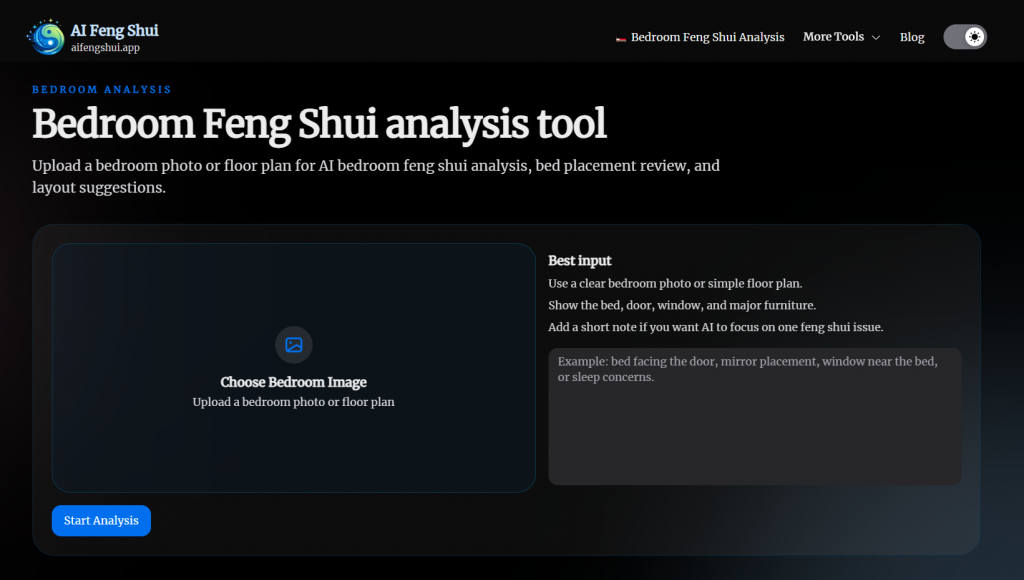
Technically, the process is quite simple and requires no special knowledge from the user. Just follow four steps.- Upload an image. You upload a photo of the room, a floor plan from a rental ad, a hand-drawn sketch, or even a screenshot from a design program. The key is that the walls, doors, windows, and major furniture are visible.
- Neural network analysis. The AI recognizes the room’s structure: where the bed, door, windows, and mirrors are, and how objects are positioned relative to each other. It uses computer vision algorithms – the same ones used for object recognition in photos.
- Application of feng shui principles. The service overlays basic principles onto the recognized layout: the flow of chi energy, balance of elements, correct positioning of the bed and desk, and undesirable proximity of mirrors and doors.
- Generation of a report. The output is a list of the room’s strengths, problem areas, and specific actionable steps, such as “turn your bed so the headboard faces the north wall” or “remove the mirror facing the door.”
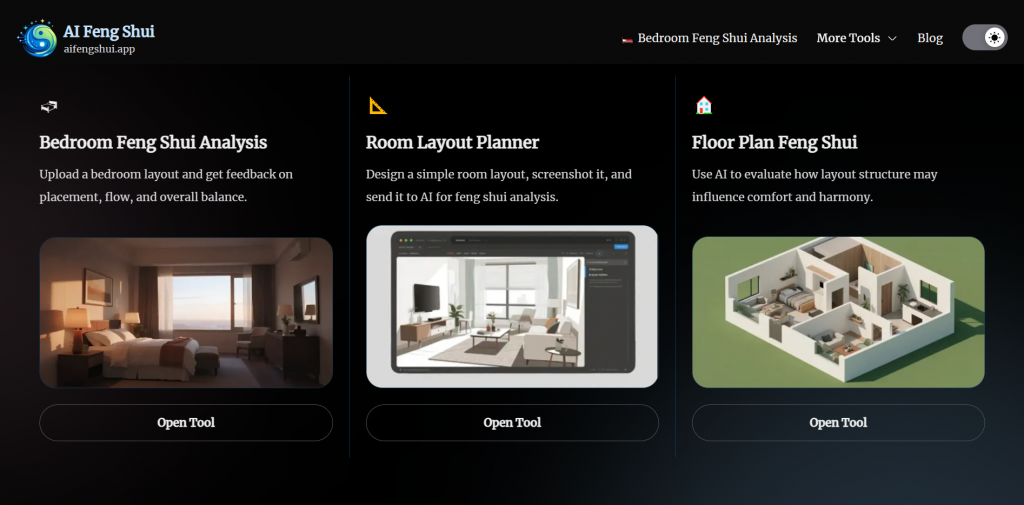
- Bedroom Feng Shui Analysis – the primary mode, focusing on the bedroom.
- Floor Plan Feng Shui – analysis of an entire floor or apartment.
- Room Layout Planner – you draw a plan yourself, then submit it for analysis.
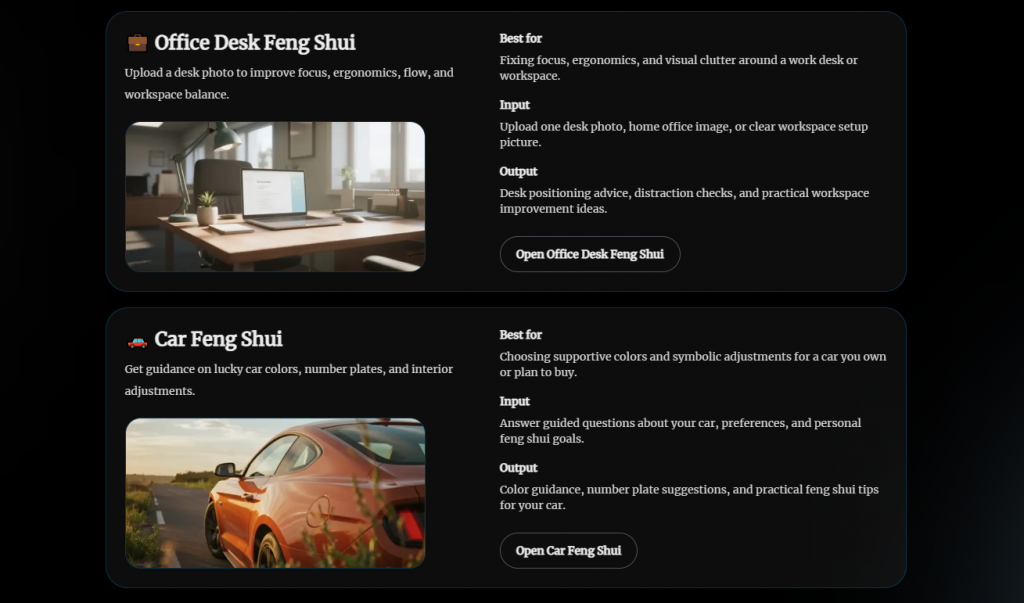
- Additional options for the living room, desk, color selection, and even feng shui for a car.
Positioning
In the AI feng shui market, there are several players, but most are either paid or overly esoteric. Traditional consultants charge high fees (from $100 per hour) and take a long time, but they go deep and consider your birth date. However, one might question whether such an in-depth consultation is truly necessary just to post an apartment rental ad. AI Feng Shui stands out precisely for its simplicity and free entry point. For most people, it is an ideal entry point: modern, technological, and not overloaded with esotericism. Plus, it focuses on real, often imperfect living spaces rather than on idealized diagrams from textbooks.Nuances of Use: What to Pay Attention To
Before you rush to upload a photo of your bedroom, it is important to understand a few limitations.- The quality of the analysis strongly depends on the uploaded image. If the photo is dark, the furniture blends together, or the hand-drawn plan is crooked, the neural network may make mistakes. A clear plan or a well-lit photograph is the key to an adequate result.
- AI Feng Shui is not a professional feng shui master. It does not account for complex schools like Flying Star, does not calculate your personal Kua number (unless you enter it separately), and does not consider the building’s construction date. For everyday needs, this is often sufficient, but if you need an esoteric breakdown along the lines of “chi is escaping into the toilet through the wrong angle,” you will need to consult a human.
- The service analyzes what already exists; it does not invent a new design. It will not draw a beautiful new layout for you or select wallpaper – it will only point out problematic aspects of your current arrangement.
Examples of Use for Personal Purposes and Business
To make it clearer, let’s examine several real-life scenarios.
Checking an Apartment Before Moving In. You have found a great one-bedroom in a new building. The landlord sends you the floor plan. You upload it to AI Feng Shui. The service writes: “The bed ends up facing the front door – this is unfavorable for sleep, as the energy flow is direct. We recommend adding a screen or moving the bed to a solid wall.” You check and see that space allows for it – and you confidently agree to rent the apartment. Without this step, you might either miss the issue or struggle with insomnia later.
Rearranging Your Bedroom. You already have a room, but you sleep poorly. You photograph it from the doorway and upload the image. The AI notices that a mirror on the wardrobe door reflects the bed and that the headboard is against a window – causing a draft over your head. You temporarily cover the mirror with fabric and turn the bed so the headboard is against the wall. A week later, you sleep noticeably more peacefully.
A Small Hotel or Hostel. You have 5 rooms. You upload the floor plan of each into the service and see that in two rooms, the beds have their headboards against the bathroom wall (on the other side), and in one room, a large mirror faces the bed. You rearrange the furniture in those rooms according to the recommendations and add to your booking description: “rooms arranged according to principles of harmony.” For some guests, especially those from Asia, this will be a significant plus.
A Real Estate Agent or Agency. You add a short AI Feng Shui report to your apartment listings as a bonus for potential renters. Especially if the apartment is being rented to families or expats from China – for them, this could be a deciding factor.
Who Will Benefit from AI Feng Shui
The service addresses several typical needs, and its audience is quite broad.- Beginners in feng shui – those who have heard “don’t place your bed facing the door” but do not know where to start. Instead of reading three books, you can upload a floor plan and get a ready-made summary.
- Renters and homebuyers – before signing a lease or paying a deposit, it is useful to check the bedroom in a promising apartment. What if the bed is pushed against a window or a mirrored wardrobe faces the bed directly?
- Owners of small apartments – in compact spaces, every inch counts, and following classical feng shui canons is often impossible. AI Feng Shui knows how to work with imperfect spaces and offers realistic advice, not abstract commands like “widen the hallway.”
- Busy people who want to improve their sleep and environment without unnecessary effort. Upload a photo, get three tips, rearrange the bed – profit.
- Owners of rental properties and small hospitality projects – to check whether rooms contain gross errors that might repel guests or worsen their rest.
User Reviews and Assessments
The service is relatively new, and a flood of reviews in open sources has not yet occurred. Nevertheless, on platforms like Microlaunch and in thematic blogs, several dozen opinions can be found.- What users praise: the convenience of “upload-get-do,” personalization for a real room (rather than abstract advice), speed of work, and usefulness for beginners. Users note that the AI often notices what an ordinary person would overlook: for example, a sharp corner of a wardrobe pointing at the bed, or a chain of doors creating a draft of energy.
- What users caution about: on Reddit forums and in feng shui communities, people discuss that AI tools sometimes give overly general recommendations like “remove clutter.” We found no explicitly negative reviews, but some skepticism exists: that a real master is still necessary, and the neural network might miss important details.
- Free basic functionality without registration or dubious subscriptions.
- Real personalization based on your actual layout, not templated filler from articles.
- Focus on bedrooms and sleep – the most practical aspect of feng shui for the average person.
- Instant speed: minutes instead of hours of conversations with a consultant.
- Built-in educational base: a blog with guides and explanations for beginners.
- AI does not replace a professional master for complex feng shui schools (Flying Star, Compass, etc.).
- The quality of the result strongly depends on the clarity and quality of the uploaded image.
Conclusion
AI Feng Shui is not magic, but a useful and honest tool. It does not promise you millionaires behind the door or enlightenment, but it provides concrete, testable advice for improving your bedroom and home. If you are a beginner, a renter, or simply want to check your apartment without extra expense – this is an excellent option. If, however, you have firmly decided to build a house according to all the canons of the Flying Star school, taking into account your personal Kua number and year of birth – go see a living master. AI will let you down there. The service is at the beginning of its journey, but it is already handling its task: making an ancient practice fast, understandable, and accessible to ordinary people without a hint of infogypsy hype.❓ Frequently Asked Questions
Answers to relevant questions about this AI tool
Sources
-
AI Feng Shui — aifengshui.app
-
About - AI Feng Shui - Who We Are & Why We Built This — aifengshui.app
-
Bedroom Feng Shui Analysis — aifengshui.app
-
Living Room Feng Shui Analysis — aifengshui.app
-
Floor Plan Feng Shui Analysis — aifengshui.app
-
Fengshui Knowledge - AI Feng Shui Blog & Tips — aifengshui.app
-
Suggest a Feature - AI Feng Shui — aifengshui.app