


SermonAI is a web-based AI platform for pastors, offering biblical research, writing templates, preaching mode, and a 500+ book library. It saves time while preserving spiritual priority.
SermonAI: AI Resources for Pastors & Ministries
On this page
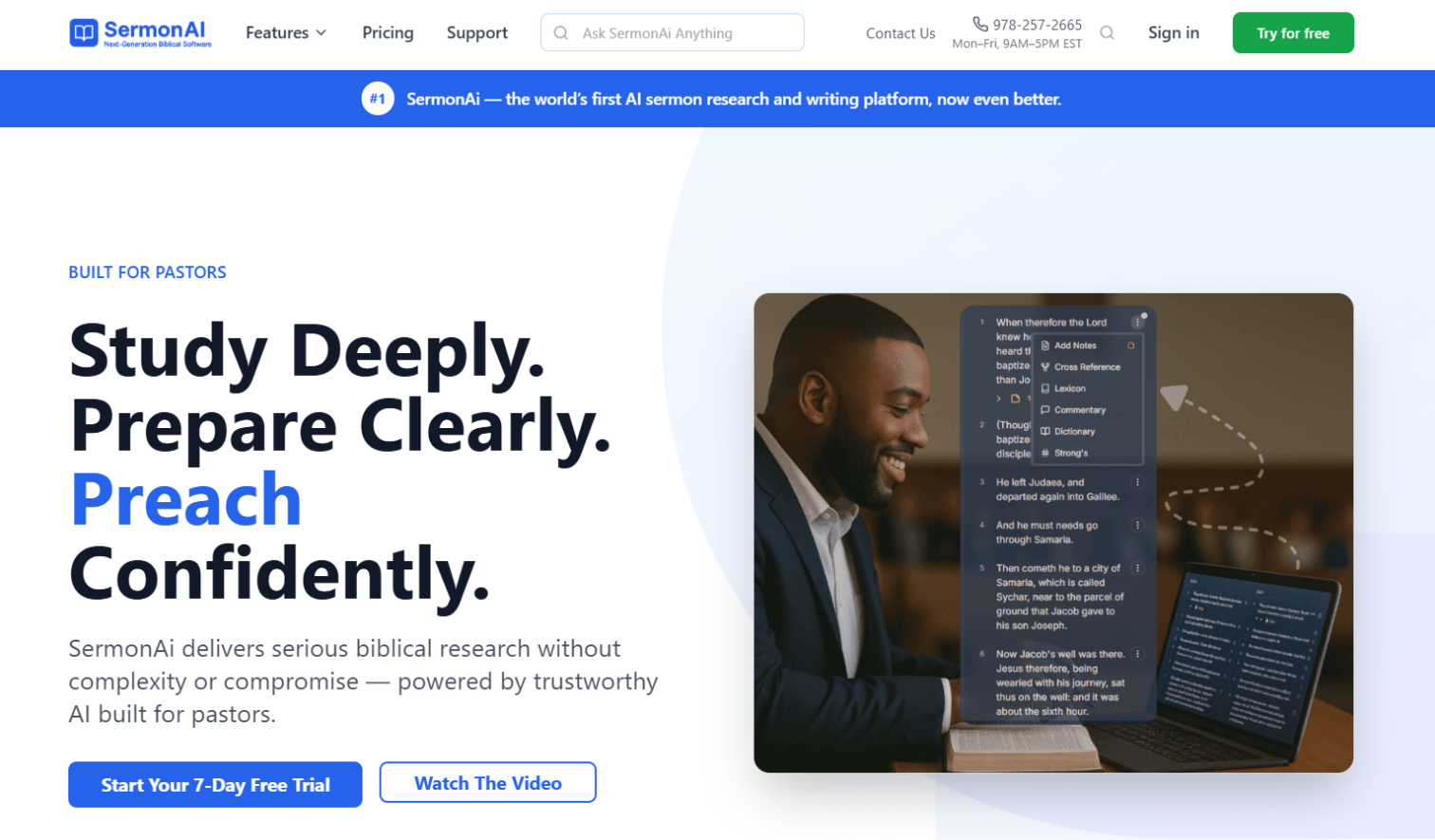
SermonAI is a web-based artificial intelligence platform positioned as “the world’s first AI sermon research and writing platform.” The service was created specifically for pastors and church ministers to simplify sermon preparation, minimize distractions, and allow them to focus on the essence of ministry. The company was founded in 2019 in West Brookfield, USA, by a development team led by Ben Nero.
The main difference between SermonAI and general-purpose neural networks is its biblical orientation. The AI is trained on trillions of data points from Scripture, theology, history, Greek and Hebrew languages, all filtered through a “biblical lens.” This eliminates secular noise and provides doctrinally sound answers.
How SermonAI Works
The platform is entirely web-based and requires no installation. SermonAI works on any modern browser on Windows, macOS, iPadOS, and Android. All data is synchronized through the SermonAI Cloud.
There is no dedicated mobile app, but the mobile version of the site is fully functional. Preaching Mode is optimized for iPad and Android tablets.
Before purchasing, it is worth taking the 7‑day free trial to assess whether the platform suits your needs.
Key Modules and Features
The service combines the power of modern language models with biblical filtering, making it safer for conservative evangelical and protestant circles than general-purpose neural networks.
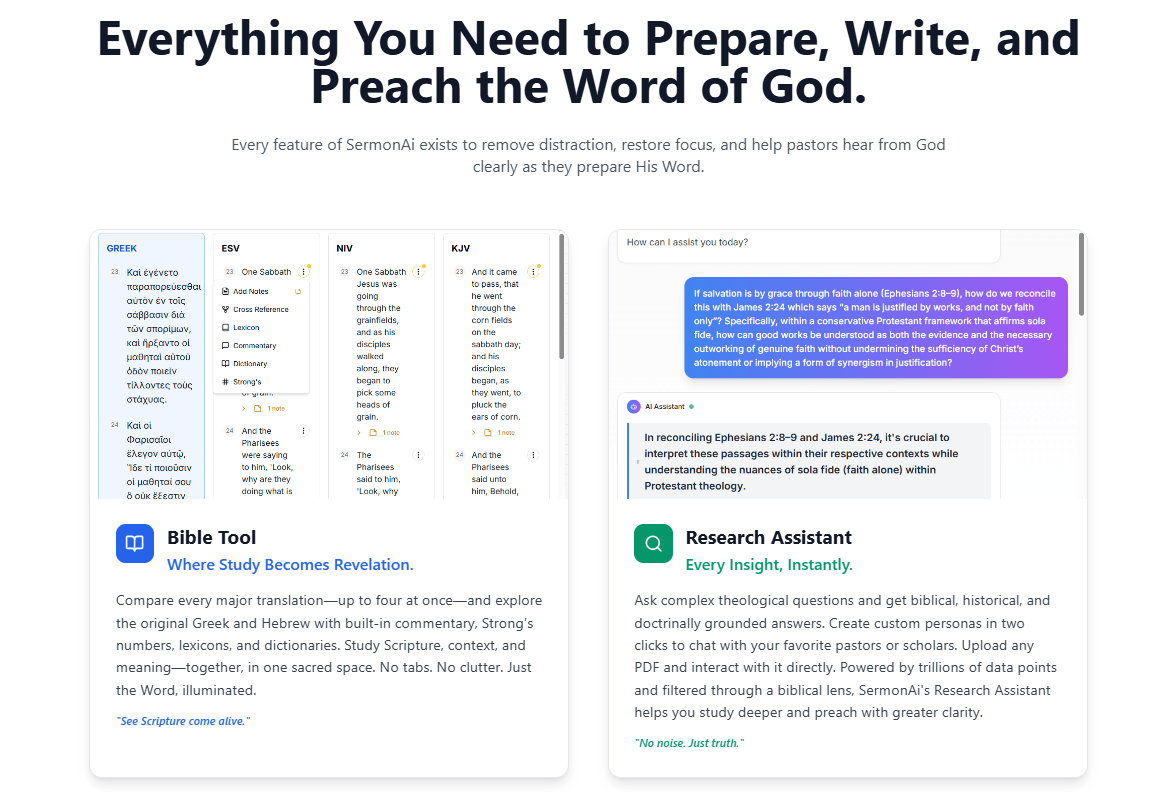
- Bible Tool allows simultaneous comparison of up to four Bible translations, working with original Greek and Hebrew texts, Strong’s numbers, lexicons, and commentaries in one interface.
- Research Assistant is a chatbot for theological questions. You can create custom personas and upload your own PDFs for analysis. Answers are based on biblically filtered data.
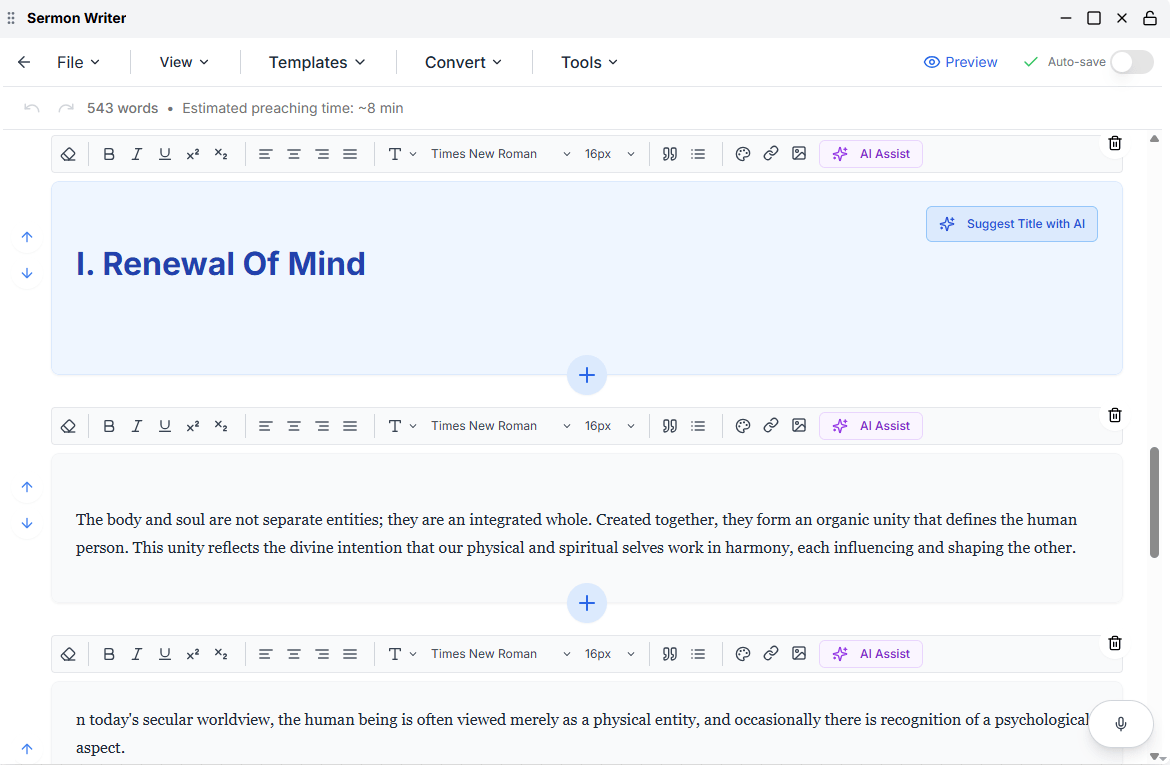
- Writing Assistant includes more than 50 templates for exegetical, topical and other types of sermons. You can train the AI on the style of favorite preachers. The tool helps overcome writer’s block but does not write text for the user.
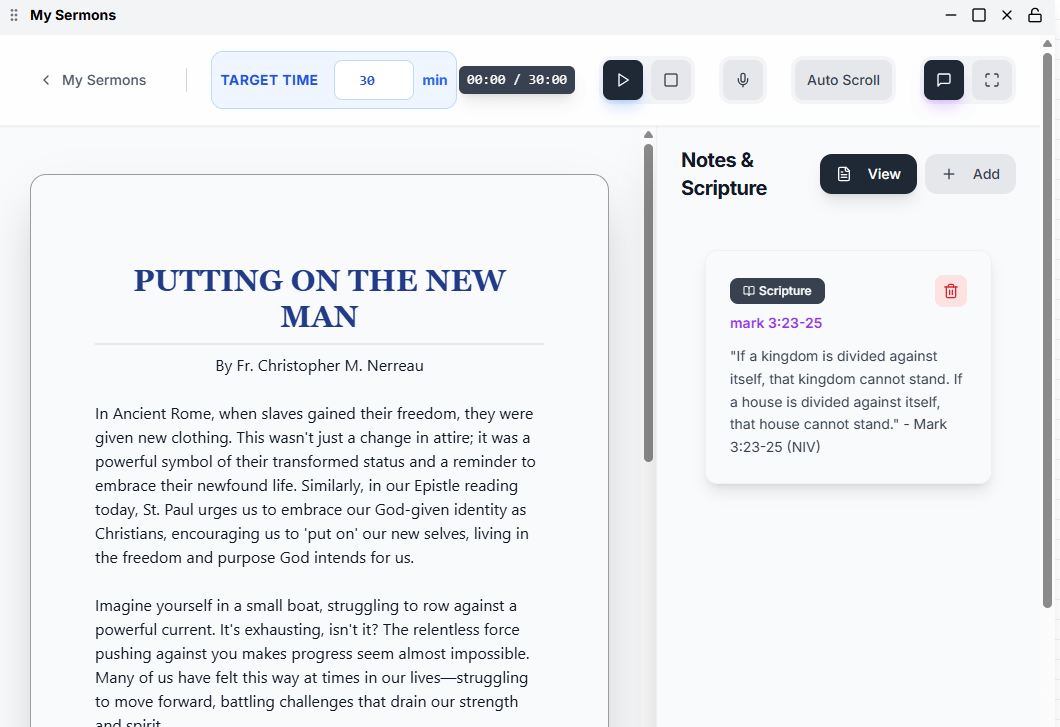
- Preaching Mode is an optimized read‑only mode for tablets with auto‑scrolling, insertion of verses and notes, a built‑in timer, and MP3 audio recording.
- Library provides access to 500+ public domain books and also allows you to upload your own PDFs and make them chat‑ready.
- Media Tools include SermonSnap to convert notes into text, YouTube and audio sermon transcription, and an image generator for slides and social media.
Pricing
Below is the current pricing table for SermonAI based on the official website:
| Parameter | Monthly Plan |
Annual Plan |
Price |
$29 / month |
$245 / year |
Effective monthly price |
$29 |
$20.42 / month (31% savings) |
Savings vs. monthly |
— |
$143 per year (equivalent to 4 months free) |
Billing period |
Every month |
Once per year |
Free trial |
7 days |
|
What is included |
Everything, no limits |
|
The 7‑day trial requires a credit card. The subscription can be cancelled at any time.
Both plans are identical in functionality — there is no “Basic” vs “Pro” tier with different features.
The price is positioned as an affordable alternative to expensive Bible software. The platform actively compares itself to traditional software such as Logos, where pastors often spend $2,000+ on books and modules. For a much more moderate price, SermonAI offers 50+ AI tools, a book library, image generation, and more.
Why Pastors Need an Assistant Like SermonAI
In real pastoral ministry, the problem of creative block during sermon preparation is much more widespread than is often spoken aloud. Preparing a weekly sermon is a constant intellectual and spiritual strain. Year after year, week after week, a pastor must find fresh wording, vivid illustrations, and deep insights.
The problem of “how to overcome sermon writer’s block” is so tangible that entire resources and training programs are devoted to it, along with dozens of articles, videos and podcasts from well‑known pastors and church leaders such as Carey Nieuwhof and Matthew Everhard. Books such as “The Sermon Maker: Tales of a Transformed Preacher” (2003) or “Love Big, Be Well: Letters to a Small‑Town Church” (Winn Collier, 2017), and films like “The Preacher’s Wife” (1996) with Denzel Washington and Whitney Houston, show the emotional and spiritual burnout associated with the constant need to produce fresh material, and the painful search for inspiration when one sermon a week can determine whether people will come the following Sunday.
The struggle with sermon preparation is not a shameful weakness nor a sign of a lack of calling. It is a normal part of ministry for thousands of pastors around the world. Many of them have fought this battle alone for years, hiding their exhaustion behind a smile from the pulpit.
Tasks That SermonAI Addresses
In this context, the solution offers practical help while preserving the user’s spiritual priority. The pastor gains the ability to focus on the most important thing — what God wants to say through him to his particular congregation here and now. AI takes on the technical routine, such as:
- Comparing parallel translations and original languages during Bible study
- Preparing Sunday school or Bible study groups
- Creating a plan for personal devotional reading
- Outlining youth ministry sessions based on the main sermon
- Generating illustrations for slides and church social media
- Transcribing and archiving audio sermons
- Preparing Bible studies for small groups
Who Can Benefit
SermonAI is primarily designed for pastors, preachers and church leaders, especially those who prepare sermons weekly. But not only them. The service will be useful for:
- Leaders of Bible study groups and small groups
- Sunday school teachers
- Students of theological schools
- Missionaries preparing ministry materials
- Christian bloggers and writers
User Reviews and Ratings
On the official website, pastors share positive experiences. Scott Johnson, a senior minister, says that SermonAI cuts his research in half. Pastor Edwin Hardy praises the user‑friendly interface and fresh insights. Charley Munro calls the service “the world’s best assistant.”
Mixed reviews appear on independent platforms. Some users complain about slow performance and slow content generation.
On Reddit and in Christian communities, the general topic of AI in sermons is discussed cautiously. Many use neural networks for ideas and outlines but emphasize that the main work must remain human. Nevertheless, as of March 2026, SermonAI’s monthly traffic is about 11,400 visitors.
The Ethical Question: May a Pastor Use AI in Ministry?
The discussion on the ethics of using AI in church ministry is active in Christian circles — Protestant, evangelical and Catholic — and intensified significantly by 2025–2026. Most Christian leaders and theologians agree that AI can be a useful tool but must not replace key spiritual processes. Understanding where the ethical boundary lies is crucial.
Arguments for Ethical Use of AI
- AI helps with research: finding parallels in Scripture, summarizing commentaries, generating ideas, illustrations and outlines.
- It saves time for busy pastors, freeing it for prayer, personal interaction with congregants, and pastoral care.
Many authors, including Ed Stetzer and Ryan Hayden, propose clear guardrails: treat AI as a research assistant or editor, not as the author of the final text.
Arguments Against Excessive Use
- The pastor’s spiritual formation happens precisely during sermon preparation — the time of wrestling with the text, prayer and the action of the Holy Spirit. Seeking a “shortcut” through AI can weaken personal holiness and dependence on God.
- Preaching is not only content but also personal conviction, emotional depth and the moral authority of the preacher. AI cannot weep over sin, experience grace, or speak from personal experience.
Transparency and honesty also raise questions. Copying AI‑generated text without attribution is considered plagiarism by many. Some pastors believe that even heavy use of AI undermines the congregation’s trust. There is also the technical risk of hallucinations and doctrinal errors, especially with general models like ChatGPT.
Known Positions of Church Organizations
The general consensus in 2025–2026 comes down to several points. AI is a tool, not a pastor. Best practices suggest using neural networks for drafting, but always passing the result through personal prayer, exegesis and editing. The main risks are laziness, loss of dependence on the Holy Spirit, erosion of pastoral character, and undermining the congregation’s trust.
Regarding specific denominations, the spectrum of opinions looks like this:
- The ERLC of Southern Baptists warns against AI‑drafted sermons and emphasizes that sermon preparation is a time when God shapes the preacher’s own heart.
- An NPR survey of clergy in 2025 found that some pastors use AI and feel guilty, while others see it as a normal tool — like books or a computer.
- The Catholic Church has taken the most rigid position. Pope Leo XIV in 2026 directly called on priests to resist the temptation to prepare homilies with AI, because a true homily is sharing living faith, and AI cannot do that. Vatican documents stress that AI is a tool, not a replacement for human responsibility and spirituality.
- Significant time savings on research and sermon structuring — pastors confirm cutting preparation time in half.
- Biblical purity of data — information is curated specifically for Christian ministers, excluding secular noise.
- All in one place: research, writing, library, delivery preparation — no need to switch between different services.
- Preaching Mode for convenient tablet‑based sermon delivery with timer and auto‑scroll.
- Affordable price compared to traditional digital libraries such as Logos, where books and modules can cost thousands of dollars.
- Slow performance and slow content generation according to some user reviews.
- Lack of transparency — the website provides almost no information about the team, and AI responses lack detailed source references.
- The price may be high for small churches compared to free alternatives such as ChatGPT with well‑crafted prompts.
- Ethical concerns in the Christian community: excessive use of AI may weaken personal dependence on the Holy Spirit.
Conclusion
SermonAI is an interesting example of a vertical AI tool that solves a real problem of busy pastors: too much time goes into technical preparation instead of prayer, study, and pastoral care. The platform emphasizes biblical data filtering and does not claim to replace the work of the Holy Spirit or the pastor’s personal labor.
The key balance to understand is that technology should be a servant, not a master. Any church leader considering such tools must answer the crucial questions: does AI help me hear God better and serve people, or does it simply allow me to labor less in the Word and in prayer?
❓ Frequently Asked Questions
Answers to relevant questions about this AI tool
Sources
-
SermonAI Official Website — sermonai.com
-
SermonAI Pricing — sermonai.com
-
SermonAI Features — sermonai.com
-
SermonAI About Us — sermonai.com
-
SermonAI Login — sermonai.com
-
SermonAI Getting Started Guide — sermonai.com
-
SermonAI Review - Medium — medium.com








Does anyone know if SermonAI allows you to select specific Bible translations (like ESV or NASB) when generating the outlines?
Yes, Mark! You can usually specify the translation in your prompt or settings. If you explicitly ask it to format the verses using the ESV, it does a pretty good job of pulling the correct phrasing.