Tarotap: AI-Powered Online Tarot Card Readings
On this page
The market for spiritual consultations in the U.S. and around the world is experiencing a genuine boom that’s hard to ignore. The global Tarot card market was valued at $1.43 billion in 2025. North America accounts for at least 34% of that — roughly $510 million in 2026 alone. What’s more, Tarot readings remain the most popular format for esoteric services. It’s into this context that Tarotap arrives — a service trying to carve out its niche at the intersection of traditional Tarot symbolism, technological convenience, and accessibility.
What Is Tarot Today?
For some, Tarot is a mystical ritual that requires candles and a “special gift” from the reader. For others, it’s just pretty pictures and a psychological projection test. The truth, as often happens, lies somewhere in the middle.
A traditional Tarot deck has 78 cards with a fixed set of symbols, archetypes, and stories. Once upon a time, they were used for playing games. Now they’re used for divination.
Here’s how it works:
- You ask a question or describe a situation that needs clarity.
- The deck is shuffled, and you randomly draw one or three cards.
- A spread is laid out in a specific order. Each position has a meaning, “the past,” “the future,” “what’s standing in your way,” “advice,” and so on.
- The spread is interpreted based on the symbolic meaning of the cards.
More than 52% of American adults today are interested in intuitive practices to some degree. Among millennials and Gen Z, that number is even higher. For younger audiences, Tarot isn’t a dimly lit mystical ritual; it’s part of a wellness routine, a tool for self-care and reflection. Young people are actively integrating Tarot into their daily habits alongside meditation or journaling.
But live consultations cost money , take time, and most importantly, they aren’t available 24/7. Major players like Co-Star and Nebula have been using AI to personalize forecasts for years. Their algorithms analyze natal charts, search history, and behavior patterns to deliver interpretations that feel uniquely relevant to each person. So it’s no surprise that online services like Tarotap are becoming more and more popular.
What Is Tarotap?
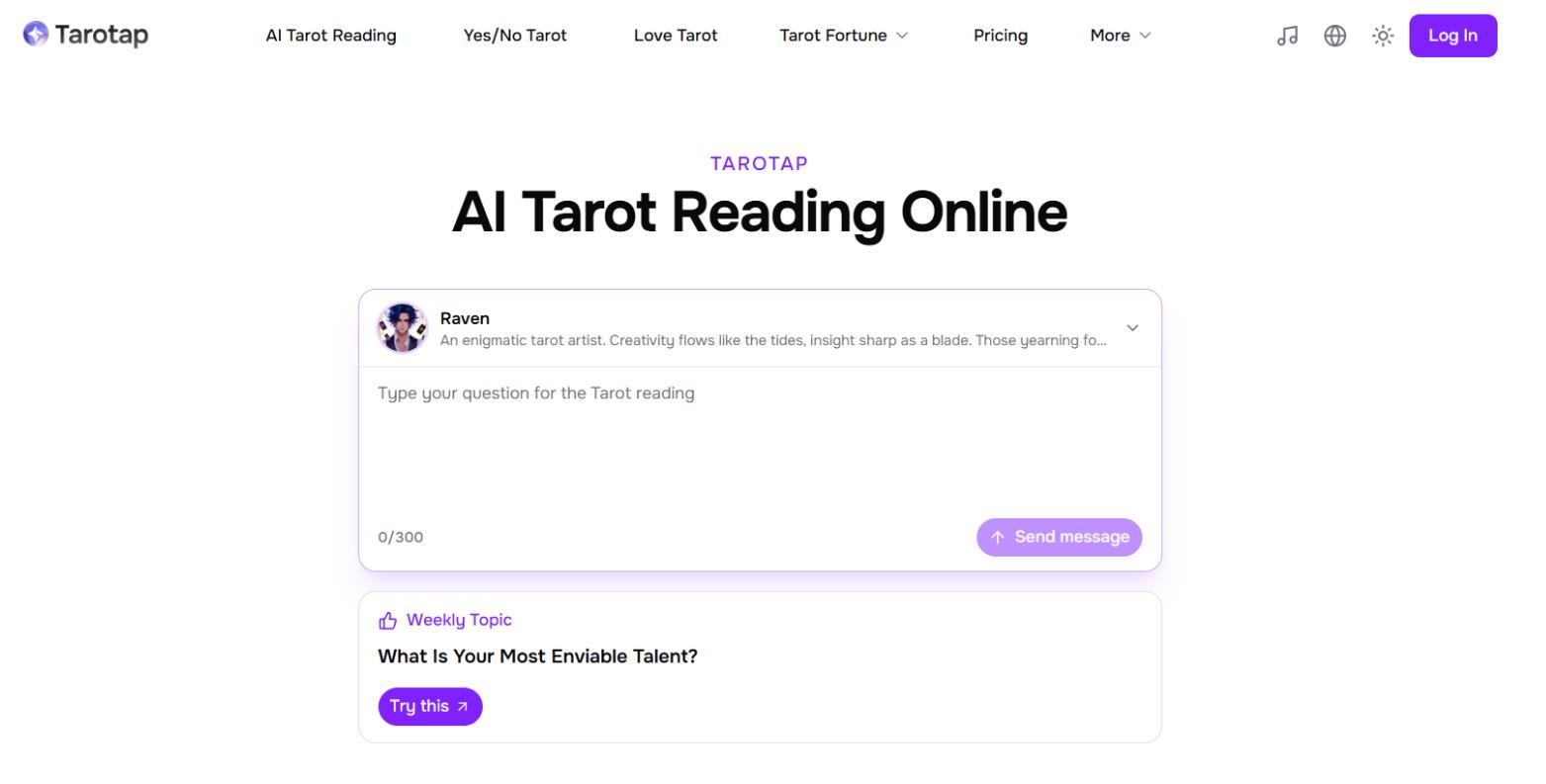
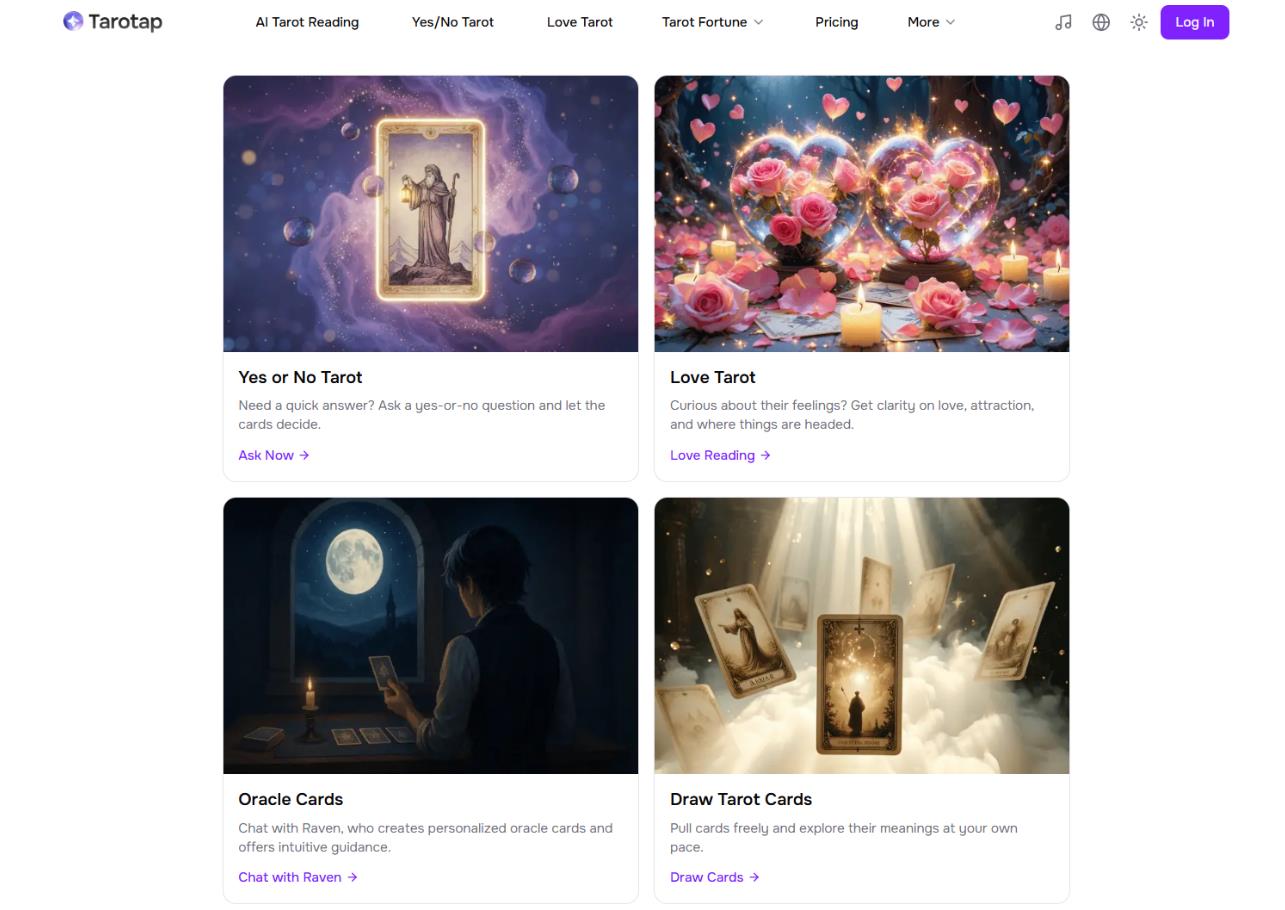
Tarotap (tarotap.com/en) is a browser-based AI assistant for Tarot card readings. The key word here is “assistant.” The platform doesn’t position itself as an oracle dispensing absolute truth. Instead, it’s more like a tool for brainstorming and emotional support.
From a technical standpoint, it combines the traditional symbolism of the Rider-Waite-Smith deck (including reversed cards) with generative AI to produce coherent, personalized interpretations.
Tarotap is trying to digitize an ancient tool for self-reflection using artificial intelligence. Not as a replacement for a human reader, but as an alternative for everyday questions and daily reflection.
Platform and Pricing
Tarotap is only available as a web service — there are no mobile or desktop apps. The project runs on a freemium model: basic features are free, but advanced options require a subscription. To generate answers, users are given an in-app currency called Pentacles.
| Plan |
Free |
Plus |
Pro |
|
Price |
Free |
$10.83/month |
$83.33/month |
|
AI Tarot Reading |
1 per day |
Unlimited |
Unlimited |
|
Pentacles |
5 per day |
50 per day |
500 per day |
|
Follow-up questions |
Minimal |
8 per reading |
20 per reading |
|
Manifestation Goals |
1 |
3 |
Unlimited |
|
Deep Insight |
No |
Yes |
Yes |
|
Custom AI readers |
No |
1 |
5 |
|
Long prompts & session memory |
Limited |
Full access |
Full + advanced access |
You can change or cancel your subscription at any time.
Who Is It For and What Does It Do?
The service is upfront about what it isn’t: a tool for medical, legal, or financial decisions. And definitely not a replacement for therapy. Tarotap is meant for three things:
- Self-analysis and reflection. When you phrase a question for the AI, you’re already structuring your problem.
- A jumping-off point for thinking. The AI gives you an interpretation that might spark an unexpected idea or direction.
- Accessible practice. It’s a way to learn the logic of Tarot without buying a physical deck or memorizing the meanings of all 78 cards.
The target audience is tech-savvy millennials and Gen Z who are interested in “spiritual tech.” Also busy people who don’t have time to find “their” tarot reader in the middle of the night.
How Does a Tarotap Reading Work?
Technically, it all looks very simple, but behind the scenes there’s some solid prompt engineering.
- Ask your question. You type your question in natural language (many languages are supported).
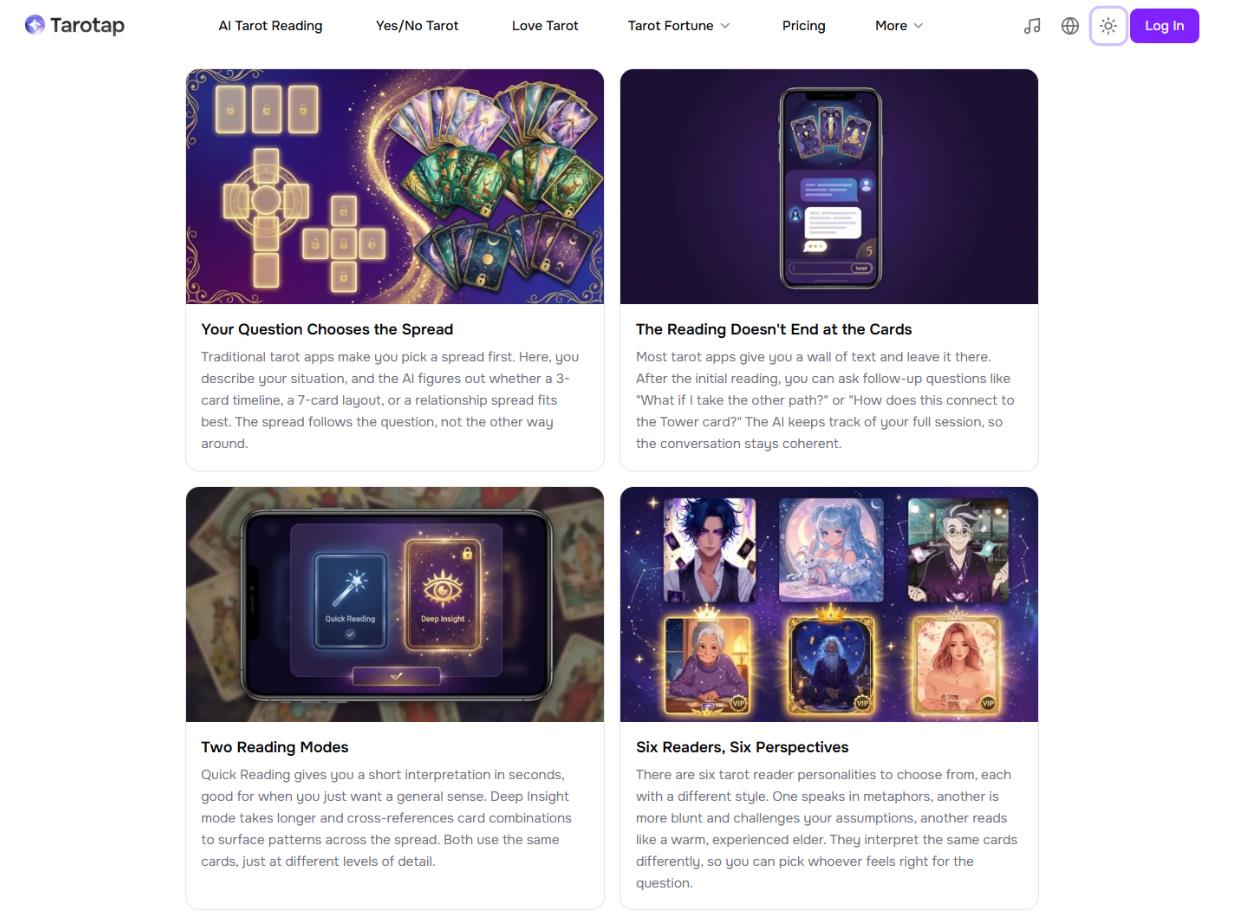
- Automatic spread selection. This is the service’s signature feature. You don’t need to know what a Celtic Cross or a Horseshoe spread is. The AI analyzes your question and decides how many cards to draw and in what order to lay them out. A question about work gets a different spread than a question about love.
- Pick a reader. You can choose from six pre-built AI personalities (a wise old woman, a straightforward logician, a metaphorical poet, etc.) or create your own — with a unique voice, tone of speech, and even an avatar.
- Get your result. There are two modes:
- Quick Reading — a short answer for when you’re in a hurry.
- Deep Insight — a detailed analysis of the connections between cards and patterns.
- Follow up. The system remembers the conversation context. You can ask, “What if I choose the other option?” and the AI will answer based on the previous spread.
Things to Keep in Mind
Tarotap comes across as a solid, ethical product — not another “spiritual grifter” startup. There’s a clear respect for both the tradition and the user. But before you jump in, it’s important to understand the limitations.
- It’s not magic. The service uses random number generation (RNG) for card draws and large language models (LLMs) for interpretations. Any coincidences with reality are either your brain doing its job (the Barnum effect) or pure statistics. Don’t expect the AI to read your boss’s mind.
- Freemium means limits. The free tier gives you one reading per day. That’s not enough for daily use. The Plus plan ($10.83/month) removes those limits and unlocks Deep Insight.
- Sensitive topics. The system blocks questions about health, drugs, crime, and large investments. It will politely decline to answer those.
- Smart spread selection. You don’t need to be an expert. You just ask a question, and the machine figures out which spread to use. It’s brilliantly simple and beginner-friendly.
- A sense of real conversation. Being able to ask follow-up questions within a session sets Tarotap apart from static “prediction generators.” The dialogue deepens the insight.
- Ideal foundation for refinement. The result of AutoPod’s work is not a final edit, but a very clean draft that is easy to finish manually.
- Reader customization. You can create the perfect advisor for your needs: strict or gentle, philosophical or pragmatic. It turns the process into a game and builds trust in the answers.
- Transparency and safety. No registration required to start. No intrusive ads. The service is upfront about its limitations (it doesn’t diagnose, doesn’t make 100% future predictions). That earns respect.
- Saves time and money. A session with a live tarot reader costs anywhere from $50 to $150 and lasts an hour. Here, you get an answer in ten seconds, almost for free.
- No “energy” or intuition. As good as the AI is, it can’t sense your mood from your voice or read your body language. For deep psychological wounds or real crises, you need a human being.
- Strict free-tier limits. One reading a day is far too little for anyone wanting to build a “daily card” ritual. It’s essentially just a demo mode.
- The service is still young. The project is just over a year old. There aren’t many long-term reviews yet, and there’s no established Russian-speaking community around it. It’s unclear how the service will evolve.
User Reviews and Ratings
On aggregators like TopAI.tools and AIPure, the rating holds steady around 4.3 to 4.5 out of 5. Many users note the “shockingly insightful” nature of the service: the AI sometimes delivers card combinations and phrasing that seem to know the intimate details of the user’s life. That creates a genuine “wow” effect.
On Reddit, you’ll find predictable comments like: “Better than some $95 human sessions.” Users compare the quality of the text to mediocre human consultations and end up choosing the AI.
Traditional tarot readers, on the other hand, criticize the service: “This is profanation,” “AI has no soul, it can’t interpret symbols.” But the voices of skeptics and traditionalists are drowned out by the overwhelmingly positive feedback from the mainstream audience.
Conclusion
Tarotap is an honest, well-crafted tool for anyone who wants to use Tarot’s ancient symbolism to sort through their thoughts but isn’t ready to spend serious money or dive headfirst into esotericism.
It’s not a replacement for a therapist or a spiritual mentor. Think of it as a pocket-sized journal and prompt generator. It’s perfect for “thinking out loud” situations: whether to take a new job, whether to patch things up after an argument, or just to get a sense of what energy might accompany you through the day.
If you treat it as a game with a smart algorithm or a modern way to journal — it’s fantastic. If you’re searching for sacred knowledge or absolute truth, you’re better off finding a live reader offline. In its niche of “AI for self-reflection,” Tarotap currently looks like one of the leaders in terms of mechanical polish and depth of personalization.
❓ Frequently Asked Questions
Answers to relevant questions about this AI tool
Sources
-
Tarotap AI — tarotap.com
-
Tarotap Pricing — tarotap.com
-
Tarotap Blog — tarotap.com
-
Tarotap Yes or No Tarot — tarotap.com
-
Tarotap Draw Cards — tarotap.com
-
Tarotap Trustpilot Reviews — it.trustpilot.com