Gemini 3.6 Flash and 3.5 Flash-Lite: Google’s New Models
On this page
Google shipped three new Gemini models on July 21, and the release was atypical: no keynote, no new flagship, no claims about scaling another intelligence peak. Instead, there were three mid-tier models and one clear idea. Teams running AI agents in production do not need a smarter monster. They need fewer tokens burned, lower latency, and predictable behavior at a fixed price.
Google also let slip two things about what comes next: Gemini 3.5 Pro is already in partner testing, and the most ambitious pre-training run in the company’s history has begun for Gemini 4.
What Actually Shipped
The update covers the entire Flash line, the tier built for everyday high-volume work rather than benchmark records.
-
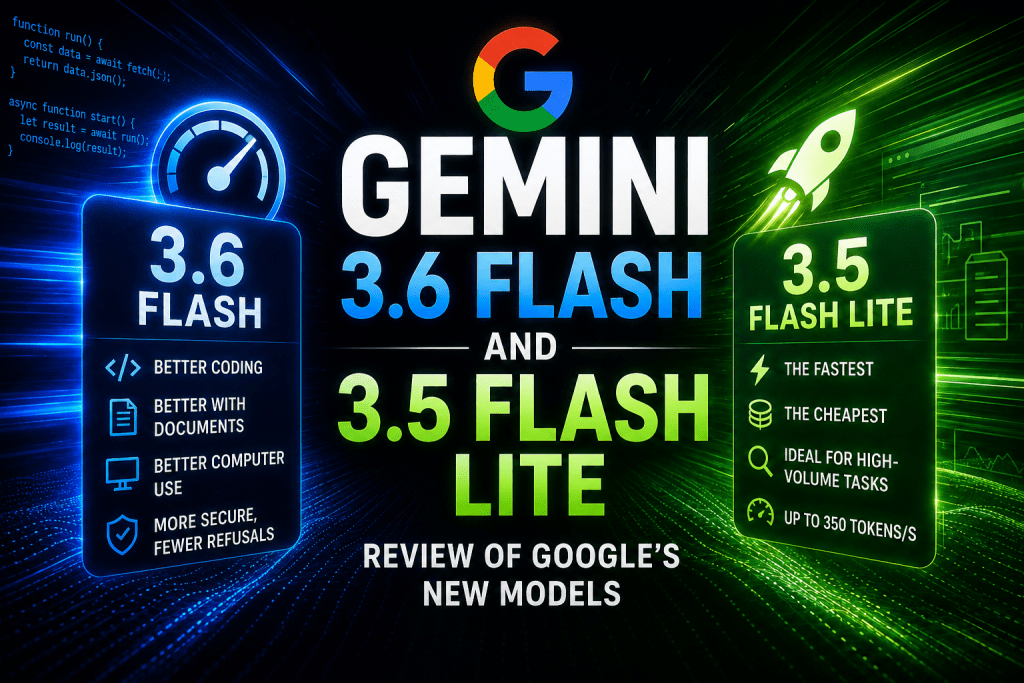
Gemini 3.6 Flash is the new mainline workhorse and successor to 3.5 Flash. Better at coding, better with documents, and noticeably cheaper in tokens spent.
-
Gemini 3.5 Flash-Lite is the fastest and cheapest model in the family, built for streaming workloads: agentic search, document processing, data extraction.
-
Gemini 3.5 Flash Cyber is a narrow model for finding and fixing code vulnerabilities. It will not be publicly available, going only to governments and vetted partners through the CodeMender agent. The reason is dual-use risk, and after the Mythos 5 and Fable 5 episode at Anthropic, AI developers have raised their caution levels.
Gemini 3.6 Flash: Cheaper Tokens and Leaner Inference
The interesting part of the new workhorse is not intelligence but economics. Per Artificial Analysis, the model spends 17% fewer output tokens than 3.5 Flash, and on long agentic scenarios like the DeepSWE benchmark the saving reaches 65%, because it takes fewer reasoning steps and calls tools less often.
At the same time, Google cut the output token price from $9.00 to $7.50 per million, with input holding at $1.50. The effects multiply: not only is each token cheaper, there are fewer of them per task.
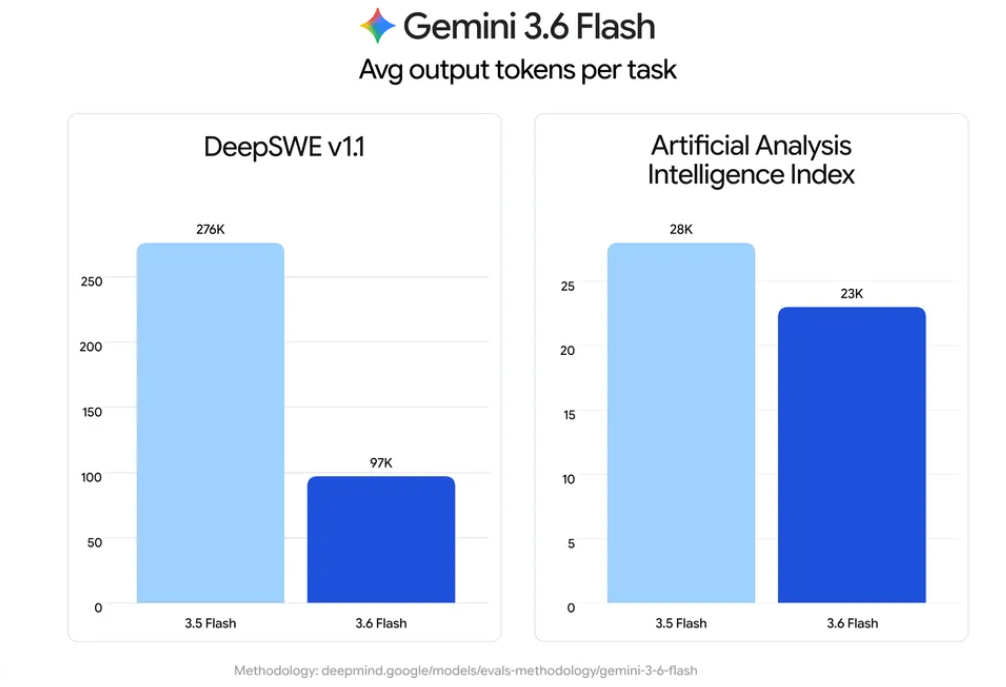
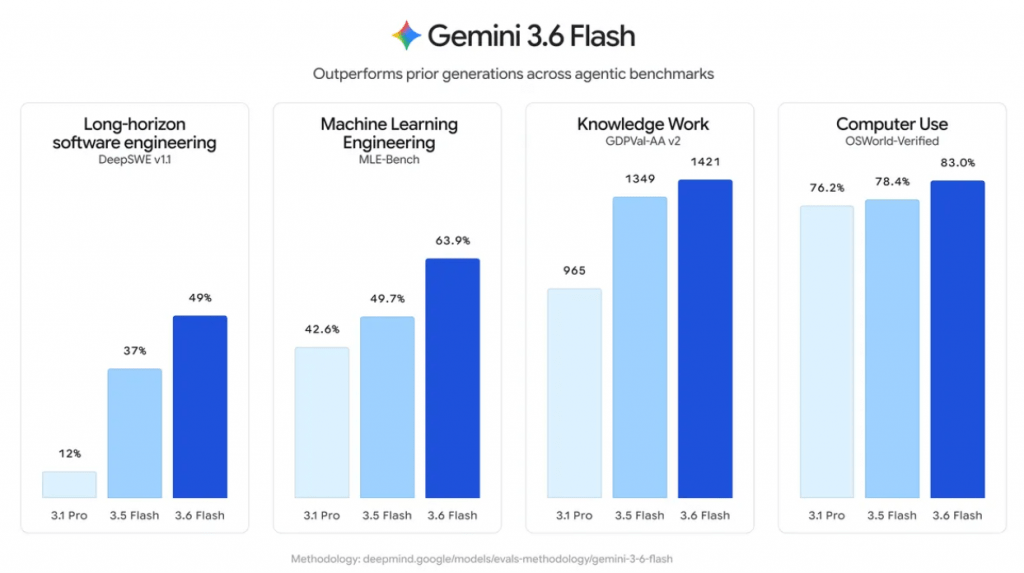
Against its predecessor, the published benchmarks show honest gains rather than cosmetic ones:
-
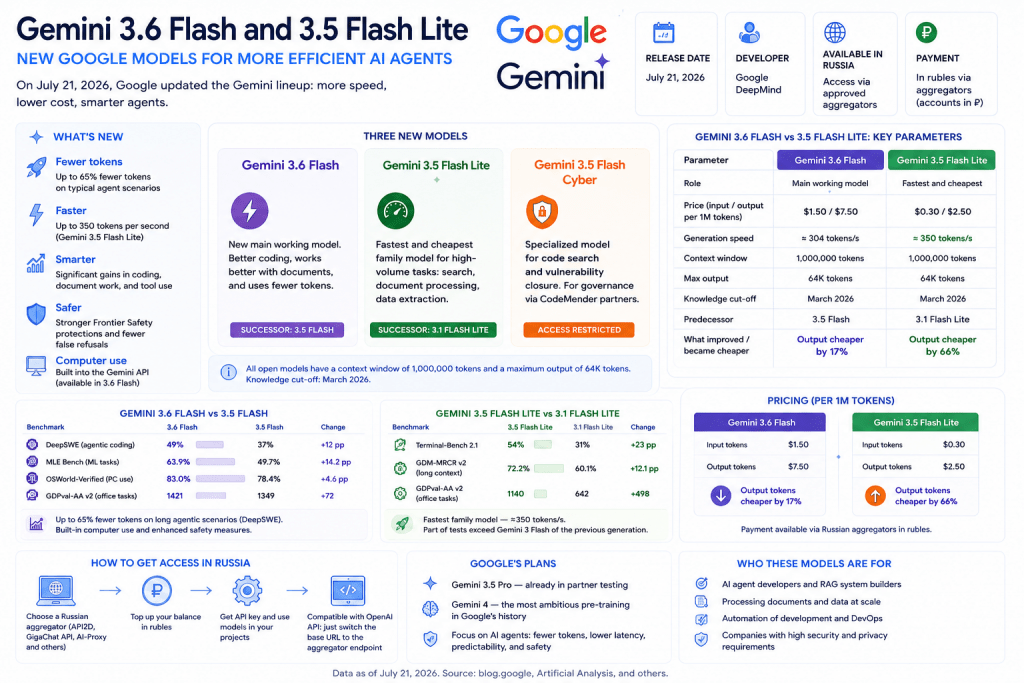
DeepSWE (agentic development): 49% versus 37%, meaning fewer unwanted code edits and execution loops
-
MLE Bench (ML research tasks): 63.9% versus 49.7%
-
OSWorld-Verified (computer use): 83.0% versus 78.4%
-
GDPval-AA v2 (knowledge work): 1421 versus 1349
Two things are genuinely new. Computer use is now a built-in tool in the Gemini API, so the model can drive a browser or desktop interface without third-party wrappers, a capability 3.5 Flash lacked entirely. And Google shipped enhanced Frontier Safety protections covering chemical, biological, and cyber risks, noting separately that the model was trained to refuse harmless requests less often.
Gemini 3.5 Flash-Lite: Speed Against Price
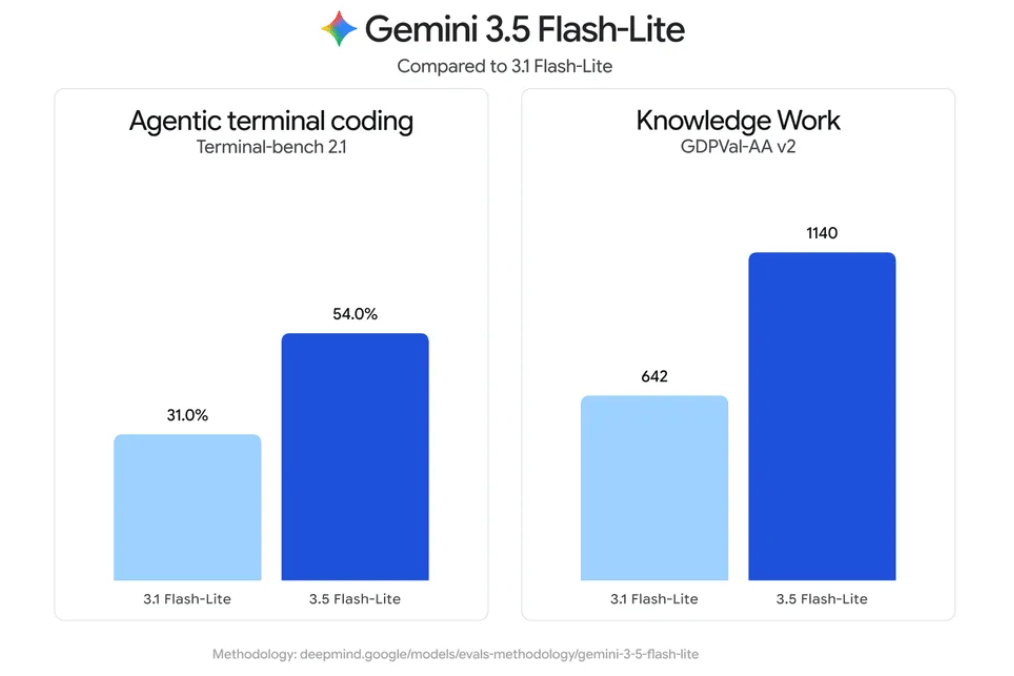
The junior model runs at roughly 350 tokens per second, the fastest in the family. It suits work where throughput matters more than depth: document indexing, extracting data from thousands of product cards, and agentic search. Developers can adjust the thinking level, so at minimum it answers instantly and almost for free, while at high settings it can carry multi-step subtasks inside an agentic system.
Its generational comparison looks more dramatic than the senior model’s, because the predecessor was notably weaker:
-
Terminal-Bench 2.1 (command line work): 54% versus 31%
-
GDM-MRCR v2 (long context): 72.2% versus 60.1%
-
GDPval-AA v2 (work tasks): 1140 versus 642, close to a twofold jump
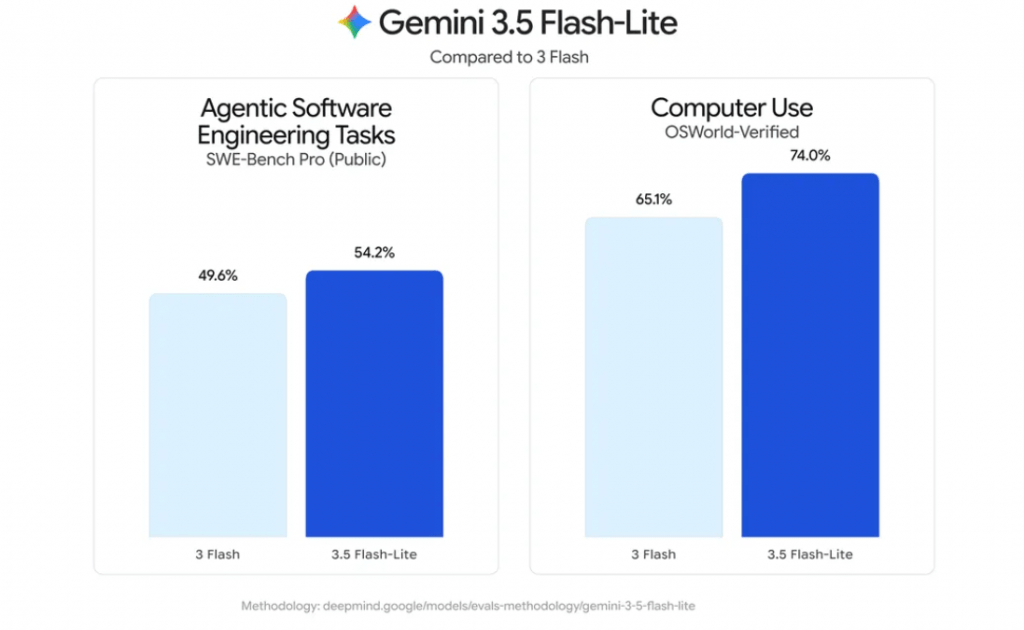
On some agentic tests, the small model even beats the previous generation’s full Gemini 3 Flash: SWE-Bench Pro at 54.2% versus 49.6% and OSWorld-verified at 74.0% versus 65.1%. The cheapest model of the new generation is smarter than yesterday’s workhorse, which is Moore’s law showing up in AI.
There is a catch the press release passes over quietly: Flash-Lite got noticeably more expensive. The previous 3.1 Flash-Lite cost $0.25 per million input and $1.50 per million output tokens. The new one runs $0.30 and $2.50, making inference roughly two-thirds costlier on output. The logic is clear enough, since the model is far more capable, but projects whose economics were calculated at the old rates will need to run the numbers again.
The Two Models Side by Side
|
Parameter |
Gemini 3.6 Flash |
Gemini 3.5 Flash-Lite |
|
Role |
Mainline workhorse |
Fastest and cheapest |
|
Price (input/output per 1M) |
$1.50 / $7.50 |
$0.30 / $2.50 |
|
Generation speed |
~304 tokens/sec |
~350 tokens/sec |
|
Context |
1M tokens |
1M tokens |
|
Max output |
64K tokens |
64K tokens |
|
Knowledge cutoff |
March 2026 |
March 2026 |
|
Predecessor |
3.5 Flash |
3.1 Flash-Lite |
|
Price change |
Output 17% cheaper |
Output up two-thirds |
An Updated Knowledge Horizon
The most underrated aspect of the release is the date up to which these models know the world. Previous Gemini generations were trained on data ending in January 2025. Eighteen months of news, releases, library versions, and events simply did not exist for them. That threshold has now moved to March 2026, which is still not quite current but ahead of many competitors.
This changes daily practice more than some benchmarks do. The model will not insist that the newest version of a popular framework is last year’s, and you will not need to attach a web search every time you ask about recent events. Developers get current APIs and syntax in suggestions. Content teams get fewer hallucinations and less cleanup after a model that was living two years in the past.
Where You Can Use Them
Both public models are generally available and production-ready through the Gemini API and Google AI Studio, which offers a free tier for prototyping before pay-as-you-go. Enterprise surfaces are also listed: Antigravity, Android Studio, and the Gemini Enterprise Agent Platform. For Vertex AI specifically, it is worth confirming the listing in the console, since availability there can lag. Flash Cyber has no public API pricing or self-serve access at all, since it is a pilot running inside CodeMender.
Early Reactions
Less than two days have passed since release, so there is no mass statistics yet. The early signals agree on one thing: this reads as a solid working update rather than a sensation.
Google partners who tested the models before the announcement praise the economics above all. Legal service Harvey reports roughly 12% faster task completion, and research platform Hebbia notes progress in parsing documents and charts and drafting reports. Figma and JetBrains also gave positive feedback. Among the junior model’s early customers are Palo Alto Networks and the fintech Ramp, where the key point is the combination of speed and price when processing large volumes.
Practitioners echo the same in their own words: 3.6 Flash works well specifically as an agent engine, noticeably faster, lighter on limits, and needing correction less often. That last point matters most, since the time saved on rework usually exceeds the gain in raw generation speed.
The skepticism is reasonable too. Google measured these improvements itself on benchmarks it selected, and independent measurements are still coming. One is already in: Artificial Analysis scores 3.6 Flash at 50 on its intelligence index, exactly the same as 3.5 Flash. Faster and cheaper, in other words, not smarter.
How They Compare
Both new models play in the middle class, where what decides things is not absolute intelligence but cost per task.
|
Model |
Output price per 1M |
Context |
Niche |
|
Gemini 3.6 Flash |
$7.50 |
1M |
Agents, coding, document work |
|
Gemini 3.5 Flash-Lite |
$2.50 |
1M |
High-throughput streaming tasks |
|
Claude Sonnet 5 |
Above average |
1M |
Agentic and work scenarios, text quality |
|
GPT-5.6 |
Flagship level |
Large |
Universal and complex tasks |
|
DeepSeek V4 Flash |
Minimal |
1M |
Budget high-volume work |
What this shows: Gemini leads on context and price per agentic task, Claude Sonnet 5 remains stronger for careful work with text and documents, GPT-5.6 handles complex universal scenarios, and DeepSeek wins on outright cheapness.
Pros and Cons
-
Agentic economics: 17% fewer output tokens at a lower price than before
-
Knowledge current to March 2026 instead of January 2025
-
Computer use as a built-in tool, with no third-party wrappers
-
Gains across every published benchmark, close to twofold for Flash-Lite
-
One million tokens of context and multimodal input retained
-
Flash-Lite got more expensive, with output tokens up two-thirds over its predecessor
-
All improvement figures come from Google’s internal measurements, with little independent confirmation so far
-
The one independent score available shows equal intelligence to 3.5 Flash, not better
-
Flash Cyber is closed to the public, and the promised Gemini 3.5 Pro is still only with partners
Conclusion
Google did not roll out another giant. It did what developers have been asking for: made the working models spend fewer tokens, respond faster, and behave predictably in long agentic scenarios. Gemini 3.6 Flash also got cheaper, which is atypical for the industry. The flip side is the pricier Flash-Lite, where the junior model’s added intelligence comes with a bill.
❓ Frequently Asked Questions
Answers to relevant questions about this AI tool