DorkGPT translates plain English queries into advanced Google search operators. Free, no registration. Speeds up OSINT, penetration testing, and security audits. Not a search engine — a query generator for ethical use only.
Master Advanced Search: The Ultimate DorkGPT Review
On this page
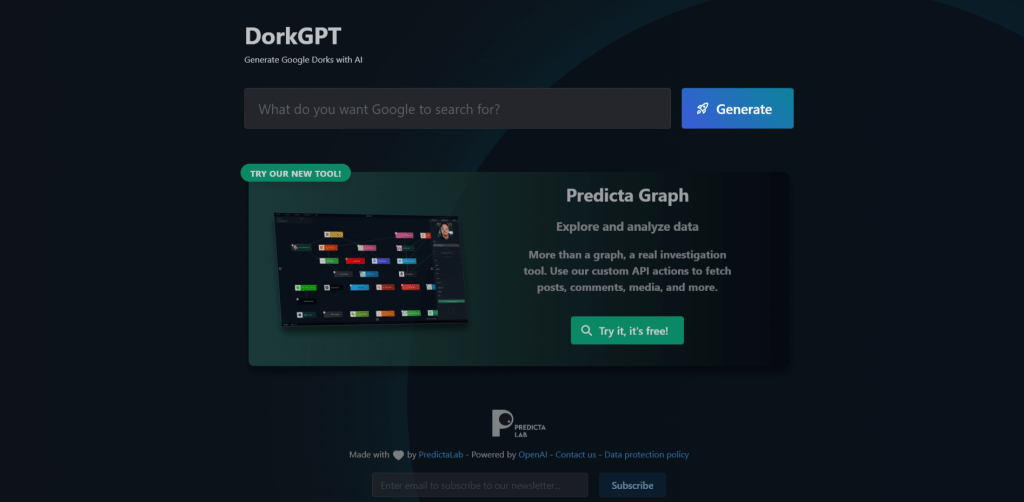
DorkGPT is a web-based artificial intelligence tool that translates ordinary natural language queries into advanced Google Dorks search commands.
Developed by the French team at PredictaLab — a company specializing in digital security and search technologies — DorkGPT provides access to its core functionality through the website dorkgpt.com with no registration required.
What Is DorkGPT and What Is It Used For
Google Dorks (also known as Google Hacking) refers to the use of special operators in web search. You have likely encountered them in Google Search documentation, and perhaps you use them yourself. Here are some familiar examples:
site:to restrict searches to a specific domainfiletype:to filter by file typeinurl:andintitle:to search within URLs and page titlescache:to view saved copies of pages
These types of queries make it possible to find information that typically remains unnoticed during standard searches: open directories, admin panels, technical documents, configuration files, and much more.
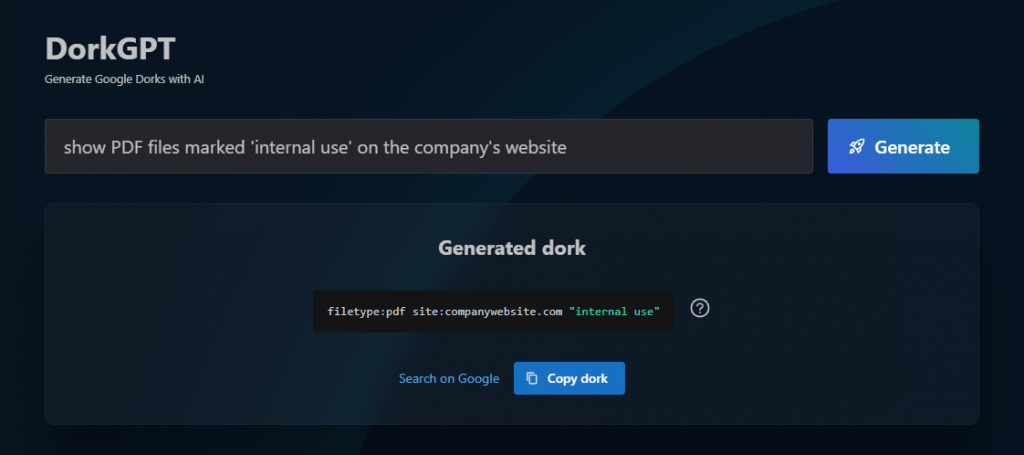
DorkGPT was created to simplify dorking for users. Instead of memorizing dozens of operators and their combinations, you can now simply describe your goal in plain language. The AI handles the translation of human phrasing into syntactically correct search constructs. For example, you type “find PDF files with reports on company.com,” and the service returns a query template such as site:company.com filetype:pdf “report.”
How DorkGPT Works
From a technical standpoint, DorkGPT is a specialized wrapper around OpenAI’s language models. The usage process is extremely straightforward:
- The user enters a text description of what they need to find.
- The AI analyzes the request and generates one or more ready-to-use Google Dorks.
- The user copies the resulting command and pastes it into Google’s search bar, or clicks “Google Search” right under the result window.
It is important to understand that DorkGPT does not perform searches itself and does not analyze results. It is simply a query generator for pasting into a search engine. The quality of the results depends entirely on the search engine and how accurately the tool interpreted your intent.
The tool works through any standard browser, requires no additional software installation, and is accessible from any device with an internet connection. As of early 2026, the service attracts more than 200,000 unique visitors monthly.
Who Can Benefit From DorkGPT
The primary audience for the service consists of professional and semi-professional users who already possess a basic understanding of the boundaries of working with public information.
- Cybersecurity professionals (SOC analysts, penetration testers) use DorkGPT to automate routine reconnaissance tasks and attack surface assessments.
- OSINT researchers and journalists use the tool to accelerate data collection from open sources.
- SEO specialists can generate queries to analyze the indexing of competitors’ websites and their own projects.
- Even recruiters, despite stereotypes, are among the active user base: with DorkGPT, they find specialist profiles on professional platforms by formulating queries in natural language.
Is DorkGPT useful for complete beginners? Hardly. If you are learning about dorks for the first time from this article, you would benefit from first understanding what search operators are and how to interpret search results. However, with DorkGPT, the barrier to entry is significantly lower compared to manually writing complex search constructs.
Practical Use Cases
DorkGPT has several applications across different domains. Below are a few examples demonstrating how DorkGPT assists with specific practical scenarios.
Use Cases for Cybersecurity Professionals
The most obvious scenario is auditing your own infrastructure. You can ask DorkGPT to generate queries for finding exposed admin panels on your domain or configuration files that have accidentally become publicly accessible.
For example, a query like find .env and .log files on the domain mycompany.com becomes a construct such as site:mycompany.com (filetype:env OR filetype:log).
Use Cases for OSINT Researchers
Gathering information from open sources is a classic use case. DorkGPT helps quickly create queries to find public profiles, resumes, mentions of individuals or organizations in specific contexts. Recruiters, for instance, use similar constructs to find developers on LinkedIn with a particular technology stack.
Use Cases for Education
In cybersecurity and digital literacy curricula, the tool demonstrates how search operators work and shows what information about a company or individual can be publicly available without specialized skills.
A real-world example: a query such as show PDF files marked ’internal use’ on the company’s website allows a security team to assess the actual level of information exposure and take steps to restrict access to sensitive documents.
Nuances and Limitations
DorkGPT has several characteristics worth knowing before you start using it.
- Dependence on input quality is a key factor. The more precisely you formulate your request, the more adequate the result will be. Vague descriptions produce equally vague dorks.
- The most important aspect is ethical and legal. DorkGPT only generates search commands; it does not control what you search for or how you use what you find. Searching for sensitive data without proper authorization may violate laws and Google’s terms of service. The tool is intended for legitimate purposes: auditing your own systems, conducting research with the rights holder’s permission, and educational tasks.
- Google may block or limit overly aggressive automated queries. This is not a problem with DorkGPT itself but rather a limitation of the search ecosystem.
The tool does not replace expertise. A generated dork may require manual refinement, especially for complex or highly specialized tasks. Furthermore, DorkGPT does not explain what each operator in the resulting construct means — that remains the user’s responsibility.
Platforms and Availability
DorkGPT is exclusively a web service. It is accessible through any modern browser, requires no application or extension installation. Mobile versions are not officially announced, but the site adapts to smartphone screens.
An important point: DorkGPT itself is free. However, the PredictaLab team develops related products — Predicta Search for advanced search and Predicta Graph for OSINT data visualization. Predicta Graph offers a free tier (up to 3 graphs, export to JSON/PNG) and a Pro version at $1,135 or €990 per year.
The paid tier does not restrict the basic dork generation functionality.
Comparison With Competitors
Direct analogues of DorkGPT include specialized dork generators such as DorkSearch. However, the main competition comes from general-purpose AI chatbots. You can open ChatGPT, Claude, or Google Gemini and ask: “generate a Google Dork to search for PDF files on example.com.” They will handle this perfectly well.
Where does DorkGPT differ? In specialization and simplicity. General-purpose chatbots require more precise phrasing and sometimes “forget” to use the necessary operators. DorkGPT is purpose-built for this task, delivering more stable and structurally correct results for search queries.
Alternatives such as manual dork lists (for example, the Google Hacking Database or GHDB) and the OSINT Framework provide ready-made constructs but require the user to know how to adapt them to a specific task. DorkGPT, by contrast, adapts the query dynamically.
Thus, DorkGPT is not a revolution but a convenient evolution of existing approaches. It occupies a niche between “ready-made recipes” from databases and “generalists” like ChatGPT.
Comparison Table: DorkGPT and Alternatives
Below is a comparison of DorkGPT with the most notable alternatives across key parameters.
|
Tool |
Type |
Key Feature |
Pricing |
Primary Platform |
Target Audience |
|---|---|---|---|---|---|
|
DorkGPT |
AI Generator |
Specializes specifically in Google Dorks, simple interface with no registration, backed by French team PredictaLab |
Free (basic generation) |
Web |
Beginners and professionals in OSINT/cybersecurity |
|
DorkGenius |
AI Generator |
Works with multiple search engines: Google, Bing, DuckDuckGo |
Free / Freemium |
Web (AI app) |
Researchers working with different search engines |
|
SearchDorks |
AI Generator |
Supports not only web search engines but also specialized engines (Shodan, Censys, ZoomEye, FOFA) |
Free / Freemium |
Web |
Cybersecurity professionals and device intelligence specialists |
|
Dork Assistant |
AI Generator |
Oriented toward OSINT, journalistic investigations, and technical intelligence |
Free |
Web |
Investigative journalists and OSINT specialists |
|
Google Hacking Database (GHDB) |
Database |
Massive collection of time-tested dorks from the community, creators of Exploit-DB |
Free |
Web archive |
Penetration testers and security researchers |
|
ChatGPT / Claude |
General-purpose AI Chatbot |
Can generate dorks but is not purpose-built for the task; requires precise prompt formulation |
Free / Subscription (from $20/month) |
Web, API, mobile apps |
General users who occasionally use dorking |
|
Dorkinator |
Automated Tool |
Automatically performs searches; evaluated as faster than alternatives based on user test results (t-stat 4.32, p=.0001) |
Free / Freemium |
Web app |
Penetration testing specialists who value speed |
The choice between these tools depends on your specific tasks. DorkGPT represents a middle ground: it is simpler than general-purpose chatbots because it is already “tuned” for dork generation, yet it lacks the flexibility of tools like SearchDorks, which work with Shodan. Tools such as Dorkinator go further by not only generating queries but also executing them, saving even more time.
User Reviews and Ratings
Within professional OSINT and cybersecurity communities, the general attitude toward DorkGPT is positive. The tool is frequently included in collections of useful utilities and recommended as a practical solution. Users note its generation speed and interface convenience.
Criticism mainly revolves around limitations. Some users initially find it difficult to formulate queries that yield good results. With complex requests, generation quality declines and manual adjustments become necessary.
- Significantly reduces the time required to create complex search queries
- Lowers the barrier to entry for beginners in OSINT and security
- Available for free with no registration, directly in the browser
- Actively supported and mentioned within the professional community
- Integrates into the PredictaLab ecosystem for expanded data analysis
- Generation quality depends directly on the precision of user input
- Does not perform searches or analyze results independently
- Requires understanding of ethical and legal boundaries of use
- May produce results that require manual refinement for complex tasks
Conclusion
DorkGPT is a clean example of how artificial intelligence democratizes access to advanced search techniques. For the OSINT and cybersecurity community, DorkGPT has become a convenient power tool in the daily arsenal. It accelerates workflows, reduces the number of syntax errors, and makes Google Hacking more accessible to beginners. However, relying solely on AI generation without understanding exactly what you are searching for and why would be a mistake.
If you are involved in asset security, lawful OSINT research, or simply want to learn how to search for information more effectively, DorkGPT deserves a place in your tool collection. But remember: the most valuable information comes not from a query generator but from the ability to ask the right questions and handle the answers responsibly.
❓ Frequently Asked Questions
Answers to relevant questions about this AI tool
Sources
-
DorkGPT — dorkgpt.com
-
DorkGPT Privacy Policy — dorkgpt.com
-
DorkGPT Review - Pricing & Alternatives — conversiongems.com
-
DorkGPT (2026): Free Trial, Real Pricing & Honest Review — comparateur-ia.com
-
DorkGPT 2026: Free AI Google Dork Generator + Examples — thetoolsverse.com