Your AI data analyst with fully transparent insights on demand.
Zenlytic: AI-Powered Self-Service Data Analytics
On this page
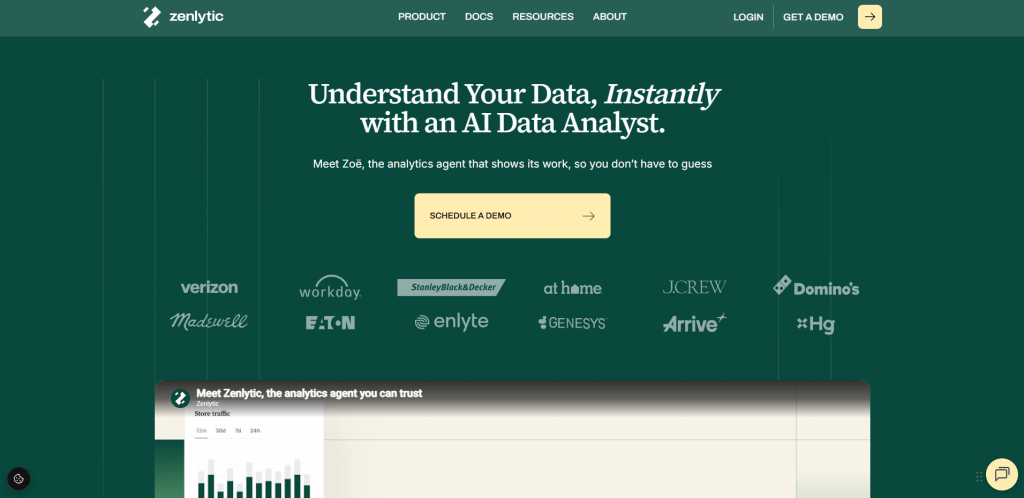
What Zenlytic Is and How It Works
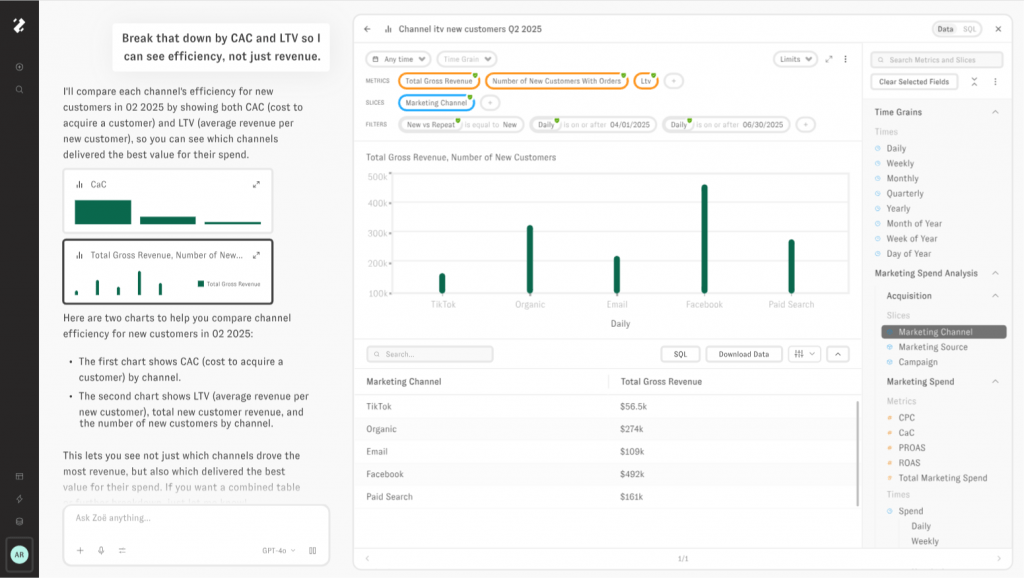
Zenlytic is an AI data analytics platform built around a conversational agent. Unlike classic systems like Tableau or Looker, where AI is added as an add-on feature, here the agent is the core. The main goal is to turn plain English questions into trusted insights in seconds. The workflow looks like this:- Connection. You integrate Zenlytic directly with your cloud data warehouse: Snowflake, Google BigQuery, Databricks, or Amazon Redshift. No ETL processes or lengthy migrations are required.
- Question. The user asks a question in plain language through the web interface, Slack, Teams, or email. For example: “Show me the month-over-month change in customer acquisition cost for the last quarter.”
- Processing. Zoë generates an SQL query using its own Clarity Engine (a hybrid of SQL and a semantic layer). She automatically learns from the team’s questions, creating new metrics if they are not yet present in the model.
- Answer. You receive a visualization, table, or report. The key difference is full transparency: Zoë shows data citations, data lineage, and a step-by-step explanation of her reasoning.
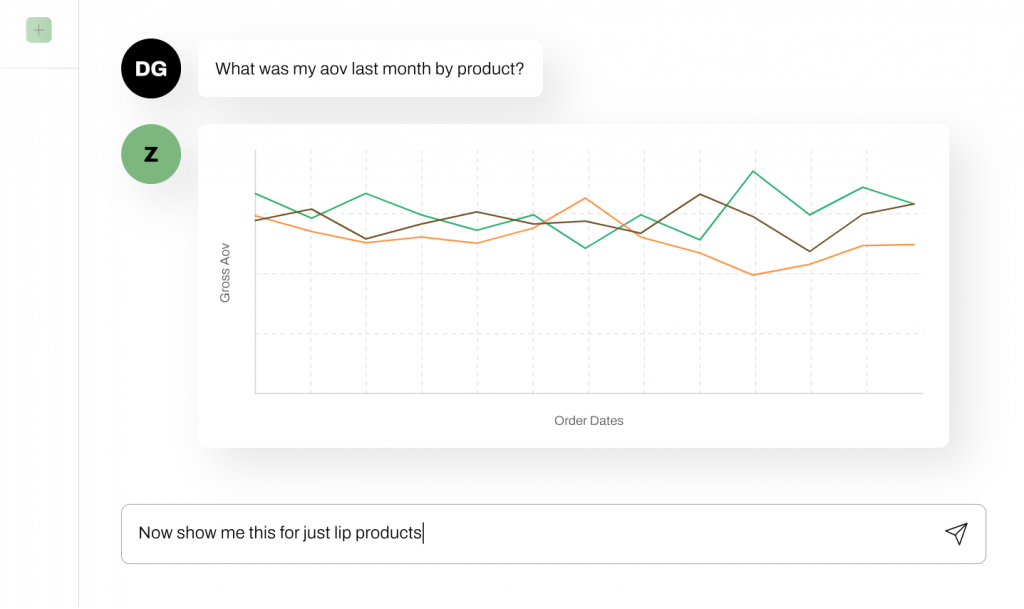
- Deepening. Thanks to the Memories mechanism, the agent remembers the context of previous questions, so follow-up queries work like a normal conversation.
What It Is For and Who Will Benefit
The tool is aimed at companies that already have a data warehouse and an analytics team, but business units still complain about slow ad-hoc queries. Zenlytic does not replace BI entirely. But it closes the gray zone between “we have dashboards” and “we need an answer to a complex question right now.” The product will be useful for:- Mid-market and Enterprise companies in retail, e-commerce, manufacturing, SaaS, and finance.
- Data teams drowning in requests from marketers, finance professionals, and operations managers.
- Non-technical business users without SQL: executives, product managers, marketers who need fast answers without intermediaries.
- Organizations with high trust requirements: it matters not just to get an answer from an LLM, but to see its justification and data provenance.
Use Cases for Business and Personal Purposes
Although the platform is designed for business analytics, for personal use it is realistically applicable only if you have a serious personal project with your own data warehouse. For most individual tasks, it is overkill. The core value is realized in team collaboration. Here are some interesting possibilities Zoë offers to small teams:- Churn Analysis. Retail brand LOLA reduced customer churn by 10% using Zoë to identify early signs of subscription cancellation.
- Marketing Attribution. A marketing leader can ask: “Which channels drove the highest LTV for customers acquired in June?” without analyst help.
- Root Cause Analysis. A manufacturing company identifies defect causes across multiple plants in minutes instead of days.
- Sales Funnel Analysis. Revenue operations track deal velocity and conversion rates by segment in real time.
- Impact of External Factors. Assessing the effect of tariff changes, seasonality, or other factors on net revenue.
Platforms
A web application that integrates with workplace messengers: Slack, Microsoft Teams. Email and Discord are also supported for sending queries and receiving reports. The service requires a connection to cloud data warehouses — Snowflake, BigQuery, and others.Pricing
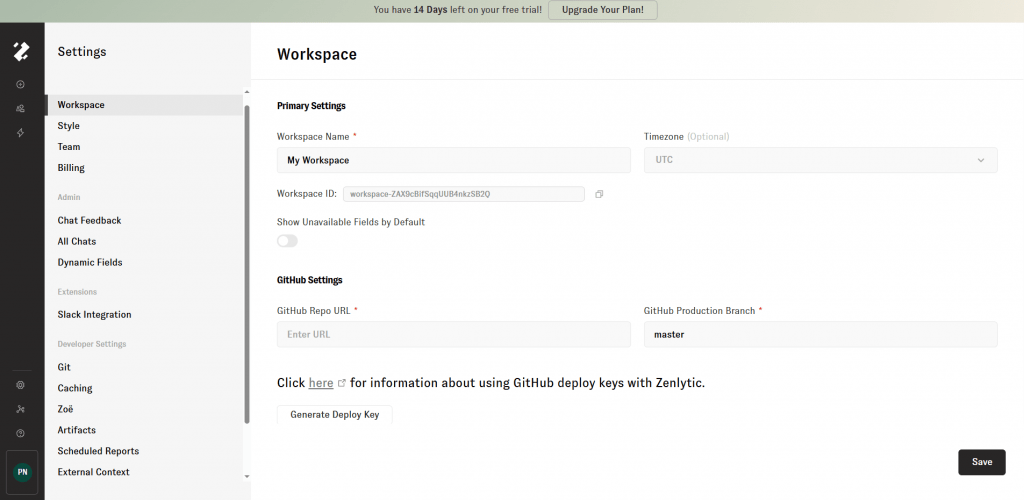
Prices for Zoë’s services are not published openly — they become available only after you sign up for a trial. The free trial period is 14 days, activated immediately upon registration. Then you will be offered a plan upgrade. Unlike many enterprise solutions, Zenlytic offers a transparent plan for small teams that does not require lengthy negotiations with a sales department. Corporate pricing remains custom. But for starting out and evaluating the product, there is an official Self-Service Plan. Below is the pricing structure based on the platform’s current offer as of May 2026.| Plan Name | Self-Service Plan |
| Cost per Seat | $79 per user per month |
| Number of Included Seats | 3 user seats |
| Estimated Amount Due | $199 per month (calculated estimate based on usage) |
User Reviews and Ratings
As of 2026, reviews of Zenlytic are very positive, especially among mid-market and enterprise clients. On Gartner Peer Insights, the average rating is around 4.9 out of 5, with many 5-star reviews. Users ranging from CTOs to Directors of Demand Planning highlight three main advantages:- Work Transformation. “80% of my queries now start with Zoë, not an analyst.”
- Time Savings. The tool genuinely saves dozens of hours per week for data teams.
- Business Results. Reviews mention not just “nice features” but concrete outcomes: churn reduction, preventing stockouts, detecting fraud.
Pros
- Exceptionally high trust in answers thanks to end-to-end transparency: citations, lineage, and step-by-step reasoning explanations.
- Fast time-to-value: first insights within days of connection, not months of modeling.
- Genuinely empowers non-technical users without losing data team control over metrics and access rights.
- Ability to answer complex exploratory questions requiring multiple sources, temporal logic, and multi-step reasoning that dashboards cannot handle.
- Eliminates LLM “hallucinations” for business-critical questions thanks to the Memories mechanism, ensuring consistent answers for the same metric.
Cons
- Opaque custom pricing that requires requesting a demo and a sales quote, making it difficult to compare costs with competitors.
- High dependence on the quality, documentation, and structure of your existing data warehouse.
- As a relatively young tool, it has fewer pre-built connectors and a smaller ecosystem compared to giants like Tableau or Looker.
- For very simple tasks and static dashboards, it can be overkill: a classic BI tool would solve the problem more simply and cheaply.
Conclusion
Zenlytic is not just another BI tool with a trendy AI add-on. It is a complete analytics agent that solves the main problem of generative models in business: distrust of answers. Thanks to the Clarity Engine and Memories mechanisms, it provides transparency and consistency, while integrations with warehouses and messengers make analytics truly accessible to business users. For mid-market and enterprise companies that already have a data warehouse but whose analysts are overwhelmed with ad-hoc requests, Zenlytic offers a clear ROI: saving dozens of hours per week and accelerating decision-making. Do we recommend it? Absolutely, but it depends on who. It is unlikely to be useful if your tasks are limited to simple dashboards or you do not have a structured data warehouse. But if you need an honest, explainable, and fast AI analyst for complex questions — Zenlytic is one of the strongest options on the market today.FAQ
❓ Frequently Asked Questions
Answers to relevant questions about this AI tool
How is Zenlytic different from ChatGPT connected to data?
A chatbot does not understand your business definitions, does not guarantee the same answer to the same question, and does not show data provenance, whereas Zenlytic is built specifically for consistency and trust.
Is a team of analysts needed for implementation?
Basic setup requires minimal data team involvement to connect the warehouse and set initial access rights, but business users can work independently.
Can Zoë automatically build dashboards?
Yes, answers can be saved as dynamic dashboards that update when new data arrives, but the tool’s core strength lies in ad-hoc exploratory questions.
How is data security ensured?
Zenlytic does not store your data; all queries run on top of your warehouse using row-level and column-level permissions and encryption.
Does Zenlytic support dbt?
Yes, the platform has built-in dbt support, allowing you to use pre-existing data transformation models.
What is the minimum plan and price?
There is no public information; pricing is custom and discussed only after a demo, with a suggested range for enterprise being thousands of dollars per month.
Sources
-
Zenlytic — zenlytic.com
-
Zenlytic Privacy Policy — zenlytic.com
-
Zenlytic Docs - Terms of Service Agreement — docs.zenlytic.com
-
Zenlytic Docs - Data Processing Addendum — docs.zenlytic.com
-
Zenlytic Docs - Customer Support Policy — docs.zenlytic.com
-
Zenlytic GitHub — github.com
-
Zenlytic Reviews - G2 — g2.com