Main page » Vibecoding: A New Approach to Programming
Vibecoding: A New Approach to Programming
Published: 10/31/2025Updated: 08/28/20266939 min readby Judely Delva
The traditional way of programming is gradually taking a backseat, where every line of code had to be manually typed. A new approach is emerging, allowing programs to be created with minimal coding.
This is called “vibecoding.”
To put it simply, it works like this: you don’t write the code yourself; instead, you describe the task in plain language—what you need the program to do. A specialized AI then generates the working code based on your description.
This means the essence of programming is slowly but surely changing. You no longer need to memorize every rule and syntax in detail. Being able to clearly and concisely define the task is enough. Now, virtually anyone can build their own app, portfolio website, or game—without having to learn complex programming languages from scratch. There are some nuances, which we’ll explore in this guide.
What is Vibecoding?
Vibecoding can be explained without any technical jargon. Essentially,
it’s when you don’t manually write code but simply tell an AI what you need using everyday language.
Behind the scenes, this magic is powered by advanced AI tools that understand human language. You say, “Create a login form with fields for email and password,” and the AI delivers the finished code. No more spending hours typing out lines of commands.
Interestingly, the term “vibecoding” only emerged recently—in February 2025. It was coined by
Andrej Karpathy, a renowned machine learning expert who previously worked at OpenAI and Tesla. He describes it like this: “It’s not quite programming—I just envision something, say something, run something, copy-paste something, and it mostly works.”
It’s similar to asking a coworker for help with a task—you explain what needs to be done, and they handle the technical details. Here, instead of a coworker, an AI understands your words and turns them into functional code.
Key Features of Vibecoding:
- Minimal manual coding. It’s easier to provide a prompt and oversee the process than to write code from scratch.
- Iterative process—fixing errors. The initial code generated by AI isn’t always perfect, much like a first draft of a text or a sketch. The key is that you don’t have to rewrite everything yourself. You refine and tweak the result until it’s exactly what you need.
- Voice control. You don’t even have to type—prompts can be given using voice commands.
- Automated decision-making. AI models learn over time, resulting in fewer errors as they improve.
Tools for Vibecoding
Several specialized tools are available for applying the vibecoding approach in practice:
Cursor

Website:
https://cursor.com/
A reimagined version of VS Code with built-in AI capabilities. Available on Windows, macOS, Linux, and in browsers.
Pricing starts at $20 per month, but a free version is also available.
What makes it special?
Cursor doesn’t just write code based on prompts—it can manage entire projects, working across multiple files and understanding their connections. You describe a task, and it sets up the environment, organizes code into modules, and even fixes errors. It leverages models from OpenAI, Google,
DeepSeek, and
Anthropic, allowing you to choose your preferred one.
Since its interface resembles VS Code, it’s easy to get the hang of. It’s convenient for those who don’t want to constantly switch between a code
editor and an AI chatbot.
Windsurf
 Learn more about Windsurf
Windsurf
Learn more about Windsurf
Windsurf is another VS Code-based editor and a direct competitor to Cursor. Available on Windows, macOS, Linux, and as a plugin for other development environments.
Pricing starts at $15 per month, with a free trial option.
Its interface is simpler than traditional IDEs, likely designed for users who don’t want to deal with complex configurations. It can write code, make edits, and manage projects effectively.
Notably, it was recently acquired by OpenAI for $3 billion. Rumors suggest it will soon feature unique capabilities not found in other tools. It’ll be interesting to see what they come up with.
Replit
Link:
https://replit.com/
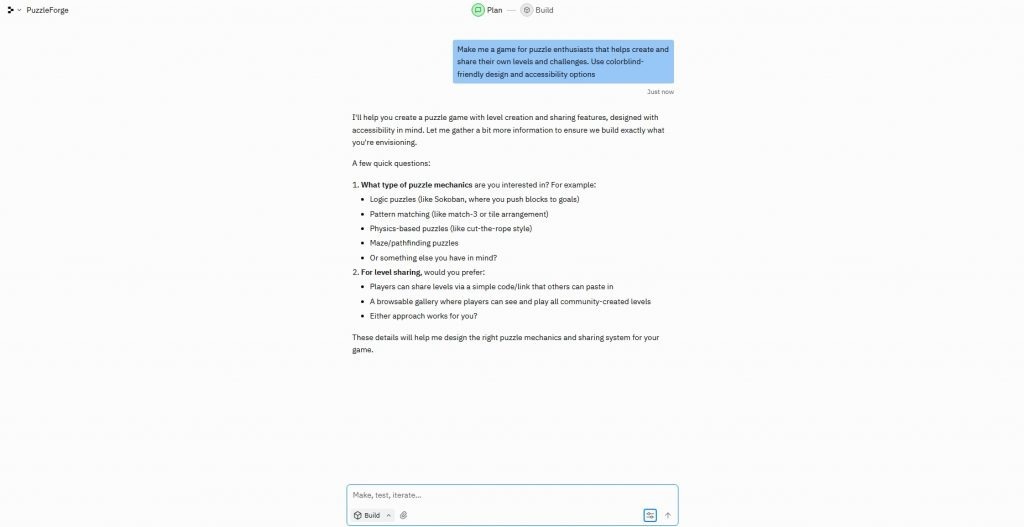
Replit is a cloud-based development environment.
Pricing starts at $20 per month, but you can start for free.
It’s ideal for building websites or mobile apps—you can write code and run it directly on their servers.
The main advantage is accessibility: open a browser and start working, even from a phone. However, this comes with a drawback—cloud-based editors can feel slower compared to local programs.
Devin
Link:
https://devin.ai/
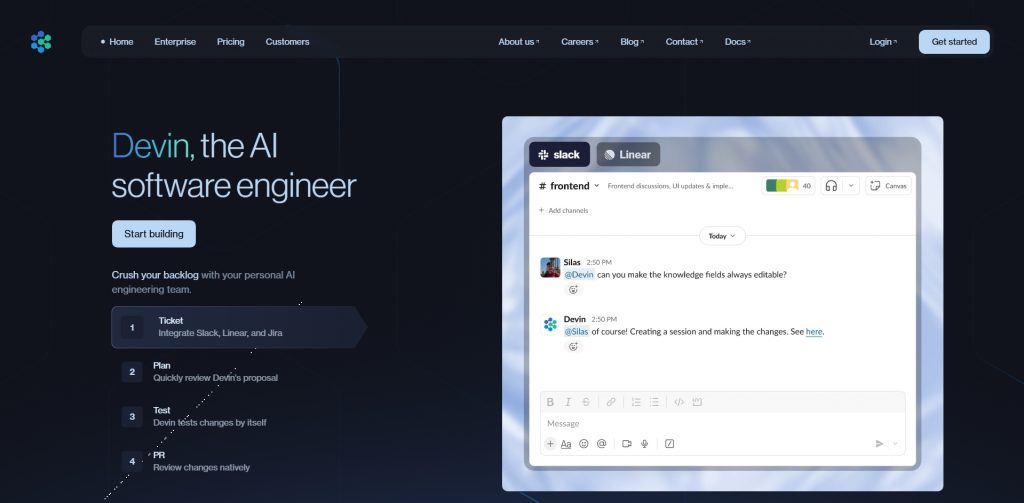
Devin is an AI assistant that functions almost like an autonomous programmer.
Pricing starts at $20 per month, accessible via a browser.
It can be integrated into team chat platforms and assigned tasks directly from project management tools like Jira. Devin analyzes the project’s codebase, asks clarifying questions, and then handles the task: writing code, fixing bugs, or even conducting research. Afterward, it uploads the results to the repository and provides a report.
Its creators recommend using it for routine tasks, such as updating dependencies, rewriting code in another language, or fixing bugs. It feels like an attempt to create a true digital teammate for developers.
Claude Code
Learn more about Claude AI in our review.
A terminal-based assistant for coding, powered by
Claude Opus 4, the AI model from Anthropic.
Pricing starts at $17 per month, available on Windows (via WSL), macOS, and Linux.
It can build projects from scratch, fix bugs, and even push changes to repositories. Since it operates in the terminal, it’s likely more suitable for those comfortable with command-line workflows. Beginners might prefer something with a graphical interface.
There’s a service called LM Arena that compiles performance stats for different AI models and ranks them. If you’re focused on coding, just check the “Coding” filter.
If you’re already comfortable with
ChatGPT and don’t want to explore other options, here’s what Andrej Karpathy recommends:
- GPT-4o — for everyday questions and simple tasks
- GPT-o3 — for information retrieval and complex tasks
- GPT-4.5 — for creative tasks or text generation
- GPT-4.1 — for working with code
Why Is Vibecoding Gaining Traction?
Why is everyone suddenly talking about vibecoding? Several factors have converged.
Technology has finally matured. AI models now genuinely understand what we want, rather than spitting out generic responses. Remember a couple of years ago when you had to craft the perfect prompt to get anything useful? Now, it feels much more natural.
People are tired of complexity. It became clear that not everyone with a great idea should have to spend years learning to code to bring it to life. There’s a demand for a more human-friendly way to interact with computers—closer to how we communicate with each other.
Additionally,
the approach to development itself has shifted. We used to think in terms of strict rules and syntax. Now, it’s more about meaning and tasks. Programming is becoming less about writing technical instructions and more about having a conversation with a smart assistant.
Finally, businesses are prioritizing speed. Vibecoding enables rapid prototyping and faster time-to-market for products.
Advantages and Disadvantages of Vibecoding
With vibecoding, you can create a working framework for any website or app in just a few hours. The best part? You don’t need to be a coding expert to turn your idea into reality. You might not know syntax or remember every function, but if you can clearly explain what the program should do,
the AI will write the code for you.
It also handles the most tedious tasks, like
finding and fixing bugs. Instead of staring at code for hours, you simply tell the system, “There’s an error when someone enters an invalid email—fix it.” And it does.
Another benefit is the freedom to experiment. Want to try a new technology but don’t have time to read the documentation? Just give the AI the task, and it will select the right tools and write the code.
One developer shared on a tech forum that they’ve been writing only about 10% of their code manually for the past two years, with AI generating the rest. This highlights how significantly vibecoding is changing day-to-day work in IT.
However, there are notable downsides that can’t be ignored.
The quality of generated code can sometimes be subpar. It might contain errors or vulnerabilities that aren’t immediately obvious.
Such code is often described as “it works, but you don’t want to look under the hood.” This can lead to “technical debt,” where maintaining or refactoring poorly written code ends up costing more time and effort later.
For critical systems where reliability is paramount—like those impacting lives or businesses—relying solely on generated code is still risky.
As Simon Willison noted in Ars Technica, using vibecoding in production is an obvious gamble. A large part of a programmer’s job isn’t creating new code from scratch but refining existing systems, where a deep understanding of the codebase is crucial.
Lastly,
there’s a risk of losing core programming skills. By offloading routine tasks to AI, developers might lose the very expertise that makes them professionals.
Future Prospects
Experts predict that vibecoding will carve out its own niche in the development process. The ideal scenario, according to practitioners: “Know the basics of coding and use AI to draft an MVP. This saves time and lets you test ideas quickly and affordably. Then, you can bring in traditional programming to refine the project properly.”
Forbes reported in March 2025 that while
vibecoding speeds up software development, it raises concerns about long-term reliability. The
article emphasized that companies using vibecoding must establish robust code review processes and invest in debugging tools.
What’s Happening with Vibecoding in IT?
When any idea can be turned into working code almost instantly,
many developers are left wondering: what does this mean for our jobs?
For those who’ve worked with assembly or low-level programming, this feels less like a threat and more like a natural evolution. Remember the anxiety over switching to high-level languages? It seemed like the end of “real” programming, but it was just a shift in tools.
For developers overall, vibecoding represents a similar transition.
It doesn’t eliminate the need to understand how things work under the hood. Instead, the focus is shifting. We’ll write less code manually and spend more time designing the overall structure, thinking through how everything connects, and tackling complex, non-standard problems.
The real value will lie not in coding faster than a machine but in doing what AI can’t yet handle: seeing the big picture, identifying non-obvious connections, and making critical decisions.