

China AI Restrictions: Is Beijing Closing Off Access to Its AI Models?
On this page
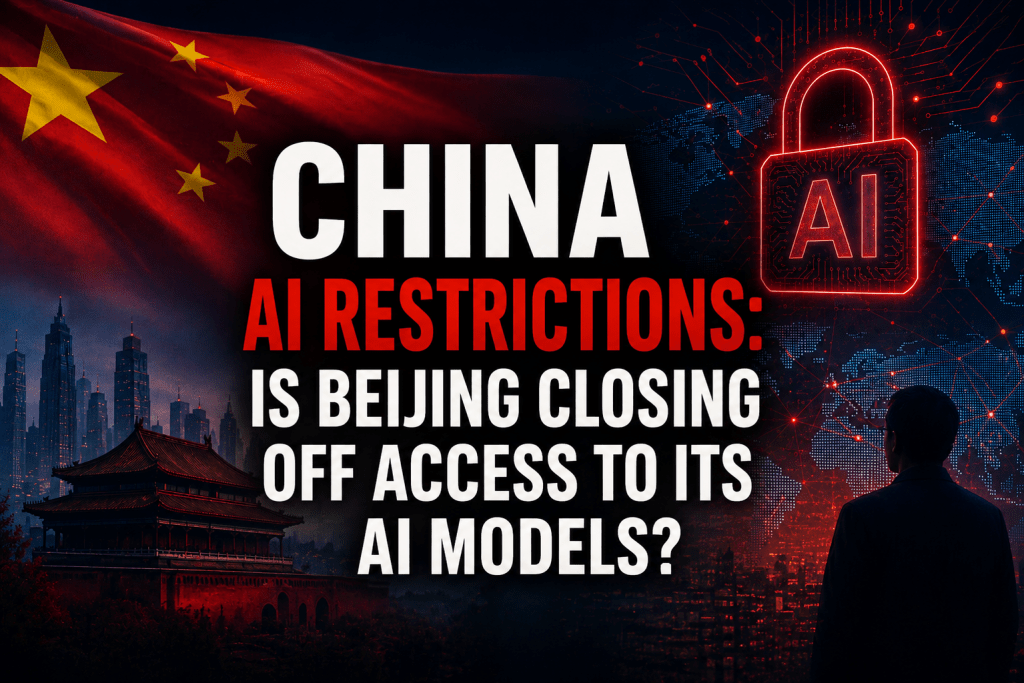
The era of “cheap Chinese AI for everyone” may be drawing to a close. According to Reuters, China is weighing restrictions on foreign access to Chinese AI models. Over the past month, Beijing has reportedly discussed the idea with the country’s largest technology companies. Here is what is known so far and what it could mean for the market.
What’s Happening: Beijing’s Talks With Alibaba, ByteDance, and Z.ai
Citing three people familiar with the discussions, Reuters reports that the meetings were convened by China’s Ministry of Commerce. Among the participants were Alibaba (maker of the Qwen models), ByteDance (whose Doubao assistant dominates the domestic market), and the startup Z.ai (of the GLM family). The talks reportedly covered models from across China’s AI companies.
On the agenda:
- Limiting foreign access to the most advanced models, both closed-source and open-weight, including versions not yet released*
- Tougher penalties for the leak or theft of AI technology, potentially treating it as a violation of national security law
- Restrictions on foreign investment in Chinese AI startups
*Open-weight models are AI systems whose underlying parameters are published freely, so anyone can download, run, and adapt them. That openness is exactly what made Chinese models like Qwen and DeepSeek popular worldwide and exactly what Beijing is now weighing whether to pull back.
No final decision has been made. The specific measures and timing are still under discussion, and neither the ministries nor the companies commented on Reuters’ queries.
How the Restrictions Might Work
A clue comes from a discussion among Chinese legal experts in May about regulating open-source AI. They proposed a three-tier system:
- Basic open tools, requiring only simple registration
- Advanced technologies, subject to mandatory security reviews
- The most sensitive frontier models, either barred from public release or restricted to domestic use only
In other words, China may keep its strongest models to itself while releasing lighter versions to the rest of the world.
Why Now
The timing is telling. Z.ai’s recent GLM-5.2 approached the capabilities of leading American systems at a fraction of the cost, becoming one of the most talked-about models in Silicon Valley. And in the wake of DeepSeek’s success, Chinese models captured a notable share of the global market by combining low cost with solid performance.
China now treats frontier AI as a strategic national asset, exactly as the United States does. The parallels are hard to miss: in June, the U.S. Department of Commerce temporarily blocked global access to Anthropic’s Claude Fable 5 and Mythos 5 models (which we covered in detail), and OpenAI reportedly delayed the full-scale launch of GPT-5.6 at the government’s request. Beijing’s stance mirrors Washington’s.
What China’s AI Restrictions Would Mean for the Market
If the restrictions are adopted, the effects would ripple across the market.
- Developers and companies that built products on cheap Chinese open-source models would face rising costs.
- The affordable open-AI segment could lose its main suppliers, since Qwen and DeepSeek are among the most widely used models in the world.
- Competitive pressure on Western providers would ease, leaving them less incentive to lower prices.
One important caveat: according to the sources, any restrictions may apply only to future models. Open-source versions already published cannot physically be recalled, as their weights were downloaded long ago and run on servers around the world.
The Takeaway
For now, these are only discussions, and it is far from certain that China will close off access entirely. But the trend is unmistakable: both AI superpowers, the United States and China, are shifting from a race toward openness to a posture of control. The era in which frontier models circulated freely around the world appears to be ending.
The broader lesson is one about technological sovereignty. Building genuinely competitive domestic technology first, by collaborating with global leaders and adapting their work, is what puts a country in a position to help set the rules rather than follow them. Once that self-sufficiency is achieved, controls become an option. We will continue to follow how this story develops.

That’s a really interesting development, and makes a lot of sense considering the concerns about data security and intellectual property. It seems like a significant shift in their approach to AI.