Claude Sonnet 5: A New Standard for AI Performance
On this page
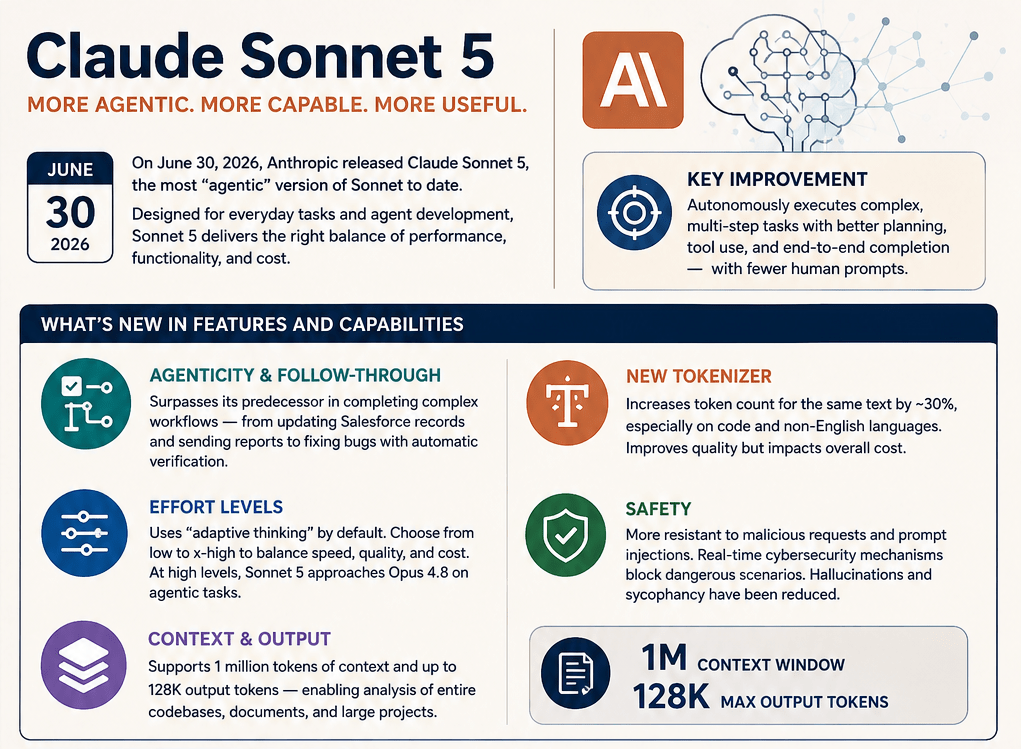
On June 30, 2026, Anthropic released Claude Sonnet 5, an updated mid-tier model that, according to the company, has become the most “agentic” version of Sonnet to date. The new model is designed to serve as a primary tool for everyday tasks and agent development, offering a balance of performance, functionality, and cost.
This review provides a detailed analysis of Sonnet 5’s key features, its performance on benchmarks, community feedback, and its position within the Anthropic lineup.
What’s New in Features and Capabilities
The key improvement in Sonnet 5 lies in its ability to autonomously execute complex multi-step tasks. The model plans its actions better, utilizes tools (browser, terminal) more effectively, and can complete tasks end-to-end with fewer human prompts.
- Agenticity and Follow-Through: Sonnet 5 surpasses its predecessor in completing complex workflows, such as updating records in Salesforce followed by sending reports, or fixing bugs with automatic verification.
- Effort Levels: The model uses “adaptive thinking” by default. Users can select levels from low to x-high to manage the balance between speed, quality, and cost. At high thinking levels, Sonnet 5 approaches the flagship Opus 4.8 model on agentic tasks.
- Context and Output: The model supports a context window of 1 million tokens and can generate up to 128 thousand output tokens, allowing it to process large volumes of information, such as code from entire projects.
- New Tokenizer: Sonnet 5 uses a new tokenizer that increases the number of tokens for the same text by approximately 30%, particularly noticeable on code and non-English languages. This improves processing quality but directly impacts the final cost of use.
- Safety: The model demonstrates improved resilience to malicious requests and prompt injections. Built-in real-time cybersecurity mechanisms block dangerous use scenarios, and hallucinations and sycophancy have been reduced.
Benchmarks and Performance
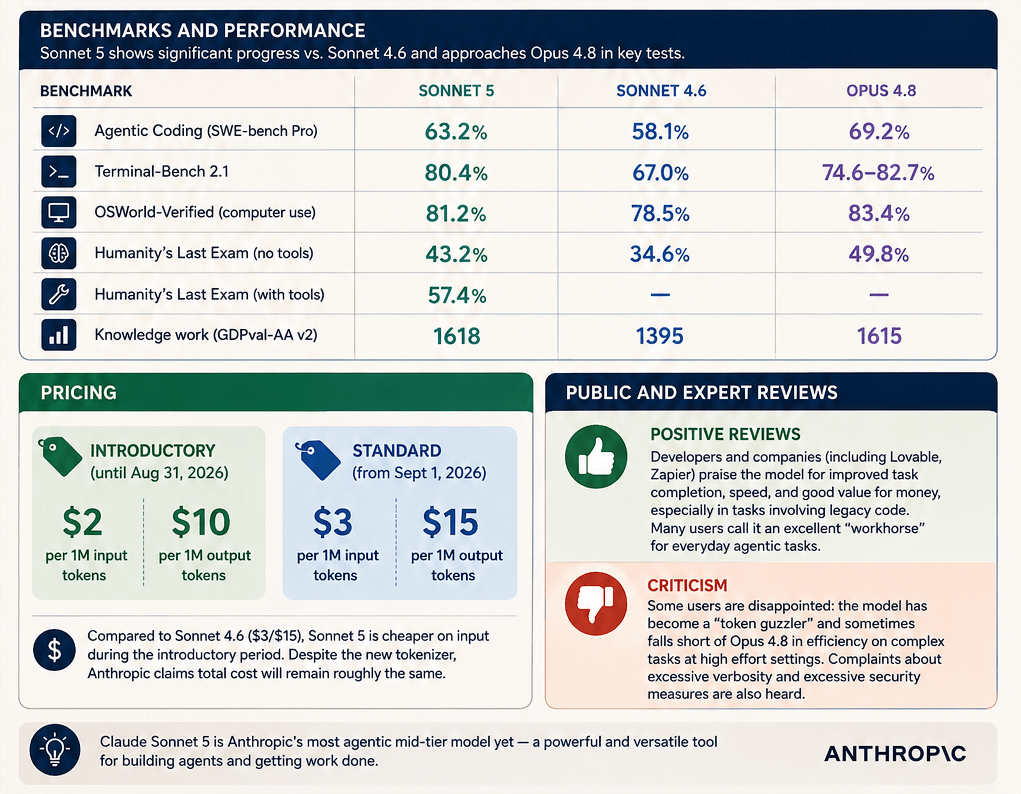
According to data provided by Anthropic, Sonnet 5 shows significant progress compared to Sonnet 4.6 and approaches the performance of Opus 4.8 in several key tests.
|
Benchmark |
Sonnet 5 |
Sonnet 4.6 |
Opus 4.8 |
|---|---|---|---|
|
Agentic Coding (SWE-bench Pro) |
63.2% |
58.1% |
69.2% |
|
Terminal-Bench 2.1 |
80.4% |
67.0% |
74.6–82.7% |
|
OSWorld-Verified (computer use) |
81.2% |
78.5% |
83.4% |
|
Humanity’s Last Exam (no tools) |
43.2% |
34.6% |
49.8% |
|
Humanity’s Last Exam (with tools) |
57.4% |
— |
— |
|
Knowledge work (GDPval-AA v2) |
1618 |
1395 |
1615 |
Pricing
Anthropic is offering an introductory period with special pricing to attract users.
- Introductory (until August 31, 2026): $2 per million input tokens, $10 per million output tokens.
- Standard (from September 1, 2026): $3 per million input tokens, $15 per million output tokens.
Compared to Sonnet 4.6 ($3/$15), Sonnet 5 is cheaper on input during the introductory period. Despite the new tokenizer, the company claims the total cost of use will remain roughly the same.
Public and Expert Reviews
The community reaction to Sonnet 5 has been mixed.
- Positive Reviews: Developers and companies (including Lovable, Zapier) praise the model for improved task completion, speed, and good value for money, especially in tasks involving legacy code. Many users call it an excellent “workhorse” for everyday agentic tasks.
- Criticism: Some users are disappointed with the update, noting that the model has become a “token guzzler” and sometimes falls short of Opus 4.8 in efficiency on complex tasks at high effort settings. Complaints about excessive verbosity and excessive security measures are also heard.
- Significant progress in reasoning, tool use, and agentic performance compared to the previous generation.
- An excellent balance of speed, quality, and cost, especially during the introductory period.
- Flexibility through effort levels settings for optimization across specific tasks.
- Strong performance in multi-step workflows and self-verification.
- The new tokenizer increases token consumption, which may affect the final cost.
- At maximum effort settings, it may lose its price advantage over Opus 4.8.
- Opinions on its superiority over Opus in real-world scenarios are divided.
Final Comparison Table with Competitors
|
Parameter |
Sonnet 5 |
Sonnet 4.6 |
Opus 4.8 |
|---|---|---|---|
|
Agentic Coding (SWE) |
63.2% |
58.1% |
69.2% |
|
Terminal-Bench |
80.4% |
67.0% |
~74-82% |
|
OSWorld-Verified |
81.2% |
78.5% |
83.4% |
|
Context Window |
1M |
1M |
1M+ |
|
Price (intro/standard) |
$2/$10 → $3/$15 |
$3/$15 |
$5/$25 |
|
Best For |
Agentic work, coding |
Previous mid-tier |
Maximum accuracy |
Overall Conclusion
Claude Sonnet 5 sets a new standard for mid-tier models, making advanced agentic capabilities accessible and cost-effective. It is an excellent choice for developers building agents and businesses needing near-flagship quality without the Opus price tag. The introductory period is an ideal time to test the model in real-world workflows. For the most complex tasks requiring maximum accuracy, Opus 4.8 or the future Fable model may still be preferable, but for most scenarios, Sonnet 5 becomes the optimal default choice.
❓ Frequently Asked Questions
Answers to relevant questions about this AI tool