


Hugging Face is a platform with a huge selection of models and libraries for NLP and other AI tasks. A community for developers and researchers in artificial intelligence
Hugging Face: The Top AI Model Platform
On this page
Hugging Face is a tool where you can use AI without coding through ready-made solutions, download an NLP model for local deployment, or run inference with Hugging Face right in the cloud. What makes this hub remarkable isn’t just the name. It turns machine learning into an accessible resource thanks to:
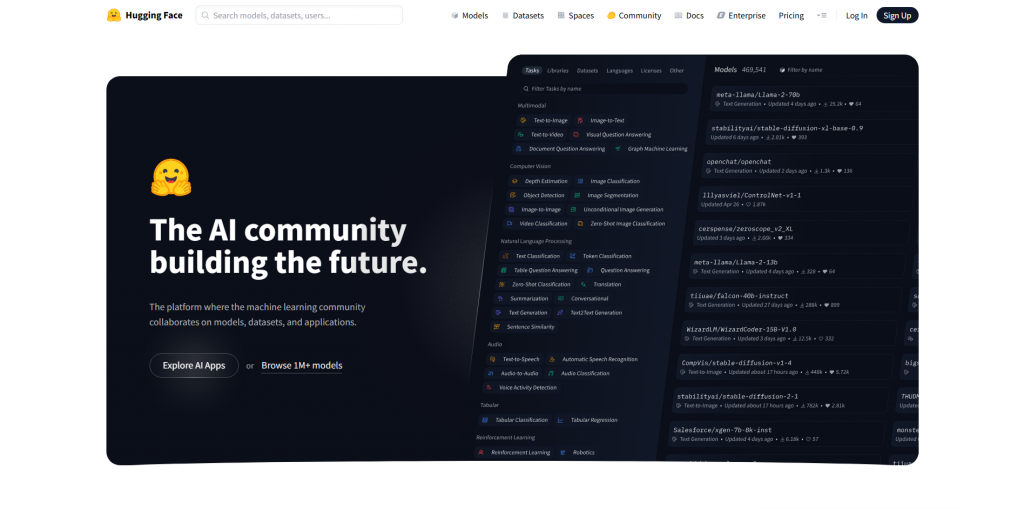
- The Hugging Face Transformers library for working with multi-task AI models
- Cloud AI models for performing NLP tasks online
- No-code text processing tools and AI for text analysis
- The ability to train your own AI model on custom data
Here you’ll find AI text recognition, code generation with neural networks, and hundreds of other specialized solutions—all in a single ecosystem.
- Pricing model: Free basic features; paid subscriptions (Pro: $9/month, Enterprise: $20/user/month)
- Developer: Hugging Face Inc. (independent company).
- Availability: Works seamlessly in most countries and supports multiple languages.
- Payment: Visa/MasterCard, PayPal.
Hugging Face is a platform with AI models that provides unprecedented free online access to AI models. At its core are powerful NLP libraries (especially Transformers), which simplify working with Hugging Face models. The platform supports training AI models on user data and offers thousands of open-source artificial intelligence models for tasks of varying complexity. For online natural language processing, free machine learning models are available through a convenient NLP API, including top NLP models like BERT and GPT. It’s the ideal artificial intelligence for text: from analysis to text generation with neural networks. You can use free text generation models, experiment with open-source AI models, or run transformer models online directly in your browser. All this makes Hugging Face a universal hub for AI development.
Key Features
- Transformers Library: Pre-built models for NLP (translation, summarization, classification), computer vision, and audio analysis.
- Hugging Face Hub: Hosting of models (BERT, GPT, RoBERTa) and datasets with open-source code.
- Spaces: Hosting demo AI applications with CPU/GPU support (e.g., image generation, chatbots).
- Development Tools:
- AutoClass for automatically loading model architectures.
- Pipelines — ready-made solutions for tasks in just 1 line of code (e.g., text toxicity analysis).
- Integrations: Support for PyTorch, TensorFlow, JAX, and export to ONNX/TorchScript.
How It Works
The platform uses transformer architectures (e.g., BERT, GPT) that analyze contextual relationships in data. To get started:
- Model Selection On the Hugging Face Hub, you find the right model via search—for example, a toxicity classifier for text analysis. Each model includes documentation and usage examples.
- Data Preparation Text is processed by a tokenizer:
- Breaks a phrase into parts: “This is an example of a toxic comment” → [“This”, “is”, “an”, “example”, “of”, “a”, “toxic”, “comment”]
- Converts to numeric IDs: [101, 202, 305, 415] (This is necessary because models work with numbers, not words)
- Transformer Analysis Models like BERT or GPT:
- Analyze connections between all text elements
- For the example above, identify the combination “toxic comment” as key
- Output result: {“toxic”: 0.985} (98.5% toxicity probability)
For specialized tasks Suppose you need analysis of medical records:
- Take a base model (e.g., BioBERT)
- Fine-tune it on medical texts
- The model starts correctly interpreting terms: “Carcinoma in situ” → medical diagnosis (not a spelling error)
Why it’s effective In the past, such tasks required months of specialist work. Now the solution takes just 3 lines of code: python
- from transformers import pipeline
- classifier = pipeline(“text-classification”, model=”…”)
print(classifier(“Your text”)) # Result in 2-3 seconds Key Components
- Transformers: Contextual relationship analysis in text
- Tokenizers: Data preparation for models
- Fine-tuning: Model adaptation for narrow tasks
- Pipelines: Ready tools for common scenarios
- 80% of features free, including model hosting;
- Largest community: 60k+ models, regular updates;
- Compatibility with popular ML frameworks;
- Support for multimodal tasks (text, images, audio).
- Complexity for beginners: requires Python and ML knowledge;
- High GPU requirements for training large models;
- Quality of user-submitted models varies.
Practical Use Cases
- Marketers: Customer review analysis, automated social media responses.
- Developers: Code generation, bug fixing in IDEs.
- Researchers: Training models for specialized fields (law, medicine).
- Content creators: Text creation, article summarization, translation.
- Corporations: On-premise deployment for document analysis
Pricing Plans
| Plan | Cost | Features |
| Free | $0 | Public models, datasets, CPU Spaces |
| Pro | $9/month | Priority GPU, private datasets |
| Enterprise | $20/user | SSO, audit logs, enterprise support |
Hardware: GPU from $0.03/hour (T4) to $80/hour (H100). If you’re an AI developer needing to assemble a complex puzzle with pieces scattered worldwide, Hugging Face is like a massive warehouse where all those pieces (thousands of open-source models) are free and waiting. You just walk in and grab what you need: ready solutions for basic tasks like review analysis or experimental work for something advanced—like diagnosing diseases from medical records. Beginners might feel overwhelmed at first—like stepping into a welder’s workshop for the first time: tools are there, but without guidance, it’s tricky. The good news: if you just need to check text for toxicity, translate a few phrases, or generate product descriptions—the platform provides ready tools in literally five minutes, no coding required. For professionals, it’s complete freedom. Want to fine-tune a model on your data? Go ahead. Need to deploy a powerful API for thousands of requests per second? Easy. Looking for a unique architecture for a niche task? Chances are someone in the community has tackled something similar—you can find and adapt it. Of course, there are caveats. Complex projects demand technical skills: for example, combining multiple models or optimizing for your hardware won’t happen without a programmer. Resources matter too: GPT-3-level models won’t run on a standard laptop—you’ll need GPU servers (though the platform helps with rentals). But the real game-changer is this: technologies once exclusive to giants like Google are now open to anyone—a student, startup, or small business. Yes, complex projects need experts—but you can start experimenting with AI right now. Today. And that changes everything
❓ Frequently Asked Questions
Answers to relevant questions about this AI tool
Sources
-
Pricing — huggingface.co
-
Billing — huggingface.co
-
Team & Enterprise plans — huggingface.co
-
Pricing and Billing — huggingface.co
-
Hugging Face - GitHub — github.com
-
The Hugging Face break-in explained - TechCrunch — techcrunch.com







But it handles everything. Massive time saver.