Neural network fusion recipe generator from Google — a free culinary experiment.
Google Food Mood: Your Personal AI Recipe Generator
On this page
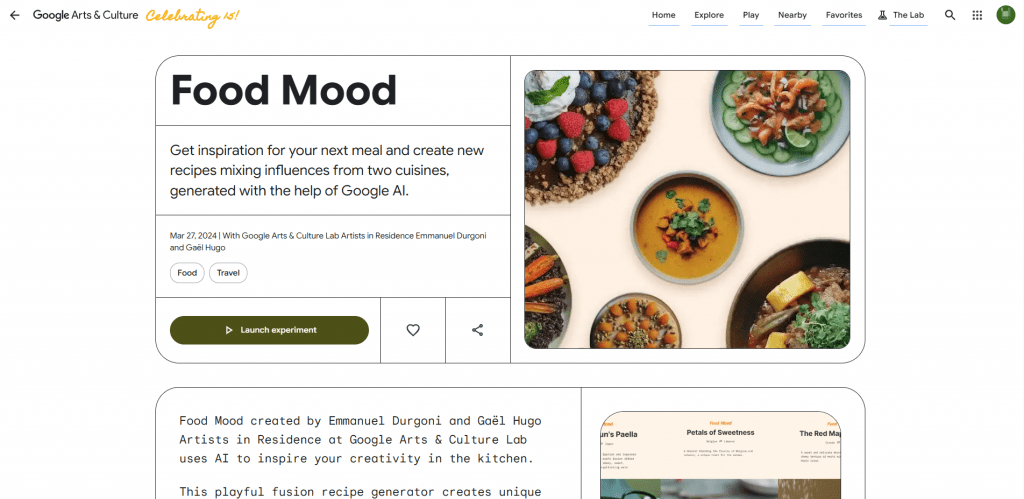
In March 2024, the Google Arts & Culture lab introduced an experimental tool with a modest name: Food Mood. This is neither another “smart chef” nor a replacement for culinary websites. The project positions itself as a playful fusion recipe generator that uses AI to blend elements from two different world cuisines. Behind the design and concept are artists-in-residence Emmanuel Durgoni and Gaël Hugo — an important detail, as it sets the tone for the entire service: creative, somewhat artistic, and without pretensions to industrial scale.
What It Is and What It Is Used For
Google Food Mood is a free web experiment that helps step outside the routine of familiar breakfasts, lunches, and dinners. It does not solve the problem of “what to cook from three ingredients in the fridge.” Instead, it answers the question, “how to unusually combine Hungarian goulash and Japanese ramen.” People use the service for:
- Finding unconventional ideas for home dinners or gatherings with guests
- Discovering culinary traditions from different regions through unexpected pairings
- Overcoming a “culinary rut” when habitual dishes have become boring
- Generating content for food blogs: a name, description, ingredient list, and unique photo are created in seconds
How the Service Works
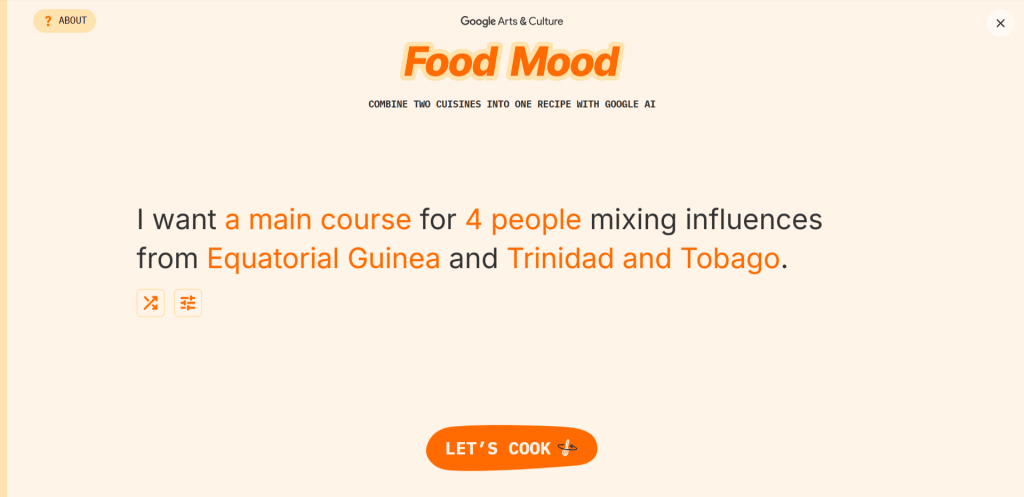
The interface is extremely simple and requires no prior study. The user sequentially selects parameters on the experiment page, after which generation starts.
Basic steps:
- Choose a dish type: starter, soup, main course, or dessert
- Indicate the number of servings
- Select two countries or cuisines from an extensive list — from South Korea and India to Chad and Venezuela
- Optionally add dietary preferences — vegan, vegetarian, gluten-free, and others
- Optionally specify up to three specific ingredients that must appear in the recipe
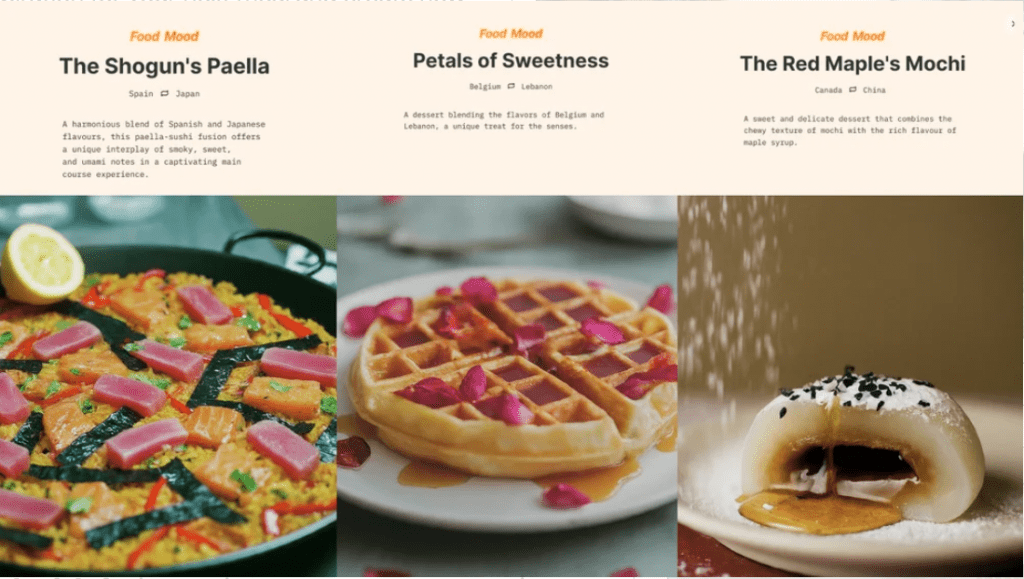
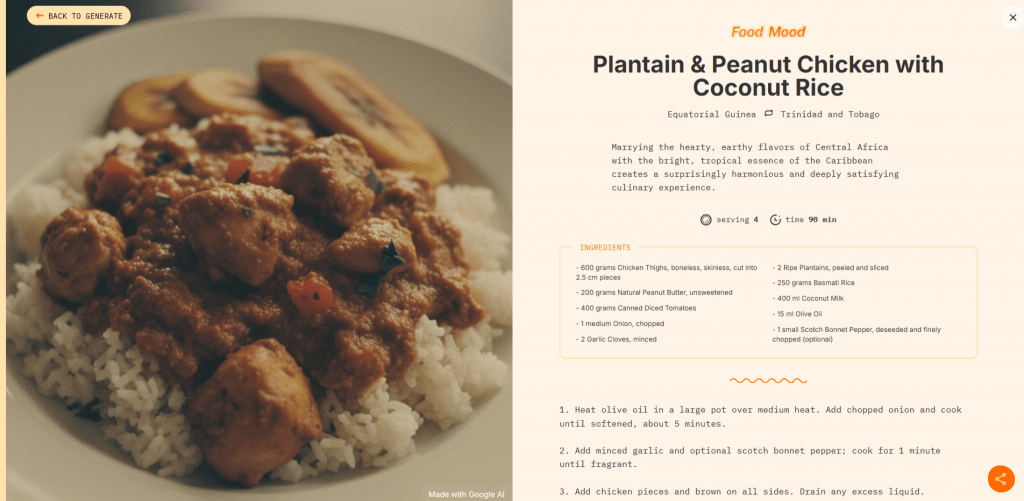
After clicking the “Let’s Cook” button, Google’s models get to work. Gemini 1.0 Pro via Vertex AI handles the text, while a Google generative model produces the image. The result includes:
- A creative name for the dish
- A brief description of the fusion logic
- A complete ingredient list with quantities
- Step-by-step cooking instructions
- Estimated cooking time and a few tips
- An AI-generated photo of the dish
- Links to information about key ingredients in the Google Arts & Culture database
Each recipe carries a clear warning: the dish has not been tested by professional chefs in a real kitchen. Users are advised to rely on common sense and follow standard food safety practices.
Platforms and Access Conditions
Food Mood works exclusively through a web browser at artsandculture.google.com, and it opens correctly on desktops, tablets, and mobile phones. No standalone iOS or Android application exists.
The service is completely free, with no subscriptions or hidden fees. As of 2026, there are no limits on the number of generations. A Google account may be required for full access to Google Arts & Culture features, but the recipe generator itself runs without one.
Features and Nuances
Food Mood should be viewed as an experimental creative tool, not as a database of proven culinary solutions. The developers explicitly state that the recipes have not undergone real kitchen testing. This means that proportions, cooking times, or ingredient combinations may sometimes need manual adjustment.
The India Edition deserves special attention — a version of the experiment focused on blending cuisines from different Indian states.
Among the less obvious nuances: Food Mood does not provide detailed nutritional information (calories, proteins, fats, carbohydrates) and does not accommodate complex dietary restrictions beyond the basic options. Generation results can be either brilliantly successful or strange — this is normal for any creative AI.
Who Might Find Google Food Mood Useful
The tool is unlikely to become your “every evening chef,” but it can be useful for certain categories of users.
- Enthusiasts of culinary experiments and fusion cuisine. Those who have already tried classic recipes from different countries and want to reach a new level.
- Home cooks tired of routine. When the weekly menu has turned into a set of five repeating dishes, Food Mood offers a risky but refreshing alternative.
- Those looking for ideas for special occasions. A dinner for two, a party, or a themed gathering — an unusual dish can become the center of attention.
- Creative bloggers and content creators. A ready-made package consisting of a name, description, and unique photo saves hours of brainstorming and shooting.
We cannot recommend this service if you need strictly tested recipes, precise calorie counts, or a meal plan with a carefully balanced macronutrient profile. Other specialized AI tools exist for such tasks.
Use Cases
The most straightforward scenario: an evening when you do not want to cook anything familiar. The user chooses a main course, selects Italy and Thailand, adds a vegetarian option, and receives, for example, “Pad Thai with pesto sauce and rice noodles.” The result is either inspiring or amusing, but in either case, it provides fresh food for thought.
A second scenario: preparing for a small gathering. You can generate three different desserts by mixing French and Japanese cuisines and then choose the most realistic option to actually prepare.
A third scenario: blogger style. A food content creator generates a recipe, cooks it, compares the AI-generated photo with the real result, and produces a breakdown. This format regularly generates strong engagement in culinary communities.
User Reviews and Ratings
Overall, audience reaction is positive, especially among those seeking inspiration rather than ready-made instructions. Users praise the service for its creativity and the fact that roughly three out of four recipes look coherent enough to want to cook them. They note successful examples such as “Teriyaki Jerk Salmon” — a combination of Japanese and Caribbean approaches.
Criticism mainly concerns the superficiality of some pairings. Occasionally, the fusion turns out to be a mechanical combination of two sets of ingredients without real culinary sense. Users also point out that the generated images do not always match what ends up on the plate, and minor inaccuracies in the instructions do occur.
On culinary forums and in thematic communities, curiosity mixed with a degree of healthy skepticism prevails. The general verdict from everyday users: a great “toy” and a tool for finding new ideas, but not a primary source of recipes for daily use.
- Generates genuinely original and coherent combinations of two cuisines, not a random set of ingredients
- Requires minimal clicks and does not force users to navigate complex settings
- Completely free, with no registration and no hidden limits on the number of generations
- Delivers a ready-made, visually appealing package consisting of a name, description, instructions, and photograph
- Offers a high fun factor and inspires real culinary experiments
- Recipes have not been tested in real kitchens — proportions and techniques may need adjustment
- Some combinations turn out to be too experimental or superficial
- Lacks detailed nutritional information and support for complex dietary protocols
- Quality of generation depends on the current version of Gemini, and minor inaccuracies in the instructions are possible
Conclusion
Google Food Mood is a rare example of an AI tool that does not try to solve a practical problem faster, cheaper, or more accurately than a human. It does something else: it democratizes culinary creativity and turns the mixing of two countries’ cuisines into a fast, free, and visually pleasing experience. The service will not replace a professional chef or a tested recipe from a trusted source, but it excels as a “culinary therapist,” helping users break out of routine and see food in a new light. Recommended to try at least once — the result may surprise you, even if not every dish ends up in your personal collection of favorites.
❓ Frequently Asked Questions
Answers to relevant questions about this AI tool
Sources
-
Food Mood — artsandculture.google.com
-
Google Arts & Culture — artsandculture.google.com
-
Google Arts & Culture - Food Mood — artsandculture.google.com
-
Google Arts & Culture - Food Mood India Edition — artsandculture.google.com
-
Google's 'Food Mood' Will Mix a Recipe for You Using AI - Lifehacker — lifehacker.com