

Old English Translator Tools: Your Gateway to Historical English
On this page
Gemynst þū, lā rǣdere… Oops, sorry about that! Remember that moment in English class when you first opened “Beowulf” or Chaucer’s original texts and realized—this isn’t even English? The language looks familiar, but good luck deciphering it without a cheat sheet.
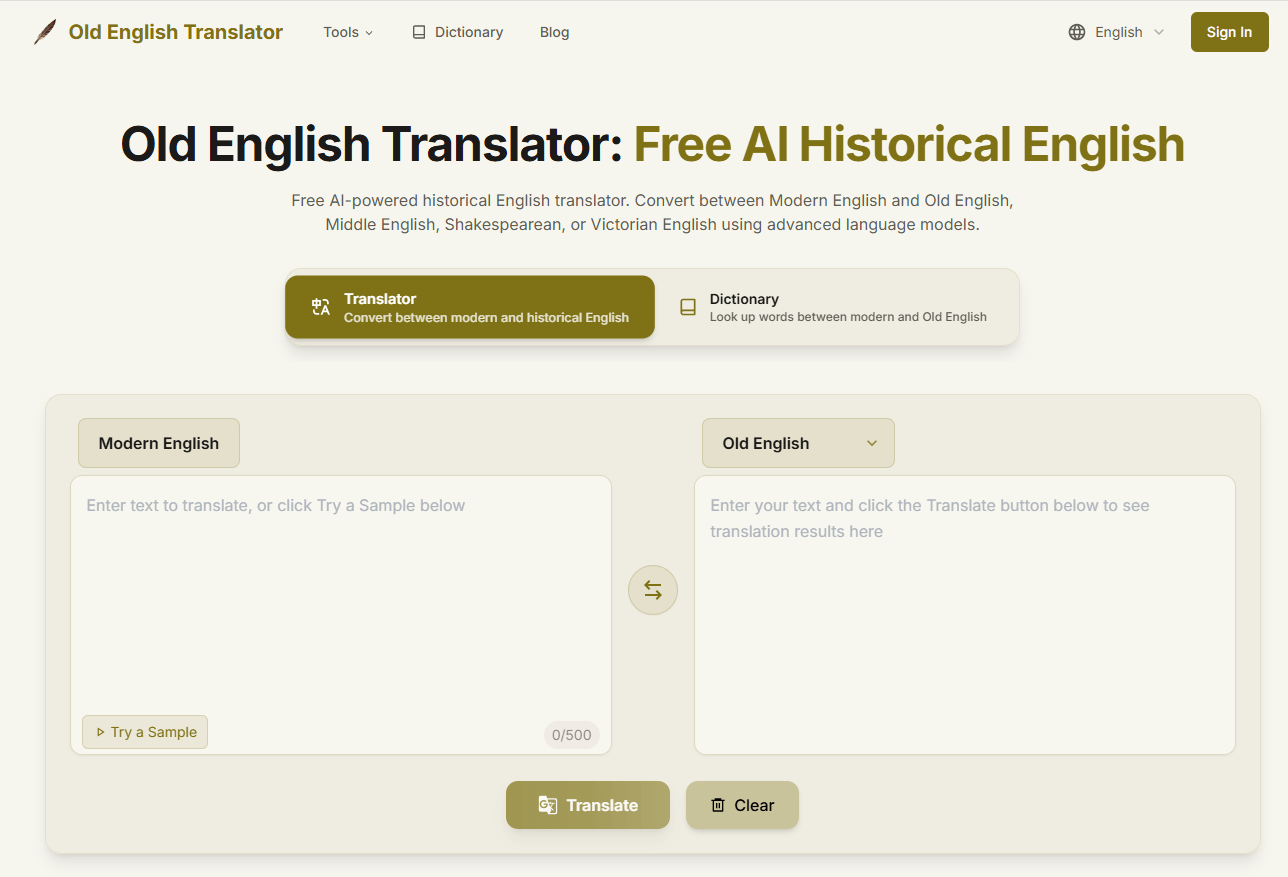
That’s exactly where Old English Translator comes in. It’s an AI-powered web service that bridges the gap between modern English and its archaic ancestors. The tool works with four historical forms: Old English (5th–11th c.), Middle English (11th–15th c.), Shakespearean (16th–17th c.), and Victorian English (19th c.).
In this review, we’ll take a close look at it, plus a few popular alternatives. So, hwæt! That is—listen up!
How Does Old English Translator Work?
Old English Translator translates both ways (modern → historical and historical → modern), comes with a built-in etymology dictionary, and actually pays attention to context. Max input length—500 characters.
On the technical side, Old English Translator uses language models trained on a hefty corpus of authentic historical sources—from ancient poems to Anglo-Saxon chronicles.
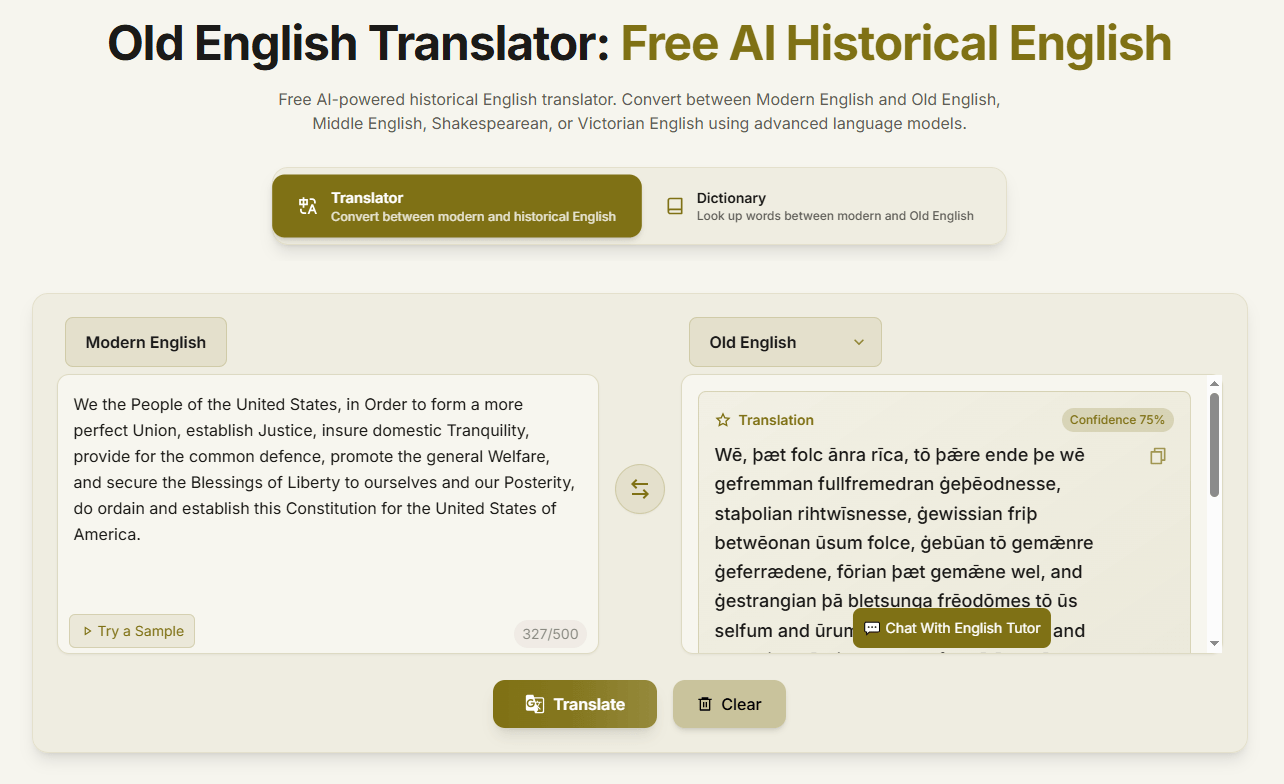
The interface is minimalist: one input field, a direction toggle, Translate and Clear buttons, and a character counter. You type your text into the “Modern English” field, pick your direction (Modern → Old or Old → Modern), hit Translate, and watch the magic happen.
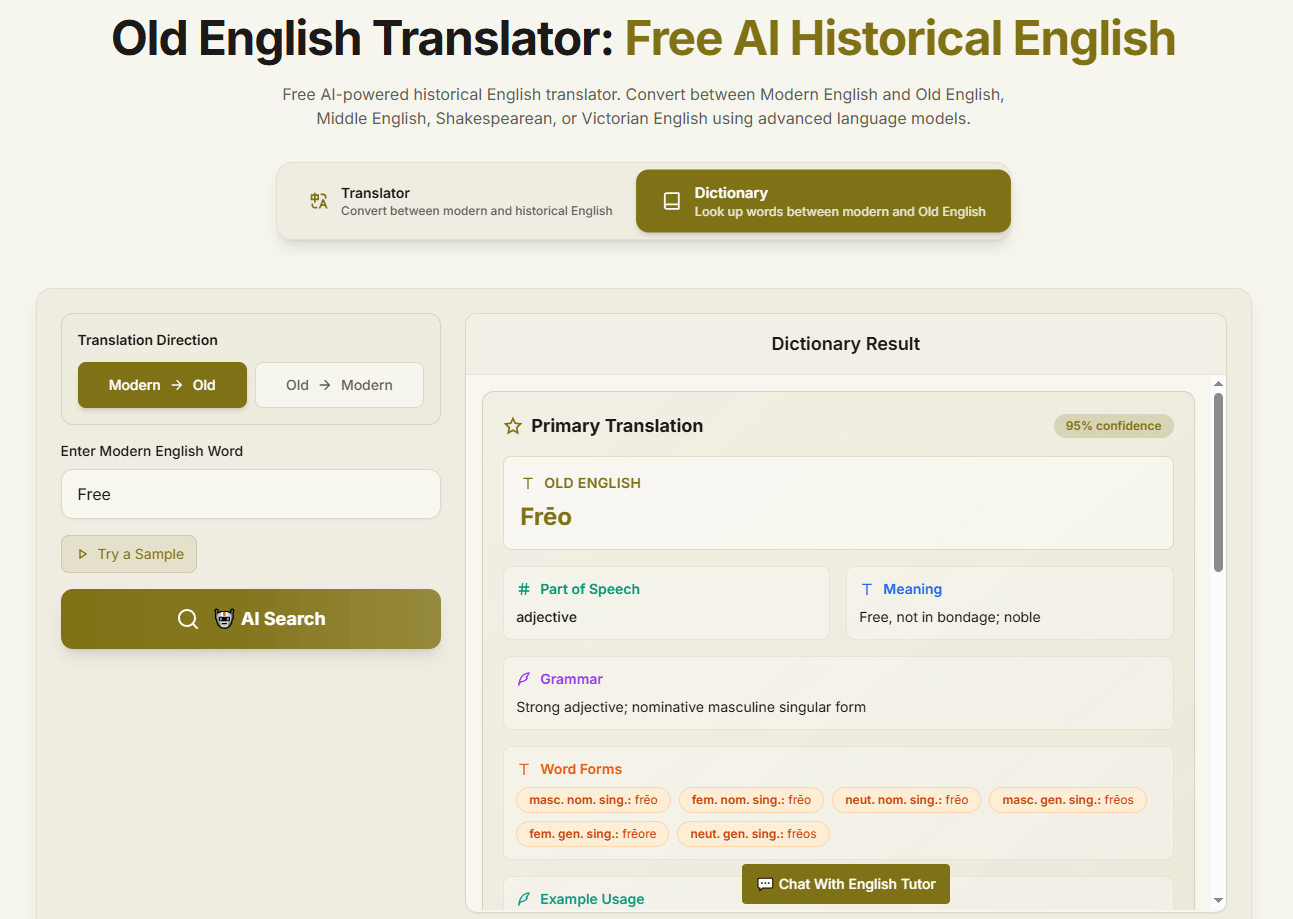
For individual words, there’s a dedicated “AI Search” block—a dictionary with detailed breakdowns, etymology, and usage examples.
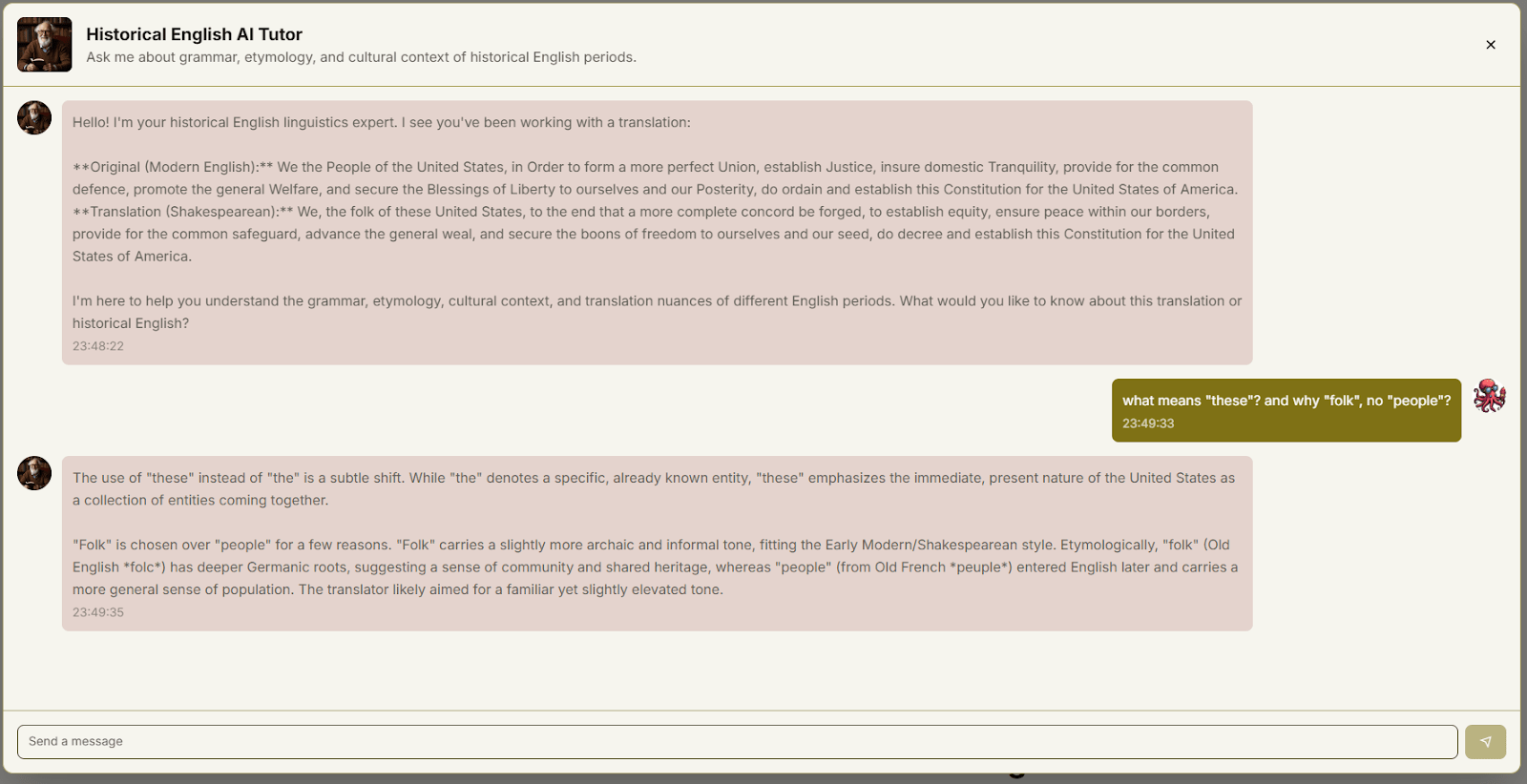
The built-in Historical English AI Tutor in the live chat can explain grammar, etymology, and cultural context for any historical period.
Key features of Old English Translator:
- Translation between modern English and four historical periods
- Bidirectional translation (past → present and present → past)
- Built-in dictionary with etymology and word analysis
- Built-in Historical English AI Tutor
- Contextual analysis (not just dictionary look-up)
- Completely free, no registration, no request limits
Who Actually Uses Old English Translator
Turns out, Old English Translator isn’t just for academics—it’s found its way into some pretty unexpected corners.
- Students and professors use it to quickly get the gist of texts like the Exeter Codex without diving straight into academic dictionaries.
- Researchers and linguists get a solid starting point for analysis. As historian David Miller puts it: “Being able to make sense of Old English manuscripts has seriously sped up my research.”
- Theater directors and actors adapt Shakespearean monologues for modern audiences—or translate contemporary plays into Elizabethan style for that authentic vibe.
- Fantasy writers and game devs use it to whip up authentic-sounding names, prophecies, and battle cries. One Reddit author swears the swear words take on a far more epic quality in Old English.
- LARPers and reenactors generate phrases for rituals, skaldic songs, and warcries.
- Content creators and TikTokers make viral videos, cook up “medieval” memes, record Old English ASMR, or challenge followers to guess what ancient phrases mean.
- Ink enthusiasts and gift-givers translate names, mottos, and quotes for tattoos, engravings on weapons, mugs, or pendants.
And just the curious folks who like messing around with language for fun.
- Completely free, no limits, no sign-up
- Supports four historical periods
- Built-in etymology dictionary & chat bot
- Simple, clean interface
- Bidirectional translation
- Trained on authentic historical texts
- 500-character limit
- Needs expert fact-checking for academic use
- No mobile app (web only)
- Can stumble on stylistically complex texts
What the Community’s Saying About Old English Translator AI Tools
There aren’t any glowing—or scathing—reviews specifically for oldenglishtranslators.com yet; the tool’s still pretty fresh. But there’s genuine buzz in the community around any new AI tool for Old English. Over on r/OldEnglish and r/anglosaxon, people are regularly discussing AI translators.
The general take: for short phrases and names, new tools are “decent—better than the old dictionary-based ones.” But for grammar and poetry? “Still needs manual tweaking, especially with inflections and verb forms.”
One user shared: “I attempted to back-translate a short section of Beowulf—it was recognizable, but more archaic than it should be. Good enough for fanfiction or a video game, but not suitable for an academic paper.”
The consensus: AI beats old dictionary tools for full sentences, but “you cannot replace someone that has studied Old English for at least a year.” The community of linguists and reenactors is hungry for quality AI solutions—and they’re actively engaged in discussions.
Are General LLMs More Effective Than Specialized Tools?
On the r/OldEnglish subreddit, this question keeps popping up. And the results are quite fascinating.
Why general LLMs (ChatGPT-4o, Claude 3.5, Gemini 2.0) succeed:
- They handle context and style way better—provided your prompt is well-executed. One commenter stated: “ChatGPT is far superior to any other translator I have come across, especially for Old English → Modern. It really excels at capturing the poetic nuances.”
- They can explain grammar, offer multiple translation options, compare sources. No hard character limits. And actual models are noticeably sharper on dead languages than last year’s.
However, there are significant negatives:
- When translating Modern → Old, general LLMs often drift into Middle English or just make stuff up.
- Prompt quality matters a lot—without detailed instructions, the output can quickly become unreliable.
Specialized websites like Old English Translator have their own problems:
- Limited training data (usually just basic corpora)
- Struggle with poetic nuance, dialects, and kennings
- Rarely updated
When a specialized tool like Old English Translator makes more sense:
- You want a low-effort, no-prompt-engineering interface
- You need a quick “wow” translation for social media, memes, tattoos
- You don’t trust your ability to write a good prompt
- You just want the end result and don’t care about learning the language
Bottom line: For 80–90% of users (content creators, writers, and casual learners), a strong LLM with a good prompt wins. For specialized academic work? Still manual grind + Bosworth-Toller and DOE, with AI as a rough draft. For academic use, cross-verification with Bosworth-Toller and the Dictionary of Old English (DOE) is recommended.
Alternatives to Old English Translator
1. OpenL Translate
OpenL is a general AI translator that supports Old English (and back) among 100+ languages, including rare and historical ones (Old Norse, Ancient Greek, Toki Pona). You can translate text, documents, images, and speech. Free tier: ~40 credits per day, then paid from $7/month.
- Drawbacks: Not built specifically for Old English—so grammar and dialect nuances (West Saxon vs. Mercian) tend to break down quickly. Quality on historical languages is noticeably lower than on modern European languages.
- Verdict: Fine for casual, short-term uses—memes, TikTok content, etc. Not for serious academic or linguistic work.
2. Oldenglishtranslator.cc
Direct competitor with nearly identical capabilities: Modern ↔ Old English, multiple translation options, pronunciation guides, claims historical accuracy. Free, fast, simple interface. Spits out three variants + context per query.
Drawbacks: Accuracy is often questioned on r/OldEnglish: “Good for beginners, but you’d best check with Bosworth-Toller.” Grammar and inflections can be weak, especially in longer sentences. Less “wow factor” than top-tier LLMs.
3. GuruTrans
GuruTrans is another AI translator supporting historical languages, including Old English and Old Norse. Uses neural nets for everything from professional documentation to modern slang. Also does Shakespearean English.
- Quirk: They guarantee complete anonymity—no data retention. Geek-friendly—you can translate text into ASCII or Binary.
4. The Non-AI Classic: oldenglishtranslator.co.uk
Even though this is a non-AI dictionary tool, it gets mentioned in almost every translation thread. It’s a simple dictionary: straight lookup, no context. The site itself advises against relying on it for serious translations: “Please do not rely on this for serious translations. Longer phrases and sentences are often translated incorrectly.”
Despite the warnings, people still use it:
- Writers use it for insults and curses in historical fiction
- r/anglish members use it as a starting point to create new words (then manually correct)
- For single words—”great; for full sentences, only as a rough draft”
Experts continually assert that there is no perfect, fully automatic, high-quality Old English translator like Google Translate. The grammar and syntax of Old English are too complex to be reliably translated using solely AI. Human knowledge and experience are still required.
❓ Frequently Asked Questions
Answers to relevant questions about this AI tool
Sources
-
Old English Translator — oldenglishtranslators.com
-
Anglo-Saxon Translator — oldenglishtranslators.com
-
Middle English Translator — oldenglishtranslators.com
-
Old English Dictionary — oldenglishtranslators.com
-
Shakespeare Translator — oldenglishtranslators.com
-
Victorian English Translator — oldenglishtranslators.com
Some complex sentences get translated a bit weirdly, but for short phrases, it’s excellent.
Most online translators just swap words, but this one actually tries to capture the syntax of Old English.
Translating Beowulf is exactly what I used it for! Super fun.