Top 5 ’How Normal Am I’ AI Apps: Test Your Quirks
On this page
Have you ever wondered how symmetrical your face is or how well your personality traits align with statistical norms? Or perhaps you are simply curious about what “quirks” make you unique?
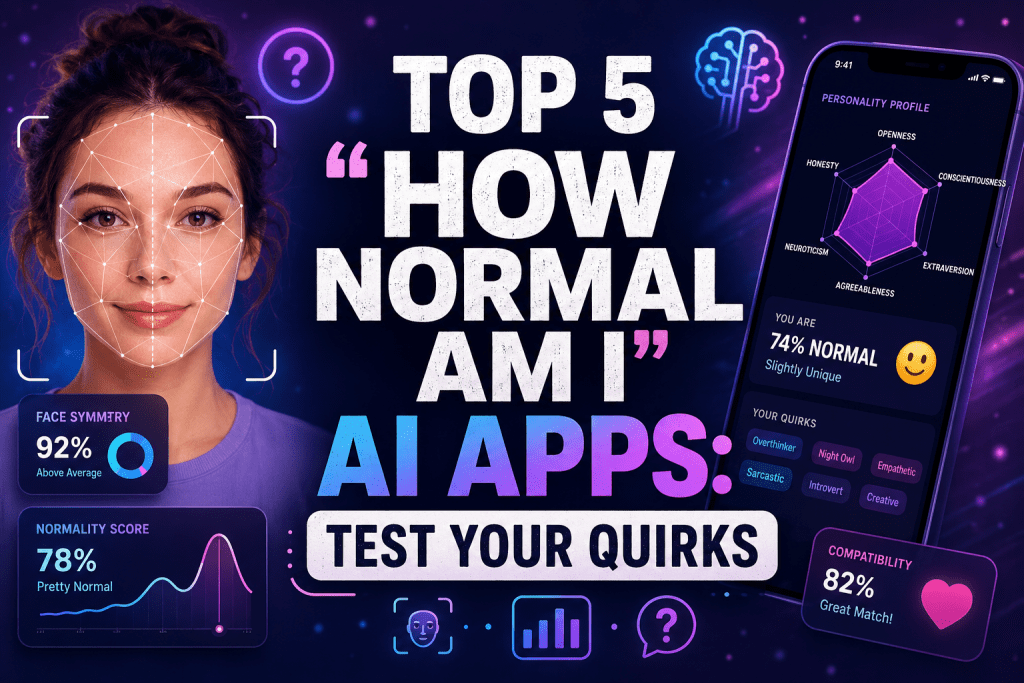
“How Normal Am I” AI apps are a category of tools that help users assess their normality, uniqueness, facial attractiveness, or personality traits. In this review, we will introduce you to several of the most interesting examples of such services.
How ’How Normal Am I’ AI Apps Work
The technology for assessing your personality and formulating conclusions is based on two different key approaches.
- The first uses computer vision: the camera scans your face in real time, while algorithms evaluate symmetry, age, emotions, and compare the results with datasets of “average” faces.
- The second is based on questionnaires: the user answers a series of questions, after which AI analyzes the responses using psychological models such as Big Five, MBTI, or Enneagram and generates a profile with charts and recommendations.
There is also a third, unofficial approach — essentially, capturing the overall vibe of the process. Some services emphasize entertainment and self-irony, while others take a more serious approach and offer practical insights for self-development.
Who Needs Such Apps and Why
These tools have several main use cases. Entertainment and self-discovery — finding out how normal or quirky you are, laughing at the results, or, conversely, reflecting on yourself. Self-development — gaining insights into strengths and weaknesses, relationships, career, and conflict behavior styles. Social interaction — comparing your profiles with friends or partners, assessing compatibility.
Who is this interesting for in the first place?
- Young people and adults aged 18 to 35 who are interested in psychology and self-development.
- TikTok and Instagram users who enjoy taking viral tests and sharing results.
- Those who want to understand their own quirks but are not ready to see a psychologist.
- Curious users who simply wonder what artificial intelligence will say about them.
It is important to understand: these apps do not replace professional psychology. They provide food for thought, but they do not make diagnoses.
Top 5 “How Normal Am I” AI Services
For this review, we selected the most relevant, popular, and interesting services as of 2025–2026. We took into account audience reach and number of reviews, the innovativeness of AI features, the focus on “normality” and personality quirks, platform availability, and the balance between entertainment and practical value. Purely entertainment tools with low ratings or questionable reputations were not included.
1. How Normal Am I?
Official website: hownormalami.eu
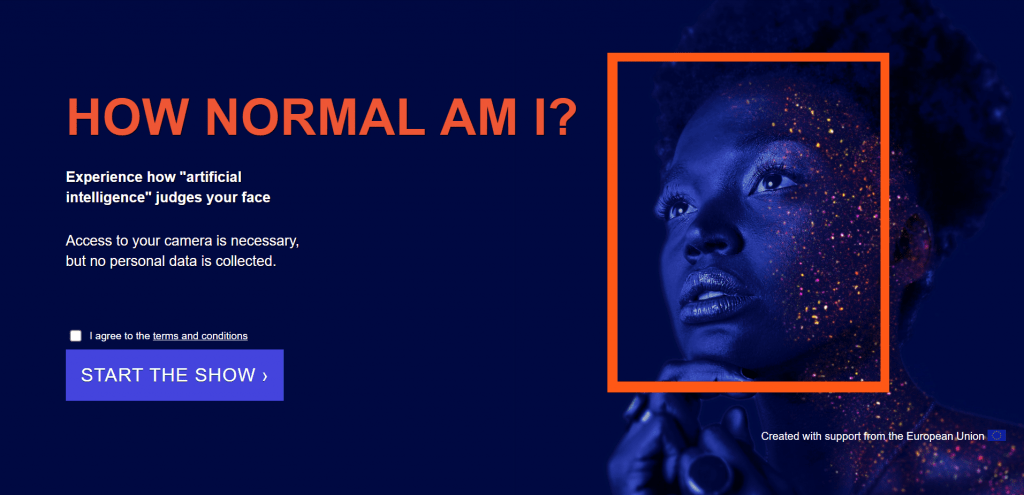
How Normal Am I is an interactive art project funded by the European Union. It does not seek to make money off you or collect your data. Its goal is to demonstrate how facial recognition algorithms work and to make you think about the nature of “normality.”
How It Works. You visit the website, grant access to your camera, and the application analyzes your face in real time. Algorithms evaluate symmetry, perceived age, BMI, emotions, and gender, then compare the results with datasets of “average” faces. The output gives you percentages and scores with humorous comments like “violently average.” The project is specifically designed so that no data is saved. After you close the tab, no information about you remains.
Features. Strong emphasis on privacy — no photographs are stored on servers. Educational aspect: built-in explanations of how facial recognition algorithms work and why they can make mistakes. A video guide from the artist explaining the project’s concept. Works in real time without needing to upload or send photographs.
User Reviews. The project became a viral hit with hundreds of thousands of views. On Hacker News and Reddit, it is called both fun and educational. Many praise the educational aspect and self-irony, but note that beauty scores should be taken with a grain of salt — the algorithms are far from objective.
- Platforms. Web version. Works best on Safari on iOS, but is available on other browsers as well.
- Pricing. Completely free. No subscriptions, no premium tiers.
- Completely free with a strong focus on privacy.
- Educational and entertaining content at the same time.
- Works in real time via camera.
- Analyzes only the face, without personality questionnaires.
- Results may shock or upset sensitive individuals.
- No in-depth profiling of character or quirks.
2. Dimensional
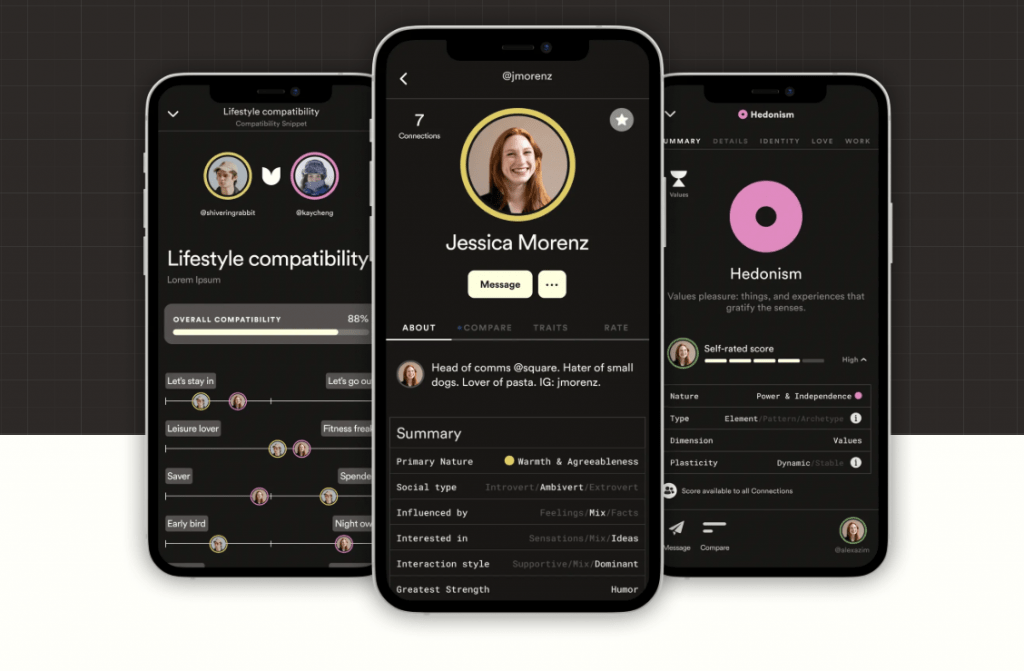
Official website: dimensional.me
Dimensional is a comprehensive personality analysis app that measures over 200 traits across more than 15 dimensions. It focuses on social comparison and compatibility with friends or partners.
How It Works. You take a series of tests covering conflict behavior style, attachment style in relationships, values, sexual attitudes, and political views. After completing the tests, AI builds your profile across multiple parameters. You can invite friends, compare your profiles, and assess compatibility. The app also delivers daily short insights and stories about “toxic traits” and behavioral patterns.
Features. The social element is Dimensional’s main distinction from other tests. The ability to compare profiles with friends, partners, or colleagues. Daily insight content that keeps you coming back to the app. Coverage of many personality aspects, not just the Big Five.
User Reviews. On the App Store, the app has a consistently high rating of 4.8–4.9. Users call it “eerily accurate” and the best app for understanding themselves and their relationships. On the downside, some find the wording stereotypical, and the paywall for full access is quite high.
- Platforms. iOS as the primary platform, Android in beta.
- Pricing. Freemium. Basic results are available for free. Full access to Dimensional+ costs about $45–60 per year or can be paid with credits for individual premium reports.
- In-depth multi-dimensional analysis across 15+ dimensions.
- Social comparison and compatibility assessment.
- Engaging daily insight content.
- Full access is locked behind a paid paywall.
- Focus on relationships and self-assessment, less attention to “quirks.”
- Potential privacy concerns regarding psychological data.
3. Apt AI

Official website: tryapt.ai
Apt positions itself as a more scientific and professional tool. It combines several psychological frameworks — MBTI, Big Five, Enneagram, and DISC — into a single test that takes about 10 minutes.
How It Works. You answer adaptive questions — the system tailors subsequent questions based on your previous answers. AI analyzes the results across all four frameworks simultaneously and delivers a unified profile. The report provides insights into character traits, behavioral style, communication, relationships, and career. The premium version adds career tools and deeper recommendations.
Features. Integration of multiple psychological models into one test. Adaptive questions that reduce completion time without sacrificing quality. Visualizations and charts for a clear representation of your profile. Focus on practical, actionable insights — not just “you are this,” but “here is what to do about it.”
User Reviews. Apt has a 4.9-star rating based on over 1,500 reviews. Users call it phenomenal and more accurate than traditional tests. They praise its nuance and the integration of multiple frameworks. On the downside, some find the test too serious and “professional” for purely entertainment use.
- Platforms. Web version and mobile app.
- Pricing. Freemium. The basic test is available for free or with partial results. Premium with full insights, a career mentor, and expanded reports is sold via subscription — details on the website.
- Scientific foundation with integration of multiple validated frameworks.
- Comprehensive and actionable insights.
- Adaptive questions save time.
- May be too professional for pure fun.
- Full experience requires a paid subscription.
- Fewer social and gamified elements.
4. Pretty Scale AI
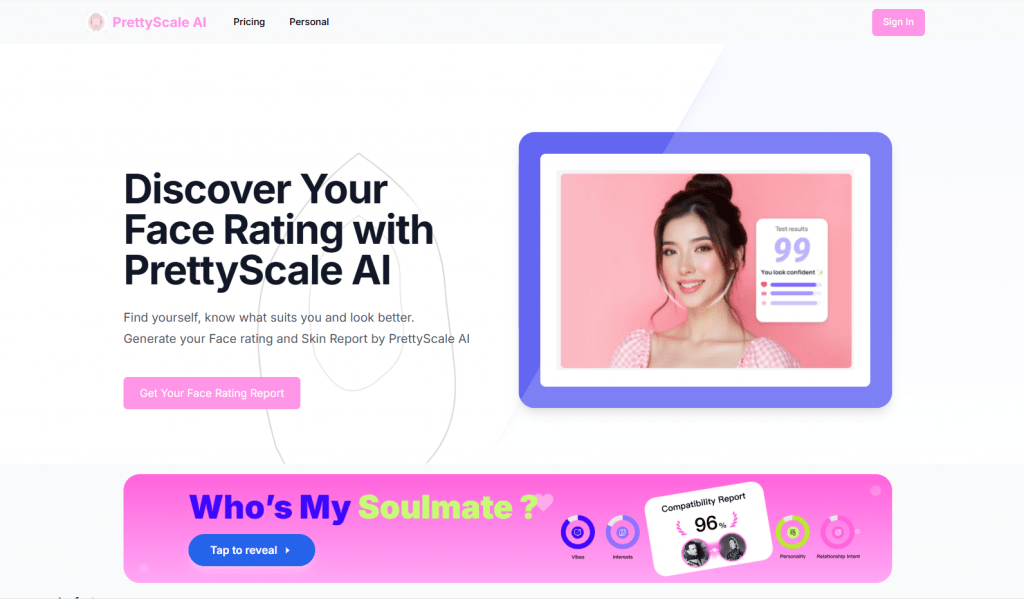
Official website: prettyscale.ai
Pretty Scale AI is a specialized web-based tool for analyzing facial attractiveness and skin condition. Unlike many competitors, it emphasizes not just producing a single number but providing a detailed breakdown by features along with personalized recommendations.
How It Works. You upload a frontal photograph taken in good lighting. The system analyzes the image within seconds and delivers a detailed report. Algorithms evaluate overall facial attractiveness in points, symmetry of the left and right halves, facial proportions and structure (face shape), and skin condition — texture, blemishes, and wrinkles. Based on this analysis, Pretty Scale AI generates personalized recommendations: which hairstyles might suit you better, which makeup accents to use, which eyeglass frames would highlight your strengths.
Features. High level of detail in analysis — you get not just a number but a breakdown of specific features. The ability to track changes over time through analysis history. Emphasis on privacy: photographs are not publicly posted and are not used without user consent. Works across various devices through a browser without needing to install an app.
User Reviews. On the official website, positive reviews predominate. Users note that the tool provides an objective perspective and in some cases even boosts their self-esteem. They praise the high level of detail — the ability to see a breakdown by individual features rather than just an overall score — as well as the usefulness of the hairstyle and makeup recommendations. In external discussions, such as on Reddit, the typical reaction is that the tool is fun and detailed, but users remind each other that the result is still subjective and heavily depends on the quality and lighting of the uploaded photo.
- Platforms. Website. No app installation required.
- Pricing. Freemium. The free plan provides a basic attractiveness score report. Paid tiers start at $9.9 for a basic paid report and go up to $14.9 for the Pro version with a full set of features, expanded recommendations, and additional analyses.
- Detailed analysis with breakdown by features, including skin condition.
- Personalized recommendations for hairstyles, makeup, and accessories.
- Fast processing with the ability to track changes in history.
- Free basic access with a focus on privacy.
- Accuracy of results strongly depends on photo quality and lighting.
- Full report with all features requires a paid subscription.
- Like all such tools, it is for entertainment purposes and not scientific fact.
5. Beauty Scanner
![A dark blue web page for "Beauty Scanner – Free AI Face Analyzer & Beauty Score Online". In the center, a photo of a mature woman with short blonde hair is being scanned by a horizontal green line with the overlay text "[ ANALYZING BIOMETRICS ]". The text below explains that the scanner measures facial symmetry, geometry, harmony, and skin health using the Golden Ratio.](https://aimarketcap.io/wp-content/uploads/2026/06/s-blob-v1-image-xtk9a15dcbc-1024x612.png)
Official website: beautyscanner.net
Beauty Scanner is a popular web-based tool for analyzing facial attractiveness. It uses computer vision algorithms and the concept of the golden ratio to assess how closely a user’s features align with classical beauty standards.
How It Works. You upload a photo or take a picture directly through the browser or app. The AI analyzes individual facial features: eyes, brows, nose, lips, chin, and overall face shape. Using the golden ratio (1:1.618), the algorithm calculates distances between key points — pupils, nose width, lip size — and compares them against the ideal mathematical proportions. The output is a beauty score out of 100, along with separate scores for symmetry, golden ratio alignment, and skin quality. Results are displayed instantly with visual breakdowns.
Features. Detailed analysis of individual features, not just an overall score. The use of the golden ratio as an objective criterion (though its applicability to beauty remains debated). Symmetry analysis comparing left and right halves of the face. Skin quality assessment including tone evenness, pigmentation, and smoothness. No app installation required for the web version — the entire analysis runs directly in the browser. No registration, 100% private.
User Reviews. The service has collected tens of thousands of reviews with ratings in the range of 3.6 to 4.0 stars. Users call it fun and surprisingly detailed. Many use it for looksmaxxing — tracking and improving their appearance. The main complaints involve intrusive ads in the free version and the fact that algorithms sometimes overestimate or underestimate scores for unclear reasons.
- Platforms. Web version.
- Pricing. Free.
- Fast facial analysis without needing to answer questions.
- Focus on the golden ratio with detailed breakdowns by individual features.
- Visually clear results with graphic indicators.
- High subjectivity of scores despite the pseudo-objectivity of the golden ratio.
- Can negatively impact self-esteem, especially among younger users.
Comparison Table
Service | Type of Analysis | Pricing | Platform | Key Strength | Main Weakness |
|---|---|---|---|---|---|
How Normal Am I? | Face AI (real-time) | Free | Web | Educational, strong privacy | Face only, no personality |
Dimensional | Personality (15+ dimensions) | Freemium | iOS, Android | Social comparison and compatibility | High paywall, data concerns |
Apt AI | Multi-framework (MBTI, Big Five, Enneagram, DISC) | Freemium | Web, App | Deep actionable insights | Career focus, paywall |
Pretty Scale AI | Face rating (golden ratio + skin) | Freemium | Web | Detailed feature analysis and recommendations | Photo quality depender |
Beauty Scanner | Face rating (golden ratio) | Free | Web | Fast detailed analysis by feature | Intrusive ads, self-esteem risk |
Conclusion
“How Normal Am I” AI apps are an interesting mix of entertainment, self-reflection, and a demonstration of the capabilities of modern algorithms. They help you see your quirks not as a deviation but as a trait that makes you unique.
If you just want to have fun and find out how “average” your face is, start with How Normal Am I — it is free, private, and educational, though the analysis is limited to the face only. If you are interested in deep psychology and comparing yourself with friends, take a look at Dimensional. For serious self-analysis with practical recommendations for career and relationships, Apt is a better fit. Pretty Scale AI is an excellent choice for those who want a detailed breakdown of their facial features with practical advice on improving their appearance, but be prepared that the quality of the result depends on your photo. Beauty Scanner can be used as a quick and lightweight tool, but with the caveat of ads and subjectivity of the scores.
Please remember the main thing: the results of these tests are not absolute truth, but merely a mirror for reflection. They are good for a first step toward understanding yourself, but they do not replace professional psychology. See your quirks as an advantage, and AI ratings as a reason to think or laugh, but not as a diagnosis.
❓ Frequently Asked Questions
Answers to relevant questions about this AI tool