

Best AI Lighting Effect Prompts: Master Digital Illuminatio
On this page
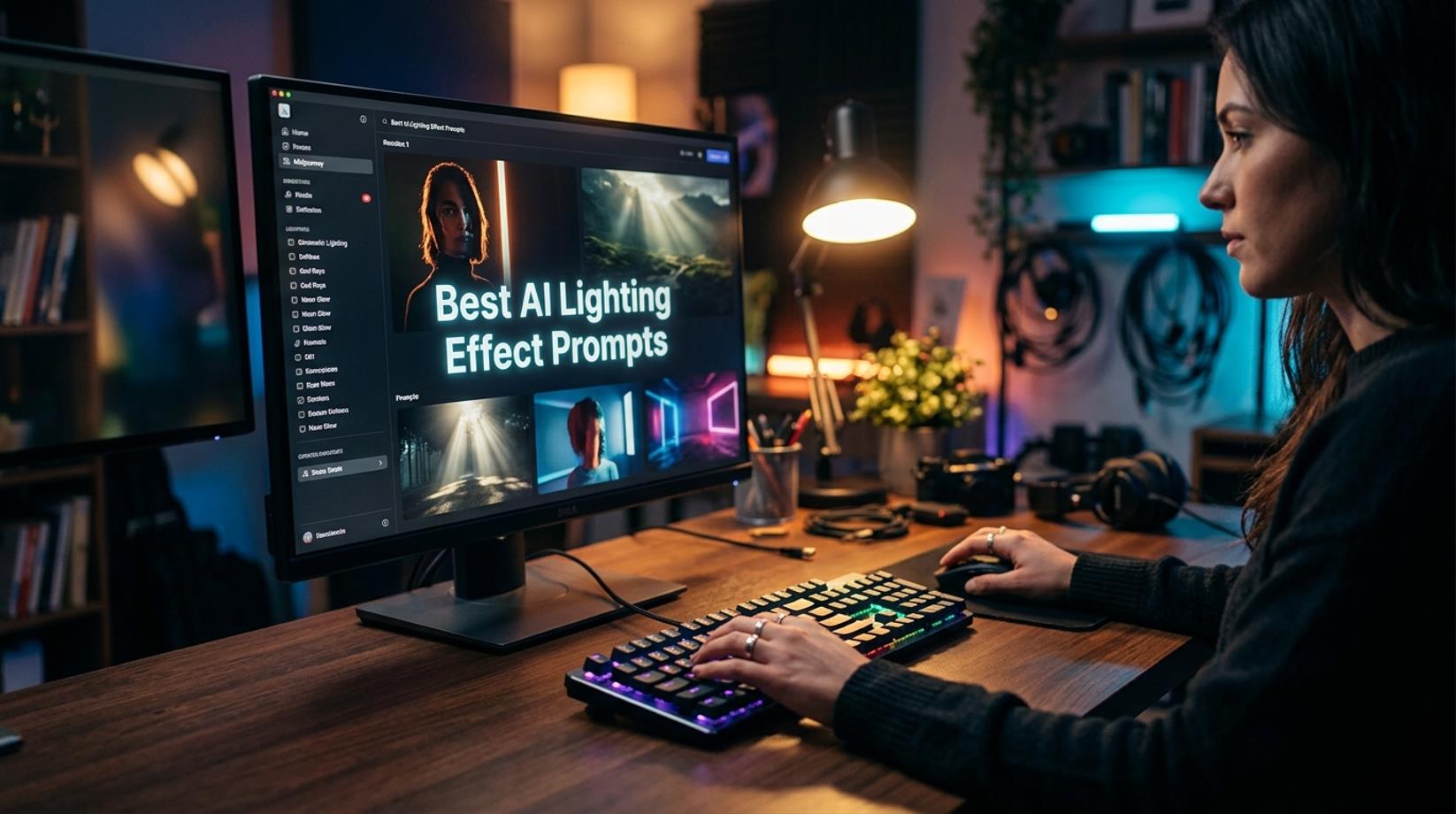
This report provides an exhaustive analysis of AI lighting prompt engineering. It begins by establishing the foundational mechanics of constructing, engineering, and iterating lighting prompts independently, exploring the underlying syntax, model-specific cognitive behaviors, and advanced parameter controls. Subsequently, the report transitions into a categorized compendium of the most incredible lighting effect prompts. This collection details the theoretical basis, physical mechanisms, keyword synergies, and precise execution strategies required to generate transcendent visual aesthetics across multiple generative platforms.
The Mechanics and Methodology of Lighting Prompt Engineering
Before exploring specific visual aesthetics, it is necessary to understand how diffusion models interpret textual lighting instructions. A robust lighting prompt does far more than simply append the phrase “cinematic lighting” to the end of a sentence. It systematically defines the origin of the light, its physical quality, its geometric directionality, the atmospheric medium it travels through, and the resulting color temperature or psychological mood.
The Anatomical Structure of a Master Prompt
Generative AI models prioritize information based on token placement, semantic weight, and structural clarity. Professional prompt engineers utilize a structured framework to ensure the model accurately renders the intended scene without allowing background elements to overpower the primary subject. The most reliable formula for image prompting follows a sequential, six-part hierarchy: Subject, Environment, Style and Medium, Lighting and Mood, Camera and Composition, and finally, Quality Modifiers.
Within this overarching framework, the lighting component itself must be anatomically precise. The architecture of a professional lighting description must explicitly articulate several variables to prevent the AI from defaulting to ambient global illumination. The prompt must define the light source, establishing the physical origin of the illumination, whether that is the sun, a window, a softbox, an LED panel, a neon sign, a flickering candle, or a bioluminescent organism. Furthermore, the directionality must be specified. This involves the geometric angle at which the light strikes the subject relative to the camera, utilizing terms such as front light, side light, backlight, overhead light, underlight, or a 45-degree key light.
The physical quality of the light must also be dictated. This refers to the harshness or softness of the shadow transitions, heavily influencing the texture of the subject. Descriptors include soft, diffused, hard, crisp, bounced, glowing, low-contrast, or high-contrast. Color temperature and mood further refine the atmosphere, indicating the spectral hue of the light, which ranges from warm tungsten and golden amber to cool moonlight, clinical blue, or stylized teal and orange. Finally, the prompt should define the atmospheric medium—the physical particles the light interacts with before hitting the subject or the lens, such as volumetric haze, mist, smoke, dust, or water droplets.
Instead of writing a generic prompt such as “a portrait of a man with good lighting,” a structured prompt utilizing this anatomical precision would read: “A cinematic portrait of an architect in a brutalist office, soft key light from camera left, cool blue rim light behind the shoulders, warm practical lamp in the background, subtle volumetric haze, shallow depth of field, realistic skin texture, no flat lighting”.
Syntax, Word Order, and Token Weighting
The placement of lighting keywords within the prompt string significantly impacts the final generated image. Elements placed earlier in the prompt receive higher implicit weight during the diffusion process, particularly in systems like Midjourney and Stable Diffusion. If the lighting is the most critical element of the desired output, placing the lighting descriptors at the very beginning of the prompt forces the model to construct the entire composition around that specific illumination. Appending a term like “backlight” to the end of a long, complex prompt may yield minimal rim lighting because the model’s attention has already been diluted by other subjects and environments. Conversely, beginning the prompt with “Backlight, editorial color photo…” ensures the model prioritizes the physical interaction of light bleeding around the subject’s edges before generating the subject itself.
Different generative platforms utilize highly distinct syntaxes for emphasizing specific concepts and controlling the interpretation of light.
| Generative Model |
Lighting Interpretation Methodology |
Control Mechanisms and Syntax |
|
Stable Diffusion |
Offers absolute control and technical precision. Requires explicit prompting and handles complex lighting exceptionally well when guided by external constraints. |
Utilizes bracket-based weighting syntax. For example, (golden hour lighting:1.4) instructs the model to weight that specific element 40% more strongly than neutral terms, while [background details:0.6] de-emphasizes competing visual noise. ControlNet plugins further elevate Stable Diffusion by allowing users to map lighting directions precisely using normal maps, depth maps, or edge detection algorithms. |
|
Midjourney (v6/v7) |
Prioritizes evocative atmospheric rendering, painterly aesthetics, and intuitive artistic interpretations. Excels at generating volumetric light, cinematic haze, and complex reflections without requiring highly technical syntax. |
Relies heavily on prompt order, parameter tuning (such as the –stylize command), and multiprompting with double colons :: to balance conceptual weights. |
|
DALL-E 3 |
Interprets conversational, natural language descriptions of light. Requires less rigid structural syntax but demands highly descriptive, adjective-rich paragraphs to prevent the model from defaulting to flat, generic lighting scenarios. |
Best prompted using narrative prose. Describing the exact location of the light source, how it hits the subject, and the shadows it casts in complete sentences yields the most accurate lighting maps. |
The Iterative Lighting Workflow
Mastering AI lighting is rarely achieved on the first generation; it requires an iterative feedback loop. Professional prompt engineers utilize a systematic process that combines generation and visual gap analysis to refine the output continually.
The workflow begins with the “Fast Start,” where the creator generates a baseline image using a loose prompt combining the subject and a broad lighting style, such as “Neon cyberpunk alley”. This establishes the model’s default interpretation of the concept and its native biases. The second stage involves a critical gap analysis of the light mapping. The creator must ask: Where is the primary light source? Are the shadows too muddy? Are the highlights blown out? Does the image feel flat because it lacks a directional rim light?
Once the deficiencies are identified, the creator moves to the “Cinematic Edit.” This involves injecting highly precise modifiers into the prompt to fix the issues. If the subject blends into the background, the creator adds “rim light,” “backlight,” or “bounced fill.” If the contrast is too harsh, terms like “diffused softbox” or “gentle shadow falloff” are introduced. The final stage involves parameter tuning, where the creator adjusts aspect ratios to give the light more physical space to travel, alters stylization values, or implements negative prompts to actively suppress unwanted global illumination or lens flares.
The Physics and Terminology of Digital Light
To command generative models effectively, one must speak the language of professional photographers, cinematographers, and 3D render artists. The latent space of these models heavily associates specific industry terms with distinct, mathematically predictable pixel behaviors.
Classical Studio Lighting Typologies
The geometric angle of light dictates the perceived three-dimensionality of a two-dimensional image. Generative models have been trained extensively on studio portraiture and respond exceptionally well to classic lighting setups.
| Studio Setup |
Visual Mechanism and Aesthetic Effect |
Optimal AI Prompt Keywords |
|
Rembrandt Lighting |
Named after the Dutch master painter, this setup places the key light at a 45-degree angle to the subject, creating a highly specific, small inverted triangle of light on the shadowed cheek. It produces dramatic, three-dimensional portraits with a classical, museum-quality feel. |
|
|
Butterfly Lighting |
Also known as paramount lighting, this places the primary light source directly above and slightly in front of the subject, creating a distinct, butterfly-shaped shadow directly under the nose. It highlights cheekbones and is universally flattering, highly associated with classic Hollywood glamour. |
|
|
Split Lighting |
The subject’s face is illuminated entirely on one side, leaving the opposing hemisphere in complete, heavy shadow. This maximizes visual drama and psychological tension, making it excellent for mysterious, intense character portraits or villainous archetypes. |
|
|
Rim Lighting and Backlight |
Placing the light source directly or obliquely behind the subject creates a glowing outline that physically separates their silhouette from the background. This technique adds profound depth and drama, and is strictly necessary in dark cinematic scenes to prevent the subject from blending into the shadows. |
|
|
Loop Lighting |
The most commonly used commercial portrait lighting, placing the light slightly above and to the side to create a small, looping shadow from the nose onto the cheek. It is flattering, natural-looking, and excellent for corporate or lifestyle imagery. |
|
Natural and Atmospheric Light Conditions
When generating exterior scenes or utilizing natural light through windows, the prompts rely heavily on time-of-day descriptors to invoke specific physical color palettes, atmospheric haze, and geometric shadow lengths.
Golden hour lighting captures the warm, magical quality of light occurring just after sunrise or right before sunset. In AI image generation, using golden hour prompts bathes subjects in a soft, directional glow, producing rich amber tones, long soft shadows, and a warm, nostalgic, or serene atmosphere. The low angle of the light naturally sculpts the scene, adding depth and dimension without the harshness of the midday sun. Conversely, the blue hour—the twilight period where the sun is below the horizon but the sky turns a deep, saturated blue—creates a cool, contemplative, and somewhat melancholic mood relying entirely on ambient light.
Overcast diffusion utilizes cloud cover as a giant, natural softbox, resulting in even, uniform, and shadowless illumination. This is excellent for rendering intricate product details or establishing flat, subdued cinematic scenes. Harsh midday sun, featuring direct overhead sunlight that creates strong, high-contrast shadows, is often avoided in standard portraiture but serves as a powerful tool for raw, documentary-style, gritty urban imagery, or hyper-realistic street photography.
Categorized Compendium of Incredible Lighting Prompts
The following sections provide a structured, exhaustive collection of the most visually stunning lighting effects achievable in AI models. Each category details the theoretical mechanism of the style, essential keyword combinations, and highly detailed prompt templates ready for deployment.
Category 1: Cinematic and Narrative Lighting
Cinematic lighting focuses entirely on visual storytelling, using extreme manipulation of light and shadow to direct the viewer’s eye, obscure unimportant details, and establish a profound emotional baseline. These prompts rely heavily on contrast ratios and atmospheric volume.
Low-Key Chiaroscuro
Low-key lighting utilizes deep, pervasive shadows and highly controlled, selective highlights. It draws its lineage from the Renaissance chiaroscuro technique (literally translating to light-dark) and mid-century film noir cinematography. It is best used for thrillers, dramatic character studies, intense architectural interiors, and luxury product photography where mystery is required.
The generative mechanism for this style forces the AI to push the majority of the image into the lower exposure registers (pure blacks and dark grays), utilizing a single, hyper-focused light source to illuminate only the critical focal points of the prompt. To prevent the model from adding unwanted ambient fill light, negative prompts such as flat lighting, overexposed, global illumination are often necessary.
- Essential Keywords:
Low-key lighting, chiaroscuro, deep shadows, cinematic shadows, dramatic contrast, selective highlights, single spotlight, moody atmosphere, pitch black background - Narrative Character Prompt:
A lone detective standing in a dimly lit alley at night, wearing a heavy trench coat, low-key cinematic lighting, deep shadows, chiaroscuro, moody atmosphere, selective highlight on his face from a distant streetlamp, 8k resolution, ultra-detailed, realistic textures, film noir aesthetic --ar 2:1 --style raw - Architectural Interior Prompt:
A 17th-century gothic library at midnight, low-key cinematic lighting, a single focused beam of moonlight piercing the darkness, illuminating an open dusty tome on a carved wooden desk, heavy chiaroscuro, deep shadows swallowing the bookshelves, mysterious mood, highly detailed, photorealistic --ar 16:9
Volumetric Lighting and God Rays
Volumetric light occurs in the physical world when a strong directional light source interacts with particulate matter suspended in the air—such as dust, smoke, fog, or morning humidity. This interaction causes the light to scatter, making the actual beam of light visible in three-dimensional space. Midjourney is exceptionally proficient at rendering this effect natively, often using it to establish awe, vast scale, or divine presence.
To successfully generate volumetric light, the prompt must explicitly contain both a strong directional light source and a defined atmospheric medium for that light to interact with. Mentioning “light” alone will just brighten the image; mentioning “dust particles” or “cinematic haze” gives the light a physical medium to travel through.
- Essential Keywords:
Volumetric lighting, god rays, visible light beams, cinematic haze, atmospheric fog, dust particles illuminated, scattered light, light piercing through - Epic Sci-Fi Landscape Prompt:
A lone explorer standing on a barren, rocky alien planet, bathed in dramatic volumetric lighting from a distant supernova, massive god rays piercing through dense atmospheric fog, dust particles illuminated brightly in the light beams, cinematic haze, sweeping wide composition, awe-inspiring grand mood, highly detailed masterpiece --ar 16:9 --v 6 - Historical Interior Prompt:
An abandoned Victorian train station, massive arched glass windows, thick volumetric god rays piercing through atmospheric dust and morning mist, illuminating overgrown green moss on the cracked stone floor, cinematic lighting, photorealistic, nostalgic and quiet --ar 3:2
Category 2: Optical Phenomena and Physics-Based Light
This category pushes the boundaries of AI rendering by forcing the model to simulate highly complex physical optics, such as refraction, spectral dispersion, and caustic reflections. Historically, these effects required immense computational power in 3D rendering engines, but diffusion AI models can hallucinate these intricate patterns instantly based purely on textual associations.
Caustics and Underwater Light Refraction
Caustics are the complex, shimmering, wave-like patterns of light created when rays are focused and bent through reflective or refractive curved surfaces, most notably moving water, glass, or gemstones. In computer graphics, a caustic is defined as a light path that travels from a light source to a specular surface, hits a diffuse surface, and finally reaches the camera. Because ray-tracing algorithms struggle to calculate these indirect light paths efficiently, AI generation represents a massive leap forward in rendering caustics quickly.
The generative mechanism requires the prompt to establish a clear refractive surface (like the top of a pool or ocean) and a solid surface for the caustic pattern to hit (like a seabed, an underwater ruin, or a marble floor).
- Essential Keywords:
Caustic light, shimmering wave-like light patterns, underwater caustics, light refraction, shafts of surface light, dappled aquatic floor, light dispersion, caustic overlays - Submerged Architecture Prompt:
A wide sunken plaza of cracked marble ringed by coral-crusted classical buildings, a toppled bronze statue at the center, intense caustic green light rippling dynamically over the silt, thick shafts of surface light from above penetrating the deep blue water, cinematic underwater lighting, serene aquatic atmosphere, highly detailed --ar 16:9 - Luxury Commercial Product Prompt:
High-end luxury glass perfume bottle partially submerged in crystal clear shallow water, bright overhead sunlight hitting the water surface, creating stunning caustic light patterns and refractive shadows across a pure white marble floor, photorealistic, commercial studio photography, sharp focus, 8k --ar 4:5
Prismatic Refraction and Rainbow Light
Prismatic texture and refraction mimic the physical dispersion of white light into its constituent electromagnetic spectrum of colors (red, orange, yellow, green, blue, indigo, violet) as it passes through a transparent geometric medium like a glass prism or cut crystal. This aesthetic provides a vibrant, surreal, and highly technical visual experience.
The AI accurately renders geometric glass or crystal elements and projects a vibrant gradient across adjacent surfaces, mimicking physical light wave bending and color separation. This is widely used in modern abstract art, aesthetic profile avatars, and high-end editorial fashion photography.
- Essential Keywords:
Prismatic texture, light refraction, rainbow spectrum dispersion, crystal prism, iridescent hues, geometric light patterns, spectral beauty, light splitting into constituent colors - Abstract Scientific Prompt:
Beautiful light refraction creating a stunning rainbow spectrum as brilliant beams of pure white light pass through a transparent geometric crystal prism, vivid cyan, magenta, and golden yellow hues flowing gracefully across a deep black background, soft bokeh effects, pure optical science, macro photography, 8k --ar 16:9 - Editorial Portrait Prompt (Rainbow Air Filter):
Editorial fashion portrait of a young woman, soft prism haze, pastel rainbow streaks, iridescent holographic edges placed around the subject, colorful air effect, light refracting dynamically across her cheekbones, dreamy rainbow aura, bright clean background, shot on 85mm lens --ar 4:5
Category 3: Sci-Fi, Cyberpunk, and Emissive Aesthetics
This category abandons natural sunlight in favor of artificial, hyper-saturated light sources. It requires the model to understand emissive materials, heavy light bleed, neon gas illumination, and complex reflections on specific urban textures like wet asphalt, brushed metal, or chrome.
Neon Noir and Split Gel Lighting
Originating from 1980s cyberpunk aesthetics, the Neo-Tokyo architectural style, and modern music video cinematography, neon lighting bathes subjects in vibrant, unnatural, and often contrasting colors. Split gel lighting specifically uses two opposing colors on the color wheel (e.g., cyan and magenta, or teal and bright orange) illuminating the subject from opposite sides to create aggressive, stylized dimensionality.
The AI maps highly saturated hex codes or color names to the directional light sources, simultaneously rendering the colored reflections on wet or glossy surfaces to ground the light in the physical space.
- Essential Keywords:
Neon lighting, cyberpunk aesthetic, cyan and magenta split lighting, color gels, wet asphalt reflections, vibrant synthwave color grading, glowing signage, volumetric neon glow - Cyberpunk Street Scene Prompt:
Narrow cyberpunk alley at night during heavy rain, vibrant neon signs reflecting beautifully on wet asphalt, steam rising from street grates, a lone figure with an umbrella silhouetted against bright holographic advertisements, exposed pipes, volumetric neon glow in teal and magenta, moody noir atmosphere, 8k UHD --ar 16:9 --style raw - High-Fashion Studio Prompt:
Studio beauty portrait of a woman in her early 30s against a pitch-dark backdrop, intense neon gel lighting, hot pink key light from the left and an electric blue rim light from the right, glossy highlights on high cheekbones, sleek black cyberpunk attire, calm powerful expression, ultra-photorealistic, shot on Canon R5 --ar 4:5
Glowing Fiber Optics and Data Streams
For conceptual technology imagery, abstract data visualization, and futuristic themes, glowing fiber optics provide an intricate, luminescent web of micro-lights. This style relies on the concept of high-speed data transmission visualized as physical light.
The AI renders thin, sweeping vector-like lines that emit their own light, often requiring terms like “bokeh” or “shallow depth of field” to create a sense of glowing depth, preventing the image from looking like flat vector art.
- Essential Keywords:
Glowing fiber optic cables, illuminated neon light, high-speed data streams, luminous strands, macro photography, tech-vibe, glowing network nodes, digital tunnel - Abstract Technology Prompt:
Futuristic fiber optic cables glowing intensely in neon cyan and electric purple, high-speed data streams flowing rapidly through a digital tunnel, cyberpunk aesthetic, cinematic lighting, macro photography, shallow depth of field with beautiful bokeh, glowing network nodes, dark background --ar 16:9 - Wearable Tech Concept Prompt:
Advanced smart-fabric texture woven with microscopic glowing fiber-optic threads, emitting warm amber and bright blue light, futuristic wearable technology, dark matte background, macro detail, hyperrealistic material texture, glowing data flow --ar 1:1
Category 4: The Ethereal, Natural, and Atmospheric
These lighting effects produce a dreamy, otherworldly, or deeply serene aesthetic. They rely on soft transitions, filtered natural phenomena, and biological luminescence to create emotionally evocative scenes.
Bioluminescence
Bioluminescence refers to light produced via chemical reactions within living organisms. In AI generation, it is highly sought after to create magical, fantasy, or alien environments where flora and fauna emit a soft, vibrant glow against dark, natural surroundings.
The model must be instructed to treat specific biological subjects (mushrooms, algae, veins, animal fur, or plants) as actual emissive light sources, casting a localized, highly saturated glow on the immediate surrounding elements (like tree roots or soil).
- Essential Keywords:
Bioluminescent, glowing cyan and purple, ethereal glow, magical atmosphere, luminescent flora, glowing underwater particles, organic light emission - Dark Fantasy Landscape Prompt:
A lone wizard standing in an ancient mossy forest at midnight, giant bioluminescent mushrooms glowing vibrantly around twisted tree roots, mist drifting slowly through tall pine trees, cinematic neo-noir atmosphere, dramatic rim light on the wizard, volumetric fog, staff emitting soft blue light, highly detailed --ar 16:9 - Conceptual Solarpunk Flora Prompt:
Secret rooftop garden in a cyberpunk city at night, bioluminescent genetically modified plants glowing cyan and deep purple, soft rain falling, a small reflective pond catching the light of the luminescent flora, peaceful contrast to urban chaos, Studio Ghibli style mixed with photorealism --ar 3:2
Dappled Light and Shadow Play
Dappled light is created when harsh sunlight is filtered through a dense canopy of leaves, branches, or geometric architectural structures, casting a randomized, high-contrast pattern of light and shadow across the subject. It is heavily utilized in “slice-of-life” anime styles, romantic portraiture, and architectural visualizations to suggest a world existing outside the immediate frame.
The AI faces a unique challenge here: it must render the physical obstruction (the leaves or canopy) that exists outside the frame by accurately mapping the complex geometric shadows over the complex 3D topography of the subject’s face or the background environment.
- Essential Keywords:
Dappled light, shadow play, light filtered through leaves, golden hour at twilight, nostalgic slice-of-life aesthetic, high contrast, intricate shadow patterns - Anime/Narrative Scene Prompt:
Background captures the golden hour at twilight, a large detailed old oak tree filtering the warm sunset light, intricate dappled light and deep shadows defining the scene, a painterly reflecting pond, nostalgic melancholic and peaceful aesthetic, high contrast, filmic grain, Studio Ghibli aesthetic --ar 16:9 - Architectural Golden Hour Prompt:
Modern glass house in a dense forest, dramatic golden hour light streaming through the windows and filtered through tall trees, creating intricate dappled light and shadow play across the minimal concrete floor, warm interior glow, peaceful and serene, photorealistic architectural digest style --ar 3:2 --stylize 150
Category 5: Experimental and Photographic Camera Techniques
AI allows creators to simulate in-camera photographic tricks that traditionally require specialized equipment, tripods, or long exposure times.
Light Painting
Light painting is a specialized long-exposure photographic technique where a moving light source is captured over several seconds or minutes, creating glowing trails, abstract shapes, or luminescent silhouettes in a pitch-dark environment.
The generative model interprets this prompt by drawing continuous, glowing ribbons of light suspended in mid-air, contrasting sharply against a black background. Midjourney is particularly adept at creating abstract curved shapes with this technique.
- Essential Keywords:
Light painting photography, long-exposure effect, paths of light, glowing ribbons, neon light trails, abstract curved shapes, ethereal energy, dark isolated background - Action and Motion Prompt:
Dynamic light painting photography, the silhouette of a dancer in motion surrounded by sweeping trails of electric blue and magenta light, long-exposure effect creating the illusion of movement, dark empty studio background, glowing ribbons of energy pulsing with futuristic charm, ultra-detailed --ar 16:9
Double Exposure Lighting
The double exposure effect blends two distinct images into a single artistic composition, often using the highlights or dark silhouettes of a portrait to mask a secondary landscape, texture, or abstract visual.
With AI, this effect is generated automatically without requiring Photoshop layers or manual masking. The prompt must clearly define the primary silhouette acting as the frame, and the secondary image that fills the backlit or overexposed areas.
- Essential Keywords:
Double exposure effect, blended composition, seamless transition, silhouette mask, backlit portrait merged with [secondary subject], artistic overlay - Surreal Conceptual Prompt:
Double exposure portrait of a contemplative woman in profile, her dark silhouette seamlessly blending into a vibrant sunset over a misty pine forest, the golden hour light from the forest illuminating her facial features, cinematic contrast, natural blending, artistic masterpiece --ar 4:5
Platform-Specific Workflows and Parameter Tuning
Achieving mastery over AI lighting requires combining the textual prompts detailed above with the specific technical parameters of the chosen generative model. While the textual words dictate what light is present, the model parameters dictate how the neural network processes and renders that request.
Midjourney Technical Parameters and Syntax
Midjourney utilizes a command-line style parameter system appended to the very end of the prompt. Proper manipulation of these parameters acts as a digital darkroom, fundamentally altering how the lighting engines behave.
| Parameter Command |
Syntax and Range |
Direct Impact on Lighting Generation |
|
Aspect Ratio |
–ar [width:height] |
Wider ratios (e.g., –ar 16:9 or –ar 21:9) provide more horizontal pixel space for directional light to travel, vastly enhancing the realism of volumetric rays, sunset gradients, and long dramatic shadows across landscapes. |
|
Stylize |
–s [0-1000] |
Dictates the strength of Midjourney’s default aesthetic training. Higher values (e.g., –s 700) give the AI freedom to exaggerate lighting effects, resulting in hyper-cinematic, glossy, or heavily dramatized artistic lighting. Lower values produce raw, unpolished, documentary-style light. |
|
Style Raw |
–style raw |
Strips away Midjourney’s automatic beautification and heavy contrast curves. Essential for making prompts like “harsh midday sun,” “direct paparazzi flash,” or “flat overcast light” look highly realistic and photographically authentic. |
|
Chaos |
–c [0-100] |
Controls initial grid variability. High chaos values (e.g., –c 50) will generate four images with wildly different lighting setups (e.g., one backlit, one front-lit, one neon) from the exact same text prompt, making it ideal for creative exploration. |
|
Negative Prompts |
–no [terms] |
Removes unwanted lighting artifacts. Using –no lens flare, washed out, flat lighting, ambient fill physically forces the model to maintain deep contrast and respect low-key lighting setups. |
|
Style Reference |
–sref [URL] |
Allows the user to upload a reference image with perfect lighting (e.g., a still from a cyberpunk film) and forces the model to mathematically map that specific neon lighting matrix and color grade onto an entirely new subject. |
Stable Diffusion: ControlNet and Prompt Weighting
For creators demanding absolute, granular control over illumination, Stable Diffusion represents the industry standard. Where Midjourney operates as an intuitive art director interpreting a vision, Stable Diffusion operates as a precision lighting technician.
If a specific lighting effect is bleeding too heavily into the image and overpowering the subject, Stable Diffusion allows for precise weight reduction. Conversely, if a neon rim light is too dim, it can be mathematically amplified. For example, a prompt formatted as A dark street, (cyan neon sign:1.5), [wet pavement reflections:0.6] instructs the model to boost the neon sign generation by 50% while suppressing the reflections to 60% of their normal power.
Stable Diffusion also relies heavily on negative prompts to clean up image quality and enforce lighting logic. To ensure a moody, low-key lighting setup remains dark, the negative prompt is essential. A standard lighting negative prompt for cinematic contrast includes: flat lighting, overexposed, blown highlights, direct flash, ambient global illumination, multiple light sources, washed out, low contrast.
Furthermore, ControlNet fundamentally changes how light is prompted in Stable Diffusion. By feeding a Normal Map or Depth Map into a ControlNet processor, a user can physically define the 3D geometry of the subject. A simple textual prompt like strong directional light from the left will then mathematically wrap around the defined 3D geometry based on the ControlNet map, producing perfect, anatomically correct shadows that text-to-image prompting alone cannot guarantee.
Prompting for Motion and Video Illumination
As AI expands into video generation (via tools like Luma, Runway, or Midjourney’s native video features), lighting prompts must account for temporal changes. The prompt must describe how the light behaves across time.
When generating video, it is crucial to separate subject motion from environmental lighting motion. To create dynamic, living light, prompts should include phrases that describe the shifting nature of the illumination: “shadows moving with sun,” “light flickering subtly,” “fire crackling and dancing,” or “caustic light rippling dynamically over the surface”. Specifying this motion prevents the AI from generating a static, frozen lighting map on a moving subject, which destroys the illusion of photorealism.
Conclusion
The structural integrity and emotional resonance of an incredible AI-generated image rely almost entirely on the successful engineering of its lighting. As demonstrated across the varied architectures of Midjourney, Stable Diffusion, and DALL-E, lighting is not an afterthought to be casually appended to a prompt; it is the foundational, mathematical atmosphere around which the physical subject is rendered. By systematically applying the anatomical structure of a prompt—explicitly defining the physical source, geometric direction, qualitative texture, and color temperature of the light—creators bypass the generic, flat aesthetics typical of novice AI generations.
From the dramatic, high-contrast storytelling of classical chiaroscuro to the highly complex, physics-defying optical simulations of prismatic dispersion and underwater caustics, generative models possess a profound, latent understanding of photographic physics. By leveraging the specific keyword synergies, studio terminology, model-specific parameters, and categorized templates provided in this exhaustive report, users transition from merely requesting images to purposefully and masterfully sculpting digital light.
❓ Frequently Asked Questions
Answers to relevant questions about this AI tool


Adding ‘cyberpunk neon reflections’ always makes night scenes pop.