
Alibaba’s new neural network generates short video up to 1080p with embedded synchronized sound, dialogue and effects. This review covers architecture, use cases, pricing and comparison with Kling and Seedance. Find out if the Happy Horse is worth your tokens.
AI Video Generator Happy Horse 1.0 — New Release from Alibaba
On this page
In April 2026, Happy Horse suddenly topped the leading industry benchmarks, surpassing Seedance 2.0, Google Veo, and Kling 3.0. A few days later, Alibaba officially confirmed that the model was their development. This marks the second major surprise from the Chinese technology giant following Qwen.
Many on social media rushed to declare Happy Horse a “Seedance killer.” Let us examine this new model — without hype or grandiose claims of “killer features,” but with due attention to its architecture, market positioning and actual capabilities.
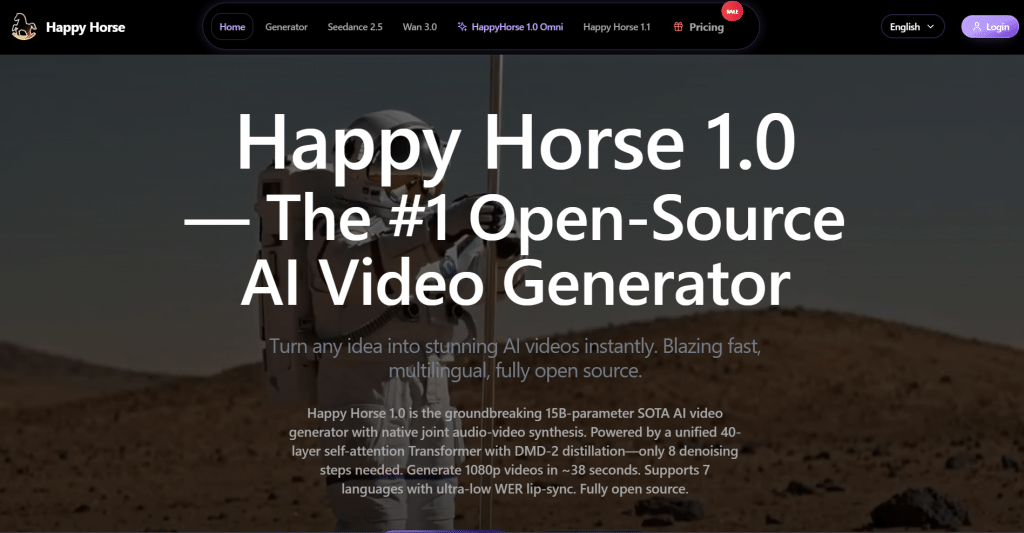
What Is Happy Horse
Happy Horse 1.0 is a multimodal neural network model for video generation, developed by one of the divisions within the Alibaba conglomerate. Recently, Alibaba has been conducting an aggressive and systematic offensive in the field of generative AI. The success of the Qwen 2.5 language model demonstrated the company’s ability to compete with the best large language models. Now it is the video’s turn.
What does Alibaba gain by launching its own video generator?
- Ecosystem development. The model is already integrated into the Alibaba Cloud Bailian cloud platform, the Tongyi Qianwen messenger and is poised to replace older video editing tools.
- E-commerce support. Alibaba Group and Taobao have a colossal demand for visual content. Generating animated storefronts, living product photographs and advertising creatives through an in-house model is many times cheaper than purchasing third-party APIs.
- Technological sovereignty. Given restrictions on chip exports, China is compelled to increase its software capabilities. Happy Horse is a direct response to Western developments such as Sora.
The company’s strategy is quite transparent: attract the public with quality and speed, bind them to the Alibaba Cloud infrastructure, then scale enterprise solutions for e-commerce and video production. And what do we, ordinary users, gain?
Setting aside geopolitics and corporate ambitions, just another very high-quality video generator. But with several important nuances that distinguish Happy Horse 1.0 from European or American counterparts and make it genuinely interesting.
Architecture of Happy Horse 1.0: What Is Under the Horse’s Hood
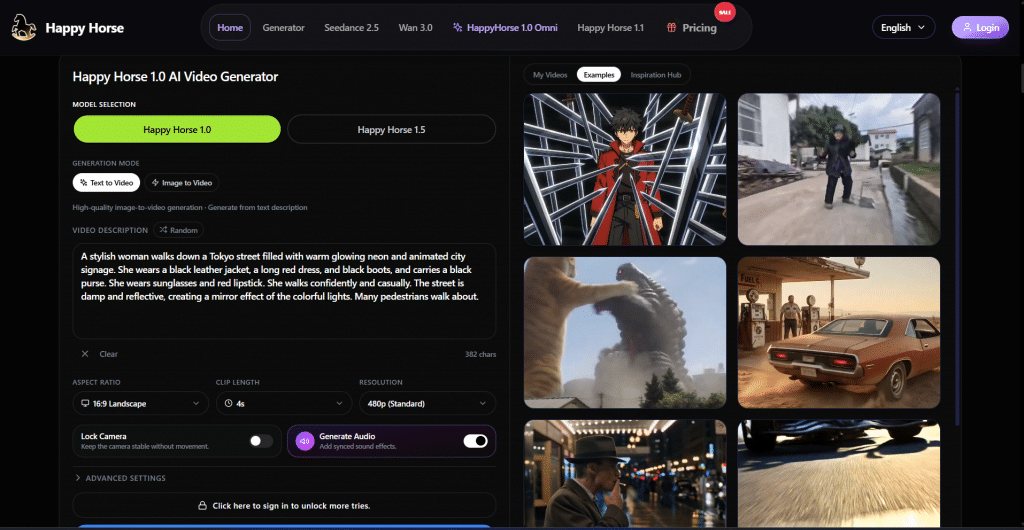
Happy Horse 1.0 is built on a 40-layer single-stream transformer with 15 billion parameters. To understand the significance of this fact, a brief digression is necessary.
Most existing models use a dual-stream architecture:
- They independently process visual and textual information.
- They then merge the streams through a cross-attention mechanism.
This approach requires significant computational resources and often leads to a misalignment between the prompt and the generation result.
Happy Horse takes a different path. The single-stream architecture converts text, image, video and audio into a unified stream of tokens processed by a single transformer. This is a fundamental difference that yields more natural coherence across all modalities.
The New Diffusion Model
The key innovation is a new method for handling noise, DMD-2 (Distribution Matching Distillation). A standard diffusion model requires 30 to 50 denoising iterations to achieve an acceptable result. Happy Horse with DMD-2 technology performs only eight iterations.
Practical consequences:
- Generation speed increases dramatically. For example, creating a five-second clip at 1080p resolution on an H100 chip takes only about 38 seconds.
- The mechanism that in other models balances prompt adherence against naturalness is absent. In Happy Horse, both are built in from the start, which conserves computational resources and reduces generation costs.
Does this make the horse genuinely cheaper compared to competitors? Not unequivocally. In the configurations we tested with an audio track, the price can reach approximately one dollar per second of video, not exactly budget-friendly for elementary tasks.
Native Audio
Some AI models generating video with sound do not truly integrate the audio track but rather simulate such integration. The audio track is created by a separate stripped-down model and layered on top of the video. This results in articulation mismatches.
Happy Horse uses joint audio-video synthesis in a single pass. The architecture perceives the sound spectrogram as another dimension of the video. The same transformer that predicts the next pixel predicts the next audio sample. Consequently, footsteps, fabric rustling, and lip movements during dialogue are well synchronized and appear more natural.
Using Happy Horse
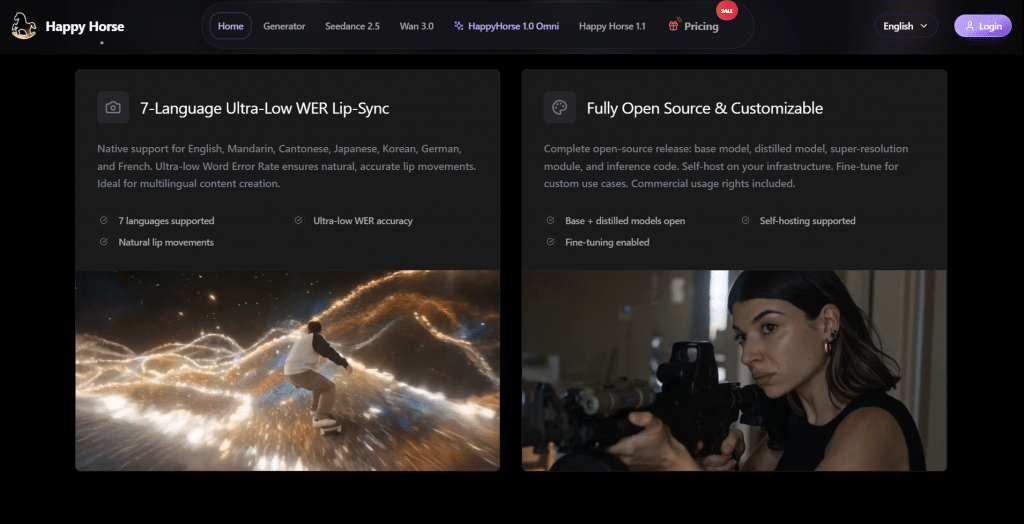
The generation process appears standard: you write a prompt, select a mode (text-to-video or image-to-video), and adjust the duration and aspect ratio. Then you wait for the result. During peak hours, waiting time can reach two minutes.
Happy Horse 1.0 is particularly advantageous in the following scenarios:
- Viral content for social media (TikTok, Reels, VK Clips, YouTube Shorts). Fast generation of short clips with ready-made sound and high-quality lip-sync. Dozens of variations can be created in a short time.
- Product videos for e-commerce. Animating static product photographs: rotation, usage demonstrations, and lifestyle scenes. Material physics work excellently (fabric, liquid, shine).
- Advertising creatives and A/B testing. Mass creation of advertising video variants for performance marketing. Multi-shot mode allows creating mini-stories with the same character.
- Multilingual content. Thanks to support for seven languages with native lip-sync, spokesperson videos can be created for multiple countries simultaneously without dubbing.
- Scene prototyping (previz). For directors, videographers, and YouTube creators—a quick way to test a scene concept with audio.
- Educational and explainer content. Short video lessons, product explanations, and instructions featuring a speaking presenter.
- Personalized videos. Greetings, personalized offers and custom content based on a user-uploaded photo.
Comparison of Happy Horse 1.0 With Leading Competitors
Will the horse become anyone’s killer, and how does it stack up against already familiar models?
In independent benchmarks, Happy Horse 1.0 leads in generation speed in the text-to-video without sound and image-to-video categories. However, there is much marketing noise here. Speed alone proves little. Real-world tests reveal a more interesting picture.
- Happy Horse vs. Seedance 2.0. ByteDance’s AI works considerably better on complex action scenes with many moving objects. Happy Horse, by contrast, is stronger at portrait shots, material physics (water, fabric), and, most importantly, sound synchronization—we have already mentioned this advantage.
- Happy Horse vs. Kling 3.0. Kling remains the benchmark for camera control: you can more precisely set panning, zoom in and zoom out. However, Kling’s generation speed is noticeably lower. If your task is mass variant creation for A/B testing in marketing, Happy Horse provides a faster iteration cycle.
- Happy Horse vs. Sora and Veo. The models from OpenAI and Google remain the gold standard for physical plausibility and generated scene length. But they are quite expensive. Happy Horse delivers top-five quality—not perfect, but perfectly competitive—at a more democratic price per token.
Comparison Table: Happy Horse 1.0 vs. Competitors (May 2026)
| Parameter |
Happy Horse 1.0 |
Seedance 2.0 |
Kling 3.0 |
Sora / Veo |
|
Generation Speed |
Excellent (~38 sec) |
Good |
Average |
Below average |
|
Native Audio + Lip-sync |
Excellent (7 languages) |
Very strong |
Good |
Good |
|
Image-to-Video |
Among the best |
Strong |
Good |
Excellent |
|
Camera Control |
Good |
Good |
Excellent |
Excellent |
|
Character Consistency |
Strong |
Very strong |
Strong |
Strong |
|
Maximum Duration |
5–15 seconds |
Up to 15 sec |
Up to 15 sec |
10–20 sec |
|
Price |
Democratic |
Medium-high |
High |
High |
|
Openness |
Claimed but currently absent |
No |
No |
No |
|
Best For |
Marketing, portraits, multilingual |
Complex motion |
Cinematography |
Maximum quality |
User Reviews and Community Reception
Opinions on specialized platforms such as Reddit are divided.
Users note that the model animates faces adequately and understands detailed prompts in English. Generation speed is described as “almost magical.”
At the same time, sound in some scenes often seems muddy, and with sharp camera movements, glitches and artifacts appear.
The main source of controversy is the question of openness.
Initially, Happy Horse was written about as an open-source model. Many enthusiasts expected to be able to run it locally on their own servers. But apparently, Alibaba’s marketing department somewhat outpaced the engineers in their promises. Weights have still not been published on Hugging Face or GitHub. Repositories contain only placeholders marked “coming soon.” Happy Horse is, for now, strictly a commercial cloud service.
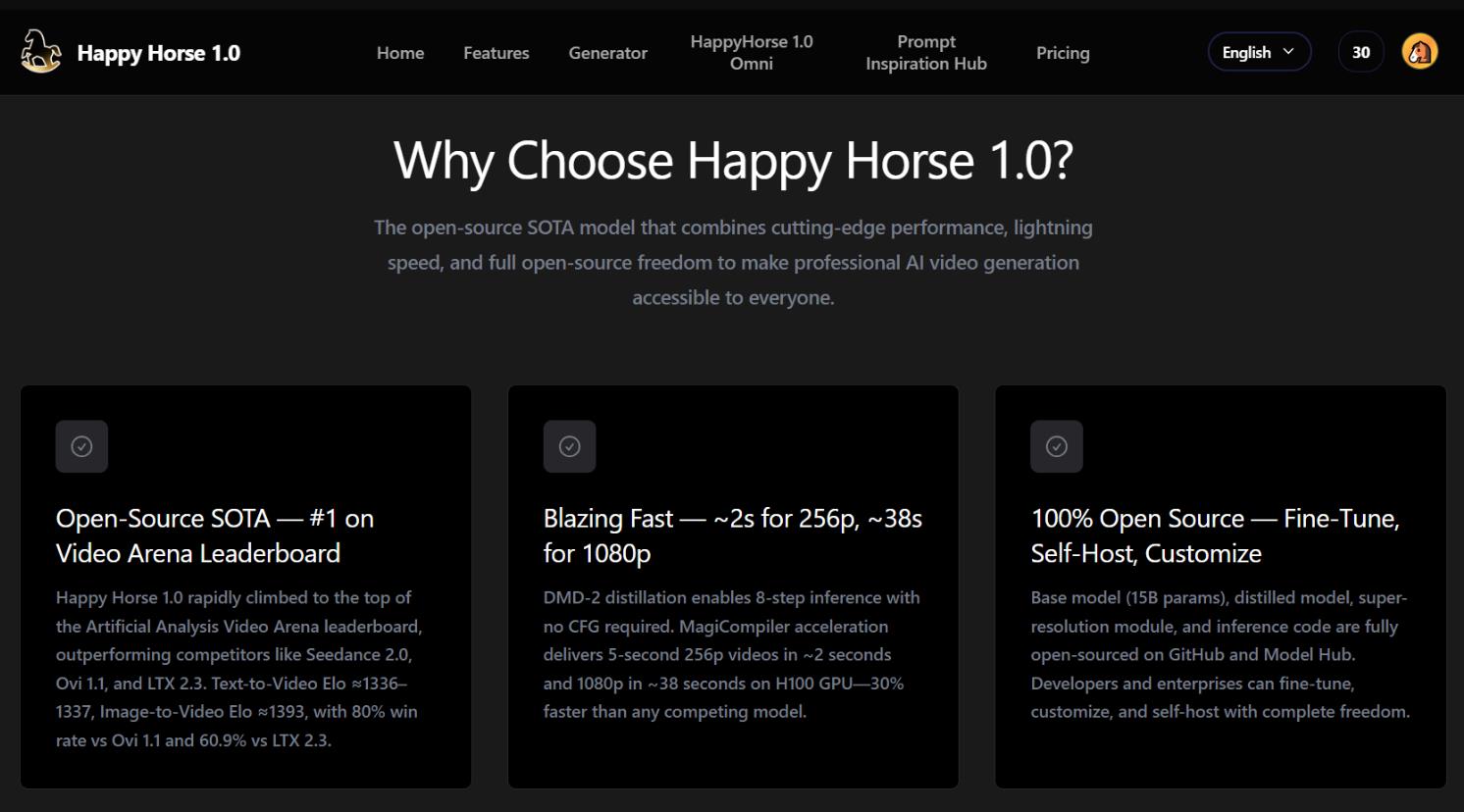
- Leading positions in independent industry benchmarks for video generation speed from text and from images.
- Native sound support, solving the articulation synchronization problem.
- Support for prompts in multiple languages, providing marketing advantages in corresponding regions.
- High character consistency thanks to single-stream architecture: facial features do not distort from frame to frame.
- Absence of open-source code and model weights precludes local fine-tuning.
- Limited duration of generated video — maximum 15 seconds.
- Instability in complex scenes with three or more actively interacting objects.
- Cost remains higher than one might expect from such an “ergonomic” technology.
Conclusion
Happy Horse 1.0 is genuinely good: fast, intelligent and overall with decent generation quality. If you are a content creator who needs to rapidly produce short animated clips for social media, Alibaba’s new model will serve you well. However, the lack of open access still significantly limits its appeal for the enthusiast community and independent researchers.
Do we recommend it? Absolutely. Regardless, we have acquired yet another excellent tool that will certainly find an audience and many use cases.
❓ Frequently Asked Questions
Answers to relevant questions about this AI tool
Sources
-
happy-horse.art — happy-horse.art«Happy Horse 1.0 - Open Source AI Video Generator»
-
happy-horse.art — happy-horse.art«Happy Horse 1.0 Pricing - Free Credits & Commercial License»
-
happy-horse.art — happy-horse.art«Happy Horse 1.0 FAQ - Open Source AI Video Questions»
-
happy-horse.art — happy-horse.art«Happy Horse 1.0 Showcase - Curated Prompts & Video Reviews»
-
happy-horse.art — happy-horse.art«HappyHorse 1.0 AI - Open Source SOTA Video Generator»