
MuseNet could generate four-minute musical compositions in the style of Mozart, the Beatles, or Lady Gaga using a single deep learning model. OpenAI quietly shut the demo down in 2023.
MuseNet by OpenAI: AI Music Generation
On this page
MuseNet was OpenAI’s AI music generation system, released in April 2019 and built on a transformer model trained on MIDI files. A single deep learning model handled melody, harmony, rhythm, and instrumentation across genres that combine styles that had no natural overlap, like a Chopin nocturne played by a country band. Compositions ran up to four minutes, longer than most AI music generators of the time could sustain.

The free public demo ran until 2023, when it quietly disappeared from OpenAI’s website without announcement or replacement.
How MuseNet Worked
MuseNet was built on a transformer architecture, the same model type that underpins GPT, applied to music rather than text. It learned from a large MIDI dataset spanning classical compositions, pop songs, folk music, jazz standards, and more, identifying statistical patterns in how notes, rhythms, and instrument combinations relate to one another.
The AI music generation process worked like this:
- Select a starting style — composer, genre, or artist.
- Choose up to ten instruments from the available set.
- Optionally provide a short musical prompt from preloaded options or upload your own.
- The generative music AI predicts what comes next, producing a full MIDI composition.
- Play back the result in the browser or download the MIDI file.
The model did not follow programmed music theory rules. Like any transformer-based system, it predicted the next element in a sequence based on learned patterns, the same principle behind GPT for text, applied here to musical structure.
MuseNet in Action
Select “Chopin” as the style, add piano and cello, choose an opening prompt, and click generate. The AI composer produced a continuation within seconds that held the harmonic language of Romantic-era piano music throughout.
Cross-genre combinations were the more revealing test. Lady Gaga with a string quartet retained pop song phrasing but replaced electronic production with orchestral textures. “Bach” with jazz instruments produced Baroque counterpoint with extended chords and syncopation.
Longer outputs sometimes lost direction toward the end, and some instrument combinations felt harmonically arbitrary. The stronger results demonstrated that a single deep learning music model could handle genuine stylistic variety across genres and instruments.
What MuseNet Covered
|
Category |
Details |
|
Styles |
Classical, jazz, pop, folk, country, rock, and more |
|
Composers |
Mozart, Chopin, Bach, Beethoven, and others |
|
Artists |
The Beatles, Lady Gaga, and selected pop artists |
|
Instruments |
Up to 10 simultaneously, including piano, violin, guitar, drums, and bass |
|
Output format |
MIDI composition, playable in-browser |
|
Composition length |
Up to 4 minutes |
|
Input options |
Style selection, instrument selection, optional musical prompt |
Who It Was For
MuseNet attracted a specific set of users rather than a general audience.
-
Music researchers and AI enthusiasts used it to explore what transformer models could do outside of language. The 2019 release predated widespread public access to large language models, and MuseNet was one of the first AI composition tools to demonstrate the same architecture applied to music generation.
-
Composers and musicians used it as a creative starting point. The MIDI composition output could be imported into a digital audio workstation, edited, layered with real recordings, or used as a structural sketch for a larger piece.
-
Educators used it in music technology and music theory courses to demonstrate AI-generated music and prompt students to analyze what the model understood about musical structure.
-
Developers and researchers used it as a benchmark reference point for newer generative music AI systems entering the market.
Pricing
|
Plan |
Price |
Status |
|
Public demo |
Free |
Discontinued (2023) |
|
API access |
Not available |
Never offered publicly |
|
Commercial licence |
Not available |
Never offered |
MuseNet was never monetised. OpenAI released it as a research demonstration with no paid tier, no API access for developers, and no commercial licensing. The free AI music generator ran entirely through the browser-based demo, which is no longer available.
Pros and Cons
- Generated coherent AI instrumental music up to four minutes long
- Handled ten instruments simultaneously within a single deep learning model
- Covered a wide range of styles through style transfer music mechanics
- Free with no account required during its availability
- MIDI composition output was compatible with standard music production software
- Tendency to drift in longer compositions
- MIDI only: no audio output, requiring additional software for realistic playback
- Limited control over generation beyond style and instrument selection
- Discontinued in 2023 with no replacement from OpenAI
Why MuseNet Was Discontinued
OpenAI made no public statement about the decision. The demo became intermittently unavailable through 2022 and stopped working entirely by 2023.
Two factors likely contributed. First, OpenAI’s focus shifted toward large language models following GPT-3 and ChatGPT, making a standalone AI music generation demo a lower priority. Second, dedicated AI music generator platforms like Suno, Udio, and AIVA had emerged by 2023, offering audio output instead of MIDI and more intuitive interfaces. A MIDI-only AI composition tool with limited controls no longer represented the state of the art in generative music AI.
AI Music Generation Alternatives to MuseNet
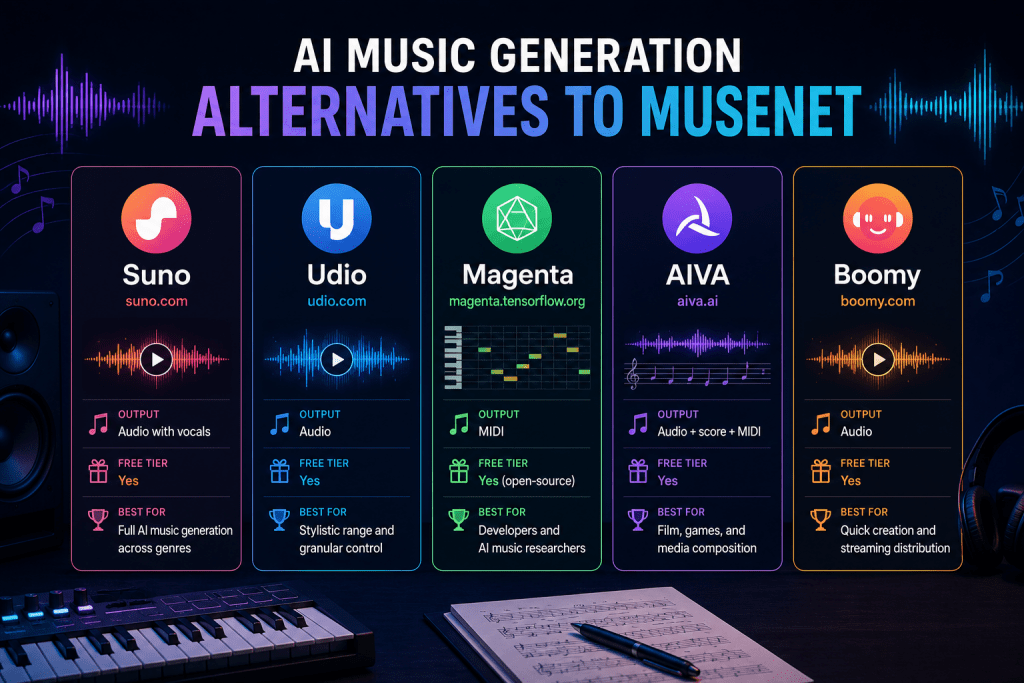
Several AI music generator tools are actively developed and publicly available in 2026. Each takes a different approach to the problem MuseNet addressed.
|
Tool |
Website |
Output |
Free tier |
Best for |
|
Suno |
Audio with vocals |
Yes |
Full AI music generation across genres |
|
|
Udio |
Audio |
Yes |
Stylistic range and granular control |
|
|
Magenta |
MIDI |
Yes (open-source) |
Developers and AI music researchers |
|
|
AIVA |
Audio + score + MIDI |
Yes |
Film, games, and media composition |
|
|
Boomy |
Audio |
Yes |
Quick creation and streaming distribution |
Comparison Table
|
Tool |
Output |
Free tier |
Best for |
|
Suno |
Audio with vocals |
Yes |
Full AI music generation |
|
Udio |
Audio |
Yes |
Stylistic range and control |
|
Magenta |
MIDI |
Yes (open-source) |
Developers and AI music researchers |
|
AIVA |
Audio + score + MIDI |
Yes |
Film, games, and media composition |
|
Boomy |
Audio |
Yes |
Quick creation and streaming distribution |
Final Thoughts
MuseNet demonstrated in 2019 that a transformer model could handle AI music generation across genres, styles, and instruments with a single deep learning system. That was a meaningful contribution to generative music AI at the time, and the free public demo gave non-specialists direct access to something previously limited to research environments.
The AI music generator landscape has moved significantly since then. Suno and Udio produce full audio output, including vocals; handle a wide range of genres; and require no musical knowledge. AIVA gives composers and media producers score-level control over AI generated music. Magenta remains the closest in spirit to MuseNet — open-source, MIDI-oriented, and built for developers and researchers working with generative music AI directly.
MuseNet is no longer available, but the direction it pointed toward is now a functioning and competitive category of AI composition tools.
❓ Frequently Asked Questions
Answers to relevant questions about this AI tool
Sources
-
MuseNet — openai.com
-
OpenAI Releases MuseNet: AI Algorithm Automatically Generates Music - NVIDIA Developer Blog — developer.nvidia.com
-
How to compose with MuseNet a piece of music in the style of Mozart - Ars Electronica — ars.electronica.art
-
MuseNet (OpenAI) - Future Tools — futuretools.io
-
MuseNet by OpenAI - Reddit r/MachineLearning — reddit.com