

3D Body Visualizers: A Complete Guide to Digital Anthropometry
On this page
Historically, clinical and industrial anthropometry relied on one-dimensional metrics—weight, height, and linear measurements obtained using a tape measure, scales, or calipers. However, these traditional methods are fundamentally incapable of capturing the complex spatial geometry of the human body, the dynamics of soft tissue distribution, and individual morphological features. Today, 3D body visualizers have come to the forefront—specialized software suites and web tools that convert basic numerical parameters or 2D images into highly accurate 3D digital twins (avatars).
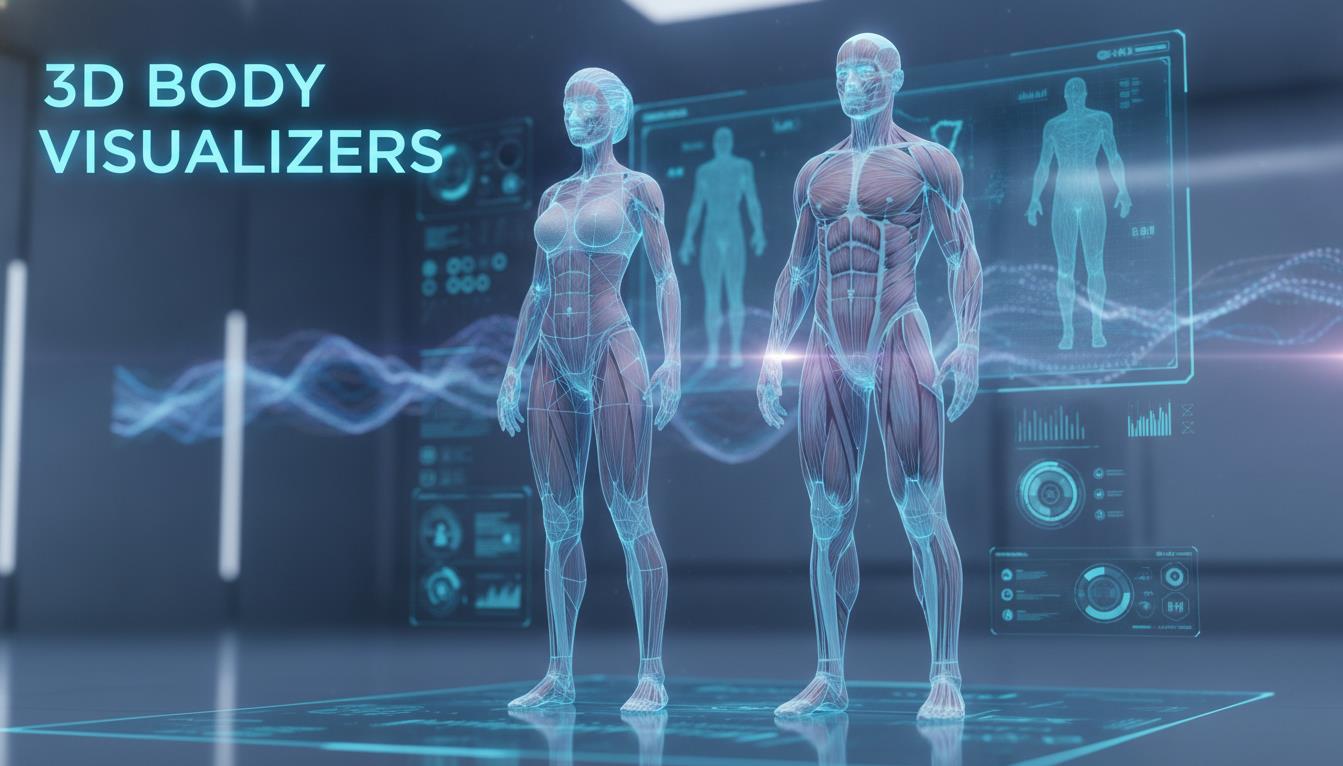
A modern 3D body visualizer is an interactive analytical tool that utilizes Statistical Body Shape Models (SBSM) to generate a realistic representation of a male, female, or child silhouette. User interaction with the system is structured so that upon entering a set of basic metrics (e.g., height, weight, chest, waist, and hip circumferences, age, and physical activity level), algorithms interpolate these data in real-time, creating a unique, anatomically correct polygonal mesh.
In preventive medicine and fitness, they shift the focus from the one-dimensional weight metric (or Body Mass Index) to a comprehensive understanding of body composition, visualizing the distribution of muscle and fat tissue and providing metrics previously accessible only via complex equipment. In the fashion industry, these tools address the critical issue of standardized patterns not matching the actual proportions of consumers, enabling virtual try-ons and significantly reducing the physical production of test garment samples.
Technological Foundation: Mathematical Modeling and System Architecture
Creating an interactive and anatomically correct 3D avatar based on a limited set of user data is an extremely complex computational task. Modern online visualizers are built on complex data processing pipelines that combine machine learning, computer vision, statistics, and 3D computer graphics.
Statistical Body Shape Models (SBSM)
The core of any advanced 3D visualizer is a Statistical Body Shape Model (SBSM). Unlike traditional 3D modeling (e.g., in software packages like ZBrush or Blender), where a digital artist manually sculpts the shape polygon by polygon, visualizers rely on massive databases of real human scans. To create such databases (the CAESAR dataset being the most well-known example), thousands of individuals of varying genders, ages, and body types are scanned using high-precision stationary laser or optical 3D scanners.
SMPL Architecture (Skinned Multi-Person Linear Model)
One of the most famous, academically recognized, and widely used models in the modern digital anthropometry industry (used, in particular, in the Max Planck Institute visualizers and professional platforms like Tennr) is the SMPL architecture. SMPL is a photorealistic, skinned, vertex-based model that mathematically represents a wide spectrum of human body shapes in natural poses.
| SMPL Architecture Component |
Description and Mathematical Function in the Model |
|
Rest Pose Template |
The averaged base 3D mesh of the human body in a strictly neutral pose (usually the T-pose or A-pose). It serves as the zero coordinate for all subsequent mathematical transformations. |
|
Identity-Dependent Blend Shapes |
Vertex displacements caused by the individual morphology of a specific person (height, corpulence, limb length proportions). SMPL supports a shape space comprising up to 300 principal components (PCA), allowing the generation of male, female, and gender-neutral bodies. |
|
Pose-Dependent Blend Shapes |
Corrective deformations that dynamically eliminate geometric artifacts during joint articulation (e.g., the volume “collapse” effect of the mesh at the elbow or knee bend). They mathematically model the realistic movement and stretching of soft tissues and muscles. |
|
Blend Weights (Skinning) |
Linear or dual-quaternion blend skinning algorithms that determine the weight coefficient with which each surface vertex is bound to the internal kinematic digital skeleton. |
|
Joint Regressor |
A mathematical matrix that dynamically calculates and maps the 3D coordinates of the joint rotation centers depending on the current body shape (since joint centers are located differently relative to the skin surface in obese versus thin individuals). |
Rendering and Frontend Technologies
To display the generated 3D model in a mobile or desktop browser without requiring heavy software installation, visualizers rely on the WebGL graphics API and cross-browser JavaScript libraries like Three.js or Viser. The Three.js library handles the heavy mathematical calculations required to project a 3D scene onto a 2D screen, including global illumination, shadows, material shaders (e.g., simulating skin matte finish), and virtual camera management, allowing the user to smoothly rotate, pan, and zoom the avatar 360 degrees.
The technical complexity of this stage is that rendering high-polygon meshes with real-time dynamic vertex recalculation strictly requires hardware acceleration from the device’s Graphics Processing Unit (GPU). On certain operating system and browser configurations (e.g., Linux environments using Firefox) without forced WebGL hardware acceleration, models may disappear from view or be replaced by a blank canvas, even though the mathematical rendering is actually occurring in the background.
In-Depth Analysis of 3D Body Visualizer Application Areas
Body visualization technologies have long moved beyond niche academic computer graphics projects. Today, they are integrated into multiple economic and healthcare sectors, solving fundamental problems in human interaction with physical and digital environments.
Health Monitoring, Dietetics, and Fitness Transformations
In the realm of preventive healthcare and fitness, 3D visualizers solve a critical psychological and analytical problem: weight itself is merely a one-dimensional number, completely incapable of telling the whole story about changes in body tissue composition. The traditional Body Mass Index (BMI), widely used by physicians, is calculated solely as body mass in kilograms divided by the square of height in meters. This metric faces well-founded criticism because it mathematically makes no distinction between dense muscle tissue, visceral fat, and water retention. As a result, highly muscular individuals are often incorrectly classified as overweight or obese.
From a psychological standpoint, this radically changes the weight loss paradigm. Visualizers alleviate the stress associated with daily scale fluctuations (which can depend on hydration, glycogen stores, or time of day and vary from 1 to 5 pounds). Tools like ColorMetric heat maps use color gradients directly on the 3D model to visualize exactly where fat loss or muscle hypertrophy occurred, shifting the focus from anxiety-inducing numbers to actual visual changes in the silhouette. Furthermore, predictive tools allow the generation of forecast avatars (goal-setting functions), showing patients what their bodies will look like upon reaching specific body fat reduction targets, serving as a powerful motivational factor.
Fashion Design, Pattern Making, and Virtual Try-Ons
The implementation of 3D visualization technologies is radically transforming supply chains and design in the fashion industry. The fundamental problem with bespoke tailoring and mass-produced clothing lies in the colossal mismatch between standardized size charts and the actual figures of real buyers. As users and sewing enthusiasts note, standard fashion sketches often depict models “eight feet tall with legs six times the length of the torso,” making it impossible to understand how an actual pattern will fit a person of normal proportions (e.g., causing a visual effect of “Mr. Potato Head wreathed in tulle”).
3D visualization technology allows the creation of accurate digital mannequins for any body type. Specialized libraries, such as the TUKA3D platform, provide brands with access to over 750 virtual fit models. This eliminates a critical productivity gap: instead of sewing numerous physical samples at a factory, fitting them on live models, adjusting patterns, and repeating the cycle, technical designers can evaluate drape, fabric tension, and overall fit directly on 3D avatars, exported in OBJ formats or via specialized plugins. Using scanned models of real people instead of idealized static mannequins accounts for natural asymmetry, posture differences, and weight distribution.
In e-commerce, online shopping platforms are increasingly integrating solutions similar to the My Virtual Model technology. These tools allow customers to create a 3D twin based on their body specifications and virtually “try on” various items. Empirical data confirm that virtual clothing try-on experiences increase consumer confidence in decision-making, leading to significantly higher sales conversion rates and reducing financially burdensome merchandise return rates.
Ergonomics, Industrial Design, and Environment Engineering
Creating industrial products that physically interact with the human body (from car interiors and pilot seats to medical respirators, exoskeletons, and VR headsets) requires strict consideration of the population’s morphological diversity. Statistical Body Shape Models (SBSM), such as UMTRI HumanShape, are specifically designed to meet the needs of engineers and ergonomics specialists.
Unlike fitness apps, ergonomic visualizers operate on the concept of generating “boundary cases” of multidimensional anthropometry. For instance, when designing a car seat, engineers no longer target the mythical “average 50th percentile” user. Instead, the tool generates a representative avatar sample including individuals with extremely high or low BMIs, different sitting-height-to-stature ratios, and accounts for age effects. The uniqueness of the HumanShape model lies in it being the first whole-body parametric model incorporating age effects based on data from individuals over 65 (up to 90 years old), which is critical for accounting for age-related changes in posture, mass distribution, and spinal degeneration. This ensures greater design inclusivity, allows for precise multivariate accommodation assessments, and optimizes passive passenger safety systems.
Cognitive Psychology and Body Perception Research
3D visualizers have become unprecedentedly powerful tools for cognitive psychology and sociology. Body schema perception research traditionally used 2D drawings or photographs; however, 3D avatars have proven superior since the human body is a three-dimensional object. Tools like the MPI Body Visualizer and DAZ3D software are actively used by researchers to assess body satisfaction. During experiments, respondents manipulate sliders to create avatars of their “current” and “ideal” bodies. The visualizer’s ability to independently alter fat or muscle volume while maintaining photorealistic proportions helps scientists quantitatively measure perception distortions in patients suffering from anorexia nervosa, bulimia, and body dysmorphic disorder.
The academic BodyTalk project by the Max Planck Institute went even further, combining morphology and linguistics. It employs a “crowdshaping” methodology to visualize gender and body stereotypes. In large-scale studies, English-speaking respondents were asked to rate various 3D models on a scale of 1 to 5 using descriptors such as “sturdy,” “feminine,” “stocky,” “pear-shaped,” or “sexy.” The algorithm derived a linear function linking these linguistic ratings to 3D shape parameters. As a result, a visualizer was created where the user can move word sliders, and the system mathematically deforms the 3D mesh (in a range from -2 to +2 standard deviations from the mean), vividly demonstrating cognitive biases and social stereotypes about physicality present in society.
The Best Free 3D Body Visualizers
The digital anthropometry market offers numerous solutions, but for the general consumer, researchers, and fitness enthusiasts, several leading free platforms (or those with comprehensive basic free functionality) stand out. Each boasts a unique architecture and specialization.
Body Visualizer (MPI Perceiving Systems)
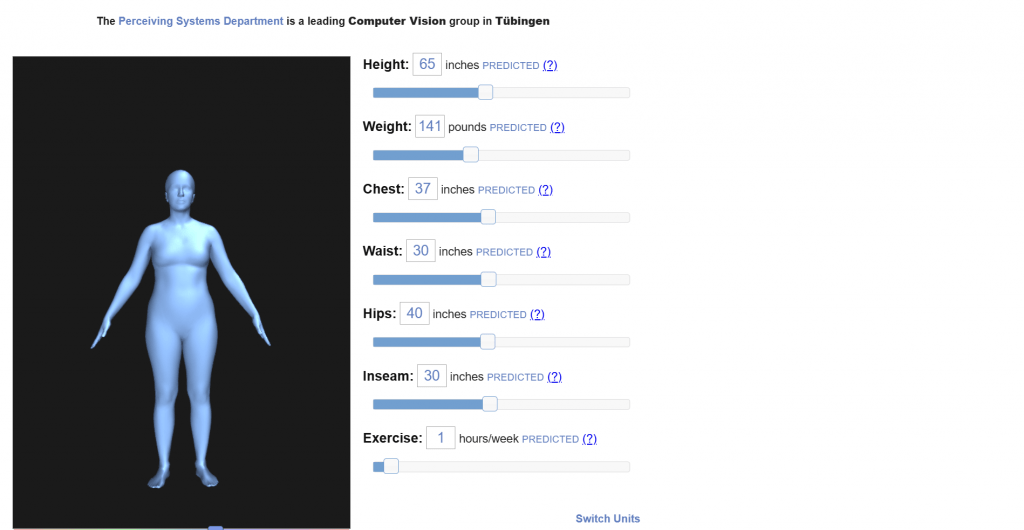
Infrastructure: Web application (WebGL-based)
Official website: bodyvisualizer.is.tue.mpg.de / bodyvisualizer.com
Developed by the Perceiving Systems Department at the Max Planck Institute for Intelligent Systems (Germany) under the direction of Michael Black, this web visualizer is one of the most famous and cited tools on the internet. The tool is strictly academic, non-commercialized, and provided for non-commercial research purposes.
Based on the powerful SMPL architecture, it offers a minimalist and highly intuitive interface where users can move sliders to adjust various metrics. The visualizer is unique for its predictive algorithm: the system can extrapolate body geometry based on incomplete data.
| MPI Body Visualizer Features |
Functional Description |
|
Input Parameters |
Height, weight, chest, waist, hips, inseam, physical activity level (hours per week). Supports both metric and imperial measurement systems. |
|
Predictive Analytics |
By entering only height and weight, internal statistical regression instantly predicts the most probable chest, waist, and hip circumferences, filling data gaps with minimal statistical error. |
|
Limitations (Ethics) |
Algorithms hardware-restrict the visualization of avatars with a BMI below 17.5. This was implemented to prevent the tool from being used as “thinspiration” in eating disorders. |
|
Rendering |
Uses a smooth, solid-color skin texture without defects. Forms smooth anatomical curves, adapting to slider changes in real-time via browser-based WebGL. |
2. MeThreeSixty (Size Stream)
Infrastructure: Mobile application (iOS, Android)
Official website: methreesixty.com
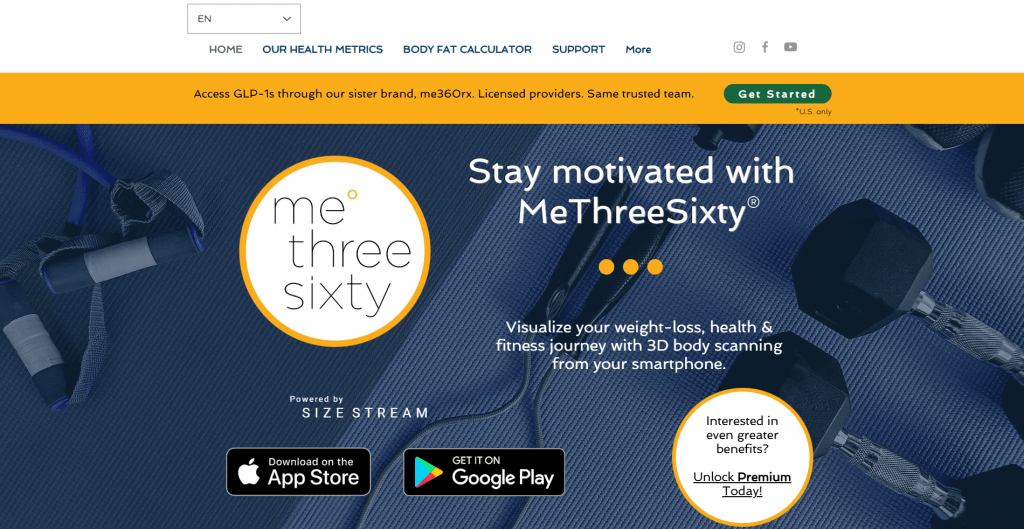
MeThreeSixty is a mobile scanner app developed by Size Stream, a company specializing in 3D measurement technologies. Unlike web tools requiring manual numerical input, MeThreeSixty automates the process: it uses the smartphone’s front or main camera to scan the user’s silhouette from the front and side, after which photogrammetric algorithms generate a highly accurate 3D avatar. This app is positioned as a free, accessible alternative to expensive clinical 3D scanners.
| MeThreeSixty Features |
Functional Description |
|
Extracted Metrics |
The app automatically calculates over 14 body measurements (neck, shoulders, waist, hips, calves), and computes Body Mass Index, lean mass, and body fat percentage. |
|
“FutureMe” Function |
A powerful goal-setting tool. The user sets a target weight or body fat percentage, and the algorithm simulates on the 3D model exactly how body proportions will change, providing high motivation. |
|
Security Architecture |
The system processes data locally (on-device privacy). Photographs used to generate the mesh are never uploaded to cloud storage, which is critical for privacy protection. |
|
Progress Tracking |
Provides the ability to spatially overlay 3D scans on top of each other (side-by-side) for clear visualization of microscopic body contour changes over time. |
Medical trials confirm the app’s outstanding hardware validity: the correlation of smartphone measurements with a stationary 20-camera 3D scanner (SS20) and a manual flexible tape shows an extremely high degree of agreement.
3. ZOZOFIT
Infrastructure: Mobile application (iOS, Android)
Official website: zozofit.com
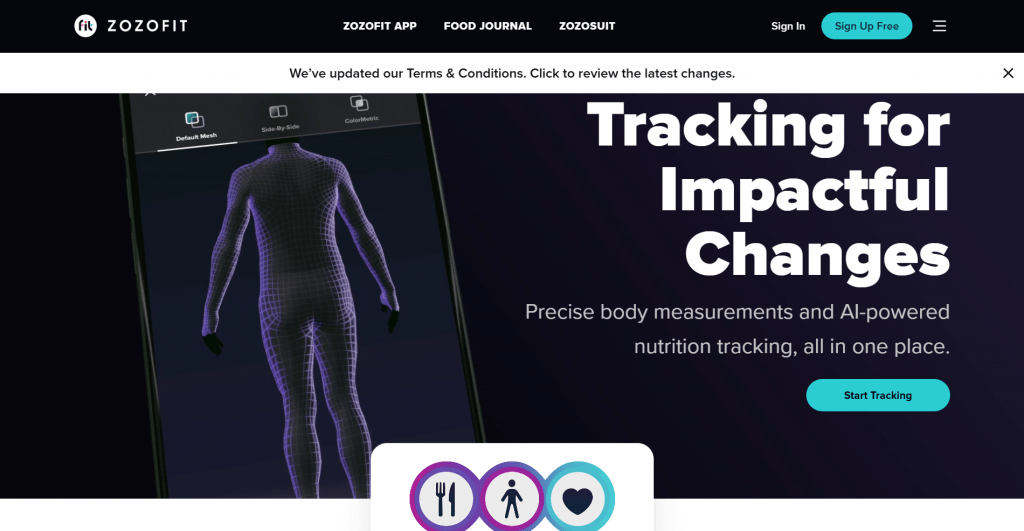
ZOZOFIT, developed by ZOZO Apparel USA, represents another powerful ecosystem for 3D body scanning. Historically, the platform was tied to using a specialized physical marker suit (ZOZOSUIT) to ensure maximum measurement accuracy. However, in its modern iteration, the system has evolved: the app now allows for full spatial scanning in under 2 minutes using solely the smartphone camera and computer vision algorithms.
| ZOZOFIT Features |
Functional Description |
|
Body Composition Analysis |
Scans 12-16 key body zones with measurement accuracy down to 0.1 inches. Applies the U.S. Navy Method algorithm to calculate fat percentage, relying on the external 3D mesh topology and height calculation. |
|
ColorMetric Tool |
A unique heat map feature. Applies color gradients directly to the avatar’s 3D surface to clearly demonstrate areas where fat loss or muscle hypertrophy has occurred. |
|
Comparison Modes |
Includes “Tailor Mode” and tools for side-by-side scan comparisons (e.g., a year-old scan vs. current) with 360-degree model rotation for symmetry assessment. |
|
Premium Ecosystem |
Basic scanning is free. Additional options include AI food scanning via photo to track macronutrients and highly specialized assessments (e.g., glute shape analysis in Booty Mode). |
Users note that the implementation of the ColorMetric feature is especially beneficial for individuals recovering from eating disorders, as it allows them to completely abstract themselves from anxiety-inducing scale numbers, focusing solely on objective shape changes.
4. HumanShape (UMTRI)
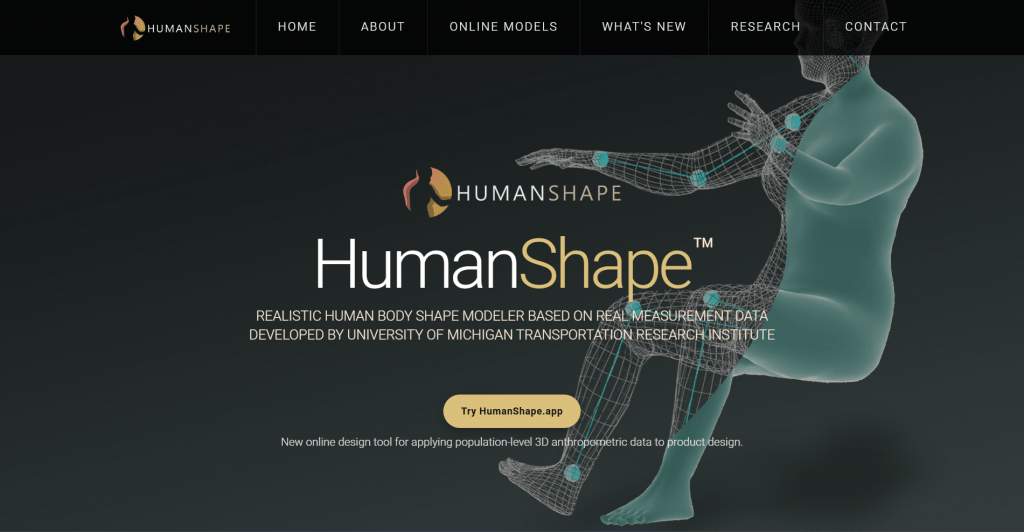
Infrastructure: Web application (Browser platform)
Official website: humanshape.org / humanshape.app
The UMTRI HumanShape™ platform is a rigorous academic toolkit created by the University of Michigan Transportation Research Institute. Unlike amateur fitness-oriented apps (like ZOZOFIT), this system is intended for professional ergonomic engineering, industrial design, and scientific research. It is based on a colossal dataset of high-resolution laser scans, including U.S. civilian and military population samples.
| HumanShape Features |
Functional Description |
|
Demographic Reach |
Allows modeling bodies across a vast age range: from 3-year-old toddlers and children (3-11 years) to adults and seniors up to 90 years old. |
|
Posture Control |
Generates 3D avatars not only in a standing position but in specific supported seated postures (e.g., in a driver’s or passenger’s car seat). |
|
Local Anatomical Models |
Includes detailed models of individual body parts: high-polygon heads, hands, feet, and even ears (with accurate geometry down to the eardrum) for designing headphones or helmets. |
|
Data Export |
All generated mannequins, as well as predicted anthropometric measurements and anatomical landmarks, are available for free download in popular 3D mesh formats (OBJ / STL). |
The platform’s interface allows users to adjust physique by tweaking several predictors (height, BMI, torso-to-stature ratio). To protect the privacy of study participants whose scans formed the database, faces on all avatars are synthesized by machine learning algorithms, maintaining statistical validity while ensuring complete anonymity.
5. Figa: Body Visualizer Simulator (Strongr Fastr)
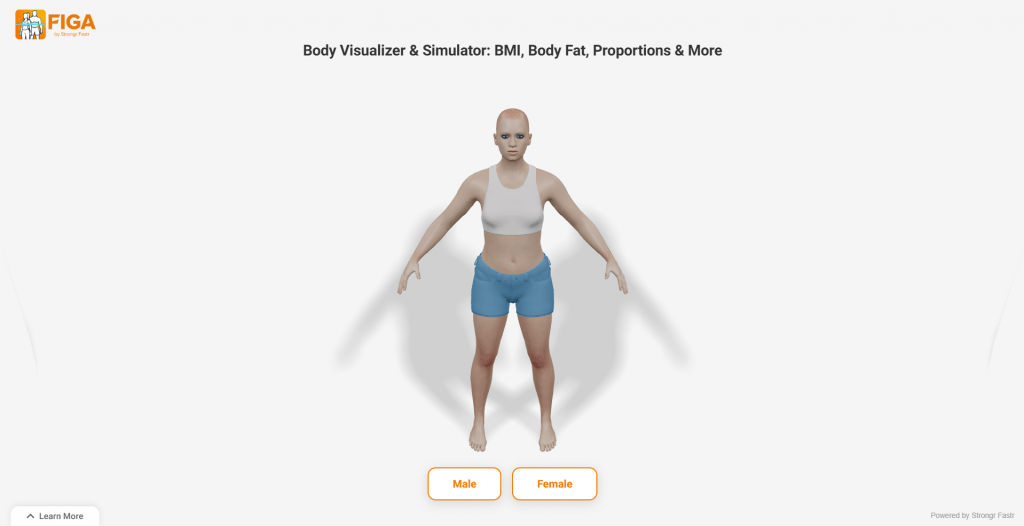
Infrastructure: Mobile application
Official website: strongrfastr.com/app/body_visualizer_simulator
The Figa app is a synergy of a photorealistic 3D simulator and a powerful algorithmic engine for planning fitness transformations. The tool steps away from the concept of passive observation and integrates visualization directly into the goal achievement process. The user starts by entering basic parameters: age, height, weight, and circumferences. Based on this data, the system conducts a full “metabolic analysis,” classifying the user’s metabolism type and ranking their physique (via percentiles) against an extensive database of real body scans.
| Figa Features |
Functional Description |
|
Photorealistic Morphing |
Generates a highly realistic avatar. The user can watch a smooth morphing animation transitioning from the current state to the target weight and body fat percentage. |
|
Time Timeline |
Relying on the metabolic profile assessment, the AI algorithm calculates and provides realistic timeframes (in weeks/months) needed to achieve the visualized goal safely. |
|
Fitness Plan Generation |
The system selects workouts (anabolic routines, home or gym) and calculates macronutrients specifically to achieve the shape created during the visualization phase. |
Many of the app’s modules, including the 3D visualizer itself and basic meal plans, are available for free, while from-scratch workout customization is placed in the premium segment.
6. Model My Diet
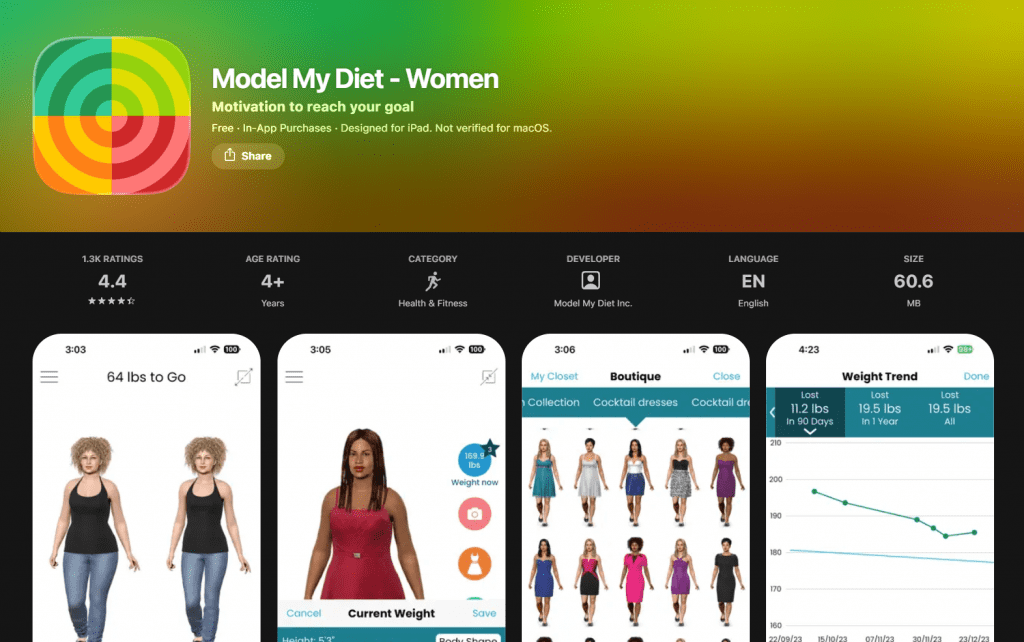
Infrastructure: Web application and Mobile application
Official website: apps.apple.com/…/model-my-diet-women
Model My Diet is a specialized virtual weight loss simulator, historically focused on motivating a female audience. Unlike analytical scanners, this tool concentrates on gamification and emotional reinforcement of the dieting process. Based on a compilation of thousands of full-body 3D scans, the algorithm takes the user’s current weight, height, and target weight to display the expected outcome on the screen.
| Model My Diet Features |
Functional Description |
|
Appearance Personalization |
Users can customize bust size, frame size, facial age features, and choose from 12 hairstyles in 6 different hair colors. |
|
Virtual Wardrobe |
A key distinguishing feature of the platform is the ability to “dress” your 3D avatar in dozens of different outfits, which helps better visualize clothing fit at the target weight. |
|
Privacy |
The process is entirely based on manual metric input; no photo uploads are required, making the platform appealing to users concerned about biometric data privacy. |
Despite its popularity, the tool faces criticism for somewhat simplistic algorithms. Specifically, users with developed musculature or borderline BMIs note that the simulator sometimes generates models with overly pronounced signs of obesity (e.g., adding a double chin at a weight that is actually athletic for that person) because the system relies on average weight-to-fat ratios, ignoring muscle mass.
Comparative Matrix of Features and Capabilities
Below is a structured matrix systematizing the technical specifications, intended purposes, and functional limitations of the analyzed platforms. This table allows for a clear comparison of tools to select the optimal solution based on professional or personal tasks.
| Evaluation Criterion / Platform |
BodyVisualizer (MPI) |
MeThreeSixty |
ZOZOFIT |
HumanShape (UMTRI) |
Figa (Strongr Fastr) |
Model My Diet |
|
Interface Architecture |
Web browser (WebGL) |
App (iOS / Android) |
App (iOS / Android) |
Web browser |
App (iOS / iPad) |
App / Web |
|
Primary Data Input Method |
Metric sliders |
3D camera scanning |
3D camera scanning |
Numerical value input |
Numerical value input |
Numerical value input |
|
Key Input Parameters |
Height, weight, chest, waist, hips, inseam, fitness hours |
2 photos (front/profile), height, weight, gender |
360° video, height, weight, gender |
Height, BMI, sitting height index, age |
Height, weight, age, circumference measurements |
Height, weight, age, frame size, bust |
|
Analytical Outputs |
Predictive circumferences & 3D model |
14+ circumferences, body fat %, lean mass, BMI |
12 zones, body fat %, ColorMetric |
STL/OBJ models, anatomical landmarks |
Body fat %, percentile, metabolism, goal timeframe |
3D model in various virtual outfits |
|
Mathematical Core |
SMPL (Skinned Linear Model) |
Proprietary photogrammetry |
3D-Mesh + U.S. Navy Method algorithm |
Statistical model (CAESAR base) |
Mapping with real 3D scan database |
Statistical female 3D scan database |
|
Future Goal Simulation |
Manual (via moving sliders) |
Automatic (“FutureMe” function) |
Automatic (target simulator) |
Not supported (current snapshot only) |
Yes (photorealistic morphing) |
Yes (Before & After state comparison) |
|
Privacy Level |
No photos used |
On-device processing |
Images encoded into 3D mesh |
No photos used (AI faces) |
No photos used |
No photos used |
|
Male / Female Body Support |
Yes / Yes |
Yes / Yes |
Yes / Yes |
Yes / Yes (plus children from age 3) |
Yes / Yes |
Predominantly female (product focus) |
|
Target Academic Audience |
Cognitive psychology, Data Science |
Sports medicine, nutrition |
Fitness industry, bodybuilding |
Industrial design, ergonomics, CAD |
Personal training, dietetics |
Motivational psychology |
|
Financial Accessibility |
Completely free |
Free (including FutureMe) |
Basic scanner is free (AI diet paid) |
Free (registration required) |
Visualizer is free (workouts paid) |
Free (wardrobe options in Premium) |
Issues, Ethical Limitations, and Future Development Vectors
Despite impressive technological breakthroughs in computer vision and statistical modeling, the 3D body visualization ecosystem faces a series of fundamental mathematical, hardware, and socio-cultural barriers. A deep second- and third-order analysis reveals the hidden limitations of the current generation of these systems.
Algorithmic Bias and Demographic Gaps
Algorithmic fairness remains a pressing issue in digital anthropometry. Mathematical models (SBSM) are only as good as the data they are trained on. If the foundational dataset (e.g., the CAESAR sample, historically collected predominantly in North America and Europe) is dominated by Caucasians, the Principal Component Analysis (PCA) algorithm will inevitably project Caucasian proportions onto other demographic groups when interpolating missing data. This can lead to systematic distortions in predicting mass distribution (e.g., waist-to-hip ratio) for people of Asian or African descent, which is critical when using avatars in medical research or garment tailoring for global markets.
Ethical Challenges: EDs and the “Uncanny Valley” Effect
Platform developers are forced to balance on a fine line between ensuring user freedom and minimizing the risks of triggering eating disorders (EDs). The previously mentioned hardcore hardware restriction of the Body Visualizer (MPI) platform, which categorically prevents generating avatars with a BMI below 17.5, sparks fierce debate. On one hand, it is an ethical safeguard protecting psychologically vulnerable individuals from projecting unhealthy, emaciated thinness (“thinspiration”). On the other hand, users with naturally asthenic builds, or those recovering from severe illnesses wanting to visualize their progress in gaining healthy muscle mass, find themselves literally “erased” by the algorithm, feeling discriminated against.
Finally, the “Uncanny Valley” effect profoundly impacts the psychological perception of digital twins. Rendering idealized, smooth skin without blemishes, stretch marks, pigmentation spots, scars, or cellulite can paradoxically exacerbate body dysmorphia. Users see a geometrically accurate copy of their body, but with an unattainable “plastic” texture perfection that actual human physiology can never achieve.
Final Provisions and Applied Recommendations
The development of intelligent 3D human body visualization systems represents a powerful convergence of higher mathematics, computer vision, statistics, and behavioral psychology. The definitive shift away from one-dimensional anthropometric data logging toward creating full-fledged interactive digital 3D twins provides unprecedented analytical and diagnostic capabilities for both academic researchers and ordinary consumers striving for health.
In the long term, 3D visualization technologies will continue to fundamentally transform how society, medicine, and industry perceive human physiology. By eliminating historical reliance on subjective, stress-inducing, and often clinically inaccurate metrics, these algorithmic tools foster a healthier, more objective, and inclusive approach to physicality, ergonomic design, and personalized medical analysis.



Solid article!
How accurate are the body metric inputs for muscle mass visualization?