

Best Funny & Weird AI SpongeBob Prompts
On this page
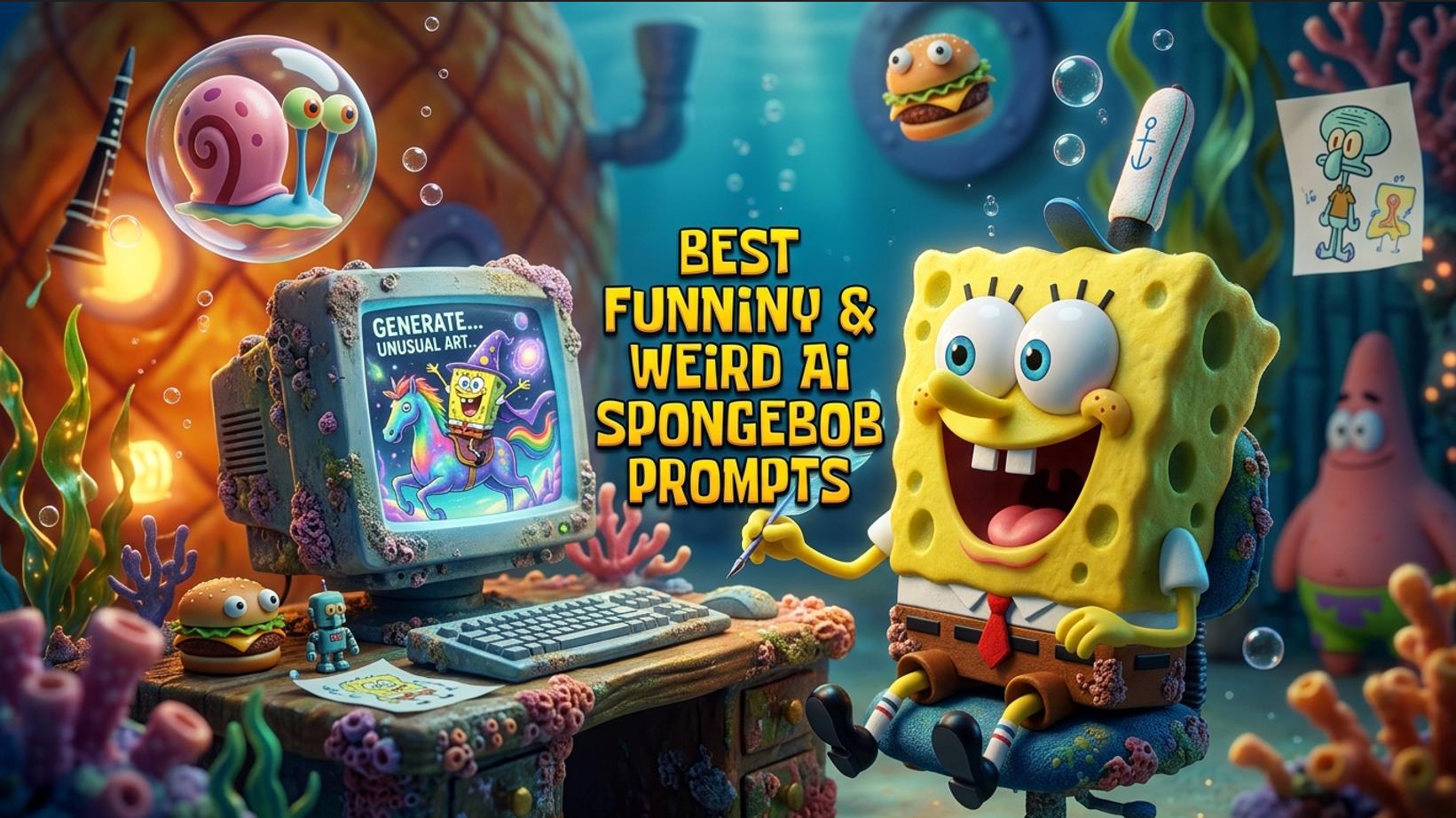
The Intersection of Generative AI and Internet Culture: Guide to SpongeBob SquarePants Image Prompting.
The cultural footprint of SpongeBob SquarePants extends far beyond its origins as a late-1990s animated television series. In the digital age, the characters, settings, and highly expressive visual vocabulary of the show have become foundational pillars of internet meme culture, digital communication, and online folklore. With the advent of generative artificial intelligence (AI), the capacity to remix, reimagine, and distort this established intellectual property has been entirely democratized. The generation of SpongeBob-themed AI imagery is no longer confined to basic character reproductions; it has evolved into a complex subculture featuring highly specific visual genres. These range from nostalgic, customized birthday greetings to deeply unsettling “analog horror” sequences that subvert the innocence of the original cartoon.
Understanding how to construct prompts for this specific subject matter requires a nuanced grasp of both prompt engineering techniques and the underlying latent space of various AI models. Text-to-image and text-to-video models have been trained on vast datasets containing decades of SpongeBob fan art, official animation frames, and internet memes, giving them a profound semantic understanding of Bikini Bottom’s aesthetics. The following guaid explores the mechanics of prompt construction, evaluates the optimal AI tools for character generation, and presents a highly structured compendium of the most popular and culturally significant prompt categories: cursed, funny and goofy, happy birthday, sus, meme, and silly imagery.
The Mechanics of Composition: How to Construct and Use Prompts
Prompt engineering for established animated characters requires a delicate balance between providing the AI with recognizable anchor terms and injecting stylistic modifiers that push the output into new, creative territories. When generating SpongeBob imagery, the core objective is to move beyond generic, flat cartoon outputs by utilizing structured prompt architecture.
The primary challenge in prompting for highly stylized cartoon characters lies in the AI’s tendency to force human anatomical logic onto non-human geometric shapes. SpongeBob is essentially a porous yellow rectangle with cylindrical limbs; when an AI is prompted to render him “photorealistically,” the friction between cartoon geometry and realistic textures often results in unintended visual distortion. Therefore, precise modifier selection is paramount.
The Anatomy of an Effective Prompt
A professional-grade prompt typically follows a specific formula: Subject + Action/Environment + Medium + Lighting/Camera Details + Technical Parameters.
The subject must explicitly name “SpongeBob SquarePants” to activate the model’s specific training weights associated with the character. Including physical descriptors reinforces the character’s accuracy, particularly when attempting hyper-realistic or altered styles. Descriptors such as “porous texture, big blue eyes, buck teeth, wearing his classic white shirt, red tie, brown square pants, white socks with blue/red stripes, and black shoes” ensure the model anchors its generation to the character’s canonical appearance.
The medium dictates the visual interpretation. Modifiers such as “1990s grainy VHS,” “Studio Ghibli style,” “cinematic 3D render,” “claymation,” or “H.P. Lovecraft style” drastically alter the aesthetic. The AI uses these keywords to filter the character through a specific artistic lens, altering the shading, linework, and color palette.
Lighting and environment provide depth and atmospheric context. Modifiers such as “harsh on-camera flash,” “deep shadows,” “bioluminescent underwater lighting,” or “cinematic rim light” dictate the mood of the generation. Environmental context grounds the character in a physical space. Instructing the AI to place the character “inside the Krusty Krab kitchen,” or “in a dimly lit liminal hotel corridor” provides the necessary spatial logic.
Technical parameters and weights control the fundamental output, particularly in advanced models. For instance, in Midjourney, parameters like –ar 16:9 determine the aspect ratio, while –stylize 500 grants the AI more artistic freedom to interpret the prompt. The –niji 6 parameter is specifically tuned for anime and illustration styles, making it highly effective for 2D character renders, whereas the standard –v 6 model is preferred for photorealism5. In Stable Diffusion, token weighting can be applied, such as (realistic skin:0.5), to carefully balance how much realism is applied to the cartoon character.
|
Prompt Component |
Function |
Examples for SpongeBob Generation |
|
Subject Anchor |
Activates core character training data |
“SpongeBob SquarePants,” “Patrick Star,” “Squidward Tentacles”3 |
|
Physical Descriptors |
Forces anatomical accuracy |
“Yellow porous sponge,” “buck teeth,” “square brown pants”7 |
|
Medium / Art Style |
Defines the visual execution |
“Vector art,” “3D render,” “analog horror,” “stop-motion claymation”1 |
|
Environmental Context |
Establishes the setting |
“Krusty Krab kitchen,” “Bikini Bottom streets,” “liminal space”4 |
|
Camera & Lighting |
Sets mood and focal length |
“Low-angle,” “harsh flash,” “cinematic rim light,” “VHS scanlines”9 |
|
Technical Parameters |
Dictates model behavior |
–ar 16:9, –niji 6, (highly detailed:1.2), negative prompts5 |
Strategies for Iterative Refinement and Prompt Utilization
To utilize these prompts effectively, creators must engage in iterative generation. The initial prompt serves merely as a baseline concept. If a generated output lacks the desired facial expression, specific emotion keywords must be injected, such as “exaggerated mocking expression,” “deadpan stare,” or “sinister grin”.
Negative prompting is a critical technique when working with localized models like Stable Diffusion. Because cartoon characters often possess exaggerated features (e.g., four fingers instead of five), the AI can become confused, resulting in anatomical anomalies. Including negative prompts such as “ugly, tiling, poorly drawn hands, poorly drawn feet, out of frame, extra limbs, disfigured, deformed, body out of frame, blurry, bad anatomy” acts as a computational guardrail, filtering out unwanted distortions.
When generating narrative sequences, complex scenes, or specific visual gags, breaking down the prompt into spatial descriptions is highly effective. Instructing the AI on relative positioning—for instance, “a pineapple-shaped house on the left, an Easter Island head in the center, and a glass dome in the background”—helps the model organize the spatial logic of the Bikini Bottom environment, preventing the architecture from blending into a disorganized mass.
Structured Prompt Categories and Analytical Breakdown
The internet’s engagement with SpongeBob spans a vast emotional and aesthetic spectrum, shifting effortlessly from wholesome childhood nostalgia to surreal, psychological horror. The following sections categorize the most popular and culturally significant prompt frameworks, providing detailed prompt formulas, recommended engines, and theoretical context for their popularity.
Category 1: Cursed and Creepy SpongeBob Images
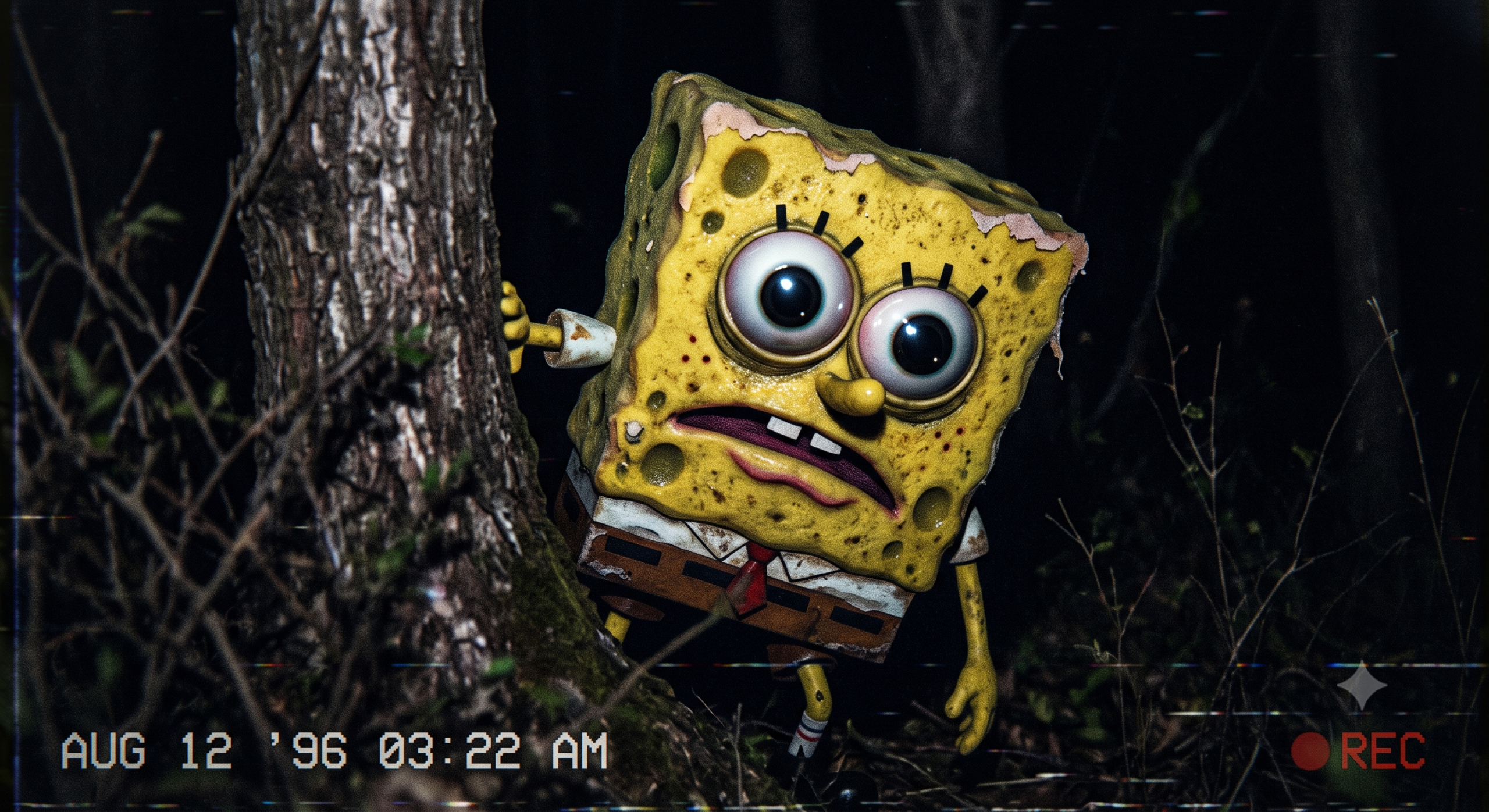
The phenomenon of “Cursed SpongeBob” imagery is deeply rooted in the internet’s fascination with corrupting innocent childhood media. This subgenre draws heavily from early internet “creepypasta” culture—most notably the infamous “Squidward’s Suicide” urban legend, which detailed a fictional, hyper-graphic lost episode of the show. Today, this text-based horror has evolved into visual “analog horror,” a genre characterized by outdated media artifacts, distorted audio, and unsettling visual anomalies. The objective of these AI prompts is to evoke a profound sense of the uncanny valley, utilizing hyper-realism, anatomical corruption, or found-footage aesthetics to transform a comedic icon into a source of psychological terror.
The effectiveness of these prompts relies heavily on camera and lighting modifiers. Instructing the AI to render the image through the lens of a “1990s grainy VHS” or to use “harsh on-camera flash” simulates the visual language of amateur found-footage horror. This places the cartoon character—which belongs in a bright, flat, 2D world—into an alarmingly realistic, three-dimensional, and physically threatening context.
|
Prompt |
Target AI Engine |
Critical Modifiers |
Theoretical Output |
|
Found Footage / Analog Horror A grainy, creepy found footage photo of SpongeBob SquarePants caught creeping behind a tree in the dead of night, staring directly into the lens. |
Midjourney v6 / LTX-2 (Video) |
flash photography, 1990s VHS, heavy film grain, deep shadows, analog horror |
A highly unsettling, low-fidelity image where the character appears as a physical, threatening entity stalking the viewer in a real-world environment. |
|
Liminal Space / The Backrooms SpongeBob SquarePants standing motionless at the far end of an endless, dimly lit hotel corridor with repeating yellow wallpaper, buzzing fluorescent lights, and dirty carpets. |
DALL-E 3 |
liminal space, dutch angle, 24mm lens perspective distortion, uneasy emptiness |
A surreal, claustrophobic image leveraging internet “Backrooms” lore, isolating the bright character in an endless, oppressive, and empty architectural space. |
|
Lovecraftian / Eldritch Horror SpongeBob rendered as a grotesque, towering deep-sea entity in the style of H.P. Lovecraft, decaying porous flesh, glowing red eyes, standing in the ruined remains of Bikini Bottom. |
Stable Diffusion (with Horror LoRA) |
macabre, biomechanical, Eldritch horror, blood-soaked, cinematic horror lighting |
A total subversion of the cartoon’s bright aesthetic, resulting in a terrifying, highly detailed monster design reminiscent of cosmic horror literature. |
|
Five Nights at Freddy’s (FNaF) Aesthetic A withered, decaying animatronic version of SpongeBob SquarePants standing in a dark, abandoned pizzeria hallway, viewed through a security camera. |
Midjourney v6 |
animatronic, decaying metal, security camera footage, glowing eyes, CCTV overlay |
A crossover utilizing the visual tropes of popular indie horror games, emphasizing robotic stiffness, rusted joints, and technological decay. |
The underlying theoretical trend in this category is the juxtaposition of safety and threat. By placing a universally recognized symbol of childhood joy into environments fundamentally associated with adult anxiety, isolation, and mortality, the AI exploits the psychological dissonance of the viewer. The viewer’s brain recognizes the character but rejects the context, creating the deeply unsettling sensation that defines a successful “cursed” image.
Category 2: Funny and Goofy SpongeBob Images
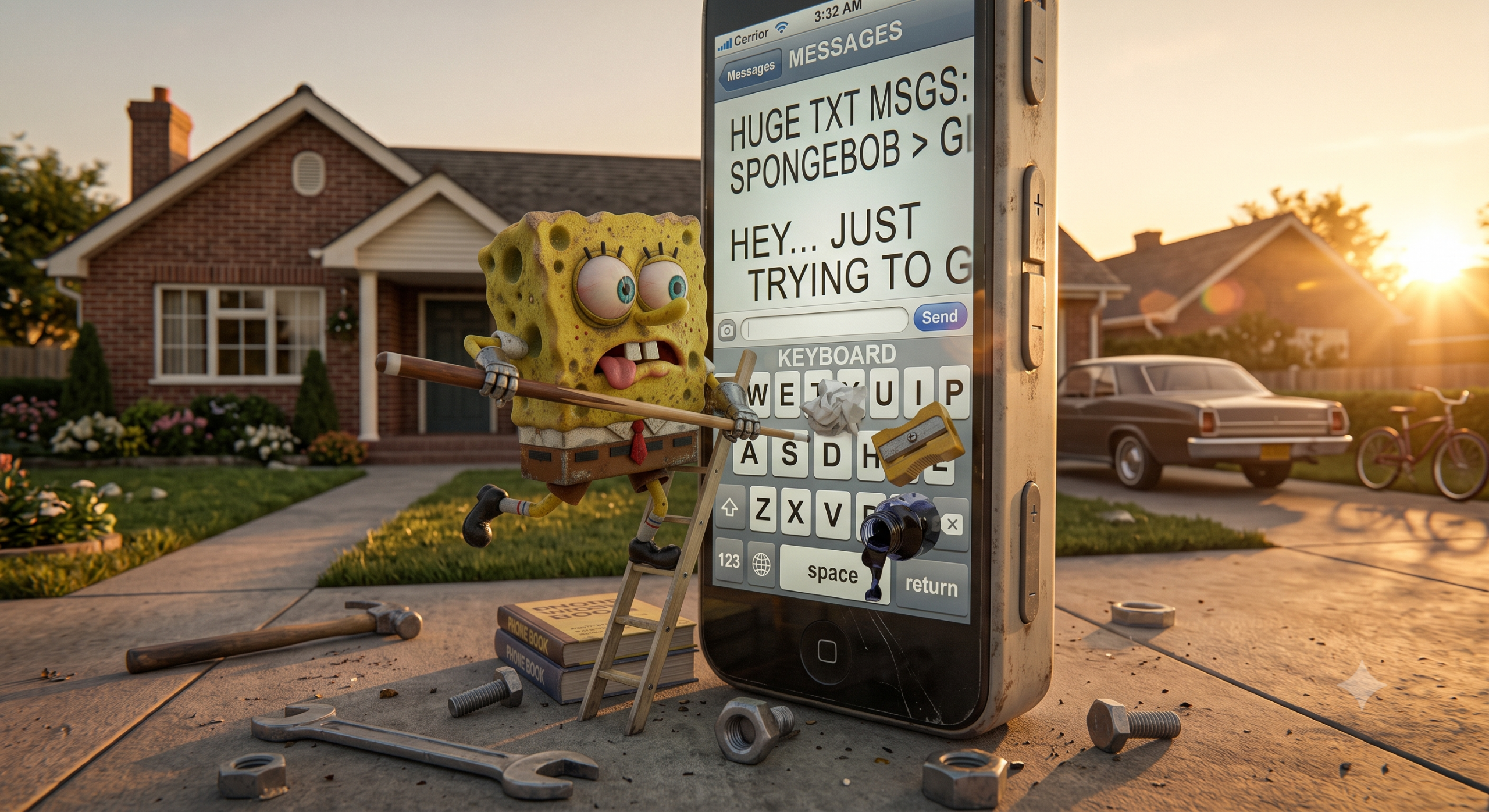
The “Funny and Goofy” category leans into absurdism, surrealism, and cinematic stylistic crossovers. Rather than relying on the show’s inherent slapstick humor, these prompts use generative AI to place the characters into wildly incongruous situations or filter them through the highly specific lenses of famous cinematic auteurs. The humor in these images is derived from the extreme juxtaposition of high art, serious historical situations, or realistic physics colliding with a brightly colored cartoon sponge.
This category highlights the AI’s remarkable capacity for style transfer. The models possess a deep latent understanding of what constitutes a “Wes Anderson” film (symmetry, pastels) or a “Tim Burton” film (gothic, spindly, claymation). By forcing the AI to resolve the aesthetic conflict between the geometric design of SpongeBob and the rigid rules of these cinematic styles, the resulting images are inherently comedic and visually fascinating.
|
Prompt |
Target AI Engine |
Critical Modifiers |
Theoretical Output |
|
The Wes Anderson Crossover SpongeBob SquarePants and Patrick Star sitting across from each other in a retro pastel diner, directed by Wes Anderson. |
Midjourney v6 |
pastel color palette, perfect bilateral symmetry, planish composition, deadpan expression |
A visually stunning, highly stylized image that perfectly mimics Anderson’s cinematic framing, turning animated slapstick into deadpan indie cinema. |
|
Historical / Cinematic Absurdism An ultra-realistic portrait of a medieval knight in full plate armor sitting at a booth in the Krusty Krab eating a Krabby Patty with extreme royal seriousness. |
DALL-E 3 |
cinematic rim light, professional photography, humorous contrast, high resolution |
A highly detailed, historically accurate setting crashed by cartoon logic, creating humor through the absolute seriousness of the subject matter. |
|
Animals Doing Human Things / Scale Play A photorealistic image of SpongeBob trying to text on a smartphone the size of a refrigerator in a suburban driveway at sunset. |
Midjourney v6 |
24mm wide-angle exaggeration, struggling pose, playful absurd scale, golden hour lighting |
Slapstick humor generated by playing with the physical scale and proportions of the character interacting with mundane human objects. |
|
The Tim Burton Treatment SpongeBob SquarePants and Squidward reimagined as a Tim Burton stop-motion animated film set in a gloomy, twisted version of Bikini Bottom. |
Midjourney v6 |
claymation, gothic architecture, spindly limbs, desaturated colors, stop-motion aesthetics |
A moody, quirky, and slightly macabre visual overhaul of Bikini Bottom, bridging the gap between spooky and goofy while maintaining character recognizability. |
The proliferation of these prompts demonstrates a shift in how internet users engage with media. Fans are no longer satisfied with consuming the show as it was broadcast; they use AI as a tool to direct their own micro-episodes, exploring “what if” scenarios that bridge disparate areas of pop culture.
Category 3: Happy Birthday SpongeBob Images
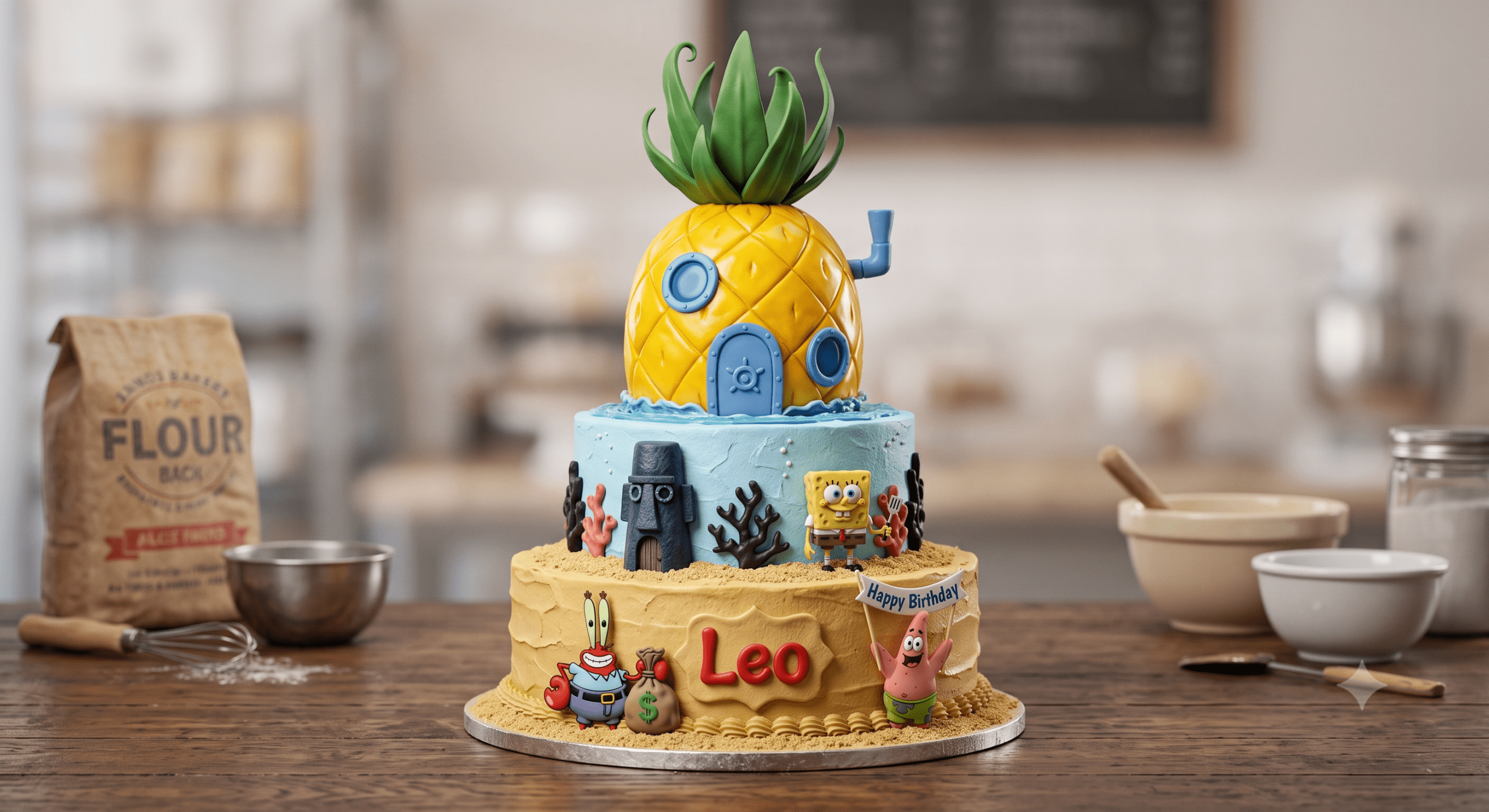
A highly practical and immensely popular use case for AI image generation revolves around personalized celebrations and event planning. Parents, friends, and fans frequently utilize AI to design bespoke SpongeBob-themed birthday cards, custom party invitations, and highly detailed conceptual cake designs.
The technical challenge in this category is twofold: precise typography and accurate material rendering. Many AI models historically struggle to spell words correctly, rendering gibberish instead of “Happy Birthday.” Furthermore, generating a photorealistic cake requires the AI to accurately render the physics of food—such as glossy fondant, textured buttercream, and cake crumb—while maintaining the cartoon shape of the characters.
|
Prompt |
Target AI Engine |
Critical Modifiers |
Theoretical Output |
|
The Ultimate Custom Bakery Cake A photorealistic, highly detailed tiered birthday cake themed around SpongeBob SquarePants. The top tier is shaped like a pineapple under the sea, with flawless glossy icing. |
Midjourney v6 |
glossy fondant, thick buttercream edges, macro detail, soft bokeh, studio lighting, shot on 85mm lens |
A stunning, bakery-quality reference image that can be shown to a real-world pastry chef for inspiration, featuring realistic frosting textures and lighting. |
|
Personalized 3D Character Greeting Card A 3D Pixar-style render of SpongeBob holding a giant brightly colored gift box and a balloon shaped like the number 25. Text reads “Happy Birthday.” |
Ideogram 4 / DALL-E 3 |
3D rendering, vibrant colors, party confetti background, soft lighting, perfect typography |
A clean, highly legible graphic perfect for digital greeting cards, utilizing Ideogram’s or DALL-E’s superior ability to render numbers and text accurately. |
|
The “25” Gag Meme Cake A half-yellow, half-pink cake with blue icing spelling “What’s better than 24? 25!” featuring small figurines of SpongeBob and Patrick laughing. |
DALL-E 3 |
homemade cake aesthetic, bright window light, comic typography, casual photography |
A customized recreation of the iconic internet joke regarding the number 25, tailored specifically for millennials celebrating their 25th birthday. |
The emergence of “Prompt Seen Birthday” templates—which are pre-structured, copy-paste formulas engineered to help AI create flawless 3D birthday designs with custom names, ages, and party confetti backgrounds—demonstrates the commercial and practical utility of generative AI in everyday life27. These prompts effectively bypass the need for traditional graphic design software or expensive stock imagery, allowing everyday users to create professional-grade party collateral in seconds.
Category 4: Sus (Suspicious) SpongeBob Images
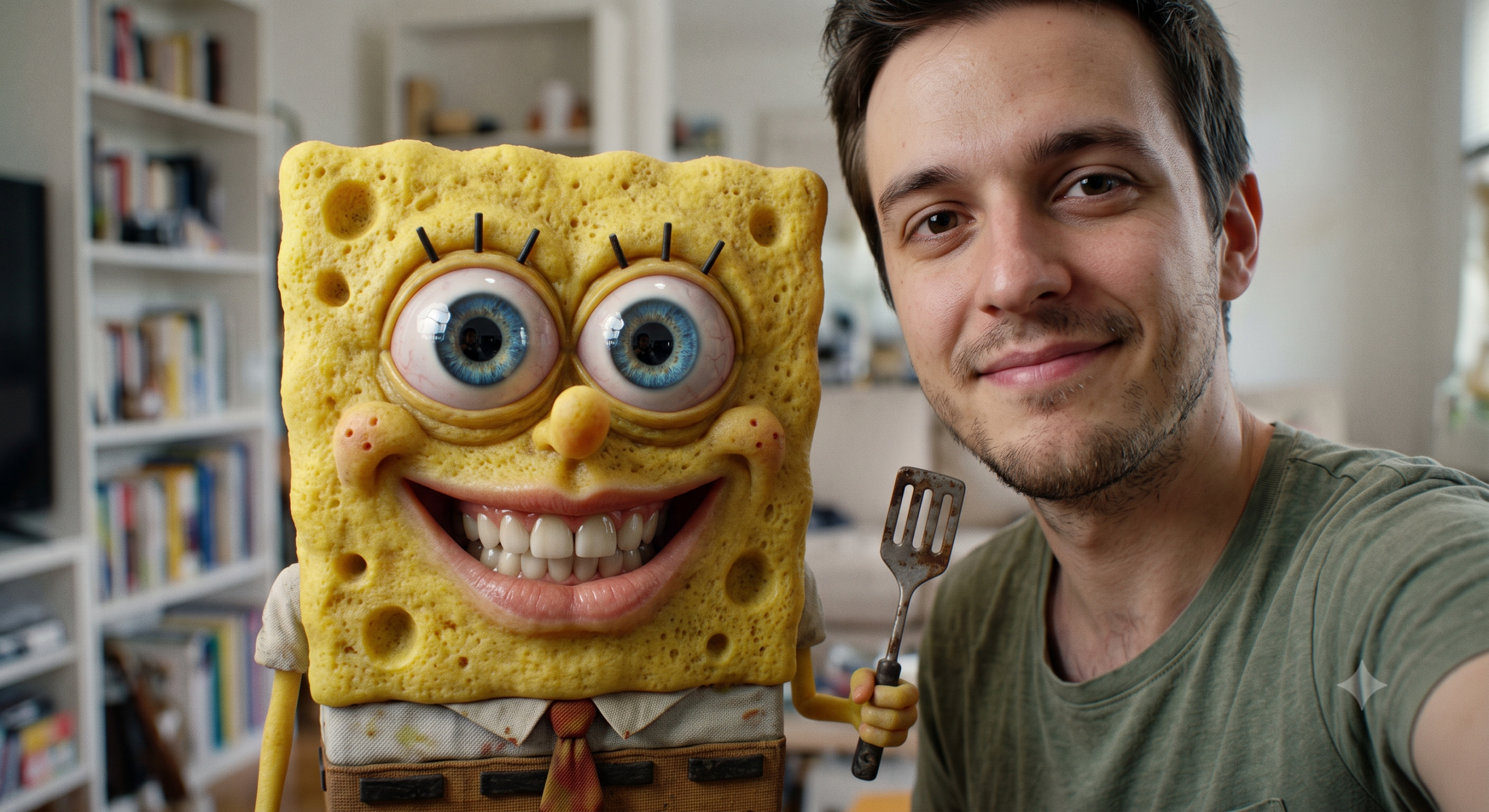
“Sus” (slang derived from the game Among Us, meaning suspicious or suspect) imagery occupies a unique, highly specific space between humorous and cursed. These images do not necessarily aim to terrify the viewer like analog horror, but rather aim to evoke deep discomfort and suspicion. “Sus” images often break the fourth wall, feature exaggerated, unsettling facial expressions, or place the characters in bizarre, hyper-realistic contexts that feel inherently wrong or out of place. The visual vernacular of “sus” imagery heavily involves characters staring directly at the viewer with unnatural intensity or possessing photorealistic human anatomical features.
|
Prompt |
Target AI Engine |
Critical Modifiers |
Theoretical Output |
|
The Hyper-Realistic Humanoid Selfie An ultra-realistic selfie taken from a front-phone-camera perspective. The user is standing next to SpongeBob, who has bright yellow porous skin, big blue eyes, and highly realistic human-like buck teeth and lips. |
Midjourney v6 |
handheld selfie angle, accurate selfie-camera distortion, realistic human teeth, shallow depth of field, candid vibe |
A profoundly unsettling, uncanny valley image where the cartoon character is mapped onto human anatomy, complete with realistic dental and optical reflections. |
|
Biblically Accurate SpongeBob A biblically accurate depiction of SpongeBob SquarePants, featuring interlocking rings of yellow sponge covered in hundreds of glowing blue eyes, floating ominously in a golden sky. |
Midjourney v6 / DALL-E 3 |
biblically accurate angel, surrealism, glowing auras, trypophobia triggers, ethereal lighting |
A majestic yet horrifying religious iconography parody, morphing the character’s core traits (sponge holes, blue eyes) into a divine, incomprehensible nightmare. |
|
The Unblinking Staring Contest A still frame from a 1999 SpongeBob episode where the character stops moving, turns his head slowly to face the viewer directly, and stares unblinkingly with a menacing, highly detailed expression. |
Midjourney v6 |
analog television artifacts, breaking the fourth wall, unblinking stare, VHS static, extreme close-up |
An image that mimics the “lost episode” trope, relying on the psychological discomfort of a 2D cartoon character making sustained, menacing eye contact with the physical viewer. |
This category reveals the internet’s tendency to deconstruct and interrogate its own idols. The “biblically accurate” trend, for example, requires the AI to synthesize ancient theological art concepts with modern pop culture, resulting in a complex visual output that serves as a meta-commentary on the omnipresence and near-religious reverence of SpongeBob in online spaces. The hyper-realistic human teeth prompt specifically exploits the AI’s struggle to delineate between human and non-human datasets, weaponizing the model’s flaws to create a disturbing masterpiece.
Category 5: SpongeBob Meme Images
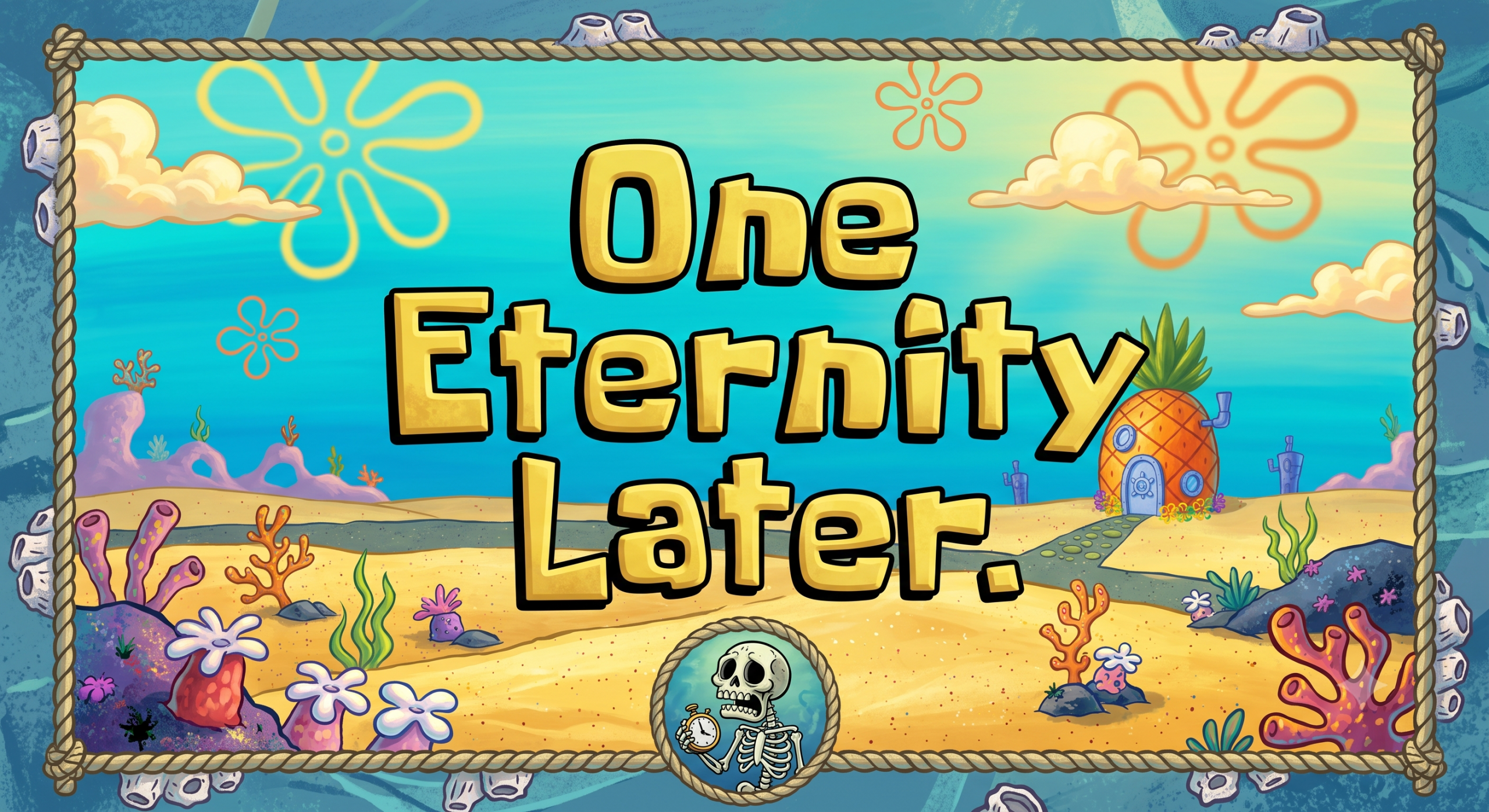
SpongeBob SquarePants is arguably the most frequently memed intellectual property in human history. Prior to the AI boom, generating these memes required finding blank templates online and manually adding text via software like Photoshop or basic meme-generator websites. Generative AI has significantly altered how these memes are created. Users can now generate entirely new, hyper-specific variations of classic memes, or rely on AI tools to automate the typography and formatting of established jokes.
The most prominent example in internet history is the “Mocking SpongeBob” meme. Originating from a brief scene in the 2012 season nine episode Little Yellow Book, where SpongeBob acts like a chicken, this image became the universal internet symbol for sarcastic imitation. It is canonically paired with text utilizing alternating capitalization (e.g., “lIkE tHiS”) to visually convey a mocking, condescending tone. Its cultural impact is so vast that spurious statistical correlations have been drawn mapping its popularity against liquefied petroleum gas usage in Kyrgyzstan, simply to demonstrate the sheer volume of data the meme generates online.
|
Prompt |
Target AI Engine |
Critical Modifiers |
Theoretical Output |
|
The Automated Mocking SpongeBob Generate a classic mocking SpongeBob meme reacting to corporate culture. SpongeBob is bent forward at the waist, arms pulled inward like small wings, with a twisted mouth. |
GoEnhance / Pixelbin |
expressive pose, sarcastic imitation, alternating caps text, meme-ready captions |
A perfectly aligned recreation of the chicken-pose meme, with the AI automatically generating and appending sarcastic, alternating-caps text in the correct Impact font. |
|
The Customized Title Card Generator A SpongeBob-inspired title card featuring a tropical nautical background, flower clouds, and bold, hand-lettered cartoon typography reading “One Eternity Later.” |
Ideogram 4 / Kapwing |
bold hand-lettered typography, tropical background, 16:9 aspect ratio, vivid color palette |
A flawless, broadcast-quality recreation of the show’s iconic time cards, customized with the user’s specific punchline, time jump, or internal inside joke. |
|
The “Rainbow Imagination” Redux SpongeBob creating a rainbow with his hands, looking upwards with an expression of awe, rendered in high definition 3D, bright vibrant colors. |
DALL-E 3 |
classic meme template, vibrant colors, bold outlines, 3D render |
A modernized, high-definition 3D recreation of the classic “imagination” meme, ready for text overlays regarding mundane or absurd concepts. |
The critical insight within this category is the shift from curation to generation. Users no longer need to scour the internet for a blank, low-resolution template of a specific SpongeBob frame; they can prompt an AI to generate the exact meme format, tailored to their specific joke, and even alter the lighting, resolution, or artistic style of the meme itself. This creates an infinite, highly personalized iteration loop of internet humor.
Category 6: Silly SpongeBob Images
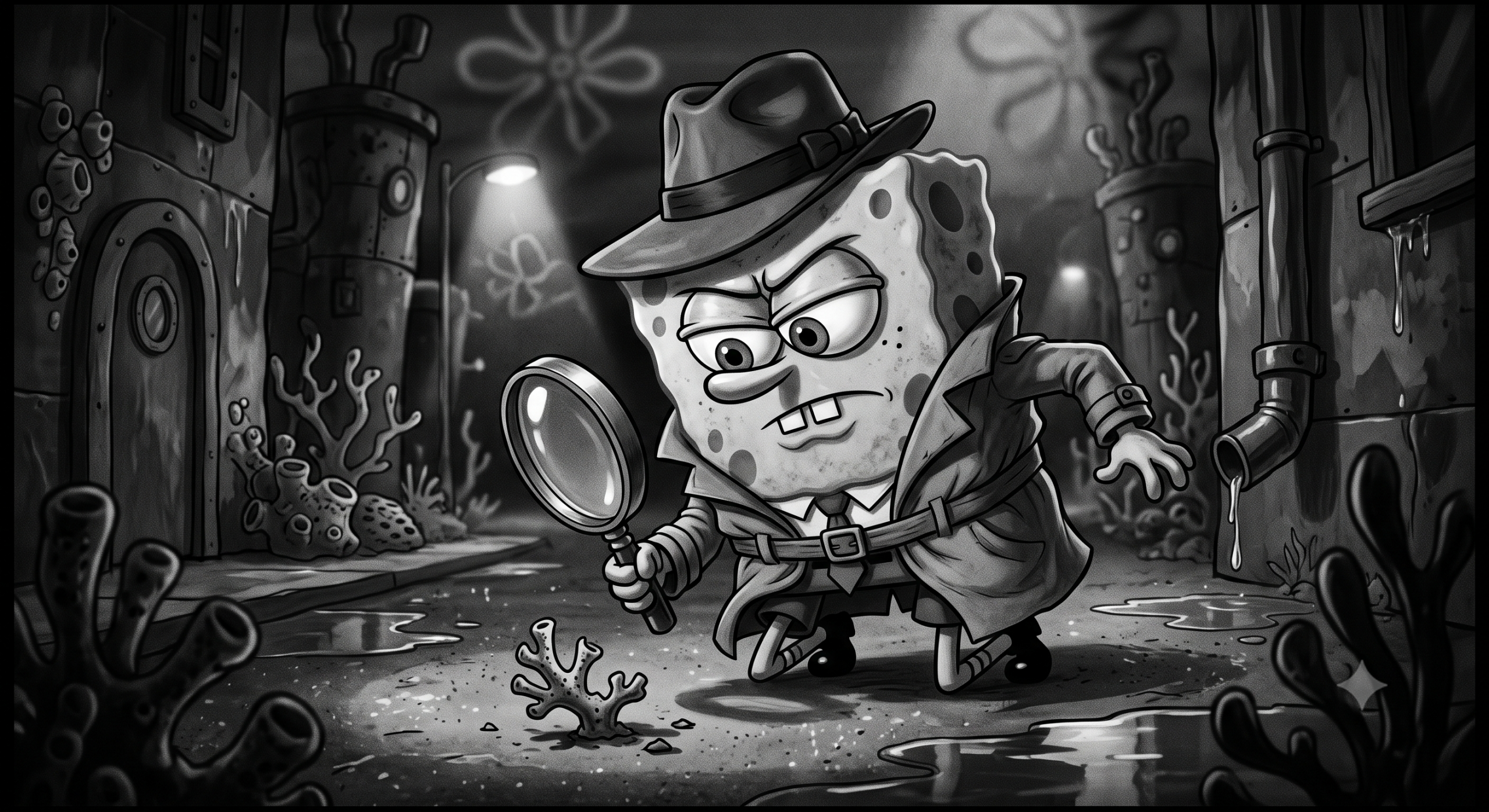
The “Silly” category returns to the fundamental roots of the character: lighthearted, chaotic, absurd, and joyful. These prompts are frequently used to generate digital avatars, profile pictures (PFPs), stickers, custom apparel designs, or simple fan art. The focus is on cute, exaggerated, or affectionately “derpy” interpretations of the Bikini Bottom residents, moving away from horror and sarcasm into pure aesthetic exploration.
This category often utilizes prompts that place SpongeBob in completely unrelated professional or historical contexts, maintaining his cheerful demeanor amidst chaotic surroundings.
|
Prompt |
Target AI Engine |
Critical Modifiers |
Theoretical Output |
|
Kawaii / Chibi Sticker Design A cute kawaii chibi-style portrait of a yellow sea sponge character, highly detailed, vector image, simple flat colors, clean clear linework on a white background. |
Midjourney v6 (–niji 6) |
kawaii, chibi, die-cut sticker design, flat shading, vector graphics |
A highly stylized, adorable, minimalist reinterpretation of the character suitable for digital sharing or printing as physical die-cut stickers. |
|
The Absurd Cinematic Scenario SpongeBob as a noir detective in a trench coat, investigating a mystery in Bikini Bottom with a magnifying glass, dramatic shadows, black and white. |
DALL-E 3 / Midjourney |
film noir, dramatic shadows, detective aesthetic, monochrome, cinematic lighting |
A visually striking yet inherently silly image that places the famously optimistic sponge into a gritty, hardboiled detective narrative. |
|
Weird/Derpy Art Style A deliberately weird, derpy, and silly drawing of SpongeBob with uneven eyes, a massive goofy smile, and noodle arms, looking confused. |
Midjourney v6 |
goofy, awkward cartoon style, ridiculous proportions, amateur hand-drawn aesthetic |
An image that mimics the aesthetic of internet “shitposting” or amateur MS Paint art, highly prized in meme culture for its chaotic, unpolished, and authentic energy. |
|
Action / Superhero Crossover An action-packed underwater scene featuring SpongeBob as a dynamic superhero, striking a heroic pose against a backdrop of oceanic villains. |
DALL-E 3 |
comic book style, dynamic pose, heroic framing, vibrant colors, action scene |
A high-energy, comic-book-style rendering that transforms the fry cook into an action star, utilizing dramatic angles and bright colors. |
This category showcases the AI’s ability to act as an on-demand, tireless illustrator for fans. It empowers individuals who lack traditional drawing skills but possess highly specific comedic or aesthetic visions for the characters, allowing them to participate in the fan-art community actively.
The Ripple Effects of AI Meme Generation
Consumers are no longer passive viewers of a television broadcast; through AI, they become active directors and co-creators. They are utilizing the visual language, architecture, and characters of Bikini Bottom as a flexible, open-source vocabulary for their own daily communications, identity expression, and event planning.
The study of AI-generated SpongeBob imagery is, therefore, not merely a trivial analysis of a cartoon sponge; it is a real-time observation of how generative technology is fundamentally rewiring internet humor, digital folklore, and the mechanics of modern cultural production. As these models evolve from static image generation into cohesive, long-form video creation, the internet’s ability to reshape its own mythology will only accelerate.
❓ Frequently Asked Questions
Answers to relevant questions about this AI tool


Patrick in hyper-realistic style is hilarious.
I used the Bikini Bottom cyberpunk prompt and got a killer wallpaper.
So funny 😂
Can you add some prompts for Sandy and Mr. Krabs too?