

Best AI Prompts for Kids Photoshoots: Create Magical Photos
On this page
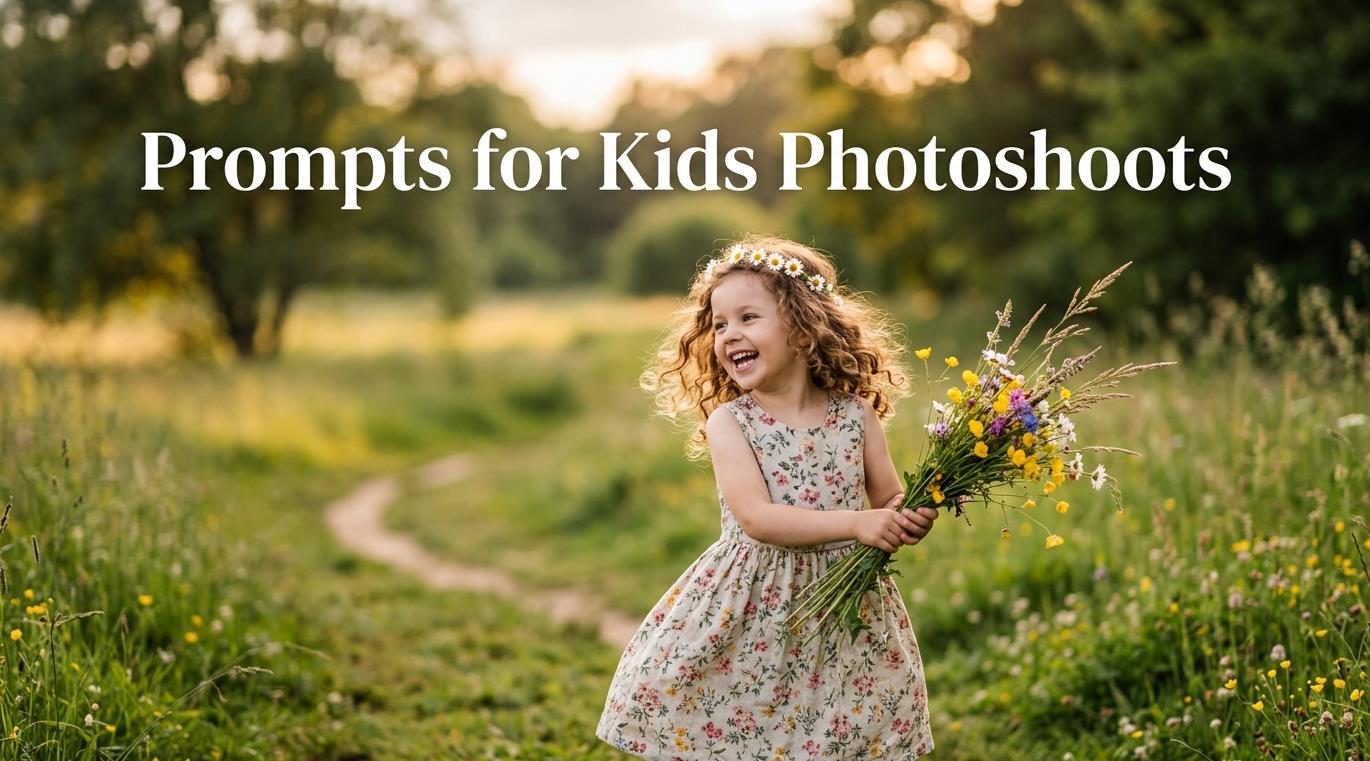
Mastering Generative AI for Children’s Photography: Prompt Engineering, Methodologies, and Stylistic Repositories.
The traditional challenges of photographing children—colloquially referred to as the “wiggle factor,” unpredictable lighting conditions, and chaotic background environments—can now be entirely bypassed through latent space generation. Advanced diffusion models such as Midjourney (specifically versions V6.1 and V7), Stable Diffusion, DALL-E 3, and specialized platforms like Nano Banana and Seedream offer unprecedented control over lighting, optics, styling, and environmental contexts.
Traditional 30-minute studio mini-sessions for children often cost between $100 and $400, while specialized thematic sessions can easily exceed $800. Beyond the financial barrier, traditional shoots are plagued by the practical realities of managing toddlers: the necessity of scheduling around naps, the requirement for constant animation behind the camera, and the struggle against cluttered backgrounds. Generative AI provides an elegant solution to these friction points, allowing creators to conjure highly stylized, cinematic, and photorealistic imagery through meticulously engineered text prompts.
This analysis deconstructs the mechanics of AI prompt engineering specifically tailored to children’s photography. It explores the syntactic architecture of an effective prompt, best practices for model optimization and character consistency, and provides an exhaustive, categorized repository of professional-grade prompts designed for hyper-realistic and highly stylized outputs.
The Architecture of an Effective Photographic Prompt
Constructing an effective prompt for an AI image generator is analogous to directing a physical photoshoot. The model requires explicit instructions regarding the subject, the environmental context, the optical equipment, the lighting rigging, and the post-processing color grade. Vague inputs yield generic, algorithmic aesthetics, whereas structured, highly specific prompts produce cinematic, photorealistic imagery.
The most effective architectural formula for photorealistic AI generation follows a sequential, three-layer hierarchy: Composition, Lighting, and Style. This can be expanded into a precise string: Subject Details + Action/Pose + Environment + Camera/Lens Specifications + Lighting Setup + Mood/Color Grading + Technical Parameters.
Subject Definition and Anatomical Specificity
The baseline of any children’s portrait prompt is the subject. Generative models tend to default to symmetrical, flawless, and often doll-like faces if not instructed otherwise. To ground the image in reality, the prompt must introduce specific human characteristics and minor imperfections. Demographics must be explicitly stated, including age, ethnicity, hair texture, and eye color. Merely requesting a “child” leaves too much to the latent space; requesting a “7-year-old girl with curly auburn hair and soft freckles” anchors the generation in specific physiological realities.
Expression and emotion are equally critical. Generic terms like “happy” often result in forced, unnatural smiles. Instead, the physical manifestation of the emotion must be described. Phrases such as “genuine mid-laugh,” “eyes sparkling with curiosity,” “thoughtful lean,” “mouth open in a cute wow expression,” or “puckering mouth playfully” dictate highly specific facial geometries that enhance realism.
Wardrobe and styling serve as the final anchor for the subject. Clothing informs the era, aesthetic, and cultural context of the image. Detailed descriptions such as “oversized linen coat,” “red and white striped matching family pajamas,” “royal Sherwani,” or “vintage aviator leather hat” prevent the AI from defaulting to generic, untextured garments. Furthermore, ensuring the prompt utilizes innocent, thematic keywords—such as “playing,” “reading,” or “costume”—guarantees that the resulting outputs remain wholesome, family-friendly, and suitable for commercial children’s albums.
Optical Specifications and Camera Gear
AI models have been trained on billions of images accompanied by their EXIF data. By specifying professional camera bodies and prime lenses, the prompt forces the AI to simulate specific optical physics, including depth of field (bokeh), lens distortion, and focal compression.
| Focal Length & Aperture |
Optical Effect in Latent Space |
Ideal Photographic Use Case |
|
35mm f/1.4 |
Wider field of view, slight edge distortion, rich environmental context. |
Candid lifestyle, dynamic outdoor play, street fashion, and puddle jumping scenes. |
|
50mm f/1.8 |
Natural human eye perspective, moderate background separation. |
Half-body portraits, indoor lifestyle, documentary styles, and classroom settings. |
|
70-200mm at 135mm |
Strong background compression, isolating the subject from clutter. |
Glamorous beauty portraits, luxury magazine aesthetics, and high-end fashion. |
|
85mm f/1.2 / f/1.4 |
High facial compression, extreme background blur (creamy bokeh), flattering proportions. |
Studio headshots, fine art portraiture, Vogue covers, and tight crop facial portraits. |
|
100mm Macro |
Extreme detail rendering, hyper-focused textures with razor-thin focal planes. |
Close-up details of eyelashes, newborn features, skin pores, and beauty photography. |
When appending camera gear to a prompt, citing specific sensor models alongside the focal length acts as a stylistic trigger. For instance, prompting with “Sony A7R V” or “Canon EOS R5” encourages the generation of crisp, modern digital sharpness, whereas “Leica Q3” or “Hasselblad X2D” triggers a more intimate, documentary-style rendering with subtle color science nuances. Requesting a “Kodak Portra 400” film stock or “fine film grain” further breaks the digital perfection, adding a layer of organic texture to the final output.
Precision Studio Lighting Terminology
Lighting dictates the mood, volume, and three-dimensionality of the portrait. Bypassing generic phrases like “good lighting” in favor of exact studio terminology grants the creator absolute control over the shadow falloff and highlight placement. The three-layer formula dictates that the lighting rig must specify direction, softness, contrast, and color.
| Lighting Pattern / Term |
Visual Characteristic |
Optimal Implementation in AI Prompts |
|
Rembrandt Lighting |
Creates a dramatic 45-degree angle of light, forming a distinctive triangle of light on the shadowed cheek. |
Cinematic, bold portraits; moody superhero or dramatic editorial themes. |
|
Butterfly (Paramount) Lighting |
Placed directly above and in front of the subject, creating a butterfly-shaped shadow under the nose. |
High-fashion, Vogue-style editorials, beauty portraits, and luxury fashion. |
|
Split Lighting |
Illuminates only half the face, leaving the other in deep shadow for high contrast. |
Intense athletic shots, dramatic storytelling, and edgy street style. |
|
Cinematic Rim Light |
A strong backlight placed behind the subject to create a glowing outline separating them from the background. |
Golden hour silhouettes, fantasy portraits, and separating dark hair from dark backgrounds. |
|
Negative Fill |
Blocking ambient light to carve out shadows on one side of the face, enhancing three-dimensionality. |
Moody editorial portraits, window-lit serene shots, and fine art concepts. |
Understanding fill light is equally important. In a prompt, specifying a “low-power strobe fill” or “soft LED fill opposite the key light” instructs the AI to lift shadows gently without destroying the contrast ratio. Alternatively, relying on natural modifiers such as “golden hour backlight,” “soft diffused window light from camera-left,” or “dusk ambient with wet neon reflections” produces stunning outdoor and lifestyle aesthetics.
Defeating the Uncanny Valley: Skin Textures and Imperfections
The most pervasive defect in generative portraiture is the “plastic” or “waxy” skin effect, where algorithms over-smooth human textures, resulting in a CGI or doll-like appearance. To counteract this and achieve true photorealism, the prompt must explicitly demand biological imperfections and realistic physical rendering.
When algorithms generate human skin, their default optimization leans toward standard beauty metrics—resulting in poreless, perfectly smooth gradients. To force the model to calculate realistic skin physics, the prompt must introduce specific dermatological and optical terminology. The inclusion of the phrase “subsurface scattering” acts as a powerful catalyst; it forces the AI to simulate how light penetrates the translucent outer layer of skin and scatters beneath the surface, a hallmark of high-end 3D rendering and professional portraiture that dramatically increases lifelike qualities.
Combining this with explicit texture modifiers such as “visible skin pores,” “subtle freckles,” “fine microtexture,” “stray hairs,” “peach fuzz,” and “natural skin texture” grounds the rendering in biological reality. For high-end editorial looks, adding phrases like “glowing realistic skin,” “subtle facial lines,” or “realistic catchlights in eyes” ensures the portrait breathes with life.
Environmental and physical clutter also plays a crucial role in tricking the eye. A pristine background often feels artificial. Requesting “slight motion blur on hands,” “dust particles in a light beam,” “messy soft white linens,” or “flour particles suspended in the air” forces the AI to render a lived-in, physically authentic reality rather than a sterile digital void.
Methodologies for Deployment: Workflows and Platform Mechanics
Understanding prompt syntax is only one facet of the generative process. The chosen platform dictates the specific workflow required to achieve the desired result. Distinct methodologies exist for Midjourney, Stable Diffusion, and specialized Image-to-Image platforms.
Midjourney Core Parameters (V6.1 and V7)
Midjourney is widely considered the premier tool for artistic and photorealistic image generation, provided the correct parameters are applied. By default, Midjourney applies an artistic beautification layer. To achieve professional photographic results, this must be aggressively bypassed using specific suffix parameters.
- –style raw: This parameter is strictly non-negotiable for photographic realism. It instructs the model to turn off its default “auto-pilot” beautification, forcing it to adhere strictly to the laws of physics and lighting described in the prompt, thereby eliminating the painterly aesthetic.
- –stylize [value] (or -s): Dictates how heavily Midjourney applies its aesthetic training. The scale ranges from 0 to 1000. For photorealistic children’s portraits, values between 100 and 250 strike the optimal balance—retaining structural realism and detail without becoming sterile. Values above 500 should be reserved strictly for highly stylized editorial, abstract, or fantasy concepts.
- –q 2: Increases the rendering quality and processing time. This is highly recommended for final portrait generations, as it dedicates more computational power to extracting maximum micro-texture detail in hair and skin.
- –ar [ratio]: Aspect ratio is vital for composition. Utilizing –ar 4:5 is the standard for Instagram-ready vertical portraits, –ar 16:9 creates cinematic, wide-angle storytelling frames, and –ar 3:2 mimics standard 35mm digital photography framing.
Character Consistency and the Omni Reference System
One of the most complex requirements in commercial children’s photography is maintaining a consistent model across multiple scenes—such as generating a catalog of different seasonal outfits using the exact same child’s face.
In Midjourney V6, consistency was driven by the Character Reference (–cref) and Character Weight (–cw) parameters. By appending –cref [image URL] to a prompt, the algorithm mapped the facial geometry of the reference image onto the new generation. The –cw scale (0-100) controlled the strictness: –cw 100 transferred face, hair, and clothing perfectly, while –cw 0 locked onto the face alone, allowing the prompt to dictate entirely new garments and environmental contexts.
In Midjourney V7, this system evolved into the Omni Reference (–oref) and Omni Weight (–ow) architecture. The current V7 workflow for absolute consistency requires a highly disciplined, foundational approach:
- Generate a Base Anchor: Create a clean, well-lit reference portrait with a neutral expression against a plain background. Complex backgrounds in a reference image will bleed into future generations. Crucially, extreme expressions must be avoided; a laughing or crying reference image will permanently bias all subsequent generations, locking the character into that singular emotion.
- Apply Omni Reference: Secure the image URL of this base anchor and utilize it in all future scene prompts. Example: /imagine candid shot of the same girl exploring a misty forest, holding a lantern –oref [URL] –ow 250.
- Calibrate Omni Weighting: The –ow parameter acts as a slider between identity fidelity and prompt flexibility. If the character’s facial identity begins to drift across scenes, the –ow value must be increased. Conversely, if the model stubbornly refuses to change the character’s original clothing or lighting despite explicit text instructions, the –ow value must be decreased.
Stable Diffusion and the Mechanics of Negative Prompting
Unlike Midjourney, which utilizes suffix parameter flags, Stable Diffusion relies heavily on negative prompts to steer the diffusion process away from algorithmic hallucinations and visual degradation. A negative prompt acts as active mathematical guidance during the noise-refinement cycle, actively suppressing unwanted visual concepts before they form.
However, a common pitfall is the “kitchen sink” approach—pasting massive, 500-word negative prompts (e.g., “ugly, bad, terrible, wrong”) into every single generation. This approach is highly detrimental; it confuses the AI, causes the image quality to degrade, and overcorrects the output. The model does not understand subjective, abstract judgments like “ugly.” Instead, negative prompts must be concise, targeted, and focused on observable, structural symptoms.
| Target Defect / Artifact |
Optimized Stable Diffusion Negative Prompt Formulation |
Rationale |
|
Anatomical & Appendage Errors |
bad anatomy, extra fingers, fused fingers, mutated hands, missing limbs, disconnected limbs, disfigured |
Directly addresses the model’s known struggles with the logic of human extremities, specifically the rendering of correct digit counts. |
|
CGI / Plastic Appearance |
3d, render, cgi, painting, cartoon, waxy skin, overprocessed skin, poreless, doll-like, airbrushed |
Pushes the model away from digital illustration and 3D rendering datasets, forcing it to sample from photorealistic photographic datasets. |
|
Text, Clutter & Artifacts |
watermark, signature, text, logo, username, jpeg artifacts, compression noise, grainy |
Eliminates the residual stock-photo watermarks and text overlays the AI learned during its initial training on commercial image databases. |
|
Composition & Framing Flaws |
out of frame, cropped, cut off, asymmetrical eyes, uneven eyes, distorted facial features, long neck |
Ensures the subject remains properly centered within the frame and prevents geometric mapping errors on facial symmetry. |
To exert granular control over these avoidances, UI platforms like Automatic1111 allow for prompt weighting. By wrapping a negative term in parentheses with a colon and a numerical value—such as (fused fingers:1.4) or (waxy skin:1.2)—the user forcefully multiplies the algorithm’s aversion to that specific defect.
Image-to-Image (Img2Img) and Low-Budget Physical Setups
For parents, bloggers, and creators who wish to feature a specific real-world child in highly produced environments without relying on complex reference URLs, platforms like Novi AI (utilizing Seedream and Nano Banana models) or Media.io offer robust Image-to-Image (img2img) capabilities.
A highly effective “low-budget” workflow involves capturing a simple photograph of the child in a controlled, un-distracting setting. Indoors, this might mean sitting the child against a plain, solid-colored bedsheet with a favorite stuffed animal; outdoors, a clean patch of grass or the base of a tree suffices. By uploading this basic structural photo to an AI generator and applying a highly descriptive prompt, the AI uses the physical contours and facial identity of the child as an absolute blueprint. The plain bedsheet can thus be seamlessly hallucinated into a “magical wonderland forest with oversized glowing mushrooms,” preserving the child’s exact physical likeness while completely transforming the production value of the environment.
The Categorized Prompt Repository
The following exhaustive repository categorizes advanced, ready-to-use prompt templates for various styles of children’s photography. These prompts have been engineered utilizing the architectural formulas discussed above, integrating precise optical, environmental, and stylistic commands to guarantee maximum fidelity.
Implementation Note: Replace the bracketed text (e.g., [Subject Details]) with highly specific physical descriptions of the child (age, hair style, ethnicity). The provided examples utilize optimal Midjourney V7 syntax (–v 7 –style raw –ar 4:5 –stylize 200), but the core descriptive text is universally applicable across DALL-E 3, Stable Diffusion, and specialized platforms like Seedream.
Category 1: Milestone and Birthday Celebrations
Milestone photography requires vibrant, cheerful environments. These prompts balance cluttered, colorful props with shallow depth of field to ensure the visual focus remains locked sharply on the child’s expression.
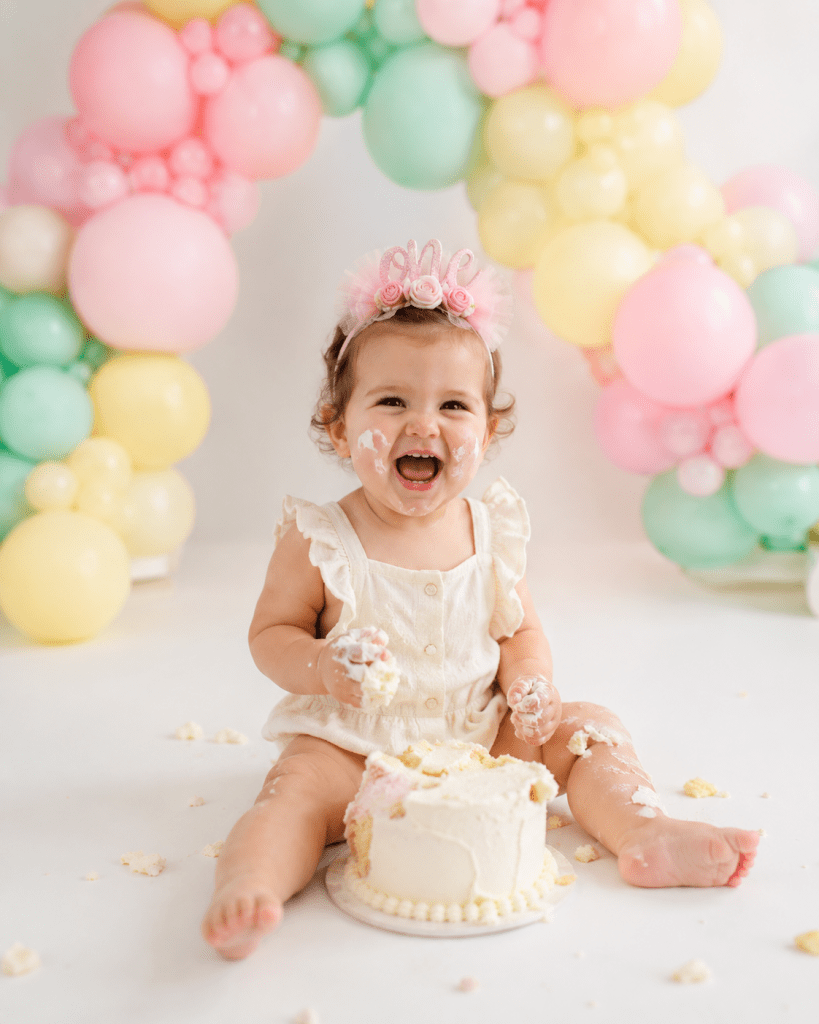
Prompt 1.1: The Pastel Balloon Cake Smash
Photorealistic portrait of a [Subject Details], sitting on a pristine white studio floor, engaging in a joyful, messy cake smash. The background features an elaborate, sweeping arch of pastel balloons in shades of mint green, blush pink, and pale yellow. Soft, diffused high-key studio lighting with a large overhead octabox providing even illumination. Shot on Sony A7R V, 85mm f/1.4 lens. Genuine, candid mid-laugh expression, vanilla frosting smeared playfully on cheeks and hands. Realistic skin texture, bright and airy aesthetic, crisp focus on the eyes, creamy background bokeh. --style raw --v 7 --ar 4:5 --stylize 200
Prompt 1.2: The “Big Number” Foil Balloon Celebration
Full-body environmental portrait of a [Subject Details] leaning excitedly against a massive gold foil "5" balloon. Set against a solid blush-pink studio backdrop. The floor is scattered with matte silver balloons, clear balloons filled with silver confetti, and curled ribbon. Shot on Canon EOS R5 with 50mm f/1.8 lens. Soft wrap-around window light originating from camera-left, gentle fill light on the right to lift shadows. Childlike retro vintage playful style, rich intense colors, strong contrast, realistic fabric textures on the child's party outfit. --style raw --v 7 --ar 4:5 --stylize 250
Prompt 1.3: The Messy Little Baker
Medium shot of a [Subject Details] sitting on a rustic, butcher-block kitchen counter, wearing a miniature white chef's hat and a heavily flour-dusted apron. The child is holding a wooden whisk, giggling uncontrollably. Fine flour particles are suspended and floating in the air, catching the warm backlight. Bright, warm kitchen window lighting, lifestyle photography aesthetic. Shot on Fujifilm X-T5, 35mm f/1.4 lens. Shallow depth of field, natural messy kitchen clutter subtly blurred in the background, highly detailed skin pores and fabric weave. --style raw --v 7 --ar 16:9 --stylize 150
Category 2: Fantasy, Fairytale, and Cinematic Adventures
Fantasy concepts leverage the immense creative power of latent diffusion, conjuring environments that would cost thousands of dollars to construct practically. Lighting in these prompts shifts dramatically from natural softboxes to cinematic, ethereal, and high-contrast setups.
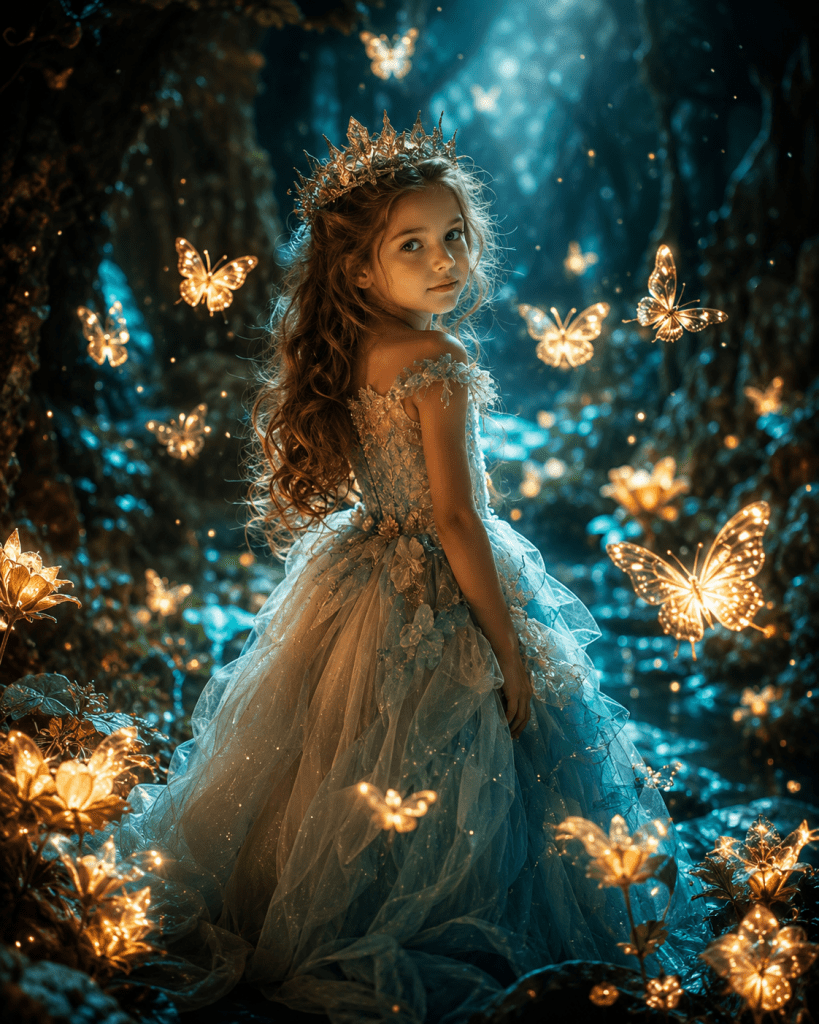
Prompt 2.1: The Bioluminescent Fairy Queen
Cinematic fantasy portrait of a [Subject Details] dressed as an elegant fairy queen in a layered tulle skirt, standing in an enchanted, glowing ancient forest. Bioluminescent flora and glowing, translucent magical butterflies surround the subject, illuminating her face. Dreamy, ethereal lighting mixing cool teal moonlight from above with warm golden practical light emanating from the butterflies. Shallow depth of field, 85mm portrait lens look. Realistic fantasy photography, hyper-detailed gossamer dress textures, soft glowing skin, mystical and atmospheric depth. --style raw --v 7 --ar 4:5 --stylize 400
Prompt 2.2: Deep Space Little Astronaut
Photorealistic wide-angle shot of a [Subject Details] wearing a highly detailed, miniature white NASA extravehicular astronaut suit adorned with mission patches. The child is kneeling to explore a realistic, cratered lunar surface. A massive, brilliantly blue Earth is visible rising in the stark black sky in the background. Dramatic, high-contrast directional sunlight simulating harsh space lighting, casting sharp, distinct black shadows. Shot on Leica M11, 24mm lens. Adventurous mood, cinematic sci-fi aesthetic, visible moondust on the spacesuit knees, ultra-realistic texture. --style raw --v 7 --ar 16:9 --stylize 300
Prompt 2.3: The Alice in Wonderland Tea Party
Storybook editorial portrait of a [Subject Details] sitting at an elaborate, whimsical miniature tea party deep within a dense, mossy woodland. The child is surrounded by oversized glowing red mushrooms, vintage brass pocket watches hanging from tree branches, and stacks of mismatched porcelain teacups. Soft, dappled sunlight filtering through the heavy forest canopy, creating pools of light. Shot on Hasselblad X2D, 80mm lens. Rich, saturated jewel tones, magical realism, highly detailed macro textures on the green moss and chipped porcelain. --style raw --v 7 --ar 16:9 --stylize 350
Prompt 2.4: Rooftop Superhero Twilight
Dynamic low-angle "hero shot" of a [Subject Details] wearing a custom crimson superhero cape and a domino mask, standing in a confident, wide-stanced power pose on a gothic city rooftop gargoyle. A sweeping, neon-lit urban skyline sprawls in the background at deep twilight. Cinematic rim lighting illuminating the billowing edge of the cape, dramatic split lighting on the face creating intense shadows. Shot on 35mm lens, f/2.8. Comic book movie aesthetic, gritty realism, wind blowing the fabric, intense heroic mood, ultra-sharp focus. --style raw --v 7 --ar 16:9 --stylize 250
Category 3: High-End Fashion and Editorial Portraiture
Generative AI excels at replicating the aesthetic of high-fashion magazines and luxury lookbooks. These prompts focus heavily on wardrobe styling, specific studio lighting patterns (like Butterfly or Rembrandt), and high-end camera optics to mimic Vogue editorials or modern streetwear campaigns.
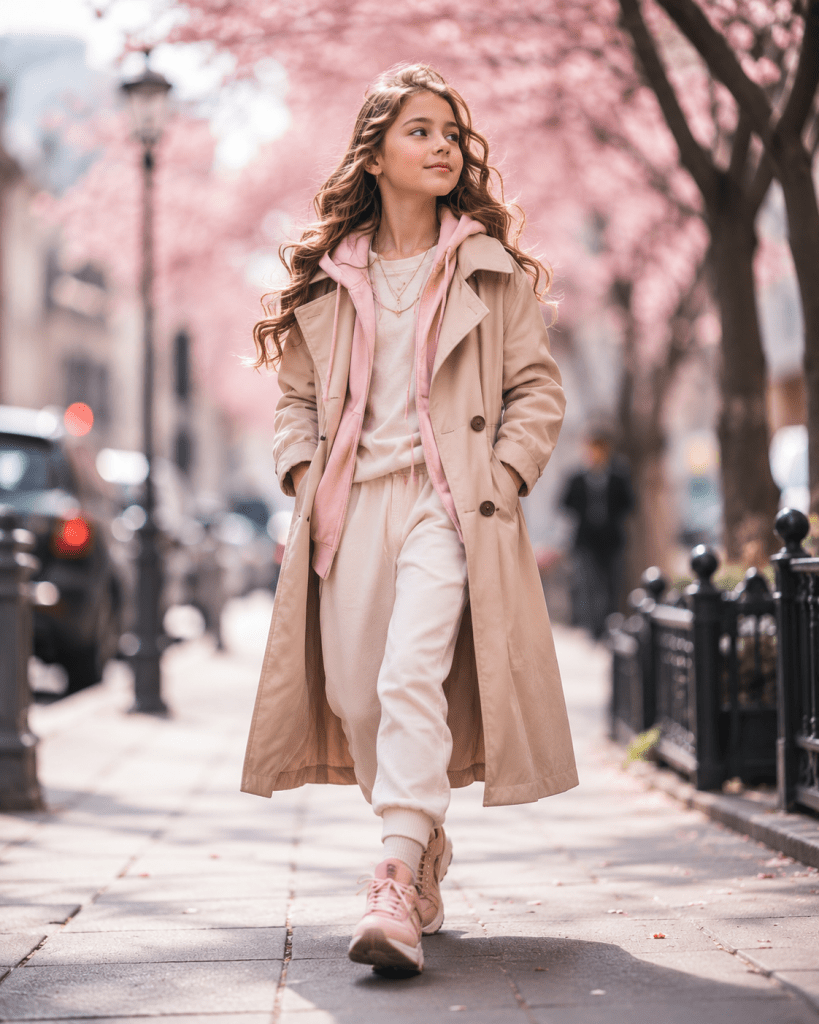
Prompt 3.1: Korean-Style Aesthetic Streetwear
High-fashion street style full-body portrait of a [Subject Details] wearing an oversized beige trench coat over pastel minimalist streetwear layers. The child is walking confidently down a chic, blurred metropolitan sidewalk lined with cherry blossoms. Soft, diffused natural light, dreamy pink and pastel color grading, viral Pinterest aesthetic. Shot on 85mm f/1.4 lens for extreme background bokeh. Confident, candid expression, slight motion blur on the feet indicating movement. Photorealistic, hyper-detailed fabric weaves, luminous flawless skin with subtle subsurface scattering. --style raw --v 7 --ar 4:5 --stylize 300
Prompt 3.2: Vogue Editorial Cover Layout
Luxury fashion magazine editorial portrait of a [Subject Details], winking playfully and framing their face with their hands in a heart gesture. Flawless glowing skin, natural glossy lips. Wearing an avant-garde, structural off-white gown adorned with luxury jewelry. Solid seamless studio background. Cinematic professional studio lighting utilizing a classic Butterfly lighting setup to accentuate cheekbones, soft HDR effect. Shot on professional DSLR, 85mm f/1.8, crisp focus on the eyes, subtle fine film grain. Elegant, high-end lifestyle aesthetic, cover-shoot ready. --style raw --v 7 --ar 3:4 --stylize 350
Prompt 3.3: Upcycled Avant-Garde Couture
Provocative high-fashion editorial portrait of a [Subject Details] wearing an elaborate, highly imaginative gown constructed entirely from recycled materials, reclaimed textiles, woven plastics, and upcycled metallic accessories. Set inside a massive, industrial, rust-decayed warehouse. Striking visual contrast between the pristine, innovative haute couture and the corroded industrial decay of the background. Large softbox key light from above, deep dramatic shadows. Shot on medium format camera, 120mm macro lens. Highly conceptual, intricate texture details on the recycled materials, bold and surreal aesthetic. --style raw --v 7 --ar 4:5 --stylize 450
Prompt 3.4: Vintage 1960s Technological Fusion
Retro-modern fashion portrait of a [Subject Details] wearing stylish 1960s-inspired kidswear (tweed blazer, neat collar) integrated seamlessly with subtle futuristic technological gadgets and glowing piping. Polished college campus setting blurred in the background. Muted colors, washed photography style, ethereal ambiance, Kodak Portra 400 with ISO 400 film grain. Shot on Hasselblad X2D 100C. Candid posture, confident attitude, sharp focus on the face, neutral color grading. --style raw --v 7 --ar 4:5 --stylize 200
Category 4: Seasonal and Holiday Concepts
Seasonal photography requires distinct color palettes (e.g., golden hour oranges for autumn, cool blues and stark whites for winter) and specific environmental props to anchor the time of year.
Prompt 4.1: Autumn Pumpkin Patch Golden Hour
Environmental portrait of a [Subject Details] wearing a chunky rust-orange knit sweater and a cute knitted slouchy beanie, sitting comfortably among dozens of large, vibrant orange pumpkins in an open rustic farm field. Golden hour sunset lighting casting long, warm shadows and a beautiful glowing backlight on the child's hair. Shot on Canon EOS R5, 50mm f/1.8 lens. Rustic farm aesthetic, falling autumn leaves softly blurred in the background, razor-sharp detail on the knit fabric of the sweater, cinematic warmth and natural skin tones. --style raw --v 7 --ar 16:9 --stylize 200
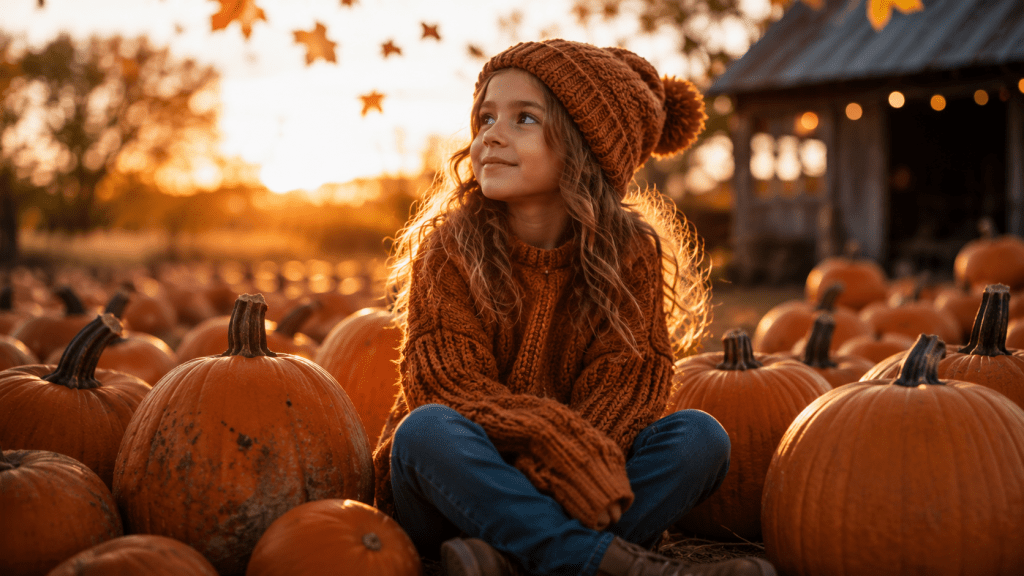
Prompt 4.2: Cozy Christmas Morning
Candid indoor portrait of a [Subject Details] sitting cross-legged on a plush white faux-fur rug in front of a heavily decorated, glowing Christmas tree. The child is wearing classic red and white striped pajamas, looking down with pure wonder while untying a ribbon on a wrapped gift box. Warm, cozy ambient light emanating entirely from the tree lights, creating rich, colorful circular background bokeh. Shot on 35mm lens, f/1.4 for shallow depth of field. Soft contrast, highly detailed reflections in the glass ornaments, nostalgic and festive atmosphere. --style raw --v 7 --ar 4:5 --stylize 150
Prompt 4.3: Summer Puddle Splashing
Dynamic action photography of a [Subject Details] wearing a bright yellow raincoat and matching rainboots, jumping joyfully with both feet into a large, reflective puddle on a wet city street. Water droplets and splashes frozen mid-air in absolute sharp focus. Overcast, moody ambient lighting, with vibrant neon storefront signs reflecting vividly in the wet pavement and the puddle surface. Shot on Sony A7R V, fast shutter speed 1/1000s, 85mm lens. Dynamic kinetic energy, high contrast, highly realistic water textures and wet fabric. --style raw --v 7 --ar 16:9 --stylize 200
Category 5: Fine Art and Newborn/Toddler Serenity
These prompts are characterized by their extreme softness, delicate color palettes, and intimate framing. They rely heavily on macro details, soft window light, and negative fill to sculpt gentle, flattering shadows.
Prompt 5.1: The Sleeping Artistic Portrait
Angelic, macro close-up portrait of a [Subject Details] sleeping peacefully. The subject is wrapped securely in a chunky-knit, cream-colored throw blanket, resting on messy, soft white linens. Wearing soft, neutral-colored organic cotton pajamas. Soft, diffused natural window lighting illuminating the face from the right side, with negative fill on the left to create sculpted, gentle shadow falloff. Shot on 100mm macro lens, extreme shallow depth of field. Serene atmosphere, neutral and warm tones, photorealistic exquisite skin texture with subtle peach fuzz and visible pores. --style raw --v 7 --ar 3:2 --stylize 150
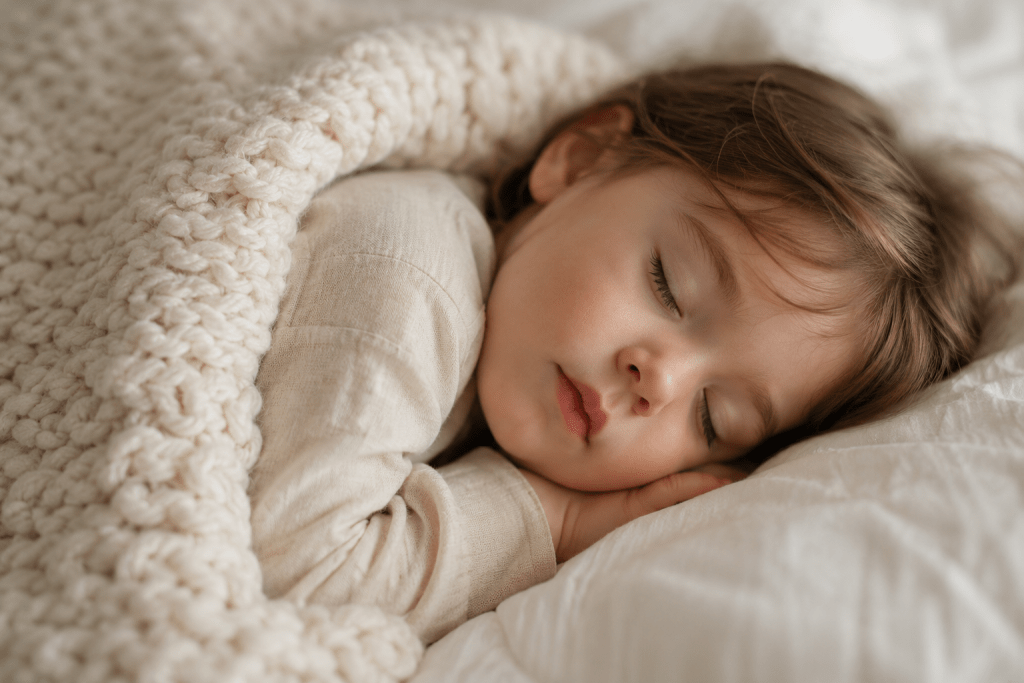
Prompt 5.2: Botanical Floral Milk Bath
Overhead top-down shot of a [Subject Details] sitting calmly in a vintage white clawfoot tub filled to the brim with opaque, milky water. Floating gracefully on the surface around the child are fresh pastel pink roses, purple lavender sprigs, and bright yellow citrus slices. Soft, even, high-key white lighting bouncing off a studio ceiling to eliminate all harsh shadows. Shot on 35mm lens, f/4 for edge-to-edge sharpness. Spa-like serenity, clean organic aesthetic, highly detailed water surface tension and delicate floral textures. --style raw --v 7 --ar 1:1 --stylize 200
Prompt 5.3: The Vintage Aviator
Nostalgic fine-art portrait of a [Subject Details] wearing a vintage brown leather aviator hat and old-school glass flight goggles resting pushed up on the forehead. The child is sitting inside a beautifully crafted vintage metal pedal-plane. The background features soft, painted-looking cumulus clouds in a blue sky. Sepia-toned color grading, muted low-contrast lighting mimicking 1940s analog film photography. Norman Rockwell-inspired composition, highly detailed weathered leather textures, emotional storytelling aesthetic. --style raw --v 7 --ar 4:5 --stylize 250
Category 6: Dynamic Outdoor Lifestyle and Sports
Candid lifestyle imagery completely rejects stiff, studio posing in favor of kinetic movement, environmental storytelling, and natural, un-manipulated lighting patterns.
Prompt 6.1: Golden Hour Bubble Blowing
Candid lifestyle photograph of a [Subject Details] wearing a light cotton sundress, standing in an expansive, lush meadow of blooming wildflowers. The child is gleefully blowing a swarm of iridescent soap bubbles into the air. Golden hour sunlight piercing through a distant tree line, intensely backlighting the child and creating prismatic rainbow reflections inside the floating bubbles. Shot on 85mm f/1.4 lens, rule of thirds composition. Natural, unposed movement, joyful carefree atmosphere, rich saturated greens and warm amber yellows. --style raw --v 7 --ar 16:9 --stylize 150
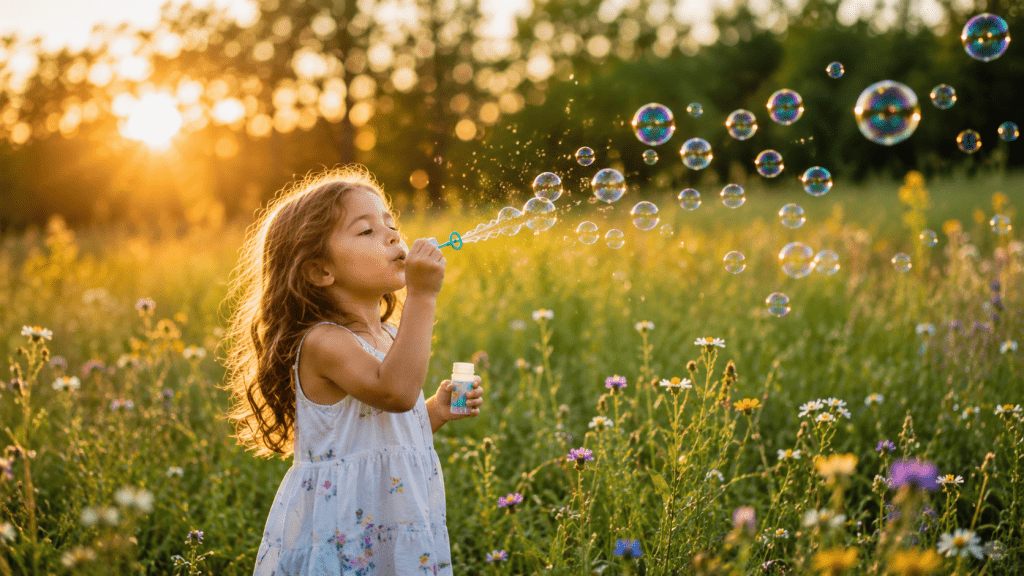
Prompt 6.2: The Skateboarder at the Park
Action sports photography of a [Subject Details] wearing cool streetwear, a protective helmet, and sneakers, performing an energetic trick on a skateboard mid-air above a concrete skatepark bowl. Bright, harsh midday sunlight casting hard, sharp shadows on the concrete. Shot on a wide 24mm lens to capture the scale of the skatepark, fast shutter speed to freeze the kinetic action. High-definition grit, energetic atmosphere, highly detailed textures of scuffed grip tape and worn denim. --style raw --v 7 --ar 16:9 --stylize 200
Prompt 6.3: Sidewalk Chalk Muralist
High-angle candid photograph looking down at a [Subject Details] sitting cross-legged on a concrete suburban driveway, surrounded by scattered, colorful chunks of sidewalk chalk. The child is intensely focused, drawing a vibrant, messy rainbow mural on the ground. The child's hands, knees, and cheeks are lightly dusted with bright chalk powder. Bright midday sun, sharp shadows, overhead perspective. Vibrant, high-contrast colors, capturing raw childhood creativity in action. --style raw --v 7 --ar 3:4 --stylize 150
Prompt 6.4: The Little Baseball Player
Classic Americana sports portrait of a [Subject Details] sitting on the dusty dirt of a baseball diamond, wearing a traditional striped baseball jersey and oversized cap. A worn leather baseball glove and a scuffed white baseball rest on the dirt nearby. The background features blurred, glowing stadium lights at twilight. Shot on 85mm lens, f/2.8 for a shallow depth of field. Dusty ground texture, classic pastime vibe, determined and focused expression, cinematic sports lighting. --style raw --v 7 --ar 16:9 --stylize 150
By synthesizing a deep understanding of photographic physics, targeted studio vocabulary, and platform-specific operational parameters, creators can seamlessly bypass the limitations, costs, and chaotic variables of physical children’s photography. The meticulous engineering of an AI prompt transforms a simple concept into a masterful, emotionally resonant, and technically flawless portrait.
❓ Frequently Asked Questions
Answers to relevant questions about this AI tool



The fairy tale forest lighting prompt creates such a dreamlike atmosphere.