AI Celebrity Voice Changer: Parody And Text-To-Speech
On this page
How to Voice Text with a Celebrity’s Voice: A Detailed Guide
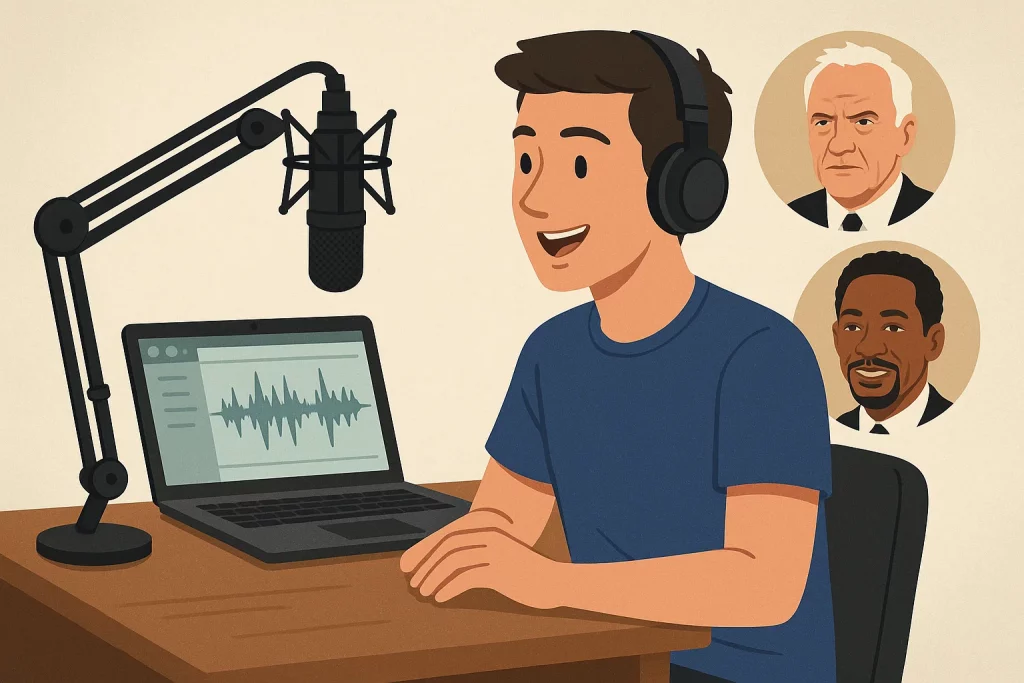
Set aside what you thought was possible for a moment. Imagine launching an ad campaign narrated by Morgan Freeman’s iconic, velvety baritone. Or picture your employee training course delivered in Elon Musk’s focused and energetic tone. Maybe you run a gaming blog, and your latest review suddenly features Ryan Reynolds’ signature sarcastic, world-weary commentary. He drops witty one-liners right in the pauses between your points, making it feel like he genuinely played the game and is now sharing his trademark cynical take on the gameplay. Just 5–7 years ago, this idea would have seemed impossible. At best, people would have smiled politely and said, “Dream on.” That kind of magic was reserved for big-budget studios. Getting a celebrity voice meant jumping through endless hoops with agents, lawyers, and massive fees. But the world has changed. A quiet AI revolution has put this superpower—voicing any text with a celebrity’s voice—right on your laptop or desktop, available to everyone.What Is Text-to-Speech and How Has It Evolved?
Let’s break down the term “text-to-speech” together. A couple of decades ago, professional voice-over work felt like an exclusive ritual reserved for the elite. It happened inside soundproof recording studios packed with expensive gear and layers of acoustic foam. Picture the scene:- A dimly lit control room where the audio engineer sits focused like an air-traffic controller behind thick glass.
- In the isolated booth, a professional voice actor stands before a microphone that costs as much as a luxury car.
- They deliver your script live, in one breath, with perfect diction and the exact emotion needed. One mistake and the whole take starts over.
Why Traditional Voice-Over Became Less Common
- The high cost of perfection. Studio rental, voice talent, and engineering fees often ran hundreds or thousands of dollars per hour.
- Scheduling nightmares. Coordinating availability between the studio, talent, and your team could drag the project out for weeks.
- Revision hell. Spot a typo or want to tweak a line after listening? You’d pay for another full session.
- Location limitations. You were stuck with whatever talent and studios were available locally. Finding truly unique voices was a challenge.
AI in Voice Synthesis: The Breakthrough
Imagine teaching someone to perfectly mimic your voice. You wouldn’t just show them how to pronounce words—you’d reveal your personal speech quirks: where you pause for drama, how your pitch rises in questions, or how you stretch certain vowels when joking. That’s exactly how modern AI works—it doesn’t just “read” text; it learns to speak by capturing a person’s unique vocal DNA.From Robotic to Lifelike: How the Revolution Happened
Remember the early text-to-speech systems that sounded like clunky robots from 1980s sci-fi? Today’s AI voices represent the next evolutionary leap. They’re no longer collections of pre-recorded phrases but complete virtual vocal systems trained to mimic human brain and vocal cord behavior. How does AI create a “voice clone”? It’s like a master impersonator who:- Listens and absorbs. The model is fed dozens of hours of real speech—interviews, movies, podcasts. It analyzes everything with scientific precision, measuring thousands of parameters:
- Timbre—the unique “color” that makes a voice warm, gravelly, high, or deep.
- Intonation patterns—how pitch rises and falls to form questions or statements.
- Rhythm and pacing—signature pauses, accelerations, and natural flow.
- Articulation quirks—slight lisps, breathiness, chuckles, or swallowed endings.
- Builds a digital blueprint. From this data, it creates a complex mathematical model—essentially virtual vocal cords—that can generate brand-new speech while preserving every learned trait.
- Brings any text to life. Feed it new words, and the model “vibrates” those digital cords exactly like the original speaker would.
How AI Voice Generators Work
Think of training a friend to impersonate a famous actor—playing clips, pointing out quirks, and practicing. AI follows the same process, only millions of times faster and more precise.Stage 1: Capturing the Vocal DNA
First, the AI needs high-quality audio samples of the target voice. The more diverse and clean the recordings, the better the result. The algorithm looks for:- Clean phrases without background noise
- Varied intonation (questions, exclamations, statements)
- Different emotions (joy, sadness, surprise)
- Specific sound pronunciation traits
- Characteristic pauses and rhythm
Stage 2: Training—Building the Voice Clone
This is where the magic happens. The AI analyzes the data, identifies patterns, and constructs a sophisticated mathematical voice model. It breaks speech down to:- Frequency characteristics of each sound
- Acoustic fingerprints of the vocal cords
- Individual speech patterns
- Emotional modulations
Stage 3: Synthesis—Creating New Audio
With the model trained, you simply type or paste text. The AI processes it through the voice model:- Analyzes punctuation and meaning for natural emphasis
- Selects appropriate intonation contours
- Generates sounds with the correct timbre and rhythm
- Adds realistic pauses and breathing
Best Services for Celebrity-Style Voice Synthesis
- ElevenLabs — tops the list for quality and flexibility. Their voices are incredibly emotional and realistic. Choose from a huge library of ready-made voices or train your own custom model from scratch.
- Murf AI delivers a massive voice library plus intuitive controls for speed, pitch, and emotion. It’s perfect when you need precise, professional results and full creative control.
- Descript revolutionizes editing: type your script, generate the voice-over, then simply edit the text—audio updates instantly. No more tedious timeline cutting.
Who Benefits from Celebrity-Style Voice-Overs?
Powerful Real-World Uses
Borrowing a famous-sounding voice isn’t just fun—it’s a game-changer:- Social Media. Creators using recognizable voices see explosive engagement—videos go viral faster and reach millions.
- Advertising. A trusted, familiar voice builds instant credibility. Campaigns perform better and stay memorable longer.
- Gaming & Entertainment. Imagine games, audiobooks, or podcasts narrated by a star-quality voice. Characters feel alive, immersion skyrockets, and audiences connect on a deeper level—like an old friend telling the story.
Important Warnings & Best Practices
Proceed with caution—there are serious risks:- Legal Issues. Voices are protected by personality rights and likeness laws. Unauthorized cloning can lead to lawsuits and major fines.
- Ethical Concerns. Misleading audiences by faking a celebrity endorsement damages trust.
- Get Permission. Always secure proper licensing from rights holders.
- Know the Law. Research voice likeness regulations in your jurisdiction.
- Use It for Good. Focus on creative, honest, and positive projects.