Full review of Kaedim 3D – the platform for generating production-ready 3D models from 2D images. Hybrid approach: AI builds the base, artists polish it. Covers features, pricing, use cases for games, e-commerce, and product design, competitor comparison, and an honest verdict for studios and brands.
Kaedim 3D Review: AI-Powered 3D Model Generation
On this page
Kaedim 3D is an AI platform with human-in-the-loop involvement that transforms 2D images, sketches, reference photos, and briefs into production-ready 3D models. The service positions itself as a solution for game studios, brands, and product teams that need high-quality 3D assets without the lengthy manual modeling process.
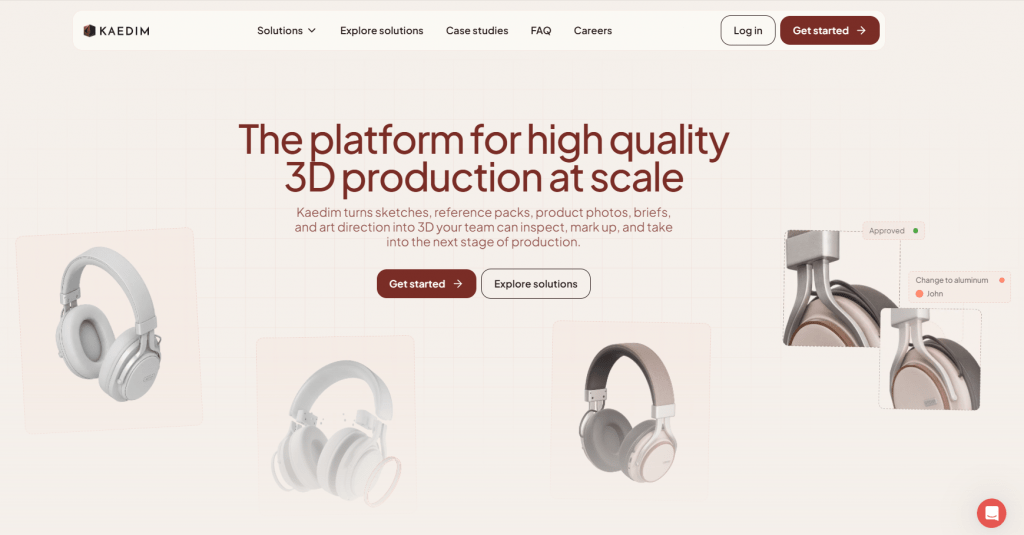
The company is headquartered in London, was founded in 2020 by Konstantina Psoma and others, and has raised more than $15 million in investment from a16z and other funds. Kaedim is aimed at professional use and promises to accelerate pipelines by 10 — 20 times compared to traditional methods.
What Is Kaedim 3D And How Does It Work?
Kaedim is not just another autonomous AI generator, but rather a hybrid approach that combines machine learning with the work of in-house artists. The AI builds the core of the model — geometry and basic textures — and then the artist team polishes it: correcting topology, UV mapping, textures, and overall geometry so that the model is ready for production.
The workflow proceeds as follows:
- Input Upload. You can upload up to six images of the object from different angles. Supported inputs include sketches, product photos, concept art, reference packs, and art briefs. For best results, it is recommended to follow the platform’s input guidelines.
- Preprocessing and AI Reconstruction. The uploaded images undergo preprocessing, after which the AI reconstructs the 3D geometry of the object. At this stage, a base model with textures is created.
- Artist Refinement. Because the AI output is not always perfect, the in-house art team reviews and cleans every model, fixing geometry, topology, and textures. This ensures that each model is ready for use.
- Iteration and Approval. You receive the model, review it, leave feedback, and the team makes changes — the cycle repeats until full approval.
- Export. The final model can be downloaded in formats including OBJ, FBX, MTL, USD, GLB, and GLTF.
Turnaround time depends on model complexity and queue load — ranging from a few hours to several days. According to the team, they are continuously improving the AI to automate an ever-larger portion of the pipeline.
Key Features And Capabilities
Beyond the core conversion process, Kaedim offers a range of capabilities that set it apart from pure AI tools and make it suitable for professional production environments.
- Production-Ready Quality. Thanks to the hybrid approach, Kaedim delivers models that can be used immediately in games, CGI, and product design. This is the main differentiator from pure AI generators, whose models often require substantial post-processing.
- Iterative Workflow. The process is built around the familiar “review — mark — compare — revise — approve” cycle that creative teams already use.
- IP Security. Kaedim guarantees that your concepts and references are not used to train models; data is encrypted and deleted upon request. The platform is ISO 27001 certified.
- Art-Style Support. The team can fine-tune generation to match a specific project style — simply send an art bible, references, and examples of target models.
- Pipeline Integration. Kaedim fits into existing studio and brand workflows, working with Unity, Unreal Engine, and other tools.
Pricing
Kaedim uses a credit model, where 1 credit roughly equals one geometry asset or a more complete asset with retopology, UVs, and textures. Prices are current as of 2026:
|
Plan |
Monthly Price |
Credits |
Features |
|---|---|---|---|
|
Indie |
$400 |
20 |
Discord support; extra credits at $22 each |
|
Pro (formerly Prototype Pro) |
$1,200 |
60 |
Priority processing, dedicated Discord channel, access to Game-Ready |
|
Enterprise |
Custom |
Unlimited |
Dedicated pipeline, priority support, custom terms |
A trial plan at roughly $50—$150 existed previously, but Kaedim now focuses on professional teams. Exact pricing should be confirmed directly with sales, as it may vary based on volume.
Who Is Kaedim 3D For And What Is It Used For?
The platform is built for professional teams that need high-quality 3D content in large volumes and tight timeframes.
Business Use Cases:
- Game Studios. Kaedim speeds up the creation of props, environments, and characters for pre-production, production, and live-service content. Models adhere to the project’s art style and are ready for engine integration.
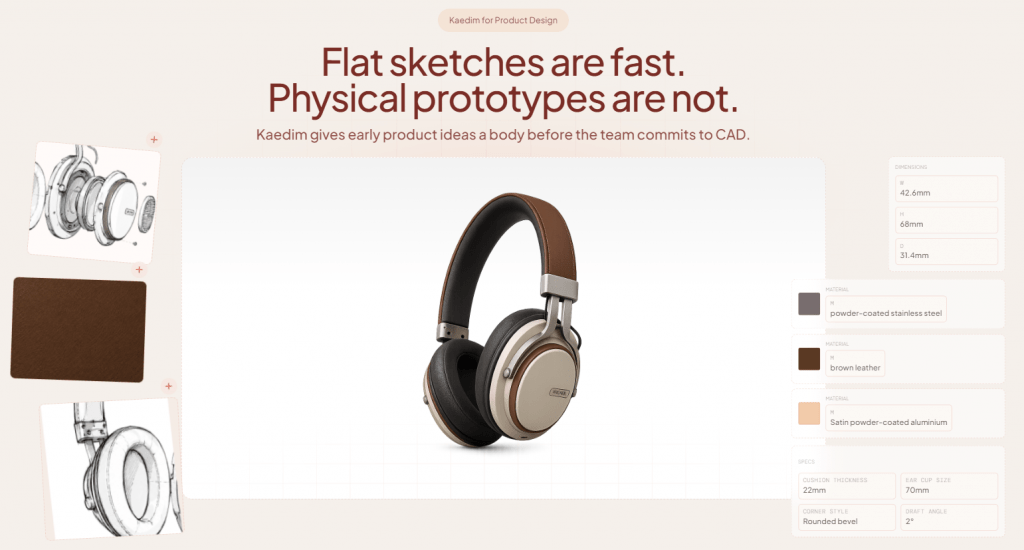
- Product Design. Designers can quickly turn sketches and concepts into 3D before the CAD stage, allowing them to verify proportions, volume, and form early.
- E-commerce and Marketing. Brands create CGI product visuals for PDPs, campaigns, and landing pages without expensive photoshoots.
- Architecture and Animation. Rapid prototyping and asset creation for visualizations.
According to the company, Kaedim enables a single artist to produce 10 times more assets. Clients include Lowe’s, Shark Ninja, and Casio, who report annual savings of $470,000—$600,000 and time reductions of 75–80%.
- High quality and production readiness thanks to the hybrid approach with artist involvement — models are immediately usable.
- Significant pipeline acceleration — 10—20× faster than traditional modeling, based on client case studies.
- IP security — your data is not used for training, with encryption and ISO 27001 compliance.
- Flexible iterative process with unlimited revisions, convenient for team collaboration.
- Art-style support — the ability to tailor generation to the project’s visual language.
- Not fully autonomous — artist involvement increases time and cost compared to pure AI generators.
- High price — starting at $400 per month, making it inaccessible for indie developers and hobbyists.
- Dependence on input quality — better results require good references; complex organic forms can be problematic.
- Subscription-only model with a credit system that requires budget planning.
User Reviews And Public Feedback
Reviews of Kaedim are generally positive, especially among professional teams. Users praise the speed, quality of base meshes (85–90% for hard-surface), and integration into existing pipelines.
Criticism mainly revolves around price and the need for post-processing on hero assets. Some older reviews on Product Hunt and Reddit questioned the “AI” component, suspecting that artists did all the work, but the hybrid model is now officially confirmed.
On review aggregators, Kaedim scores approximately 4.0–4.7 out of 5. The service is recommended for studios that need reliability, but it is considered overkill for ultra-budget indie projects.
Competitors
The 3D generation landscape includes several alternatives, each with its own strengths and trade-offs compared to Kaedim’s hybrid approach.
- Meshy.ai, Tripo AI, Luma AI — faster and cheaper pure-AI generators (text/image-to-3D). Good for prototyping but often require more cleanup.
- Sloyd.ai — strong in procedural and template-based generation, offering unlimited generations for game assets.
- Traditional methods — manual modeling, outsourcing, marketplaces like TurboSquid, and procedural tools like Houdini.
Kaedim stands out with its hybrid quality, enterprise-grade security, and focus on production pipelines for studios and brands. It is not the cheapest option, but a reliable tool for those who need guaranteed results.
Final Verdict
Kaedim 3D is a powerful professional tool for teams willing to pay for quality and speed in their production pipeline. Its hybrid approach — AI plus artists — delivers reliable results that are difficult to achieve with pure AI generators alone. However, the high price and focus on the studio segment make it inaccessible for indie developers and hobbyists.
For game studios, brands, and product teams that need hundreds of high-quality 3D assets on tight deadlines, Kaedim can pay for itself through time and resource savings. Before purchasing, it is advisable to request a demo and test the platform with real examples from your own pipeline.
❓ Frequently Asked Questions
Answers to relevant questions about this AI tool
Sources
-
Kaedim — kaedim3d.com